Top 5 Insights About the World in Orwell’s 1984, Redesigned for 2025
1. The World’s Superstates are Still Divided into Triads
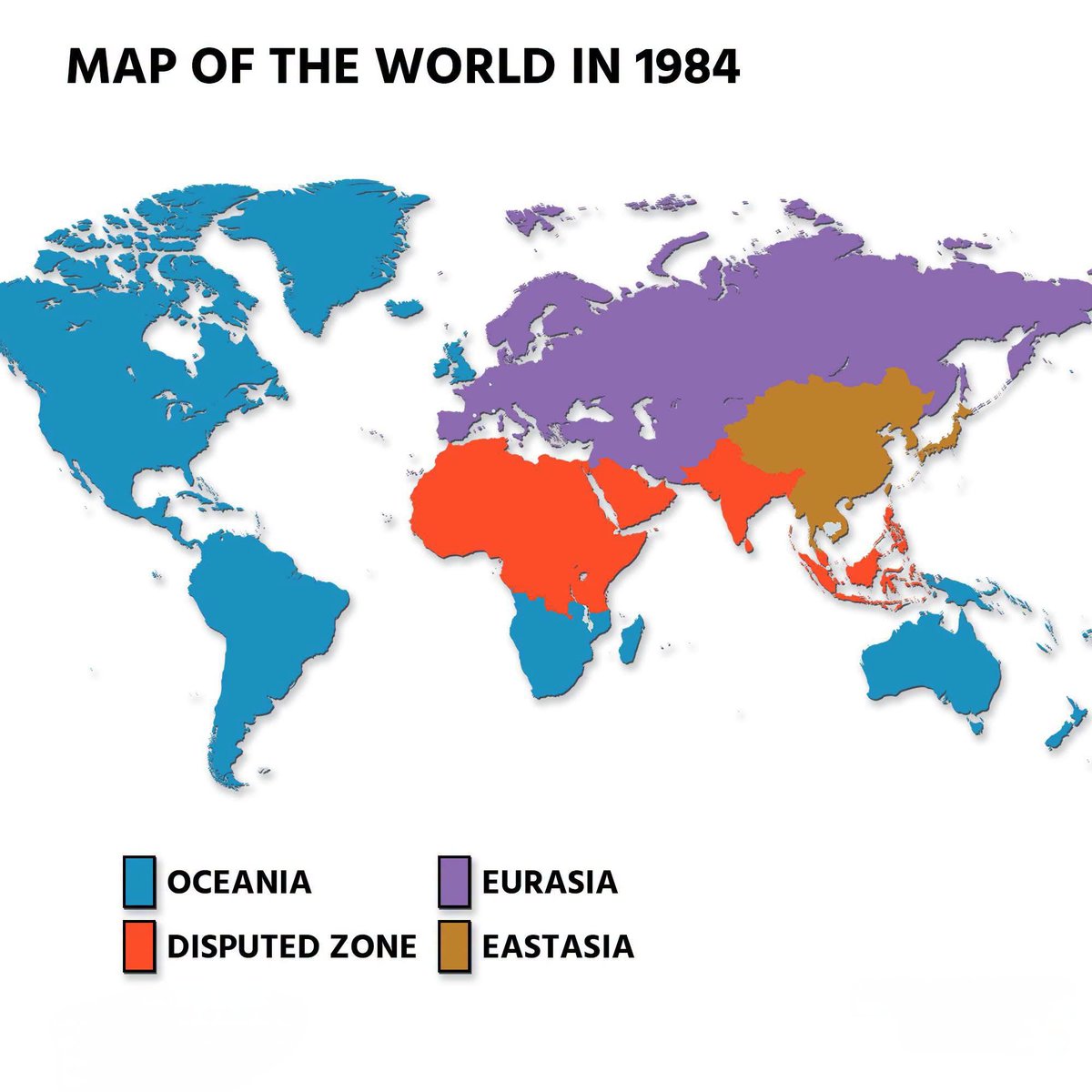
In George Orwell’s dystopian vision, the globe is carved into three dominant world superstates:
- Oceania: Covering the United States, the United Kingdom, Australia, South Africa, and their territories.
- Eurasia: Spanning across Russia and most of Europe.
- Eastasia: Encompassing China, Japan, Korea, and nearby nations.
These entities operate under totalitarian regimes, wielding absolute control over their populations. While the maps and boundaries are historically undefined, the delineation emphasizes ongoing geopolitical tensions grounded in authoritarian rule.
In 2025, recent geopolitical shifts have kept these superstates in a perpetual state of tension, reminiscent of Orwell’s predictions.
2. Disputed Territories Fuel a Never-Ending Power Struggle
Between these superstates lies a sprawling “Disputed Zone”—an orange-colored region on the map—that includes much of Africa, the Middle East, India, and Southeast Asia. This zone remains embroiled in relentless conflict, constantly shifting hands and allegiances.
This area acts as a geopolitical buffer zone, with no single superstate asserting full control. Instead, they engage in proxy wars and covert operations to expand influence without direct confrontation—mirroring Orwell’s depiction of perpetual warfare used as a tool for social control.
In 2025, conflicts in this region have persisted, fueling regional instability but also providing a fertile ground for espionage and covert operations.
3. Boundaries Are Not Set in Stone, and Their True Nature Is Obscure
Since Orwell never produced an official map, these boundaries are based solely on contextual clues from the novel. The novel intentionally leaves uncertain whether the ongoing wars are genuinely fought or fabricated by the government to maintain power—a notion that remains relevant today.
This ambiguity prompts concerns in 2025 about reality itself—are nations truly at war, or is it an orchestrated illusion? Governments could be manipulating conflicts to justify authoritarian measures, control narratives, or distract citizens from internal issues.
Overall, the fluidity and obscurity of these borders serve as reminders that truth in geopolitics remains elusive, especially under authoritarian regimes.
4. Technological Surveillance and Propaganda Reinforce Control
While not visible on the map, Orwell’s world hinges on advanced surveillance and propaganda tools. The superstates leverage AI, facial recognition, and data collection to monitor citizens tirelessly. Propaganda minimizes dissent and sustains the narrative that the current state of perpetual war is necessary for stability.
In 2025, technological advancements have deepened these controls, with some nations deploying more invasive tools than ever before. Citizens face constant surveillance, with personal privacy becoming a relic of the past—echoing Orwell’s vision where “Big Brother is watching you.”
5. The Question of “Genuine” War Remains Central to Modern Politics
Orwell’s novel leaves open whether the wars are real or merely propaganda. In 2025, this question persists as governments often suppress transparency around conflicts, claiming strategic necessity.
The blurred line between real and fabricated conflicts results in societal skepticism, protests, and clandestine investigations. Governments manipulate narratives, and ordinary citizens grapple with distrust of the information they consume, echoing the novel’s core dilemma.
As geopolitics continues to mirror Orwell’s themes, the importance of critical media literacy cannot be overstated to ensure citizens are aware of the truth behind global conflicts.
Conclusion: A World in Flux
The imaginary world depicted in Orwell’s 1984 remains eerily relevant in today’s landscape. From sprawling superstates to disputed regions, and the murkiness surrounding true motives, the narrative warns of a future where reality is shaped by the powerful and truth becomes a fluid, often manipulated concept.
In 2025, the world continues to navigate these complexities—reminding us that vigilance, transparency, and understanding are vital for safeguarding democracy and personal freedoms.
Map source: Adapted from Orwell’s 1949 novel “1984” understanding.