10 Countries with the Lowest Education Budgets in 2025
1. Indonesia’s Education Investment Falls Short
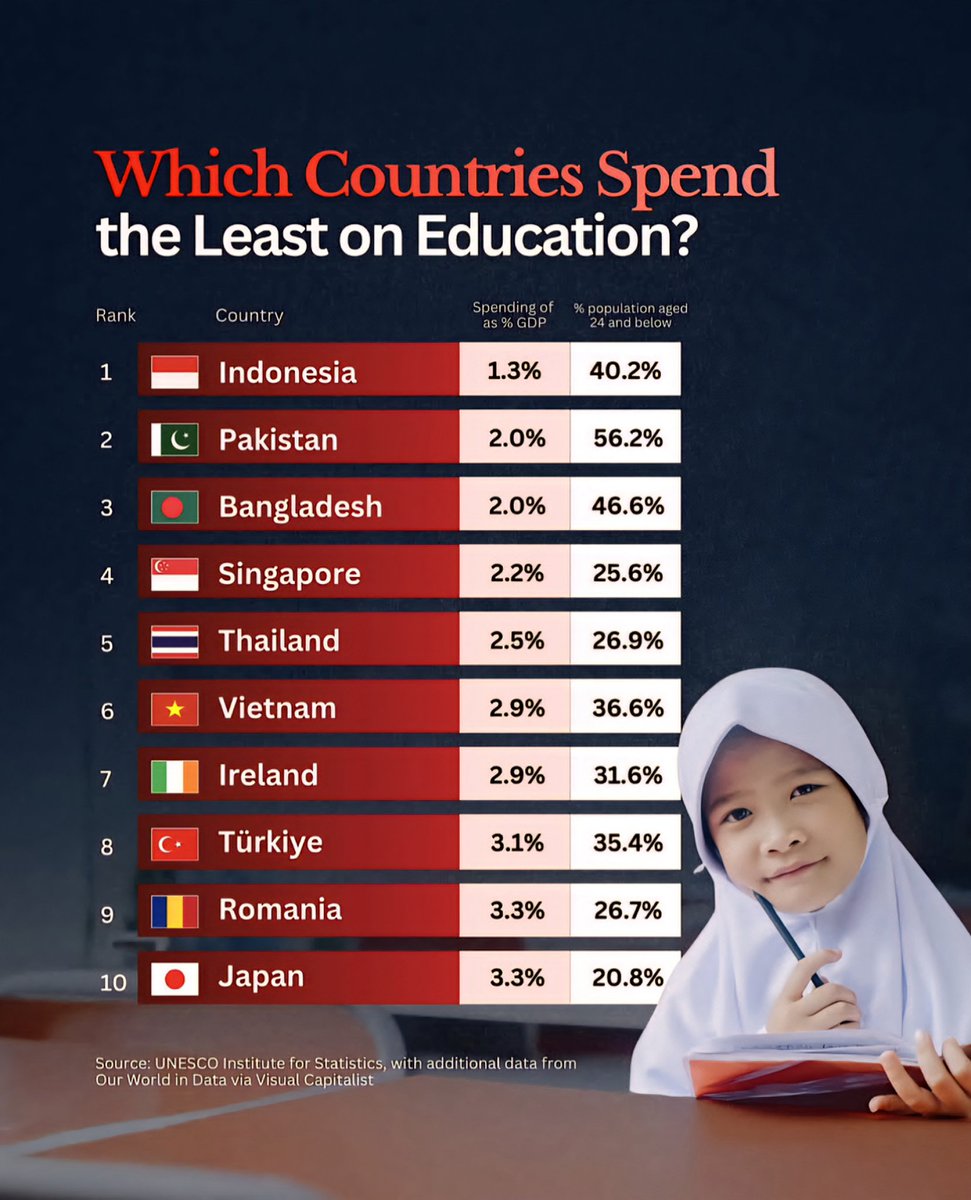
Indonesia ranks as one of the least spender on education globally, allocating only 1.3% of its GDP to the sector. Despite the low budget, a significant portion of the population is young, with 40.2% under the age of 24. This youth demographic underscores the importance of increased educational funding to prepare a skilled workforce for future economic growth. With such limited investment, challenges like overcrowded classrooms and inadequate infrastructure are frequently reported.
2. Pakistan Faces Major Education Spending Deficit
Pakistan’s educational expenditure is just 2.0% of its GDP, reflecting a tight budgetary situation. Over half of the country’s population (56.2%) is under the age of 24, emphasizing the urgent need for comprehensive educational development to accommodate its large youth demographic. The low investment hampers efforts to improve literacy rates, provide quality schooling, and reduce dropout rates, which are crucial for national progress.
3. Bangladesh’s Limited Education Funding
Bangladesh invests approximately 2.0% of its GDP into education, one of the lowest ratios among developing nations. With 46.6% of its population below 24, the country faces immense pressure to enhance educational infrastructure and access. Despite impressive economic growth, current investment levels hinder efforts to elevate educational standards across rural and urban areas alike.
4. Singapore’s Minor Investment Gaps
Singapore, often celebrated for its high-quality education system, spends only 2.2% of its GDP on education. However, with just 25.6% of its population under 24, the country faces fewer obstacles in maintaining high standards. Nevertheless, the government’s focus remains on optimizing resource allocation and integrating innovative teaching methods to sustain global competitiveness.
5. Thailand’s Educational Budget Limitations
Thailand allocates 2.5% of its GDP to education. With over a quarter (26.9%) of its population under 24, the nation continues its efforts to expand access and improve educational quality. Budget constraints sometimes result in disparities between urban and rural schools, prompting calls for increased investment to foster equitable growth.
6. Vietnam’s Growing Education Investment Challenges
Vietnam dedicates around 2.9% of its GDP to education, a modest share considering its rapid development. Its youthful population — 36.6% under 24 — necessitates deeper investment to support expanding higher education and vocational training sectors. The government aims to bridge quality gaps, but resource limitations often slow progress.
7. Ireland’s Conservative Education Spending
Ireland invests approximately 2.9% of GDP in education. With 31.6% of its population under 24, the country faces ongoing debates over resource distribution and the need for increased spending to bolster higher education and research. Despite smaller population segments, Ireland recognizes the importance of sustained investment for innovation.
8. Turkey’s Struggling Education Funding
Turkey allocates about 3.1% of its GDP to education, yet with 35.4% under 24, educational institutions are under pressure. Political and economic challenges have resulted in fluctuating budgets, affecting teacher salaries, school infrastructure, and access in underserved communities. Enhancing investment is pivotal for Turkey’s social stability and development.
9. Romania’s Budgetary Constraints Limit Educational Growth
Romania invests roughly 3.3% of GDP into education. While this percentage is slightly higher than some peers, the 26.7% youth population indicates ongoing needs for educational reform and infrastructure investment. Limited funding hampers efforts to reduce dropout rates and improve secondary and higher education quality.
10. Japan’s Low Relative Investment Amid Demographic Shifts
Japan spends about 3.3% of GDP on education, one of the lowest among industrialized nations. With only 20.8% of its people under 24, the nation faces declining birth rates and an aging population. Educational funding is concentrated on advanced research and innovation, but the low percentage raises concerns about future competitiveness and social resilience.
Summary
Despite varying degrees of education spending, these countries collectively highlight a global challenge: aligning budget allocations with demographic needs and developmental goals. Countries with large youth populations, like Pakistan, Bangladesh, and Vietnam, face urgent calls to bolster educational investment, especially as they aim to improve literacy and skill levels. Meanwhile, developed nations like Japan and Singapore, though spending less proportionally, focus on optimizing existing resources and innovations.
Source: UNESCO Institute for Statistics, Our World in Data, Visual Capitalist, 2025