| Global Perceptions of Donald Trump and Xi Jinping in 2025 | |
|---|---|
 |
## Divergent Views in Asia and the Middle East
### 1. High Confidence in Xi Jinping in Middle Eastern Countries
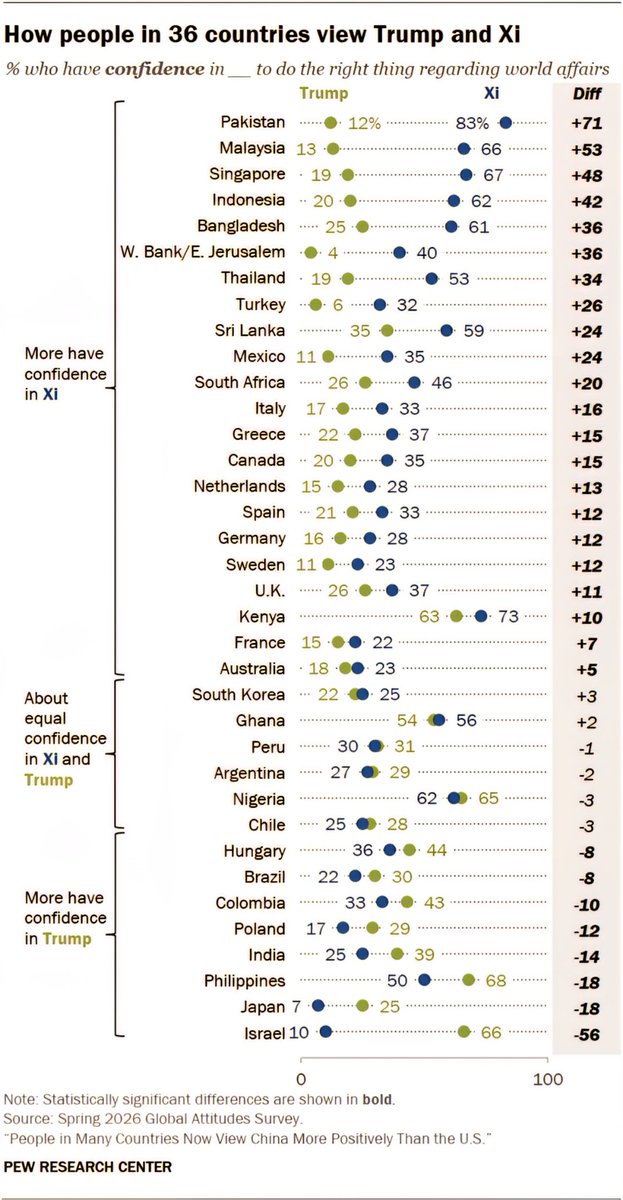
In nations like Pakistan, Malaysia, Singapore, Indonesia, and Bangladesh, the majority of the population expressed significantly higher confidence in Xi Jinping compared to Donald Trump. Notably, in Pakistan, a staggering 83% trust Xi, whereas only 12% support Trump, resulting in a 71-point confidence gap. These countries tend to favor China’s influence, reflecting a geopolitical tilt towards Beijing’s rising power.
### 2. Mixed Sentiments in Turkey, Sri Lanka, and Mexico
While countries such as Sri Lanka (59% Xi confidence versus 35% Trump) and Mexico (35% versus 11%) show a favorable view of Xi, Turkey remains less convinced with only 32% trusting Xi, compared to 6% for Trump. The disparities highlight regional variations, possibly influenced by local politics and economic ties.
## Western Perspectives Show Slight Preference for Xi
### 3. Moderate Confidence Levels in Europe and North America
European countries such as Italy, Greece, and Canada display modest trust levels in both leaders. For instance, in Italy, 33% favor Xi, with 17% supporting Trump, leading to a 16-point confidence difference. The United Kingdom shows a 37% confidence in Xi versus 26% in Trump, a difference of 11 points, indicating nuanced perceptions amid geopolitical complexities.
### 4. North American Views Reflect Limited Confidence Overall
In the United States, confidence in Trump stands at 20%; in Canada, it’s around 20% as well, with slight increases for Xi, such as 35% in Canada. These figures suggest American and Canadian populations remain somewhat skeptical of both leaders, possibly influenced by recent political dynamics.
## Sub-Saharan Africa and Latin America in Perspective
### 5. Greater Confidence in Trump in Sub-Saharan Africa and South America
Countries like Kenya (63% Trump, 73% Xi), Nigeria (65%, 62%), and Ghana (54%, 56%) display balanced trust, with slight leanings toward Xi. Interestingly, in countries like Argentina and Chile, support for Trump (29% and 28%, respectively) slightly exceeds confidence in Xi, reflecting diverse regional attitudes.
### 6. Notable Exception – Peru’s Balanced Outlook
Peru remains almost evenly split, with 31% trusting Trump and 30% trusting Xi, indicating that for many Latin American nations, perceptions of the two leaders are fairly neutral and issue-specific.
## Asia’s Complex Dynamics
### 7. Japan and South Korea: Diverging Trends
Japan exhibits only an 18-point difference, favoring Trump (25%) over Xi (7%), pointing to a cautious attitude toward China. South Korea shows a minimal gap with 22% trusting Trump and 25% trusting Xi, reflecting ongoing regional security concerns and economic ties.
### 8. India’s Slight Preference for Trump
India’s trust in Trump is at 39%, with Xi at 25%, a -14 point difference favoring Trump. This could be due to longstanding strategic alliances and mutual concerns over China’s regional ambitions.
## Polarized Views in the Middle East and Israel
### 9. Strong Support for Trump in Israel and among Palestinians
In Israel, 66% trust Trump, compared to only 10% for Xi, a stark -56 difference showcasing strong alignment with American policies. Palestinians show a stark contrast—only 4% confidence in Trump versus 40% in Xi—highlighting contrasting geopolitical narratives.
### 10. Diverse Opinions Among Gulf Countries
While not explicitly detailed here, such nations often showcase mixed perceptions, with some leaning toward China due to economic partnerships, contrasting with traditional Western alliances.
## Final Observations
The global landscape in 2025 reveals a complex tapestry of perceptions. While some regions express confidence predominantly in Xi Jinping, especially in Asia and parts of the Middle East, others like Israel and certain Latin American countries maintain strong support for Donald Trump. The geopolitical climate continues to shape public sentiment, influenced by economic policies, regional security, diplomatic relations, and media narratives across the globe.
Sources: Pew Research Center, Spring 2026 Global Attitudes Survey