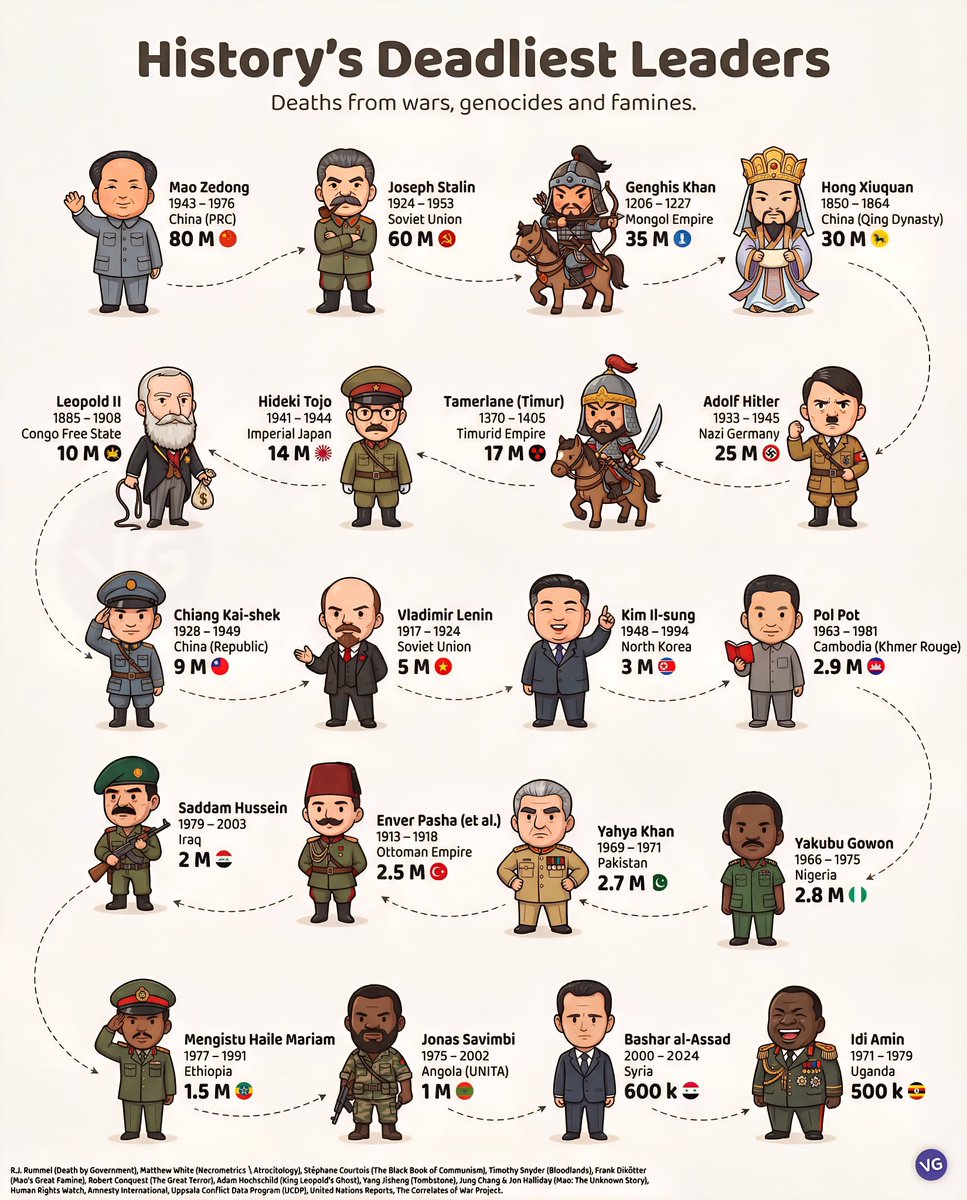
10 History’s Most Deadly Leaders: A Look at How Warfare, Genocide, and Famine Shaped Millions of Lives
1. Mao Zedong: The Architect of Mass Catastrophe in China
Mao Zedong’s rule from 1943 to 1976 resulted in an estimated 80 million deaths. His policies, including the Great Leap Forward and Cultural Revolution, led to widespread famine, political purges, and social upheaval. The disastrous economic reforms and mass executions during this period left a scar in China’s history. Mao’s leadership stands as one of the most lethal in human history, highlighting the devastating consequences of centralized power and ideological extremism.
2. Joseph Stalin: The Soviet Union’s Ruthless Totalitarian
Joseph Stalin’s leadership from 1924 to 1953 is believed to have caused around 60 million deaths. His reign was marked by forced collectivization, Great Purges, and famines like the Holodomor in Ukraine. Stalin’s oppressive policies eradicated millions of perceived enemies, often through executions and imprisonments, shaping the USSR’s darkest era. His legacy is that of a leader whose quest for industrialization and security came at an unimaginable human cost.
3. Genghis Khan: The Conqueror Who Changed History
Genghis Khan’s reign from 1206 to 1227 resulted in approximately 35 million deaths. His empire-building campaigns across Asia and into Eastern Europe were marked by brutal conquests and mass killings. While revered for unifying vast territories and fostering trade, his military campaigns were also among the bloodiest, spreading fear and devastation wherever he went. His legacy is complex, blending cultural advances with unparalleled violence.
4. Hong Xiuquan: The Heavenly King and His Devastation
Leader of the Taiping Rebellion from 1850 to 1864, Hong Xiuquan’s uprising claimed around 30 million lives. His millenarian movement aimed to overthrow the Qing Dynasty, resulting in one of the deadliest civil wars in history. The conflict devastated China’s population, infrastructure, and society, showcasing how charismatic leadership driven by religious fervor can lead to catastrophic violence.
5. Adolf Hitler: The Nazi Nightmare
From 1933 to 1945, Adolf Hitler’s leadership brought about genocide, war, and destruction with an estimated 25 million deaths. His policies culminated in the Holocaust, the Second World War, and the deaths of civilians and soldiers worldwide. Hitler’s ideology of racial supremacy and aggressive expansionism reshaped global history and left a legacy of horror that remains deeply ingrained in collective memory.
6. Tamerlane: The Turco-Mongol Conqueror
Tamerlane, also known as Timur, ruled from 1370 to 1405 and is believed to have been responsible for approximately 17 million deaths. His campaigns across Persia, India, and the Middle East were characterized by ruthless violence, including mass slaughter and destruction of cities. His former empire left a trail of devastated populations, highlighting the destructive nature of conquest-driven leadership.
7. Hideki Tojo: Japan’s War Machine
Prime Minister of Japan during World War II (1941–1944), Hideki Tojo’s policies contributed to the deaths of roughly 14 million people. As a military leader and wartime dictator, his actions spurred atrocities in Asia, including the brutal occupation of China and Southeast Asia. His leadership exemplifies how militarism and imperial ambitions can spiral into mass suffering and loss of life.
8. Leopold II of Belgium: A Colonial Atrocity
King Leopold II’s brutal colonial rule over the Congo (1885–1908) caused the deaths of an estimated 10 million people. His exploitative regime involved forced labor, violence, and widespread atrocities to extract rubber and ivory. Leopold’s reign remains one of the most heinous examples of colonial brutality and greed-driven violence.
9. Chiang Kai-shek: China’s Warlord and Nationalist Leader
Serving from 1928 to 1949, Chiang Kai-shek’s leadership is linked to approximately 9 million deaths. His government faced constant civil war, warlord conflicts, and the fight against Japanese invasion. Internal conflict, repression, and wartime atrocities contributed heavily to the staggering death toll associated with his rule.
10. Vladimir Lenin: The Bolshevik Revolution’s Founder
Vladimir Lenin’s leadership from 1917 to 1924 prompted around 5 million deaths. His revolutionary policies and civil war tactics led to widespread violence, famine, and political purges, setting the stage for Soviet totalitarianism. Lenin’s role in shaping the early Soviet Union was pivotal, albeit with a tragic human toll.
Additional Leaders Who Caused Massive Loss of Life:
- Kim Il-sung (North Korea): 3 million
- Pol Pot (Cambodia): 2.9 million
- Yakubu Gowon (Nigeria): 2.8 million
- Yahya Khan (Pakistan): 2.7 million
- Enver Pasha (Ottoman Empire): 2.5 million
- Saddam Hussein (Iraq): 2 million
- Mengistu Haile Mariam (Ethiopia): 1.5 million
- Jonas Savimbi (Angola): 1 million
- Bashar al-Assad (Syria): 600,000
- Idi Amin (Uganda): 500,000
References:
Sources include authoritative works like Death by Government, Necrometrics, The Black Book of Communism, and United Nations reports, providing detailed insights into these leaders’ devastating impacts.
The legacy of these leaders underscores how power, ideology, and war can culminate in unimaginable human suffering. Recognizing this history is essential to understanding the importance of human rights and justice in shaping a more peaceful future.