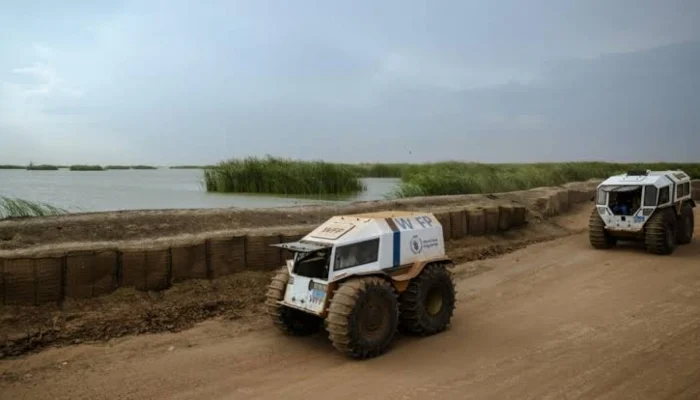
The World Food Programme (WFP) Sherp vehicles are seen operating along the Bentiu dykes in Bentiu, Unity State, South Sudan, on November 3, 2025. — AFP
Humanitarian workers are exploring ways that artificial intelligence can accelerate and enhance their work, ranging from remotely controlled trucks delivering vital aid in hazardous areas to analyzing mobile phone data to identify large-scale displacements. Despite numerous warnings about AI’s risks—especially concerning the safeguarding of sensitive information and the spread of misinformation—summit attendees at the AI for Good event in Geneva showcased several promising applications of this technology.
One notable display featured a massive white Sherp vehicle, reminiscent of a Martian rover, equipped with cameras, sensors, and a drone landing pad on its roof. Manufactured in Ukraine, Sherps are amphibious, capable of floating on water, traversing swampy terrain, and climbing over obstacles up to three feet high. The UN’s World Food Programme plans to start field-testing a version of this AI-powered truck that can be remotely steered through the most perilous terrain to reach vulnerable populations.
Bernhard Kowatsch, head of WFP’s global accelerator and ventures division, told AFP, “I believe this could be a game-changer.” He emphasized that this technology has the potential to reach communities previously inaccessible, significantly expanding aid delivery capabilities.
Currently, WFP drivers are deploying Sherps to provide assistance in Sudan, South Sudan, and Uganda. After experiencing the heartbreak of losing drivers in dangerous conditions, the organization collaborated with the German Aerospace Centre (DLR) to outfit these vehicles with AI and remote-control technology, allowing them to be operated from a safe distance during the most hazardous parts of their journey. Field tests in Germany are complete, with Uganda slated for trials in 2028. Armin Wedler of DLR explained that their remote control systems rely on advanced mathematics and traditional research, but AI is essential for processing data and making real-time decisions.
While full autonomy is technically feasible, Wedler stressed that human oversight remains crucial in complex humanitarian environments. “We’re not talking about driving on clear streets with lanes—you can’t,” he said, referring to scenes where aid trucks are overwhelmed by desperate crowds. “There are no streets, and no AI algorithms can handle that safely.”
At the summit’s over 200 booths, besides robotic demonstrations, humanitarian organizations displayed literature highlighting how AI tools are streamlining operations. The UN refugee agency, UNHCR, introduced a Legal Virtual AI Assistant to help legal professionals quickly assess the rights of refugees under specific national laws. Rebeca Moreno Jimenez, lead data scientist at UNHCR’s Innovation Service, noted that faster case processing can be “life-saving for many refugees.”
Another initiative, Data Insights for Social and Humanitarian Action (Disha), partners with private companies like Google and McKinsey to provide AI-powered data analysis that enhances disaster response. One project uses anonymized mobile phone data analysis to detect mass movements of people during crises, allowing responders to better tailor their efforts. Another leverages AI to analyze satellite images taken before and after natural disasters—such as recent earthquakes in Venezuela—to assess damage efficiently.
According to Andreas Kortis, Disha’s product lead, the goal is to deliver precise, early information that enables humanitarian groups to make informed decisions and avoid misallocating resources, ensuring aid reaches those who need it most.