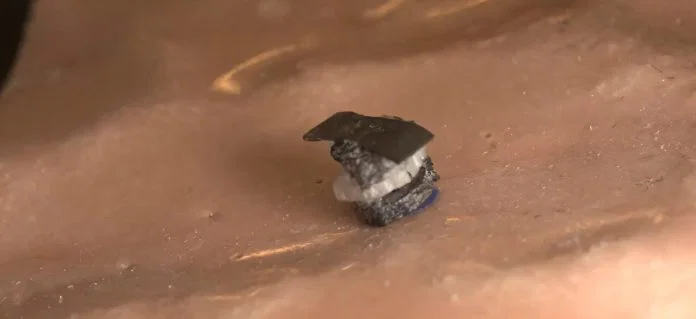
Scientists in Singapore have engineered a tiny robot roughly the size of a seed that can perform five distinct medical tasks within the body, potentially paving the way for safer, more precise surgeries in the future. This miniature robot, developed by researchers at Nanyang Technological University, measures just 4.4 millimeters long.
Despite its small stature, the robot is capable of moving across soft surfaces, cutting tissue, releasing drugs, collecting tissue samples, and generating heat for medical treatments. Even more remarkable, it can switch between these functions in less than a second.
The research, published in Advanced Materials, was led by Lum Guo Zhan, an expert in soft miniature robotics. The device is wirelessly controlled using weak magnetic fields. Laboratory experiments demonstrated how magnetic coils could guide the robot and remotely activate its various tools.
For instance, the robot can deploy a tiny blade to cut tissue, release particles that simulate medication, grip and store tissue samples for biopsies, or produce localized heat. This heat-generating capability could support magnetic hyperthermia, a method being explored to destroy cancer cells through heat.
Around the world, scientists are exploring miniature medical robots because they could enable procedures deep inside the body without large surgical incisions. This approach promises to reduce pain, shorten recovery times, and increase surgical precision.
Designing such ultra-compact robots poses significant challenges, particularly fitting multiple functions into a tiny device while maintaining precise control. The NTU team addressed this by developing a specialized magnetic control system capable of quickly altering the robot’s behavior.
Constructed from soft silicone-based materials like PDMS and Ecoflex—both flexible and commonly used in soft robotics—the robot embeds tiny magnetic particles that respond to magnetic fields in different ways. Its core features a magnetic module that can be magnetized and reprogrammed in various directions, activating different tools or movements each time.
To enhance control, the team designed the robot so only one section reacts to a magnetic field at a time, preventing all parts from moving simultaneously—a common problem with small magnetic robots. Additionally, the robot can roll by spinning around its own axis, aiding navigation through narrow, uneven spaces akin to those inside the human body.
In tests using chicken liver tissue and soft gel materials that imitate human tissue, the robot successfully executed all five functions. Moreover, the materials appeared highly biocompatible; over 99% of human skin cells exposed to the robot’s components survived in laboratory conditions, indicating low toxicity.
While the project has been in development for seven years and remains in the research phase, the team is now exploring integration with medical imaging systems and artificial organs. Future iterations could assist doctors during minimally invasive surgeries and targeted internal treatments.
Source: Nanyang Technological University