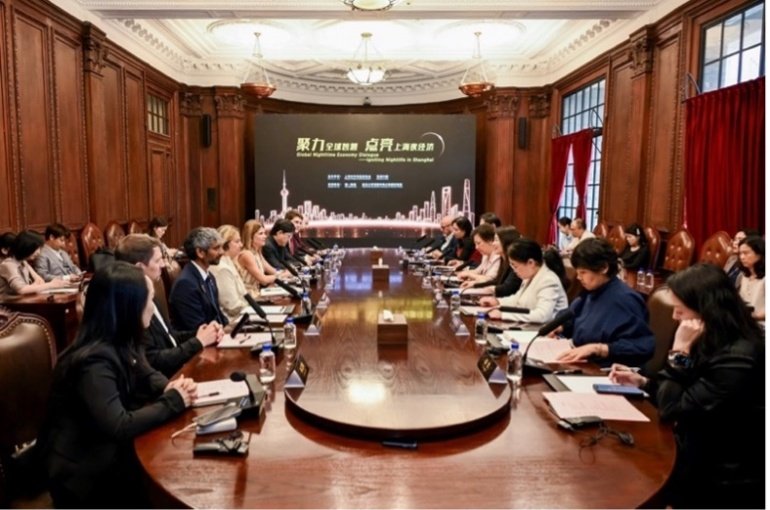
On June 6 in Shanghai, leading international experts specializing in the global nighttime economy—including policymakers, researchers, urban planners, and business leaders—convened to reassess the significance of economic activities after dark.
The event, titled “Global Nighttime Economy Dialogue: Igniting Nightlife,” was organized collaboratively by the Shanghai Foreign Investment Association and Budweiser China. The discussion centered on how the night economy can contribute to the high-quality advancement of Shanghai’s service sector and how to enhance its international appeal to develop a vibrant global shopping and entertainment hub.
Craig Katerberg, the Chief Legal and Corporate Affairs Officer for Budweiser Asia-Pacific, emphasized that Shanghai already ranks among China’s top cities for nighttime economic activity. He noted that the World Economic Forum has recognized Shanghai for its vibrant late-night scene.
Budweiser China has been actively partnering with the Shanghai government to expand the city’s nighttime offerings. Despite evening hours representing a substantial portion of consumer activity in China, foot traffic significantly declines after 8 p.m., highlighting an area ripe for growth.
Katerberg mentioned ongoing efforts to explore opportunities for extending nighttime vitality and stressed the importance of collaboration among government entities, businesses, and consumers to position Shanghai as an international consumption hub. Looking forward, Budweiser China is planning large-scale projects linked to the 2026 FIFA World Cup, including public viewing events and immersive fan experiences intended to foster community through shared passions.
Huang Feng, President of the Shanghai Foreign Investment Association, pointed out that multinational corporations are increasingly becoming vital partners in urban development. He highlighted how Budweiser China’s integration of international intellectual properties with Shanghai’s local culture and commerce not only diversifies entertainment options for residents but also sets a precedent for foreign firms participating in urban economic growth.
Andreina Seijas, founder of Night Tank and academic leader of the World Economic Forum’s 24-Hour Economy Initiative, expressed that Shanghai has a unique opportunity to leverage its cultural assets, public spaces, and global reputation to cultivate a more dynamic, inclusive, and resilient city after dark.
Michael Kill, CEO of the Nighttime Industries Association and Vice President of the International Nightlife Association, stressed that planning for the night economy should be integrated with other urban strategies such as transportation, city planning, and licensing systems, emphasizing its role as a critical component of urban infrastructure.
A consensus emerged from the dialogue: the future success of the night economy relies less on simply extending operating hours and more on curating meaningful nighttime experiences. Achieving this will require cooperation among government authorities, the business community, academia, and local residents.
During the event, Budweiser China, in partnership with the Fudan University Consumer Markets Big Data Laboratory, unveiled a special report on promoting the integrated development of culture, tourism, sports, exhibitions, and commerce to support high-quality growth of Shanghai’s night economy.