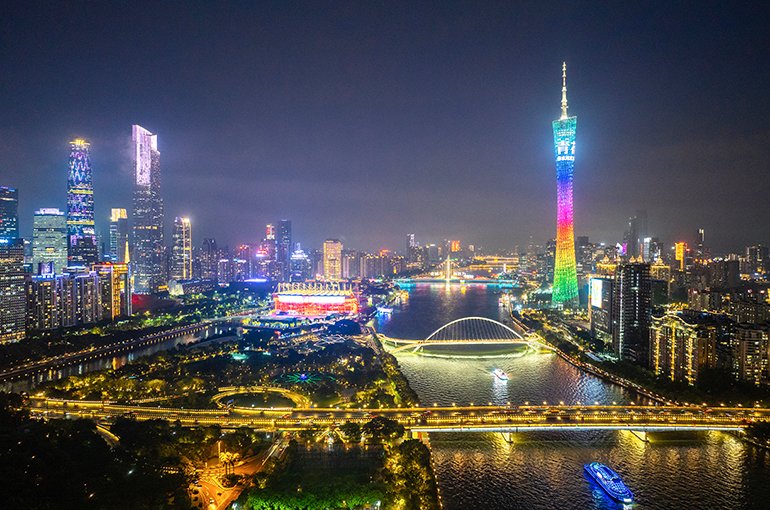
Nine of China’s ten largest cities by gross domestic product experienced economic growth exceeding the national average of 4.7% in the first half of the year, with Guangzhou and Shenzhen tying for the top spot at 5.8%.
The top ten city economies remained Shanghai, Beijing, Shenzhen, Chongqing, Guangzhou, Suzhou, Chengdu, Hangzhou, Wuhan, and Nanjing. All reported GDP growth above the national average, except Chongqing, which grew by 4.2%, based on recent data.
In the first six months, Beijing and Shanghai saw their economies expand by 5.4% and 5.6%, respectively, compared to the same period last year. Suzhou, Chengdu, Hangzhou, Wuhan, and Nanjing reported growth rates of 5.6%, 5.0%, 5.3%, 5.7%, and 5.3%, respectively.
Guangzhou’s economic growth of 5.8% in the first half was the fastest recorded since 2022, up from 3.8% a year earlier. The recovery was mainly driven by industry, with value-added output from large industrial firms increasing by 6.6%. The city’s three key sectors—automobiles, electronics, and petrochemicals—expanded by 9.1%, 11%, and 5.2%, respectively.
Despite a decline in auto production over the past two years due to a transition to electric vehicles, with decreases of 20% in 2024 and 5.1% in 2025, the first half saw a 53% surge in new energy vehicle output, which contributed to a 54% rise in lithium battery manufacturing.
Shenzhen’s growth was primarily fueled by industry and trade. The value-added output of large industrial companies increased by 8.7% in the first half, with manufacturing up 9.3%. The development of AI computing infrastructure was a key driver of industrial growth, according to local officials.
The construction of AI chips, semiconductor equipment, cooling products, and reliable power supplies supported the manufacturing of computers and communication equipment, as well as general and specialized machinery. These sectors grew by 12% to 13%, accounting for over 90% of Shenzhen’s industrial growth.
Foreign trade in Shenzhen also flourished, rising 33% to CNY 2.88 trillion (about USD 425.3 billion) in the first half, outpacing the national growth rate of 17%. Imports increased by 60%, and exports of high-tech products grew by 26%.
Chengdu, the capital of Sichuan province, experienced a significant decline in auto production—down over 21% in the first half—making it the only key indicator to shrink during this period. This slowdown affected the city’s service sector, which grew by just 4.9%, compared to 6.1% last year.
In Chongqing, industrial value-added output increased by 4.1% from January to June, a slowdown from 5.6% in the previous year. Growth in the auto sector slowed sharply to 3.4% from nearly 13% in 2025. Auto production dropped by 100,000 units year-over-year, with combustion-engine vehicle output decreasing by 18%, while new energy vehicle (NEV) production rose by 4%.
The varying growth rates among these cities highlight differences in their industrial makeup. The ability to accelerate structural reforms and transition between traditional and emerging growth drivers will determine their competitive positions moving forward.