Several major projects in leading Chinese cities such as Chongqing, Fuzhou, Nanjing, and Shenzhen, owned by financially struggling developers, are now up for judicial auction. Starting prices range from hundreds of millions to several billion Chinese yuan—equivalent to tens of millions to billions of U.S. dollars. Industry insiders believe that due to the challenges of revitalizing such large-scale developments, local government-backed investment entities may step in to assist.
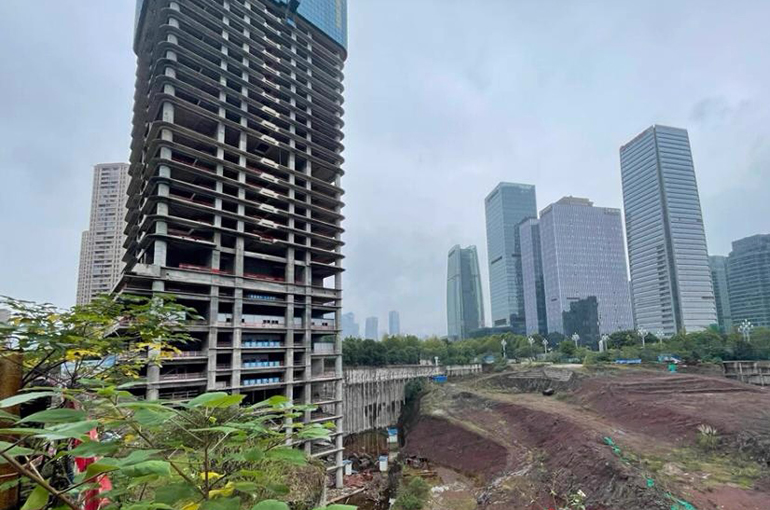
One notable project is the Chongqing Jiangbeizui International Financial Center. Once touted as the “tallest building in Chongqing,” it is scheduled for auction on July 9 and 10 through an online judicial platform operated by Alibaba. The auction is managed by the Intermediate People’s Court of Gansu Mining Area. The property has been valued at approximately CNY 2.5 billion (around USD 370 million), with an opening bid of CNY 2 billion. A security deposit of CNY 200 million (about USD 29.4 million) is required, but it remains uncertain whether a bid will be placed.
Back in October 2012, Sunac Huacheng Real Estate Development in Chongqing bought the land for CNY 1.7 billion (USD 250 million) with plans to develop a super-tall tower called “World Flower.” However, progress stalled due to a lack of funding. In May 2017, Sunac China Holdings acquired a 60% stake in Sunac Huacheng, along with related debt claims, for CNY 2.1 billion. The project was rebranded as A-ONE, with plans for five buildings, including one reaching a height of 470 meters.
The project faced delays as the real estate market shifted and developers faced liquidity shortages. Foundation work was completed between 2017 and 2018, and main construction started in 2019. However, construction was halted in July 2022 and has remained paused ever since. Currently, only one building has reached 25 stories above ground.
Although situated in a prime area within Chongqing’s western financial district, disposing of this asset involves significant challenges, according to industry sources in the city. The project’s large scale demands a high level of investment, and with 70% of the space allocated for commercial use, returns depend heavily on long-term leasing income from premium office and retail spaces, which entails a prolonged absorption and investment period. Moreover, completing a super-tall building requires advanced technical expertise and considerable additional capital.
Due to the project’s financial complexity, substantial investment needs, and existing debt, prospective buyers are more likely to be asset management firms or government-backed entities.
Other cities also have landmark developments awaiting new investors. For instance, in Nanjing’s Hexi Central Business District, Suning Real Estate Group bought a parcel for CNY 429 million (USD 63 million) in 2008, intending to build a 400-meter iconic tower. Development was halted due to financial issues, and in 2023, the foundation was filled in, turning the site into an urban park. After two unsuccessful auction attempts, the project is scheduled for judicial sale on July 1 with an asking price of CNY 1.5 billion (USD 220.4 million), more than 40% below its appraised value.