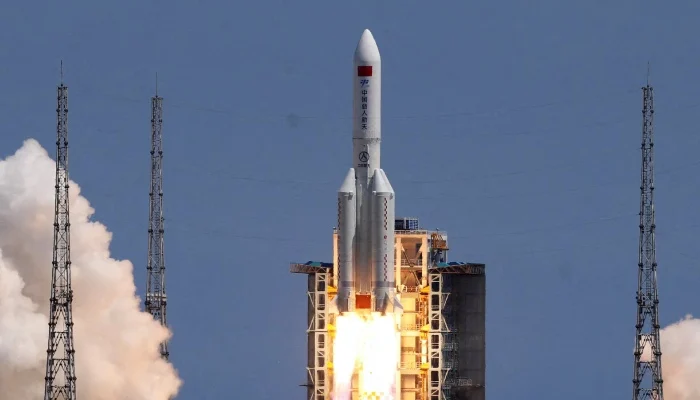
A Long March 5B Y3 rocket, carrying China’s Wentian lab module for the country’s space station under construction, launches from Wenchang Spacecraft Launch Site in Hainan Province on July 24, 2022. — Reuters
– The Long March 10B has been compared to SpaceX’s Falcon 9.
– Shares of Chinese aerospace companies surged following the news.
– China intends to reuse the booster stage of Long March 10 in future launches.
China successfully tested an experimental rocket retrieval system on Friday, using a sea-based net attached to an offshore platform. This marks a step toward competing with U.S. dominance in reusable rocket technology.
The Long March 10B rocket launched from a commercial spaceport in southern China at 12:15 p.m. local time (4:15 a.m. GMT). About six minutes after its booster and upper stage separated, the booster returned vertically and was recovered on a nearby offshore platform, according to state broadcaster CCTV.
This achievement is China’s first successful retrieval of an orbital-class rocket, bringing the nation closer to developing fully reusable launch systems. Following the news, shares in Chinese aerospace firms like China Spacesat and China Satellite Communications hit their daily trading limits.
Designed by the China Academy of Launch Vehicle Technology, the Long March 10B is comparable to SpaceX’s Falcon 9, which is widely used for medium-lift missions. It can carry at least 16 metric tons to low-Earth orbit but diverges from Falcon 9 by using “landing hooks” to catch a net over the sea instead of autonomous ground or ship landings.
SpaceX’s Falcon 9 first landed on a drone ship in December 2015, with Blue Origin’s New Glenn following in November 2025. SpaceX currently launches roughly 150 times annually, reusing boosters dozens of times, with the engine-mounted component regarded as the most valuable part.
China has dedicated nearly ten years to developing reusable rocket technologies, moving from low-altitude hover tests to orbital recovery attempts. These advancements are expected to reduce launch costs amidst China’s rapidly expanding satellite industry.
Private Chinese companies are also competing to develop reusable rockets, with recent efforts by LandSpace and China Aerospace Science and Technology Corporation ending in unsuccessful booster landings. The Long March 10B is part of the broader family aimed at supporting China’s lunar missions planned before 2030, offering data and technology validation for future crewed lunar exploration.
China expects to reuse the Long March 10’s booster stage again by the end of this year, as reported by CCTV.