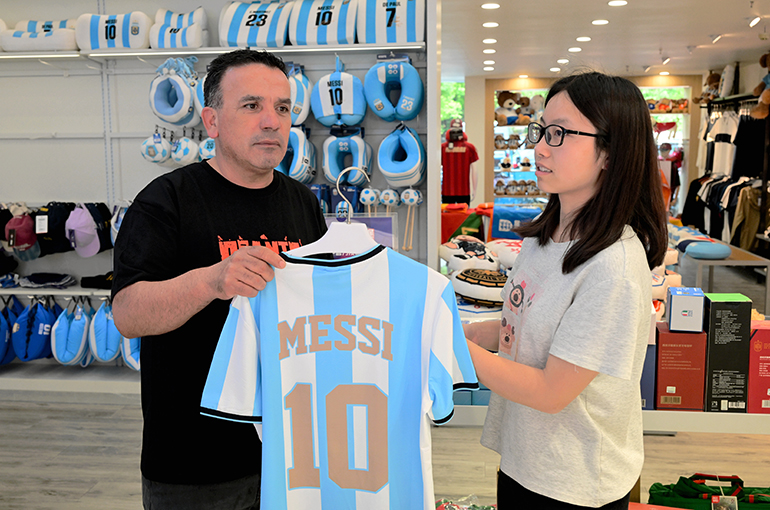
Vendors in the city known for hosting the world’s largest wholesale market for small goods have experienced a significant increase in sales related to the 2026 FIFA World Cup. This surge is driven by expanding cross-border trade resulting from more mature supply chains, increased participation from merchants, and rising consumer demand.
A seller with ten years of experience in manufacturing and selling soccer jerseys reported that overall sales during this year’s World Cup rose more than 60% compared to the 2018 event in Qatar, surpassing his forecast of a 30% increase. He also mentioned that online retail sales doubled.
The demand for national team jerseys spiked mainly because the tournament expanded from 32 to 48 teams and because the host countries—Canada, the United States, and Mexico—have large populations and stronger economies than the Middle East, the seller explained.
More importantly, enhancements in cross-border e-commerce platforms, logistics networks, and service capacities have created new opportunities for merchants to quickly secure and fulfill restocking orders once the tournament started. While large offline bulk orders were mostly finished in May, direct-to-consumer online orders continued to flow in and ships were dispatched daily once the matches kicked off, he added.
Additionally, star players like Kylian Mbappé, Harry Kane, Lionel Messi, and Erling Haaland have delivered exceptional individual performances, helping their respective teams achieve strong results. This has led to additional orders for related merchandise, the seller pointed out.
Another business owner emphasized that product prices are not the only factor influencing customer choices; quality and delivery speed are equally important. Chinese vendors have developed mature operational systems that meet diverse customer demands and can quickly adapt products based on specific consumer requests at any time.
Industry experts noted a clear “tournament pulse” pattern in cross-border merchandise trade. Orders were highly concentrated in the month leading up to and during the group stage, but as teams advanced or were eliminated, the order volume experienced sharp fluctuations, putting strict demands on supply chain agility.
To accommodate different order types, vendors have implemented varied logistics strategies. Items expected to sell well before the tournament are shipped via sea freight and stored in overseas warehouses, while mid-tournament “hot” items are fulfilled through dedicated air shipments or direct cross-border deliveries, according to industry sources.