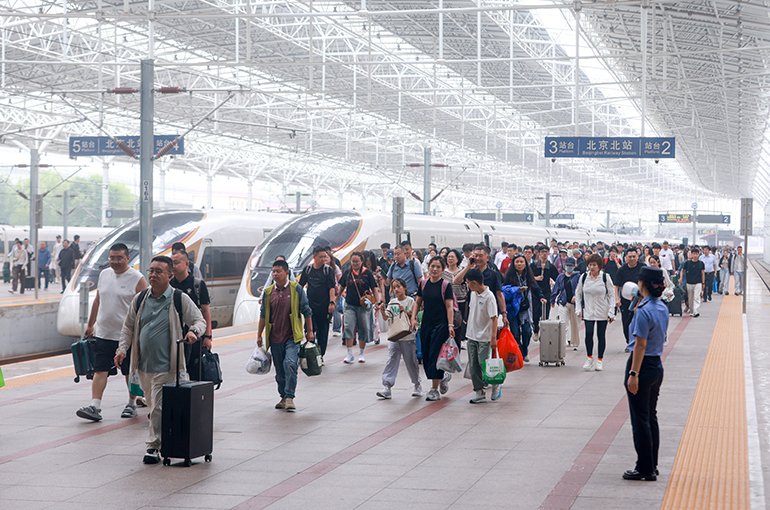
In the first half of the year, revenue at China’s national railway operator increased due to strong demand, and the company made further efforts to reduce its debt ratio. The state-owned enterprise, responsible for passenger and freight train services across the country, reported a significant rise in profits and improved financial health.
Net income surged over 19% to a record 1.85 billion yuan (about $275 million) for the six months ending June 30, compared to the same period last year, according to its latest financial statements. Operating revenue grew slightly by 0.5%, reaching 589 billion yuan (roughly $87.6 billion).
The country’s rail system handled 2.35 billion passenger trips during the first half, marking a 5% year-over-year increase and setting a new record for that period. Passenger numbers peaked on May 1, with a single-day high of 24.8 million trips as travelers celebrated the Labor Day holiday. Cargo shipments also rose, up 1.8%, to 2.02 billion tons.
The improved performance bolstered the company’s balance sheet, which saw its debt-to-asset ratio decrease by 0.15 percentage points to 61.83% at the end of June, down from 61.98% at the end of last year.
Earlier this year, during its annual work conference, the company announced plans to invest 520 billion yuan (about $77.4 billion) in infrastructure projects and to commission over 2,000 kilometers of new rail lines in 2023.
In the first half, investment in rail infrastructure reached 363.2 billion yuan (around $54 billion), a 2.1% increase compared to the previous year. Approximately 355.2 kilometers of new track were put into service, including the high-speed rail link connecting Xi’an and Shiyan.
In July, Foshan Station opened on the Guangzhou-Zhanjiang high-speed rail route, significantly cutting travel time between Guangzhou and Foshan in Guangdong Province to just 18 minutes. Construction of additional tracks continues rapidly during the second half of the year.
Over the next five years, the country plans to expand its high-speed rail network by approximately 10,000 kilometers, reaching a total of 60,000 kilometers, as announced earlier at the annual conference.