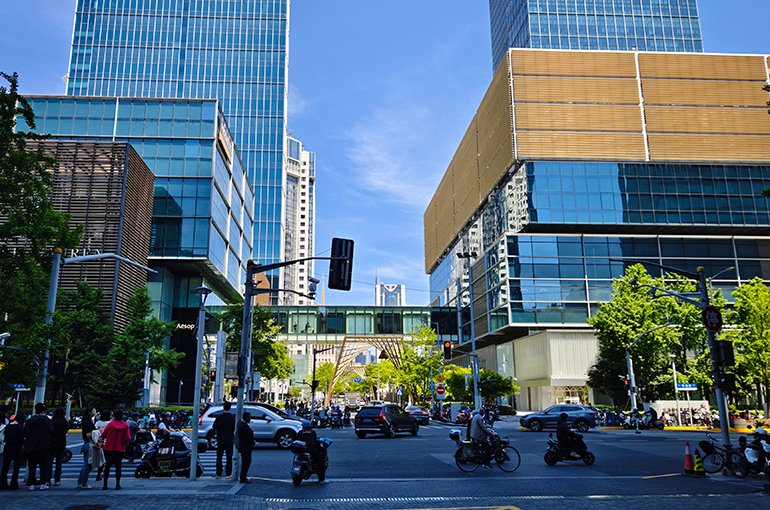
Artificial intelligence, computing power, and semiconductor companies have been leasing large office spaces or even acquiring entire buildings as their industries experience rapid growth over the past year. This trend has boosted the office markets in the central business districts of major cities across the country.
The expanding demand from AI firms has contributed to an increase in net office absorption in key urban centers. As of March, the vacancy rate in tech clusters within cities like Shenzhen and Hangzhou dropped to roughly 20 percent, down from around 30 percent at the end of last year, according to a recent analysis.
Prior to this recent rebound, China’s office market faced challenges due to the steady addition of new supply, coupled with financial institutions cutting costs and internet companies downsizing their office footprints.
“Demand for office space from AI and integrated circuit companies is growing rapidly,” said an industry veteran involved in Shanghai’s premium office leasing and asset management market. They noted that the traditional office demand driven by financial institutions and internet giants is evolving rapidly.
In the past, promotional materials for projects often highlighted terms like “financial center” or “internet headquarters,” but these are now being replaced by phrases such as “AI industry ecosystem” or “large model cluster,” the source explained.
The surge in demand from emerging sectors has created a noticeable divide in the market. While traditional financial districts are showing sluggish interest, areas designed to cater to AI, computing power, and chip industries are experiencing heightened activity. Notable examples include Shanghai’s Xuhui Riverside West Bund Digital Industry Belt, Zhangjiang Moli Community, and Yangpu Yunji Shangpu Project.
The influx of major corporate tenants has further fueled office demand in these hotspots. The Yunji Shangpu Project in Yangpu District, for instance, with over 100,000 square meters of space, leased approximately 40,000 square meters to ByteDance’s AI app Doubao at the end of 2025, making it one of the largest leasing agreements in the city last year.
“Big tenants tend to make quick decisions, sign large leases, and have high standards for building quality,” explained the veteran. “Once a major tenant moves in, the remaining spaces often fill quickly,” they added, noting that occupancy rates at Yunji Shangpu are now nearing 100 percent.
Additionally, many AI technology and chip companies are shifting from incubators or co-working spaces into high-grade office buildings within tech hubs such as Shenzhen’s Nanshan Science Park and Hangzhou’s Cloud Valley.
Financially robust AI firms are no longer content with just leasing; they are increasingly opting to purchase office buildings outright. For example, in April, Zhipu AI acquired the Diamond Tower in Beijing’s Zhongguancun Software Park to serve as its headquarters and operational center for large model projects.
However, some industry insiders remain cautious about claiming that the AI sector is revitalizing the office property market. One consultant pointed out that although AI companies are generating additional demand, it is premature to suggest that a “super tenant era” has returned.
He highlighted a key difference from internet giants during their peak — while AI companies often have high valuations, their workforces tend to be smaller.
“Most AI firms are still in the fundraising and hiring phases, so the full impact on the office market might take some time to materialize,” another expert commented.