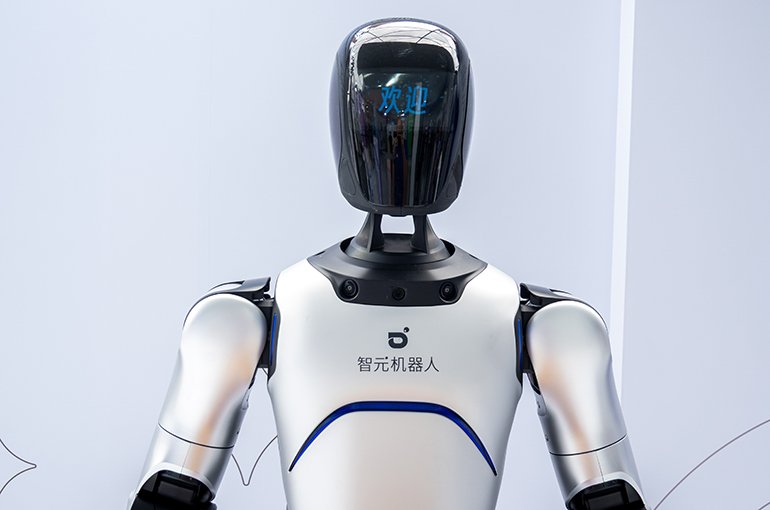
A Chinese startup focused on developing embodied intelligence and humanoid robots has begun collaborating with local semiconductor manufacturers, according to a senior executive. As the robotics industry approaches a critical stage of mass production, new opportunities are emerging for domestically produced chips.
The company is in the early stages of negotiations with several chip producers but has not disclosed their names. It is already utilizing some Chinese-made chips in its robot control systems—specifically microcontroller units that coordinate joint movements—as well as other communication components.
Leading Chinese humanoid robot companies are increasingly adopting locally developed semiconductors not just for basic control functions like motor management, communication, and dexterous hand operations, but also for advanced embodied artificial intelligence systems. This transition is primarily driven by cost considerations, the desire to strengthen supply chain independence, and the rapid growth of China’s humanoid robotics sector.
A subsidiary focused on developing dexterous robot hands has chosen Chinese microcontroller units based on performance and affordability. The CTO explained that these general-purpose MCUs, along with some customized variants, are mounted in the palms of robot hands to handle motion calculations and sensor data processing.
Another Chinese startup is set to equip its next-generation A3 robot with domestic chips. This wheeled, dual-arm robot is designed for mass production tasks, such as manufacturing vehicles. It will feature an edge computing chip capable of performing 560 trillion operations per second, balancing the computational needs for large-scale AI model inference with real-time robotic control.
A joint venture between a well-known humanoid robot manufacturer and a domestic chip provider is also underway. The partnership aims to research, develop, and produce smart chips specifically for embodied robots, seeing significant growth prospects due to the expanding embodied intelligence industry.
One company’s representative explained that they chose collaborative development over in-house chip design because the diverse application scenarios and product formats would require too many resources to develop chips independently.
Historically, many Chinese robotics startups relied on Nvidia chips; however, rising costs are increasingly prompting them to seek domestically produced alternatives. A company executive highlighted that foreign chips can constitute about a third of the hardware procurement costs, pushing the industry toward local solutions.