The Challenges of Understanding Different Spanish Accents
1. Why Do Spanish Accents Vary So Much?
Spanish is spoken across numerous countries, each with its unique pronunciation, slang, and intonation. While these variations enrich the language, they can pose significant comprehension challenges for non-native speakers and even native ones, especially when encountering unfamiliar accents for the first time. The diversity arises from historical, geographical, and cultural influences that shape how Spanish is spoken worldwide. For example, the Spanish spoken in Mexico differs markedly from that in Argentina or Spain itself, influencing clarity and understanding.
2. Categories of Accent Difficulty
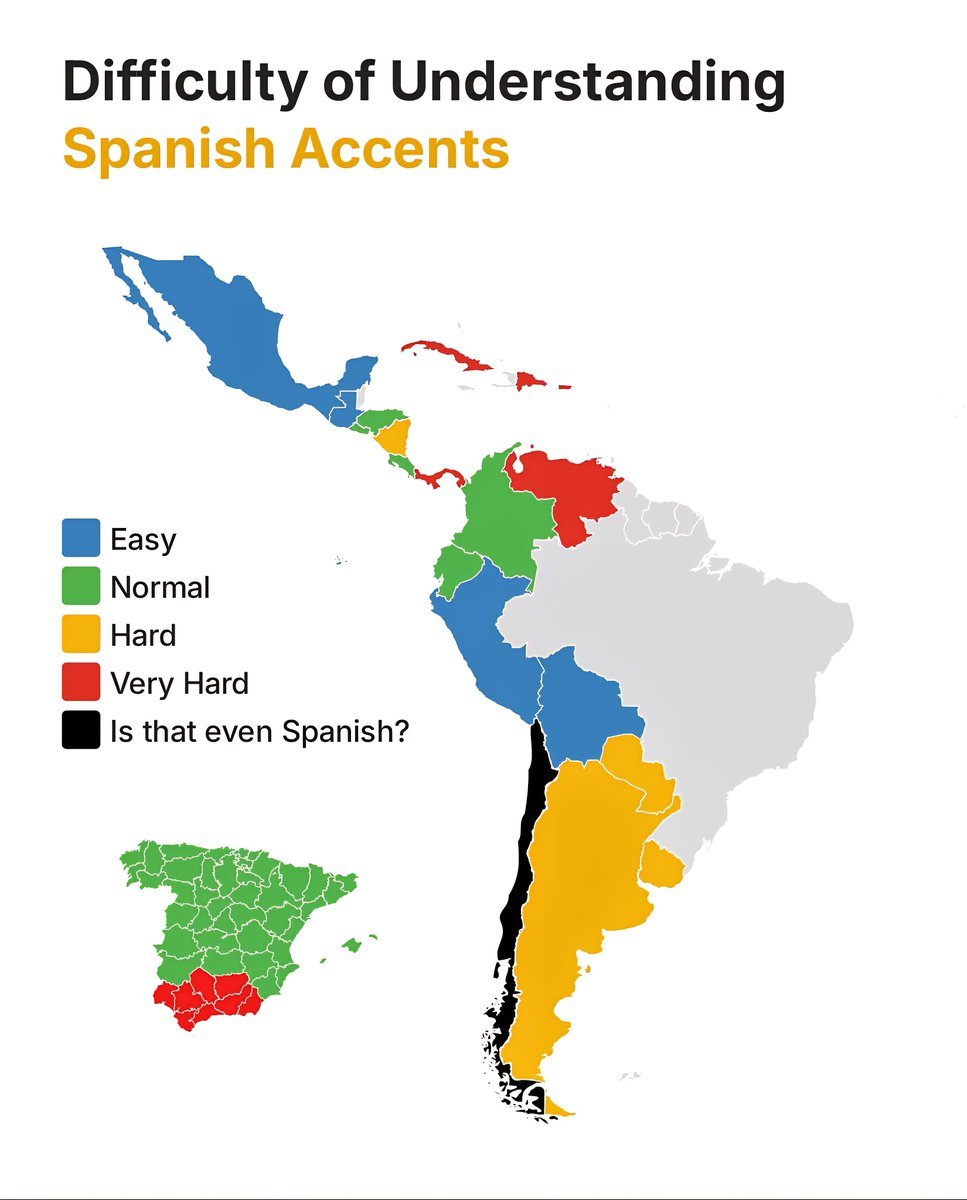
Understanding Spanish accents isn’t a binary matter—some are easier to grasp than others. Experts categorize these differences into four levels:
- Easy (🟦): Accents from regions with clear pronunciation and standard diction. For instance, many Peruvian or Costa Rican speakers fall into this category, making comprehension relatively accessible.
- Normal (🟩): Accents that may require a bit more listening effort but are generally recognizable. Examples include speakers from Chile or Colombia.
- Hard (🟨): Accents with noticeable pronunciation quirks, slang, or rapid speech patterns. Some Caribbean accents, such as Puerto Rican or some Cuban dialects, often fall here.
- Very Hard (🟥): Heavily regionalized or colloquial accents, including fast speech with many colloquialisms or indigenous influences, challenging even seasoned listeners.
- Is That Even Spanish? (⬛️): Some accents or speech patterns may seem so distinct or heavily accented that they are hard to recognize as Spanish at all, such as certain dialects influenced heavily by indigenous languages or creole languages.
3. Factors That Amplify Difficulty
Several factors complicate understanding accents:
- Speed of speech: Rapid delivery can make even familiar accents hard to follow.
- Slang and colloquialisms: Regional expressions and slang can confuse listeners unfamiliar with local vocabulary.
- Pronunciation quirks: Unique vowel and consonant pronunciations significantly differ between regions.
- Background noise: Poor audio quality or noisy environments hinder comprehension.
- Listener familiarity: Audience experience with specific accents influences ease of understanding.
4. How to Improve Comprehension
Increasing exposure is key to better understanding various accents. Here are some tips:
- Consume diverse media: Watching films, shows, or listening to podcasts from different Spanish-speaking regions broadens exposure.
- Use subtitles: Watching without subtitles can be challenging; turning them on helps associate spoken words with written forms.
- Practice active listening: Focused listening to regional radio stations or interviews enhances perception.
- Engage with native speakers: Conversations and language exchanges improve recognition of regional quirks.
- Learn slang and idioms: Understanding colloquial expressions makes comprehension more effortless.
5. The Role of Technology
Advancements in speech recognition and AI are revolutionizing how we learn to understand accents. Apps and online tools now offer region-specific audio exercises, allowing learners to hone their skills in hearing diverse pronunciations. Additionally, AI-powered transcription services improve with context, aiding understanding of rapid or heavily accented speech.
6. The Cultural Significance
Appreciating the diversity of Spanish accents contributes to a deeper cultural understanding. Each accent encapsulates a history, identity, and community. Recognizing regional differences fosters empathy and respect for linguistic diversity, enriching the language-learning journey.
Understanding the intricate tapestry of Spanish accents can be challenging but incredibly rewarding. Embracing these differences opens doors to authentic cultural connections and a more profound appreciation of the Spanish-speaking world.
Note: The image above illustrates the varying difficulty levels in understanding different Spanish accents, highlighting the complexity and diversity within the language.