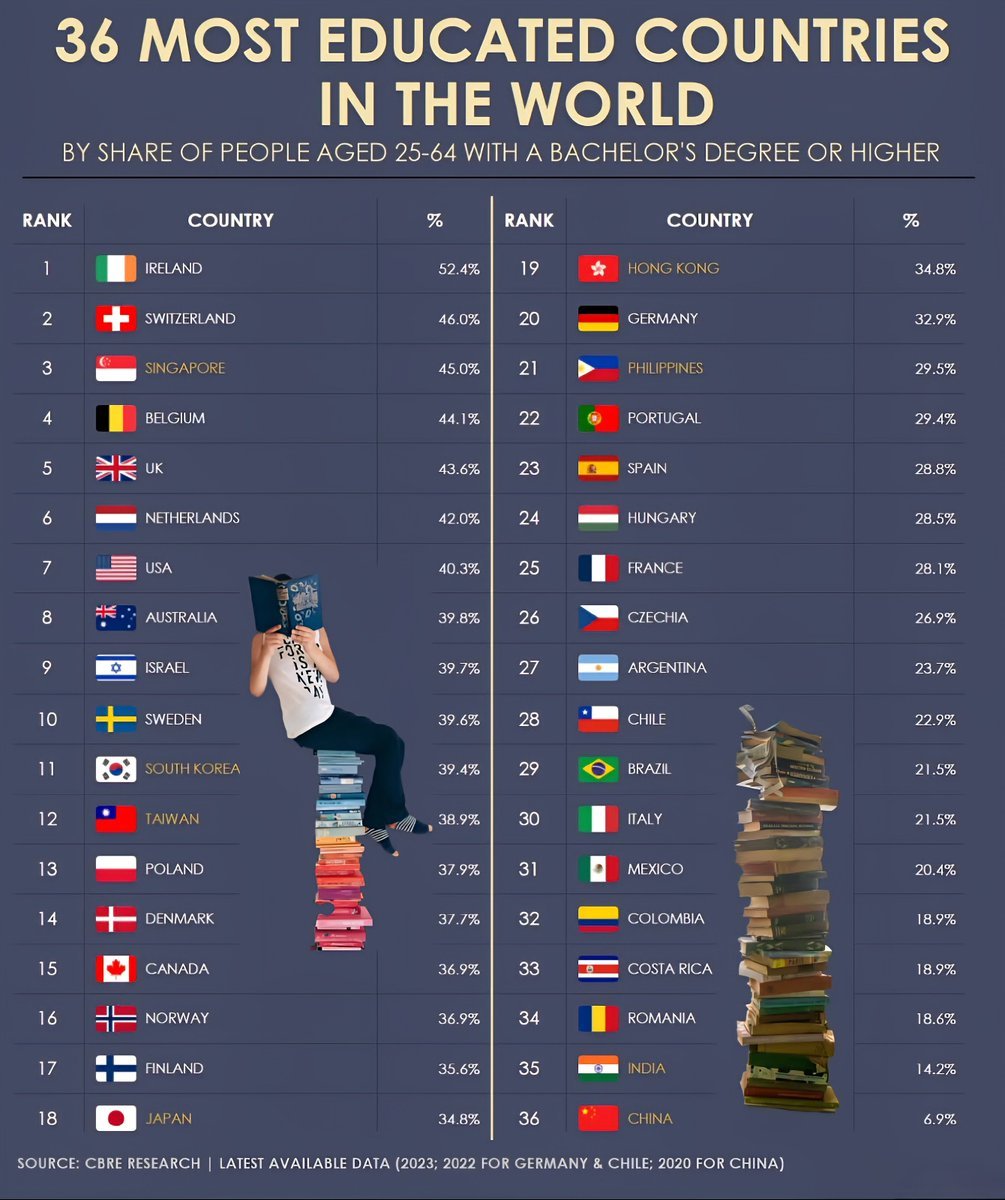
Top 36 Most Educated Countries in 2025
1. Ireland — 52.4%
Ireland continues to lead globally, with over half of its adult population holding a bachelor’s degree or higher. The nation’s investment in higher education and a robust technology sector have fueled its educational advancement, making it an international hub for technology and innovation.
2. Switzerland — 46.0%
Known for its precision and quality, Switzerland boasts a highly educated workforce, particularly in pharmaceuticals, finance, and engineering sectors. Its commitment to lifelong learning and vocational training plays a key role.
3. Singapore — 45.0%
Singapore’s education system is renowned worldwide. The city-state ranks among the most competitive, emphasizing science, technology, engineering, and mathematics (STEM) to fuel its economic growth.
4. Belgium — 44.1%
With a rich educational tradition, Belgium’s higher education participation emphasizes multilingualism and research excellence, contributing substantially to its knowledgeable populace.
5. United Kingdom — 43.6%
The UK continues to attract international students and maintains a high level of educational attainment across its adult population, especially in sectors like finance, academia, and technology.
6. Netherlands — 42.0%
Dutch universities are among the best in Europe. The nation’s educational standards and progressive policies foster a culture of continuous learning.
7. United States — 40.3%
The US maintains its position among the most educated nations, driven by top-tier universities and a thriving research landscape that spans multiple industries.
8. Australia — 39.8%
Australia’s higher education system is globally recognized. It has strong ties to industries like mining, healthcare, and information technology.
9. Israel — 39.7%
Israel’s innovative ecosystem, particularly in tech and startups, is supported by a well-educated population with a high rate of tertiary qualification.
10. Sweden — 39.6%
Sweden’s focus on progressive education policies and research and development investments have cultivated a highly qualified workforce.
11. South Korea — 39.4%
Markedly emphasizing education since its economic rise, South Korea’s high university enrollment rates fuel its global leadership in electronics and technology sectors.
12. Taiwan — 38.9%
Taiwan’s investment in higher education has paid off, fostering expertise in semiconductor technology and manufacturing.
13. Poland — 37.9%
Poland’s focus on expanding access to higher education has led to significant growth in skilled professionals, especially in IT and engineering.
14. Denmark — 37.7%
Denmark’s education policies emphasize innovation and sustainable development, resulting in a highly qualified workforce.
15. Canada — 36.9%
Canada’s inclusive and accessible higher education system produces a well-educated population, supporting its leadership in natural resources, technology, and healthcare.
16. Norway — 36.9%
Norway invests heavily in education, coupled with a focus on research, to maintain a highly skilled workforce.
17. Finland — 35.6%
Recognized globally for its education system, Finland’s emphasis on equality and quality produces a highly competent populace.
18. Japan — 34.8%
Historically strong in technology, engineering, and science, Japan’s educational standards remain high amid demographic challenges.
19. Hong Kong — 34.8%
Hong Kong’s educational system emphasizes international standards, especially in finance, law, and business.
20. Germany — 32.9%
Germany’s vocational training and university education facility contribute to its highly skilled workforce in engineering and manufacturing.
21. Philippines — 29.5%
The Philippines is rapidly increasing its tertiary education participation, bolstered by a large diaspora of skilled workers.
22. Portugal — 29.4%
Portugal has seen growth in higher education attainment, particularly in tourism, technology, and renewable energy sectors.
23. Spain — 28.8%
Spain invests heavily in university programs, notably in arts, tourism, and manufacturing industries.
24. Hungary — 28.5%
With a burgeoning tech scene, Hungary emphasizes higher education in engineering and information technology.
25. France — 28.1%
France’s elite universities and research centers have helped maintain a strong culture of higher education.
26. Czechia — 26.9%
Czechia continues to develop since joining the European Union, focusing on research and development to advance its highly educated workforce.
27. Argentina — 23.7%
A mix of public and private universities fuels Argentina’s educated population, especially in arts, sciences, and medicine.
28. Chile — 22.9%
Chile’s higher education reforms and investments in science and technology have increased educational levels.
29. Brazil — 21.5%
Brazil’s expanding university system and focus on research in agriculture and technology drive its growth.
30. Italy — 21.5%
Italy combines a rich academic tradition with modern research, particularly in arts, design, and engineering.
31. Mexico — 20.4%
An increasing number of Mexicans are attaining higher education, fostering growth in industry sectors like manufacturing and technology.
32. Colombia — 18.9%
Colombia has invested heavily in higher education, increasing access and expanding skilled human capital.
33. Costa Rica — 18.9%
Costa Rica leverages education in sustainable development, environmental science, and tourism management.
34. Romania — 18.6%
Romania’s investments in IT and engineering education are raising its profile in European tech hubs.
35. India — 14.2%
India produces a large number of graduates, especially in information technology, engineering, and sciences, although it still has room for growth.
36. China — 6.9%
Despite a modest percentage, China’s massive population means it commands the largest absolute number of graduates globally, with significant advancements in technology and manufacturing education.
Source: CBRE Research (2025) | Data from 2023 for most countries; 2022 for Germany and Chile; 2020 for China
Note: Share of adults aged 25-64 holding at least a bachelor’s degree or higher.