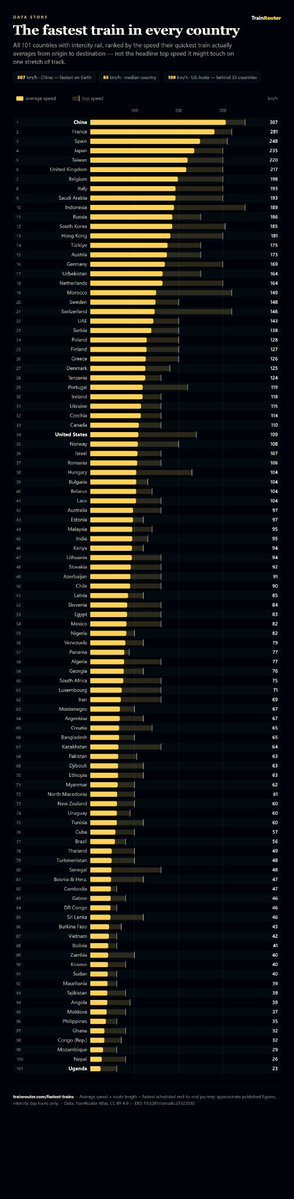
The 2025 Global Train Speed Rankings: Which Countries Lead the Way?
1. China — Average Speed: 307 km/h
China continues to dominate the global rail scene with its high-speed trains averaging over 300 km/h on daily routes. The impressive network connects major urban centers, making travel quick and efficient across vast distances. The China Railway High-speed (CRH) system is a testament to the nation’s investment in fast, reliable transportation, solidifying its position as the fastest country in the world by end-to-end train average velocity.
2. France — Average Speed: 281 km/h
France’s TGV remains a benchmark in high-speed rail technology. Despitestanding competition, French trains maintain an average speed that surpasses many of their counterparts, ensuring France stays at the forefront in Europe. The country’s meticulous infrastructure and innovative engineering contribute significantly to their sustained performance.
3. Spain — Average Speed: 248 km/h
Spain’s AVE trains have carved out their reputation for efficiency, especially between Madrid and Seville. With continuous upgrades and expansions, Spain is pushing the boundaries of its rail network, making it a European leader in average train speed.
4. Japan — Average Speed: 235 km/h
Japan’s Shinkansen, the legendary bullet train, still holds the world’s admiration for its safety and punctuality. Even decades after its inception, the network’s trains in 2025 are running at an average of 235 km/h, keeping Japan in the top five countries for fastest train services.
5. Taiwan — Average Speed: 220 km/h
Known for its efficient and modern railway system, Taiwan’s trains serve densely populated urban regions, maintaining an impressive average speed that facilitates swift travel in East Asia.
6. United Kingdom — Average Speed: 217 km/h
The UK’s rail network is rapidly modernizing, especially in the south. New high-speed lines and upgraded trains have pushed the UK into the top ten for fastest average train speeds.
7. Belgium — Average Speed: 198 km/h
Belgium’s rail system is renowned for its integration with neighboring countries, with trains averaging nearly 200 km/h across key routes. The country’s strategic location in Europe bolsters its rail efficiency.
8. Italy — Average Speed: 193 km/h
Italy’s high-speed trains connect major cities like Rome, Milan, and Florence. Continuous network developments have steadily increased the average speeds of these trains, reflecting Italy’s commitment to modern rail travel.
9. Saudi Arabia — Average Speed: 193 km/h
The Haramain high-speed railway connects the holy cities of Mecca and Medina, and its trains are now averaging close to 200 km/h. Saudi Arabia’s focus on high-speed rail as part of its Vision 2030 plan has paid dividends.
10. Indonesia — Average Speed: 189 km/h
Indonesia’s Jakarta-Bandung high-speed rail is a significant regional project, bringing modern rapid transit to Southeast Asia. At 189 km/h, it’s among the fastest in the region and promises to revolutionize intercity travel.
(Image embedded above)
11-20. Leading Countries in High-Speed Rail Development
Following Indonesia, Russia and South Korea also rank high with averages around 185-186 km/h, reflecting ongoing national investments in rail infrastructure. Hong Kong and Turkey are close behind, showcasing Asia’s and Europe’s dominance in train speeds. Meanwhile, Morocco and Sweden maintain respectable speeds, emphasizing emerging rail markets and their growing capabilities.
21-30. The Broader World of High-Speed Rail
Western European nations like Switzerland, UAE, and Serbia demonstrate consistent commitment to their rail systems, with average speeds around 140-138 km/h. Portugal and Ireland are also improving, with recent upgrades boosting their train velocities.
Slowest Countries on the List
Countries like Nepal, Uganda, and Mozambique showcase the challenges of developing modern rail infrastructure, with average speeds between 23-26 km/h. Limited track upgrades and economic factors contribute to these slower average speeds, highlighting the disparities across the globe.
Special Notes & Future Outlook
While top speeds on particular stretches can reach much higher levels, the average end-to-end speeds give a more realistic picture of daily travel performance. Countries investing heavily in infrastructure modernization are rapidly closing the gap with the world leaders. The trend indicates that in the next five years, more nations will likely boost their train speeds, facilitated by technological advances such as maglev trains and smarter rail systems.
As of 2025, the global push towards faster, safer, and more efficient rail travel continues to gain momentum, promising a future where faster trains aren’t just a luxury but a standard feature of modern life.
Source: TrainRouter Atlas (trainrouter.com/fastest-trains)