الوسم: World TV Day

  • 75% of Urban Indians Watch TV Weekly in 2024

    75% of Urban Indians Watch TV Weekly in 2024

    The Resilience of Television and Digital Viewing in Urban India

    Overview of Viewing Trends in 2024

    In 2024, the landscape of media consumption in urban India presents a fascinating blend of traditional and modern viewing habits. Despite the rise of digital platforms, a significant number of urban respondents continue to engage with both linear television and digital video content on a weekly basis. This ongoing duality underscores the resilience of TV as a medium while showcasing the burgeoning popularity of online streaming services.

    The Dominance of Digital Video Content

    A Shift Towards Digital Consumption

    As per the latest survey data from Statista Consumer Insights, digital video content consumption stands out prominently among urban Indians. Almost unanimously, online respondents reported engaging with various forms of digital media. This shift has been fueled by the convenience and accessibility that streaming platforms offer, allowing users to indulge in content on-demand rather than adhering to a fixed schedule.

    Popular Streaming Services in Urban India

    Among the plethora of streaming platforms, a few have emerged as frontrunners in the Indian market. Notably, Disney+ Hotstar, Prime Video, and Netflix have carved out substantial viewer bases. Approximately 64 to 72 percent of survey participants indicated having subscribed to these on-demand services within the past year. This dramatic uptake illustrates not only the versatility of content available on these platforms but also the shifting priorities of audiences who increasingly value curated and personalized viewing experiences.

    The Steady Presence of Linear Television

    Declining but Not Disappearing

    While digital viewing has surged, linear television remains a staple for many urban households. Despite a noticeable decline from 84 percent viewership in 2021 to a lower figure in 2024, an impressive three-quarters of respondents still make time for traditional television weekly. This statistic reflects a strong attachment to established viewing habits, particularly among demographics that may be more accustomed to scheduled programming.

    Understanding Viewer Behavior Changes

    The transition in viewer habits can be partly attributed to the behavioral shifts experienced during the pandemic. With more people confined to their homes, both digital video viewing and traditional TV witnessed spikes in viewership. However, as lifestyles normalised post-pandemic, a nuanced change emerged where many viewers oscillate between both mediums rather than fully abandoning one for the other.

    The Convergence of Viewing Platforms

    The Hybrid Model of Content Consumption

    The dual engagement with both digital and linear platforms signals an interesting convergence in how content is consumed. Many viewers find themselves leveraging traditional TV for live sports and events, while turning to digital for binge-watching series or accessing niche content offerings. This hybrid model not only caters to varied preferences but also enhances the overall media consumption experience.

    Advertisers and Content Creators Adapt

    Given the current dynamics of viewing habits, advertisers and content creators are increasingly exploring integrated strategies that cater to diverse audiences across both platforms. This duality presents opportunities for tailoring content that fits within traditional TV slots while also creating engaging digital campaigns to reach younger, more tech-savvy viewers.

    Conclusion

    The trends in viewing behaviors in urban India as of 2024 clearly outline a landscape where digital platforms are increasingly integral to daily entertainment, while traditional television continues to hold a significant share of viewership. The interplay between these two mediums highlights a vibrant era of content consumption that is reshaping how audiences engage with media.
  • TV News Drops to 25% in Urban India; Social Media Gains 3%

    TV News Drops to 25% in Urban India; Social Media Gains 3%

    The Shift in News Consumption Among Urban Indians

    Current Landscape of News Consumption

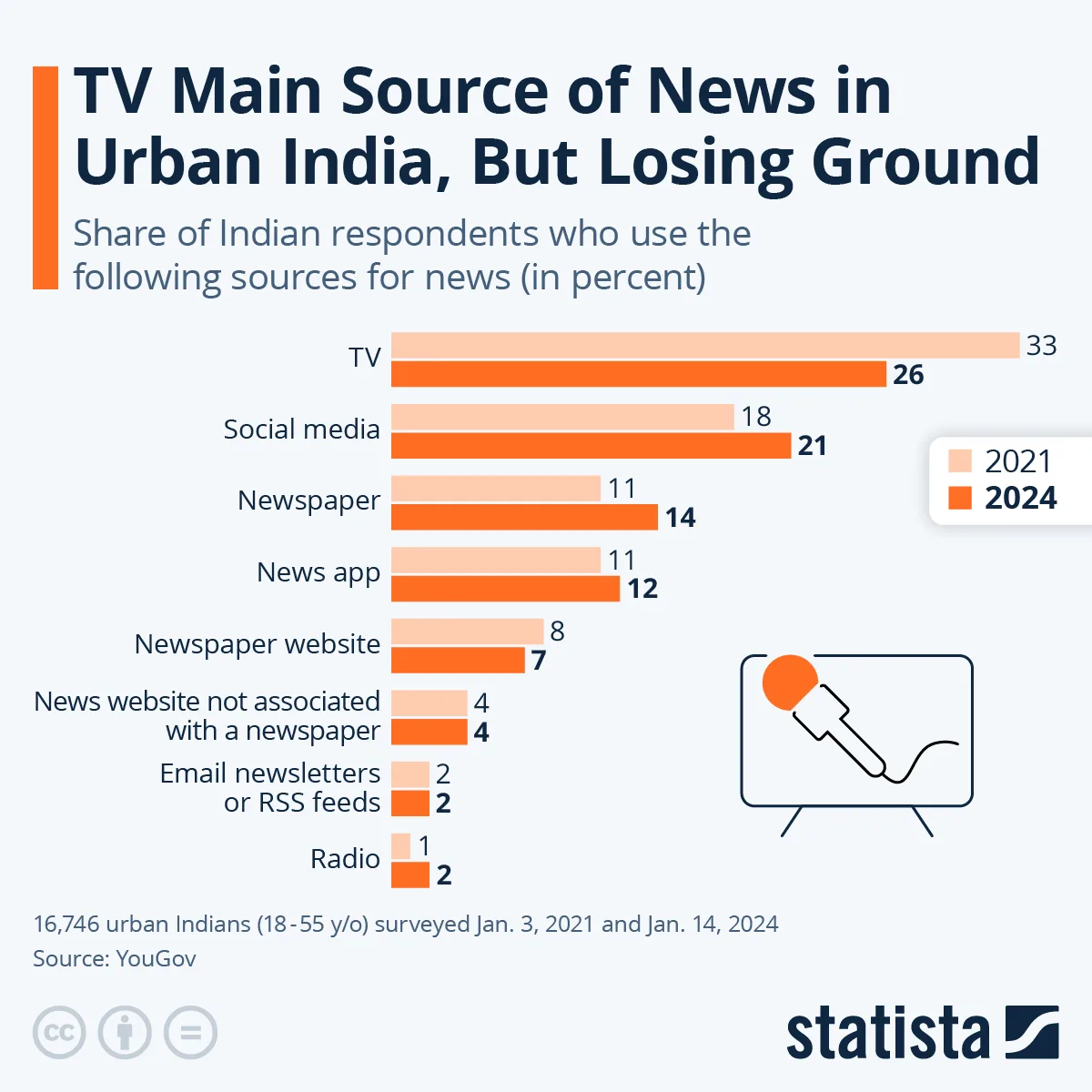
    According to a recent survey conducted by YouGov, television remains the primary source of news for urban Indians in 2024. However, a notable trend indicates that its dominance is waning. In the survey, just over 25% of respondents reported relying on television for their news. This marks a significant drop from 2021, when approximately one-third of participants identified TV as their main news source.

    The Decline of Television News

    The decrease in television viewership can be attributed to several factors. One prominent reason is the changing preferences of consumers who are increasingly gravitating towards more accessible and personalized news platforms. With the rise of digital media, urban Indians are no longer confined to traditional news broadcasting methods. Instead, they are exploring a variety of alternatives that cater to their pace and preferences.

    The Rise of Social Media

    Social media platforms have emerged as a formidable alternative for news consumption. The latest survey indicates a 3 percentage point increase in the number of people turning to social media for news. This shift reflects a broader trend where individuals value the immediacy and interactive nature of social platforms. Unlike traditional news outlets, social media allows users to engage with content, share perspectives, and participate in discussions in real time.

    Growth in Print Newspapers

    Interestingly, print newspapers are also witnessing a resurgence among urban news consumers. The survey highlighted a 3 percentage point increase in people accessing news via printed media. This could be attributed to an evolving perception of print as a credible source of news amid the overwhelming influx of digital content. Many individuals still appreciate the in-depth analysis and structured reporting that print newspapers can provide, which may be lacking in the fast-paced digital landscape.

    Increase in News Apps on Mobile Devices

    Another noteworthy change is the rise of news apps, primarily accessed through tablets and smartphones. The survey recorded a 1 percentage point increase in users relying on such applications for news. The convenience of having news updates at one’s fingertips, along with customizable content, appeals to a generation that thrives on mobility and flexibility. News apps often provide real-time updates, notifications, and tailored news feeds that enhance user engagement.

    Implications of Changing News Consumption Habits

    The shifting landscape of news consumption in urban India has significant implications for media organizations, advertisers, and consumers alike. Media outlets will need to adapt their strategies to engage a more digitally oriented audience seeking diverse news sources. Conversely, advertisers and brands will also need to reassess their promotional strategies to effectively reach target demographics through evolving channels.

    Conclusion: Embracing the Future of News

    The 2024 survey underscores a critical moment for news consumption in urban India. While television retains its status as a dominant news source, the momentum is clearly shifting towards digital platforms that offer more personalized, immediate, and interactive experiences. As urban consumers become increasingly sophisticated in their media consumption habits, the media landscape will need to evolve in tandem to meet the changing demands of its audience.

  • India’s TV Households Expected to Rise from 226M to 248M by 2026

    India’s TV Households Expected to Rise from 226M to 248M by 2026

    The Resilience of India’s TV Industry in the Age of Streaming

    The Indian television landscape is undergoing significant transformations, yet it remains a robust sector amid the global trend of cord-cutting. Despite predictions of decline in traditional TV viewership, India’s unique market dynamics showcase its ongoing relevance and potential for growth.

    Current Landscape of TV Ownership in India

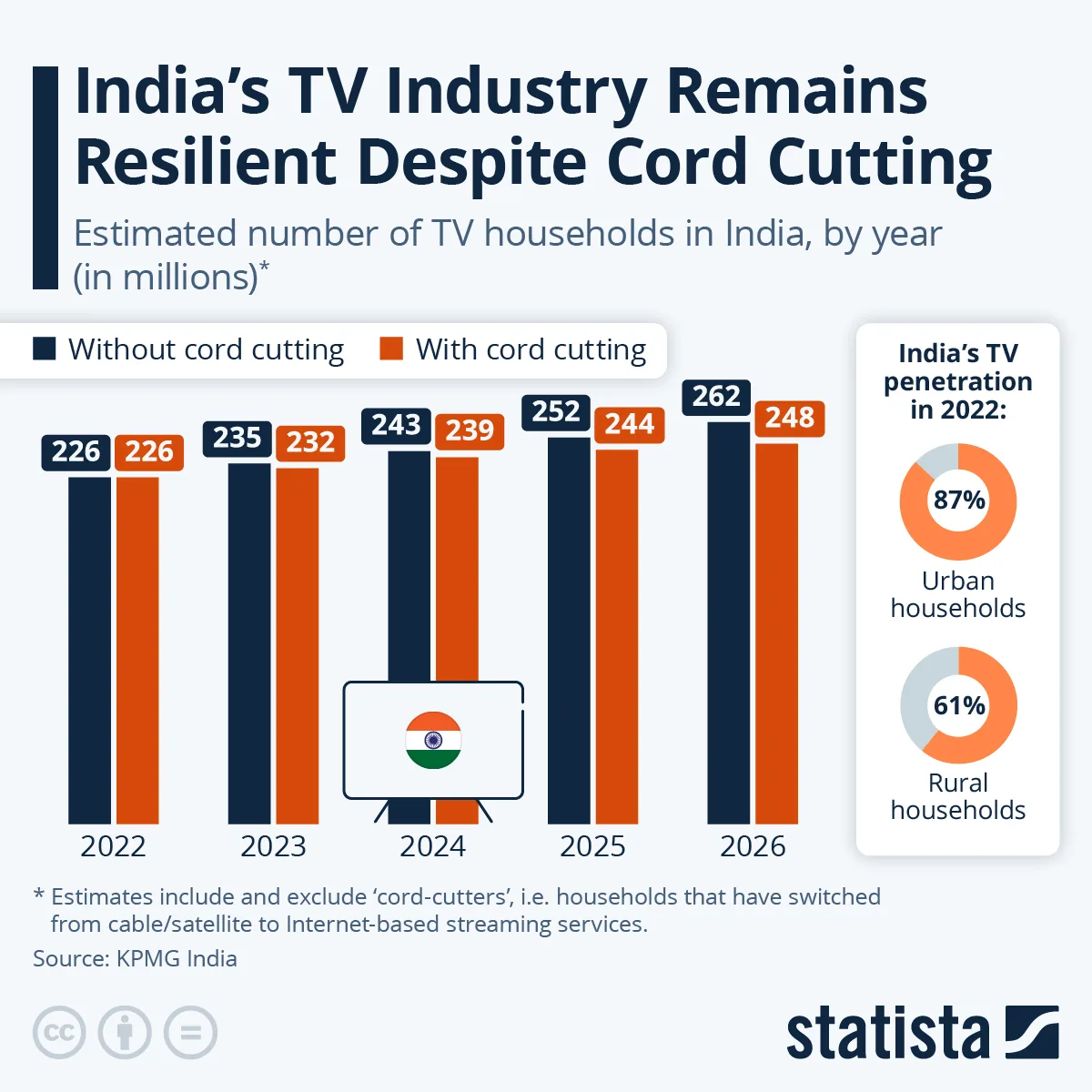
    India boasts a vibrant and rapidly expanding television market. According to the 2022 KPMG India report titled "Sports Broadcasting on TV: A Match Made in Heaven," there are compelling statistics on TV ownership that reveal the country’s evolving media consumption habits. In 2022, India had approximately 314 million households, of which 226 million owned a TV. These numbers are projected to grow, with expectations of reaching 248 million TV households by 2026, despite the backdrop of increasing streaming service subscriptions.

    Impact of Cord Cutting on Traditional TV in India

    Cord cutting—where viewers abandon traditional cable or satellite TV in favor of internet-based streaming services—is a global trend. However, its impact in India is more tempered compared to markets like the United States or the United Kingdom. Indian households are increasingly adopting streaming platforms such as Netflix and Amazon Prime Video; however, these trends coexist with continued engagement with linear TV.

    One major factor contributing to this phenomenon is the diversity in viewing preferences across different demographics and regions. While urban areas may lean towards modern streaming options due to better internet access and availability of diverse content, rural areas still heavily rely on traditional TV for entertainment and news.

    Growth Potential in Rural Markets

    The rural market in India presents a unique opportunity for the TV industry. Despite only a 61 percent penetration rate of TV households in rural regions, the growing availability of affordable television sets and satellite connection options is set to drive substantial growth. As infrastructure improves, more rural households are likely to invest in TV, fuelling both ownership and viewership statistics.

    Moreover, the allure of sports broadcasting plays a pivotal role in captivating audiences. Events such as cricket, which hold cultural significance in India, have the potential to attract viewers and reinforce traditional TV’s importance. The right mix of local programming and accessible sports content could bridge the gap between urban and rural viewership practices, sustaining the relevance of traditional TV.

    The Future of Television Consumption in India

    The imminent future foresees a television landscape that is not merely a battlefield between traditional and streaming platforms but rather an ecosystem where both can thrive. Factors such as socio-economic variations, regional preferences, and the allure of premium content are likely to keep TV alive and well in many households.

    As content providers adapt to this multifaceted environment, the potential for hybrid consumption models emerges. It is conceivable that viewers may oscillate between streaming and traditional TV, depending on their context—family viewing events, live sports, or binge-watching sessions.

    Conclusion

    The Indian television industry exemplifies resilience in the face of changing consumer behaviors. With growth prospects particularly strong in rural areas and a deep-rooted penchant for local content, traditional TV is likely to maintain a significant presence for years to come—even as viewers experiment with new digital offerings.

  • Comedy Leads TV Viewership: 61% of U.K. Fans Tune In

    Comedy Leads TV Viewership: 61% of U.K. Fans Tune In

    Understanding World Television Day: Celebrating Global Viewing Habits

    November 21 marks World Television Day, a day established by the United Nations in 1996 to recognize the significant impact television has had on global communication, education, and entertainment. This occasion serves as a reminder of how television connects people around the world and influences decision-making. In light of this day, let’s delve into the viewing habits across various nations to gain insights into how different cultures engage with television content.

    The Impact of Television on Society

    Television plays a crucial role in shaping public opinion and educating the masses. It has the unique ability to bring information directly into our living rooms, making complex issues more accessible. The establishment of World Television Day is not merely a celebration of the medium itself but a recognition of its profound influence on society.

    The Evolution of Television Content

    Over the years, television content has evolved significantly. It has transitioned from traditional broadcasting to streaming services, creating a more personalized viewing experience. This evolution has also influenced the types of genres that gain popularity among different demographics.

    Genre Preferences Around the Globe

    A survey conducted by Statista’s Consumer Insights provides an intriguing look into how preferences for television genres differ by geography. Notably, comedy has emerged as a dominant genre in several countries, while other genres have captured the interest of various audiences.

    Popularity of Comedy

    Comedy stands out as a beloved genre across various nations. According to the survey:

    • United States: Americans exhibit a strong preference for comedic content, often gravitating towards sitcoms and stand-up specials.
    • France: French audiences also show a notable inclination toward comedies, reflecting their cultural appreciation for humor and satire.
    • India: Comedy has secured a significant place in Indian entertainment, often blending local humor with social commentary.
    • Germany: German viewers similarly enjoy comedic programming, supporting both domestic productions and international hits.

    The Alternative: Documentaries and More

    While comedy reigns supreme in many regions, some countries have different genre inclinations:

    • Finland and Brazil: Here, the documentary genre takes the lead. Audiences in these nations value informative content that explores real-life issues, culture, and nature.
    • United Kingdom: The UK presents a balanced viewing landscape, with comedy and drama sharing equal popularity. Reports indicate that about 61 percent of respondents watch both genres frequently.

    A Closer Look at India’s Diverse Viewing Preferences

    India’s rich tapestry of cultural and entertainment options reflects a complex array of viewer preferences:

    • Sports (54%): Sports programming commands a massive following, particularly cricket, which is almost akin to a religion in the country.
    • Music Videos and Shows (53%): The popularity of music in Indian culture translates into a robust audience for music videos and reality music competitions.
    • Thrillers, Mysteries, and Crime Shows (49%): Intriguing narratives and suspenseful plots resonate well with Indian viewers, who enjoy the thrill of unraveling complex stories.
    • Horror (49%): The horror genre also maintains a significant following, appealing to audiences’ fascination with fear and suspense.

    Regional Variations in Viewing Habits

    The survey not only highlights preferences but also underscores the diversity in viewing habits across different regions. Factors such as cultural background, social norms, and local trends play pivotal roles in shaping what people choose to watch on television.

    The Role of Cultural Identity

    Television serves as a reflection of society’s values and cultural identity. Comedic content often provides a means of social commentary, while documentaries can help viewers connect with broader global issues. Understanding these dynamics can provide deeper insights into why certain genres flourish in specific regions.

    The Shift Towards Streaming Platforms

    The rise of streaming platforms has undoubtedly altered viewing habits. With the advent of on-demand content, audiences are increasingly curating their entertainment experiences, leading to a more diverse array of genres being explored across different demographics.

    With World Television Day shining a spotlight on how television continues to evolve and influence modern society, it also reminds us to appreciate the varied tastes and preferences that audiences around the globe exhibit. With comedy dominating many viewing preferences, and documentaries appealing to others, the landscape of television is as rich and varied as the cultures it encompasses.