الوسم: World Health Day

  • Global Nurse and Midwife Shortages: 31 Nations Below 10/10K

    Global Nurse and Midwife Shortages: 31 Nations Below 10/10K

    Understanding the Global Health Crisis: The Role of Nurses and Midwives

    The Stark Reality of Maternal and Newborn Mortality

    Every year, close to 300,000 women die during pregnancy or childbirth—a staggering statistic that underscores the dire state of maternal health worldwide. Additionally, over two million babies lose their lives within their first 28 days of life, and another two million are stillborn. This persistent tragedy highlights a significant public health challenge that requires urgent attention.

    World Health Day: A Call to Action

    April 10 has been designated as World Health Day, a platform through which the World Health Organization (WHO) aims to focus global attention on critical health issues. This year’s campaign emphasizes the need for governments and health communities around the world to elevate their efforts to eliminate preventable maternal and newborn deaths. The theme centers around the recognition of the pivotal role that skilled healthcare professionals, particularly nurses and midwives, play in this fight.

    The Role of Nurses and Midwives in Maternal and Newborn Health

    The International Council of Nurses (ICN) and the Council of International Neonatal Nurses, Inc. (COINN) have been vocal about the essential contributions of skilled nurses working in supportive healthcare environments. Despite progress in reducing maternal and newborn mortality rates, the lack of adequate staffing continues to pose a significant risk to mothers and their newborns.

    The Importance of Skilled Care

    Skilled care provided by trained nurses and midwives is proven to reduce the risk of complications during pregnancy and childbirth. Their expertise not only aids in safe deliveries but also supports maternal and infant health through continuous care and education.

    The Global Distribution of Nursing and Midwifery Personnel

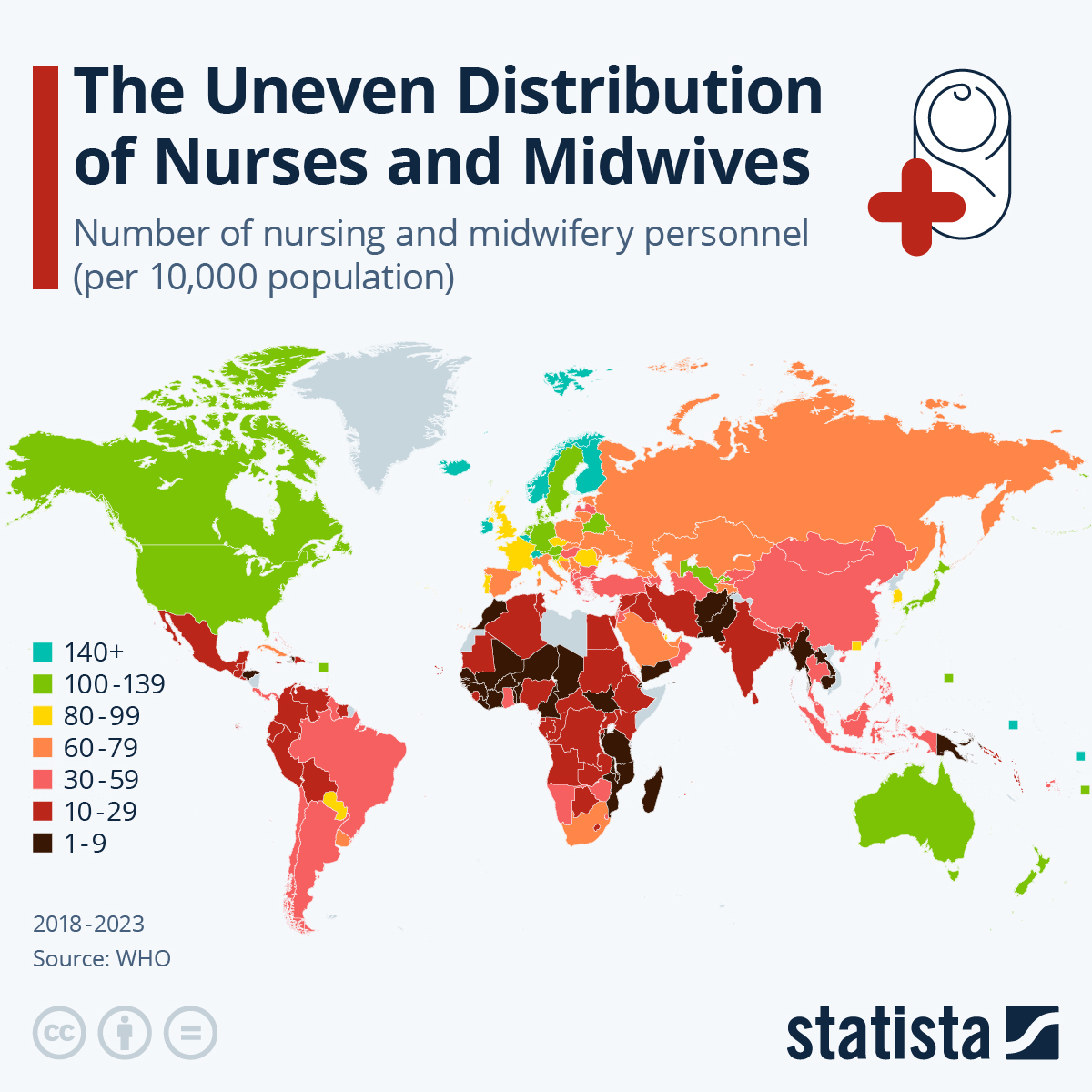
    The WHO’s data from 2018 to 2023 reveals an alarming disparity in the distribution of nurses and midwives globally.

    The Map of Inequality

    Based on the latest available data, a striking 31 countries and territories have fewer than ten nurses and midwifery personnel for every 10,000 people. This inequality is most pronounced in sub-Saharan Africa, where healthcare infrastructure is often under-resourced and overburdened.

    Regional Variations

    The disparities extend beyond mere numbers; they reveal profound regional variations:

    • China: As of 2022, the ratio stands at 37 midwives and nurses per 10,000 population.
    • Indonesia: In 2023, this figure is 32 per 10,000.
    • India: In 2020, there were only 17 midwives or nurses for every 10,000 people.
    • Cambodia: The situation is dire, with just 10 per 10,000 as of 2019.

    These statistics illustrate that while some regions have made progress in healthcare staffing, others like Cambodia and India remain critically underserved.

    The Implications of Staffing Gaps

    The uneven distribution of healthcare personnel has catastrophic implications for maternal and newborn health. Countries with fewer skilled healthcare providers face higher rates of preventable deaths. The gaps not only hinder immediate care but also affect the broader healthcare system, leading to long-term consequences for communities.

    The Way Forward: Addressing the Imbalance

    To make substantial progress in reducing maternal and newborn mortality, countries must prioritize the training, hiring, and retention of nurses and midwives. This involves increasing investment in healthcare infrastructure, ensuring that healthcare workers have the resources they need, and creating policies that support safe staffing levels.

    Recognizing the critical role that nurses and midwives play in the healthcare system is essential for creating a more equitable, effective, and responsive global health landscape.

  • 60% Drop in Global Child Deaths: Progress and Challenges Ahead

    60% Drop in Global Child Deaths: Progress and Challenges Ahead

    Decades of Progress in Reducing Global Child Deaths

    The past few decades have witnessed a profound transformation in child health outcomes across the globe. Significant reductions in child mortality rates, especially among those under five years of age, offer a glimpse into the successes achieved through concerted efforts by various stakeholders. Recent data shows that child mortality has been declining steadily, but the journey is far from over.

    Historical Context of Child Mortality Rates

    Historically, child mortality has been a pressing issue worldwide. In the early 1990s, millions of children died annually due to preventable causes such as infections, malnutrition, and lack of access to medical care. However, concerted global efforts over the years, particularly from organizations such as UNICEF, have facilitated remarkable progress.

    Since 1993, the global under-five mortality rate has decreased by an astonishing 60 percent. For newborns, the mortality rate dropped by 51 percent during the same period. These statistics underscore the advancements in healthcare technology, vaccination programs, and improved maternal health initiatives that have collectively contributed to saving countless lives.

    Current Statistics on Child Mortality

    Despite the significant strides made, challenges remain. The year 2023 recorded an estimated 4.8 million children under the age of five who died, which equates to approximately 36 infants for every 1,000 live births worldwide. Alarmingly, within this group, 2.3 million were newborns, translating to around 17 deaths per 1,000 live births among those under 28 days of age.

    This data illustrates that the fight against child mortality is still ongoing, with nearly half of all under-five deaths occurring within the first month of life. Such statistics highlight the critical need for improved prenatal and neonatal care to safeguard the lives of the most vulnerable population.

    Factors Behind Unequal Progress

    While the overall decline in child mortality is commendable, it masks some underlying inequalities that persist, particularly across different age groups and regions. The data reveals that progress has not been uniform. The disparity in survival rates is stark: children in the highest mortality countries face an 80 times greater risk of dying before their fifth birthday compared to those in the lowest mortality countries.

    Regional Disparities

    Regional inequalities are a significant concern. Some areas still struggle with high child mortality rates due to factors such as poverty, limited access to healthcare facilities, and the impact of conflict or instability. Children in rural areas, poorer households, and conflict-affected regions are particularly vulnerable, which highlights the necessity for targeted interventions in these regions.

    Socioeconomic Factors

    Research indicates that socioeconomic factors play a crucial role in influencing child mortality rates. Maternal education levels, household wealth, and access to healthcare services are intertwined with infant and child survival. For instance, mothers who possess higher education levels are generally more aware of health practices, and they tend to seek medical care earlier, leading to better outcomes for both mothers and their children.

    The Role of Global Partnerships

    The significant reduction in child mortality rates can be attributed to an integrated approach involving various stakeholders, including governments, non-governmental organizations, health professionals, and communities. This collaborative effort has been underscored through investments in healthcare systems, vaccination campaigns, and educational programs aimed at improving maternal and child health.

    UNICEF’s ongoing initiatives illustrate the importance of global collaboration in addressing child health issues. By focusing on comprehensive strategies that include community engagement and education, stakeholders have made progress in combating child mortality rates despite the existing challenges.

    Conclusion (not included as per user’s request)

    The journey toward reducing global child mortality is extensive and multifaceted, requiring continued commitment and innovative strategies to ensure that every child has the opportunity for a healthy start in life. Each statistic reflects not just the challenges faced, but also the potential for further progress through sustained efforts and collaboration.