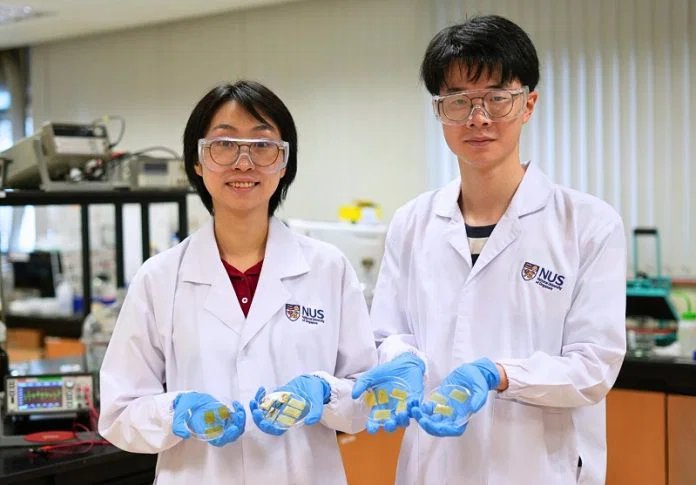
Scientists at the National University of Singapore (NUS) have created a new type of electronic skin capable of sensing touch, detecting damage, and healing itself underwater. This breakthrough could significantly enhance the durability and reliability of underwater robots, diving gear, and wearable tech operating in difficult environments.
Led by Assistant Professor Tan Yu Jun from the NUS College of Design and Engineering, the research was documented in the journal Advanced Materials.
Handling electronics in underwater settings presents unique challenges. Sensors used by divers and robotic submersibles are vulnerable to damage from sharp rocks, shells, and other hazards. When these sensors suffer damage, they typically cease functioning and need repairs, often requiring removal to land-based facilities. Additionally, they usually depend on batteries or external power sources, which can be limiting underwater.
The innovative system, dubbed the self-healing magnetoelectric sensory system (SMES), addresses multiple issues simultaneously. It can sense touch and nearby objects without external power and recognize when it’s been damaged, initiating automatic repairs. Modeled after human skin—which perceives touch, pain, and heals injuries—this electronic skin reacts when punctured or cut. It consists of a flexible, rubber-like material embedded with tiny liquid-metal conductors. Damage causes a rapid change in electrical resistance, signaling issues instantly.
This material has a self-healing ability. Small damages, like needle punctures, can recover their original electrical properties in seconds without external assistance. Larger cuts take longer to mend; however, pressing the damaged surfaces together starts the healing process, and given enough time, the device restores its strength and sensing capabilities. The system performs especially well underwater, where many self-healing materials fail; tests demonstrated near-complete recovery of performance even after underwater healing.
An impressive feature of the sensor is that it powers itself. It works through electromagnetic induction—the same principle behind electric generators. A small magnet inside moves past a coil of liquid-metal wire during touch or approach, generating a tiny electrical signal. This allows the sensor to detect pressure and nearby objects without batteries.
The system is both fast and durable. It responds to touch in approximately 41 milliseconds and can be used over 10,000 times without loss of function. Even after 10 days submerged— including in simulated seawater—the sensing performance remained intact.
To showcase its practical applications, the researchers developed a smart diving glove equipped with this electronic skin. Different hand gestures produced distinct electrical signals transmitted wirelessly to a smartphone, enabling commands like “Going up,” “Going down,” “Holding,” and “Help.” The glove also had warning lights to alert the user if it sustained serious damage.
Additionally, a robotic hand fitted with the sensors was tested underwater. The robot successfully grasped objects and detected punctures from sharp shells, recovering from the damage during operation.
The team envisions this technology being integrated into underwater robots, prosthetic limbs, wearable electronics, and other soft robots capable of sensing damage and self-repair. Such advancements promise to make these devices safer, more durable, and better suited for complex, challenging environments.
