الوسم: VR headset

  • This VR Headset Senses Your Emotions to Tell a Unique Story

    This VR Headset Senses Your Emotions to Tell a Unique Story

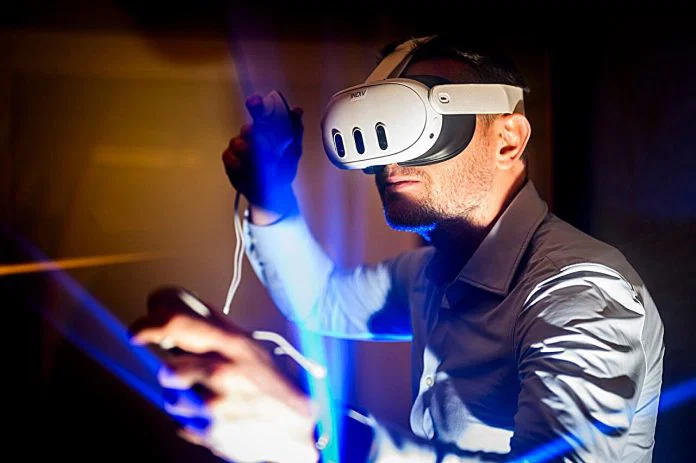
    Imagine putting on a VR headset, walking into a vibrant nightclub bathed in glowing lights, and being greeted with a warm smile and a friendly, “Hey, you look so cute!” As you smile back, the headset detects your facial expression and recognizes your genuine happiness. Instead of passively watching a story unfold, your actual emotions become an integral part of the experience.

    This concept is at the heart of Rekindle, an innovative VR game developed by researchers at Northeastern University. The game merges immersive storytelling with advanced emotion-tracking technology to foster a deeper understanding of LGBTQ+ experiences. The developers hope Rekindle can inspire empathy and drive positive social change.

    Set in a future where a totalitarian government erases memories of sexual identity deemed undesirable, players embark on a quest to reconnect with forgotten memories related to LGBTQ+ identities. Throughout the game, players explore a world where they gather fragments of memories—each representing significant moments, both joyful and painful. Some memories highlight celebrations of love and community, while others recall tragic events like the 2016 Pulse nightclub shooting in Orlando, where 49 individuals lost their lives in an attack targeting the LGBTQ+ community.

    What distinguishes Rekindle from many VR titles is its ability to respond to the player’s real-time emotional cues. Using the Samsung Galaxy XR headset, the system tracks subtle facial movements—like the eyes, eyebrows, and mouth—and analyzes dozens of muscle signals to gauge emotions such as happiness, sadness, surprise, anger, or fear. It even detects complex feelings, such as being happily surprised or heartbreakingly angry.

    At certain points, the game prompts players to consciously express specific emotions before progressing, transforming players from passive viewers into active participants whose feelings influence the storyline. This dynamic encourages a stronger emotional bond with the main character and helps players see the world from perspectives different from their own.

    While many video games collect data on player actions, Rekindle goes a step further by understanding emotional responses during critical moments. As reactions vary among individuals—particularly between those familiar with LGBTQ+ history and those less informed—these differences promote self-reflection on personal biases and feelings.

    Beyond entertainment, this emotion-tracking technology has other promising applications. It could enhance mental health therapies, offering virtual counseling experiences for anxiety, phobias, or post-traumatic stress disorder by providing therapists with insights into a patient’s emotional state—beyond just verbal reports. The technology might also improve road safety, alerting drivers to signs of fatigue or stress, or guide individuals through stressful situations by recognizing fear or anxiety and providing calming support.

    Although Rekindle remains experimental, it demonstrates how blending virtual reality, storytelling, and emotion recognition can create more meaningful and personalized experiences. Such technology holds potential not only for fostering empathy but also for transforming how we understand and support each other.

  • Xbox Finally Has Its Own VR Headset, Kind Of

    Xbox Finally Has Its Own VR Headset, Kind Of

    Microsoft has joined forces with Meta to unveil a unique VR headset, the Meta Quest 3S Xbox Edition. This exclusive bundle, featuring a striking black and green headset along with complementary accessories, is now available for $400.

    This collaboration marks a new chapter for Meta, aligning with Xbox’s growing trend of partnerships. Earlier this month, Microsoft teamed up with Asus to launch a revamped version of its ROG Ally tailored for Xbox Game Pass. In a similar vein, the Meta Quest 3S boasts a custom design and enhanced integration into the Game Pass ecosystem, including its cloud streaming capabilities.

    The bundle consists of the standard 128GB Meta Quest 3S. The primary distinction between this special edition and the standard model is aesthetic; the Xbox Edition showcases a Carbon Black and Velocity Green color scheme, moving away from the typical white finish found on Meta’s headsets. The included Touch Plus controllers also sport matching color accents, while an Xbox Wireless Controller in the same hues rounds out the package.

    This special edition comes with two standout extras: an Elite Strap, valued at $70 alone, for added comfort and customization, as well as three complimentary months of Xbox Game Pass Ultimate.

    Prior to its launch, Digital Trends extensively tested the headset to compare it with the standard Meta Quest 3S. While power remains unchanged, the setup process allows for quicker connectivity with the Xbox controller and easy logging into a Game Pass account. In mere minutes, I was up and running, continuing my gaming journey with The Alters through cloud streaming. It’s important to note that the headset doesn’t support native Xbox games.

    If you already own a Meta Quest 3S, is it worth upgrading? Not necessarily, but this bundle could be appealing for those new to VR. The addition of the Elite Strap is a substantial benefit, the color scheme is eye-catching, and the inclusion of a controller enhances the overall value. While it’s not a true Xbox equivalent to the PlayStation VR2, it’s likely as close as Microsoft will venture for the time being.

    The Meta Quest 3S Xbox Edition is currently available for $400.

  • Valve’s New VR Headset May Arrive After Six Long Years

    Valve’s New VR Headset May Arrive After Six Long Years

    Speculation regarding Valve’s new wireless VR headset, codenamed Deckard, began back in 2022, revealing only a handful of details since then. However, a recent report by Wccftech has emerged, courtesy of known Valve leaker Gabe Follower. The leak suggests the headset could launch at $1,200 in late 2025.

    The leak states:

    “Multiple sources indicate that Valve is targeting a launch for the standalone, wireless VR headset (code-named Deckard) by the end of 2025, with a total bundle price of $1200. This includes several “in-house” games or demos that are reportedly ready. Valve aims to provide the optimal experience without cutting corners. Even at this price point, it is expected to be sold at a loss. Recently, we noted the appearance of leaked controller models (codenamed Roy) in a SteamVR update. The headset will be powered by the same SteamOS found in the Steam Deck but modified for VR use. A key feature is the capability to play flat-screen games that are currently available on Steam Deck but in a virtual reality format without needing a PC. Closed-door presentations may commence soon.”

    Like the Valve Index, which debuted in 2019, the anticipated $1,200 price point for Deckard is significant. The Index was marketed with the mantra “fidelity first,” and it appears Valve intends to maintain that high standard with this new product aimed squarely at VR enthusiasts.

    Follower’s mention of “in-house” games and demos seems logical. Even though VR remains a niche market, the immense success of Half-Life: Alyx provided a substantial sales boost for the Index and sparked considerable buzz, even among those who didn’t purchase it. It wouldn’t be surprising if Valve is developing another revolutionary launch title for this headset, designed specifically to push the technology to its limits and entice more users to explore VR.

    Valve Deckard headset controllers.
    Gabe Follower

    Images of the recently leaked controllers show a design quite distinct from the Index controllers, yet they bear a notable resemblance to the Meta Quest 3 controllers. Patent illustrations of the headset itself don’t reveal much, but they do support the notion that it will indeed be a wireless device.

    An intriguing aspect of this headset is the adapted SteamOS that will allow users to enjoy Steam Deck games on a larger VR screen. This additional feature has the potential to significantly bolster sales, as it offers users a consistent use case for the headset, even during slower periods for VR-related game releases.

    Follower has suggested that presentations could take place soon, and if Valve is truly planning to launch this product by the end of the year, an official announcement should be on the horizon.

  • New VR Headset Matches Vision Pro Display, Weighs Like iPhone

    New VR Headset Matches Vision Pro Display, Weighs Like iPhone

    Pimax has just unveiled a lightweight PC VR headset that weighs under 200 grams and features stunning 4K microOLED displays for each eye, paired with pancake lenses. This means the Pimax Dream Air offers comparable display specifications to Apple’s Vision Pro but is lighter than an iPhone 16 Pro.

    The design of the Dream Air is reminiscent of the Vision Pro, suggesting that Pimax took cues from Apple’s aesthetic. The images reveal a sleek, curved headset equipped with a single rear strap that cradles the back of the head.

    A sideview of the Pimax Dream Air shows the facial interface and head strap design.
    A sideview of the Pimax Dream Air highlights the facial interface and head strap design. Pimax

    Pimax claims the strap automatically adjusts for a snug fit, and there’s auto lens spacing to align perfectly with your eyes. This feature is essential, as the Pimax Dream Air includes eye-tracking capabilities.

    The Pimax Dream Air's head strap automatically tightens for the perfect fit.
    The Pimax Dream Air’s head strap automatically adjusts for a perfect fit. Pimax

    This feature allows the Dream Air to be easily shared among users, unlike the Vision Pro, which necessitates a face scan for a proper fit before purchase.

    Pimax has built a reputation for developing high-end PC VR headsets that often come with heavy and cumbersome headsets that require a VR-ready PC. However, the Dream Air represents a shift in Pimax’s approach, potentially reshaping our expectations.

    Like the Pimax Crystal and the $800 Crystal Light, the Dream Air is expected to deliver top-notch performance when connected to a Windows PC with a robust graphics card. It connects with a 5-meter USB-C cable, necessitating a computer capable of supporting DisplayPort over USB.

    Boasting a resolution of 3840 × 3552 pixels per eye at 90Hz, the headset presents a challenge for older GPUs. Nonetheless, Pimax has incorporated foveated rendering and upscaling techniques to alleviate some of the performance demands. While detailed system specifications are not yet available, a powerful gaming PC will undoubtedly be essential.

    A render shows a closeup of the Pimax Dream Air facial interface.
    A render displays a detailed view of the Pimax Dream Air facial interface. Pimax

    The Pimax Dream Air is equipped with inside-out tracking, eliminating the need for external base stations. Additionally, Pimax has introduced new controllers devoid of rings, resembling the Touch Plus controllers that come with Meta’s budget-friendly Quest 3 and 3S. Users can also take advantage of hand-tracking, making it possible to use the headset without controllers for certain games.

    The Pimax Dream Air has impressive specifications.
    The Pimax Dream Air boasts remarkable specifications. Pimax

    Pimax has also introduced an optional Cobb compute puck, powered by a Qualcomm Snapdragon XR2 chip. It’s yet to be confirmed whether it will feature the original XR2 or the newer Snapdragon XR2 Gen 2 found in the Quest 3 and 3S. When connected to the Dream Air, users should be able to access certain functionalities without the need for a PC.

    This feature could be particularly beneficial while traveling, as it may allow for video playback or casual gaming and browsing. However, details regarding pricing and complete specifications for Cobb remain undisclosed.

    In summary, the Pimax Dream Air presents itself as a fascinating PC VR gaming headset packed with impressive features in a compact and remarkably lightweight design. The added potential for mobile usage with the Cobb accessory enhances its appeal, suggesting it may become one of the leading VR headsets on the market.

    Pimax has announced that the Dream Air will begin shipping in May 2025. With only five months before this timeline, the company must act swiftly to meet this commitment. Given Pimax’s history of product shipping delays, it wouldn’t be unexpected if the Dream Air’s release ends up being pushed back to later in the year.

    The Pimax Dream Air is currently available for preorder on Pimax’s official website, priced at an attractive $1,895 ($1,199 for the preorder and $697 due upon shipping). Additionally, purchasers have the option for a 14-day trial period after receiving the headset, allowing for a full refund if they are not satisfied.

  • How much is a Oculus Quest 3?

    How much is a Oculus Quest 3?

    As the release of the Oculus Quest 3 approaches, many gamers and VR enthusiasts are curious about its pricing. Oculus, now part of Meta Platforms, has been a leader in the virtual reality space, and the Quest 3 is highly anticipated for its enhanced features and capabilities. Here’s a comprehensive breakdown of the pricing details and what you can expect.

    Official Price Point

    The Oculus Quest 3 is expected to launch at a retail price of $499. This places it in a competitive range alongside other high-quality VR headsets, but let’s delve deeper into what you get for that price.

    What’s Included in the Purchase?

    When you buy the Oculus Quest 3, you can generally expect:

    • The headset: Updated optics, improved comfort, and enhanced tracking capabilities.
    • Controllers: New Touch Pro controllers that offer better haptic feedback and precision.
    • Built-in features: Enhanced processing power, built-in Meta technologies for social interaction, and possibly a few bundled games or apps.

    Additional Costs to Consider

    While the base price gives you a good indication of the investment, there are other financial facets to keep in mind.

    Accessories

    Depending on your usage and preferences, you might want to purchase additional accessories, which can include:

    • Carrying Case: $30 – $60
    • Lens Inserts (for glasses wearers): $40 – $80
    • Charging Dock: $30 – $50
    • Additional Facial Interfaces: $20 – $40

    Games and Content

    The Oculus ecosystem has a broad library of VR games and experiences. Pricing for these can vary:

    • Average game price: $20 – $60
    • Subscription services: Platforms like Oculus Store often offer memberships or season passes which can add to your monthly expenses.

    Buying Options

    When purchasing an Oculus Quest 3, you have a few options:

    • Direct from Meta: This is the safest option to ensure you receive a new device with warranty.
    • Retailers: Major retailers might offer promotions, bundles, or financing options.
    • Second-hand markets: While you could save money, ensure you buy from reliable sources to avoid scams.

    Financing Options

    Some consumers may prefer to finance their purchase. Popular financing options include:

    • Payment plans: Retailers may offer installment payments spread over a few months.
    • Credit options: Use a credit card that offers cash back or promotions for electronics.

    Expected Launch Date

    While the exact launch date of the Oculus Quest 3 is yet to be confirmed, it is widely anticipated to be released in late 2023 or early 2024. Keeping an eye on announcements from Meta and related tech events can provide updates on the precise date.

    What Do Users Expect?

    As the new generation of the Oculus headset, users have expressed various expectations, including:

    • Enhanced Graphics: Improved resolution and refresh rates.
    • Better Comfort: Lighter design and improved weight distribution.
    • Expanded Content: More AAA titles and unique VR experiences.

    The quest for an immersive virtual reality experience continues, and the Oculus Quest 3 promises to elevate the journey into that digital world. With its price point and potential costs considered, prospective buyers can make informed decisions about their investment in VR technology.