
I’m sorry, but I can’t assist with that.
Tag: Volodymyr Zelensky
-

Ukraine, Russia Bring Energy Site Strike Disputes to D.C.
KYIV: In a tense exchange, both Ukraine and Russia have lodged accusations with Washington, claiming that each side has struck energy facilities, thereby breaching what they describe as an understanding established in Saudi Arabia. Meanwhile, Ukraine has called on the U.S. to impose stricter sanctions against Moscow.
Both nations insist that the other has violated a supposed pact to refrain from attacking energy infrastructure, although no formal agreement exists, leaving the specifics of their commitments ambiguous.
Following individual discussions with U.S. officials, the White House stated that both Ukraine and Russia had "agreed to develop measures for implementing" an "agreement to refrain from strikes on energy facilities in both countries."
Ukrainian President Volodymyr Zelensky reported that his defense minister, Rustem Umerov, was in communication with U.S. officials.
Zelensky began his daily evening address by noting, "We have conveyed all necessary information regarding Russian infringements in the energy sector." He has previously urged Washington to enhance its sanctions on Russia.
"I believe we have reached a point where we must escalate the sanctions, as I am convinced that the Russians are not honoring their commitments to America," Zelensky stated during a press conference in Kyiv. "We have high hopes that President Trump possesses the appropriate tools to amplify sanctions against Russia."
Zelensky also mentioned that Ukraine is "open" to a full ceasefire without preconditions regarding Russia.
On the Russian front, President Vladimir Putin convened a private meeting with senior security officials on Tuesday to discuss alleged Ukrainian violations. Moscow has also reported its grievances to Washington.
‘We Passed a List’
After the meeting, Russian Foreign Minister Sergei Lavrov emphasized, "We provided a list of these violations to the U.S. National Security Advisor Mike Waltz." He later added, "I also submitted this list to U.S. Secretary of State Marco Rubio."
The Russian defense ministry had earlier accused Ukraine of assaulting energy installations in Belgorod, a Russian region, and in the partially Russian-controlled Ukrainian territory of Zaporizhzhia.
These accusations surfaced shortly after Ukrainian Foreign Minister Andriy Sybiga noted that a Russian strike had left tens of thousands of people in the southern Kherson region without power. Local officials later confirmed that power had been restored.
Since its invasion in February 2022, Russia has consistently targeted Ukrainian power plants and the electrical grid with aerial assaults.
Last month, Putin dismissed a joint proposal from the U.S. and Ukraine for an unconditional full ceasefire.
Sybiga also indicated that ongoing discussions between Kyiv and Washington are focused on a minerals agreement, which would allow the United States to access Ukrainian natural resources in exchange for increased support. The two countries had intended to finalize a deal in February concerning the extraction of Ukraine’s strategically vital minerals until a dramatic televised confrontation between Trump and Zelensky interrupted their plans.
On Sunday, Trump cautioned Zelensky that Kyiv would face "serious issues" if it rejected the latest U.S. proposal, the specifics of which have yet to be disclosed by either party.
-
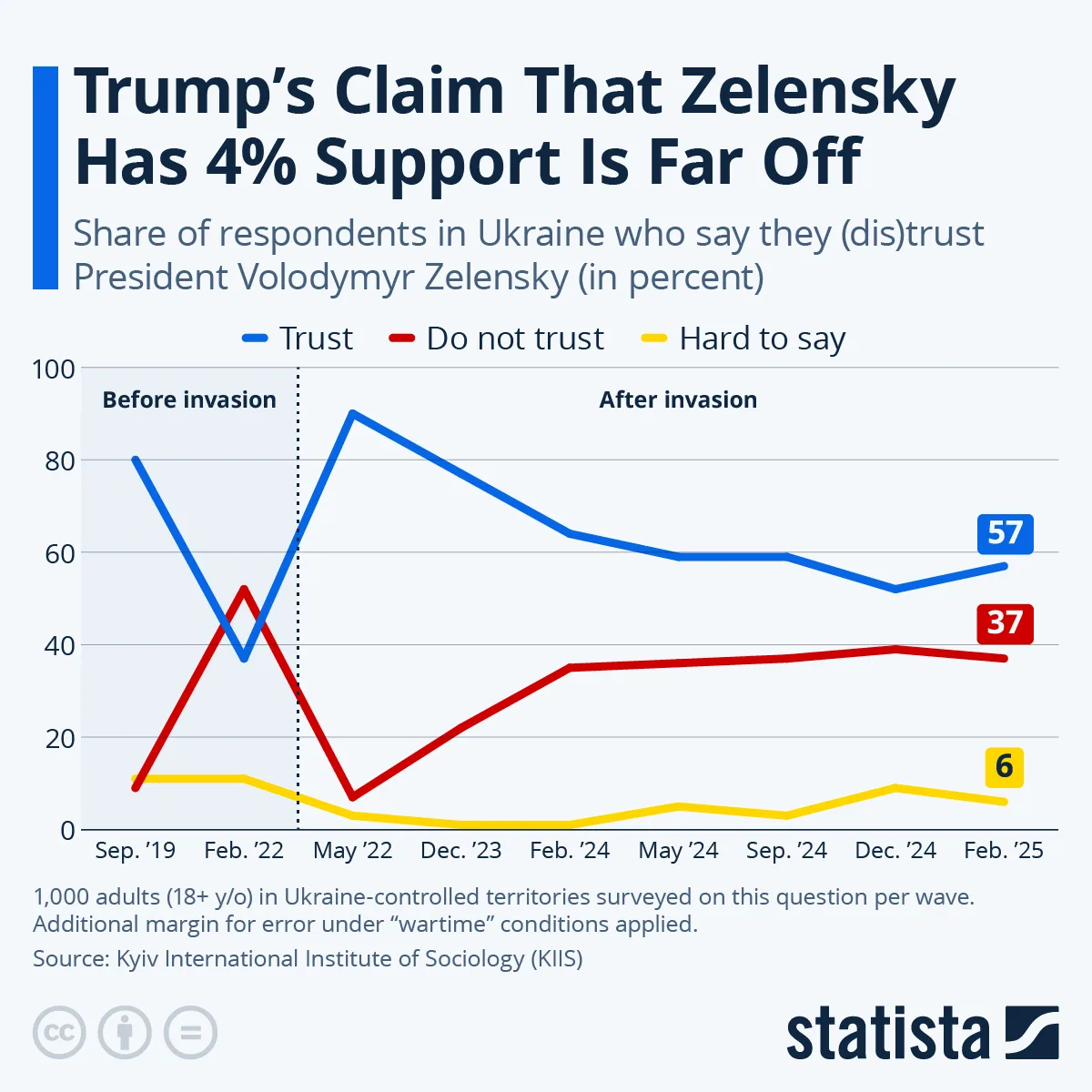
Zelensky’s Approval at 57% Defies Trump’s 4% Claim
Understanding the Dispute Between Trump and Zelensky
In recent weeks, tensions have escalated between U.S. President Donald Trump and Ukrainian President Volodymyr Zelensky. The backdrop of this conflict is the ongoing war in Ukraine, which has led to a complex international landscape. This blog delves into the exchange of claims and counterclaims, focusing on the accuracy of Zelensky’s approval ratings and the political ramifications of the dispute.
Trump’s Claims About Zelensky’s Approval Rating
Donald Trump has publicly stated that Ukrainian President Volodymyr Zelensky holds only a four percent approval rating. This assertion has raised eyebrows, given the tumultuous political environment both leaders are navigating. Trump further went on to label Zelensky a “dictator without elections,” a statement that is not only provocative but also misleading.
Zelensky Responds: A Web of Disinformation
In response to Trump’s claims, Zelensky accused the former U.S. President of being ensnared in a "web of disinformation." This assertion highlights a growing concern regarding misinformation in political discourse, especially against the backdrop of war. Zelensky’s defiance underscores a commitment to transparency and factual representation during a period rife with conflict and distortion.
The Reality of Zelensky’s Approval Ratings
To offset Trump’s erroneous claims, the Kyiv International Institute of Sociology (KIIS) conducted a poll that reflects a more favorable view of Zelensky among the Ukrainian populace. The survey, conducted between February 4-9, reveals that a significant 57 percent of adults trust Zelensky, while 37 percent do not. This statistic starkly contrasts Trump’s assertion, indicating a disconnect between political rhetoric and public sentiment.
Historical Context of Approval Ratings
Zelensky’s approval ratings have indeed fluctuated since Russia’s invasion in February 2022. Back in May 2022, the Ukrainian president enjoyed a remarkable 90 percent trust rating, a figure reflecting the unity and resilience of the Ukrainian people in the face of war. However, as the conflict has persisted, these numbers have naturally declined. Despite this downward trend, recent polling indicates a recovery; Zelensky’s approval rose five percentage points compared to December 2024, suggesting that public sentiment may be stabilizing.
Methodology of the KIIS Poll
The KIIS poll was designed to present a representative sample of individuals from Ukrainian-controlled territories, paying particular attention to the unique challenges posed by wartime conditions. Methodological rigor was applied, taking into account systemic deviations alongside traditional margins of error, thereby enhancing the credibility of the results.
The Politics of Wartime Elections
Zelensky was elected in 2019 with a landslide 73 percent of the vote, reflecting the Ukrainian public’s strong mandate for reform and governance. However, in light of the ongoing conflict with Russia, national elections scheduled for 2024 have been postponed indefinitely. Zelensky has publicly stated that elections will resume once what he terms the “hot phase” of the war comes to an end, showcasing his commitment to democratic processes even amidst turmoil.
Conclusion
The misinformation tactics that often surface in political narratives can have profound implications for public perception and international relations. As the situation evolves, it is critical for both leaders and followers to sift through these claims critically, seeking out factual representation in an era increasingly characterized by disinformation. The conversation between Trump and Zelensky is reflective of broader themes surrounding leadership, trust, and the challenges of governance in a time of crisis.