الوسم: Voice

  • Google Home Fixes Voice Commands But Not Ready for Most

    Google Home Fixes Voice Commands But Not Ready for Most

    Google has just released a genuinely useful update for Google Home centered around voice command functionalities, but there’s a hidden catch in the fine print.

    The latest update allows you to specify exact light colors using Kelvin values (or color temperature) and streamlines years of awkward voice broadcast commands. However, most of these features only work if you’ve already enrolled in the early access program.

    So, what are the real improvements with voice commands?

    In my opinion, the standout feature is the improved control over color temperature. You can tell Gemini something like “set the living room lights to 2700 Kelvins” and get that precise warmth. This update simplifies what used to be a tricky slider in the Google Home app into a straightforward voice request.

    That said, I am concerned about how users will need to memorize Kelvin values to get their preferred lighting warmth just right. For reference, 3000K is warm, 4000K is neutral or daylight-like, and anything above 5000K is considered cool.

    Other notable updates include enhancements to Spotify voice requests. Google reports improved accuracy in matching songs, artists, and playlists by name, which should lead to better search results. Additionally, the process for broadcasting messages has been redesigned into two steps: first saying “OK Google, broadcast message,” then waiting a moment to speak the actual message. This approach makes conversations sound more natural, giving you time to prepare your message.

    All three features are currently exclusive to Gemini for Home, which is still in early access. If you’re not enrolled in that program, these voice capabilities won’t be available to your setup yet, regardless of having the latest app.

    However, everyone else can still enjoy some improvements. For instance, Android streams that previously stuttered at 360p now stream in full resolution. European-style smart locks now have separate control options for unlatching and unlocking, with clearer status indicators. Lastly, temperature units now remain consistent across the app, voice commands, and Nest devices, simplifying the user experience.

  • Fraimic’s E Ink Art Frame Creates Art From Your Voice

    Fraimic’s E Ink Art Frame Creates Art From Your Voice

    We’ve encountered numerous “smart art frames” at CES over the years. Most of them come across as fancy digital photo frames dressed up in elegant shells. However, one stands out as genuinely different: Fraimic, and I say this as someone naturally skeptical of this type of product.

    The initial pitch is quite appealing. Just speak a prompt into the device, and its built-in microphone transmits the command to OpenAI’s GPT Image 2.0, which then creates full-color artwork displayed on a Spectra 6 E Ink screen.

    What sets it apart from competitors like Aura and SwitchBot? Typically, with standard digital photo frames, you’d turn to your phone to change images. With Fraimic, simply tap, speak, and a piece of art appears on your wall—more like a painting on paper than pixels on a screen. It also features an accelerometer that detects whether the device is oriented in portrait or landscape mode.

    When comparing options, Aura Frames usually require a subscription and don’t allow you to change the surrounding frame. SwitchBot frames lack voice generation capabilities. Fraimic offers both features, while also keeping your prompts and images private by default. The company provides a free quota of 100 AI-generated artworks annually and access to thousands of public domain works from the Metropolitan Museum of Art. Additionally, a REST API enables seamless integration with smart home systems for developers.

    The pricing is a bit challenging to swallow: $499 for the 13.3-inch model and $1,499 for the 31.5-inch version. For context, Aura’s similar frame costs about the same for the smaller size, but they offer smaller, less expensive options. SwitchBot also has a 31.5-inch model priced $200 lower. The 13.3-inch version is available now, but the larger one is listed for a July 2026 release. While the device has earned a Red Dot Award for Product Design in 2026, it remains a substantial investment for a first-generation product from a Chicago startup.

    In my view, Fraimic occupies an interesting but awkward position. It’s too costly for impulsive purchases yet remarkably capable to dismiss outright. We’ll reserve judgment until we have a chance to try it firsthand.

  • Voice Kids Participant Suffers Stroke After Losing

    Voice Kids Participant Suffers Stroke After Losing

    A participant in “The Voice Kids” has recently announced a health crisis following their elimination from the competition.

    Egyptian contestant Mohamed Mahmoud, a former contestant on The Voice Kids, stunned his followers when he disclosed that he experienced a health emergency due to the shock of his departure from the show.

    He shared on his TikTok account that he is grateful to everyone who inquired about his well-being over the past few weeks. He explained that he is currently receiving treatment after suffering a stroke in his vocal cords, which has sidelined him from singing and performing in front of audiences.

    The young singer clarified that the psychological stress and shock from his confrontation with artist Rami Sabry during the show contributed to his health issues, with the crisis directly impacting his vocal cords.

    Despite his health challenges, the participant reassured his fans that he remains committed to his treatment and is hopeful to recover and return to singing soon. He expressed gratitude to everyone who supported him throughout his health ordeal.

    The Voice Kids

    He concluded by emphasizing his determination to overcome his health issues and get back on stage, thanking all those who stood by him during this difficult time.

  • Is Your Voice Truly Private? AI Can Imitate and Clone It

    Is Your Voice Truly Private? AI Can Imitate and Clone It

    Talking to machines has become a daily routine. Whether it’s asking Amazon Alexa for the weather or issuing voice commands on your phone, voice technology is now everywhere.

    However, scientists warn that your voice tells more than just your words—it also reveals hidden details about you.

    Unlike a password, you can’t easily change your voice. Each person has a distinct “voiceprint,” shaped by their body, speech patterns, and habits.

    This voiceprint can identify you and even disclose information such as your background, gender, or emotional state.

    According to Andrea Cavallaro from École Polytechnique Fédérale de Lausanne, when people interact with AI systems, they’re also sharing subtle cues like tone, rhythm, and speaking style.

    These signals make voice data incredibly valuable. Researchers are exploring how to use this information beneficially, especially in healthcare.

    Small variations in speech might be early indicators of neurological issues, breathing problems, or mental health concerns.

    A startup called Virtuosis AI is investigating how voice analysis could serve as a simple, non-invasive way to monitor health.

    But with this potential comes significant privacy concerns. Voice data is deeply personal, and if mishandled, it could threaten individual privacy.

    For instance, voice recordings can be used to train AI models without explicit consent.

    Some actors and voice professionals have already taken legal action, arguing that their voices are part of their identity and should be protected.

    Another concern is voice cloning. Today’s AI can replicate a person’s voice with impressive accuracy, sometimes with just a short recording.

    This ability raises risks of scams, impersonation, and spreading false information. What once was a trusted form of identification—someone’s voice—can now be artificially mimicked on a large scale.

    To combat these risks, researchers are developing protective measures like voice anonymization.

    This technique involves subtly altering a person’s voice so it remains understandable but no longer clearly reveals who is speaking. The challenge is to find the right balance—protecting privacy without making speech unintelligible.

    Experts are also advocating for “privacy by design,” integrating protective features into technology from the outset. As voice becomes a primary mode of human-AI interaction, this approach is increasingly crucial.

    The adoption of voice technology is booming. Estimates show billions of voice-enabled devices are now in use worldwide—from smartphones and cars to smart home systems. As these become more prevalent, they’re transforming how we communicate with technology.

    While speaking may seem fleeting, in the AI age, your voice can be recorded, analyzed, and stored indefinitely. This shift is not only changing technology but also reshaping our perceptions of identity and privacy in a connected world.

  • Completing the Voice Quest in Tainted Grail’s Corrupted Temple

    Completing the Voice Quest in Tainted Grail’s Corrupted Temple

    Tainted Grail: The Fall of Avalon explores the desperate lives of the Kamelotians and Avalonians as they battle to survive while the Wyrdness engulfs their land. Dungeons stretch across the terrain, teeming with unseen dangers, monsters, and corruption that threaten to spill into the world above.

    Within the Corrupted Temple, several bosses and quests await, including the mission to free a trapped goddess. We’ll guide you in retrieving the lost pieces needed to cleanse the temple of its corruption.

    How to Begin the Deiform Quest

    To kick off this quest, head to the Corrupted Temple located in the swamps of Cuanacht. Inside, you will encounter dangerous priestesses corrupted by Wyrdness under the influence of a false goddess.

    As you navigate the main path of the temple, a gentle voice of a matronly specter will beckon you to liberate her and the priestesses. Your task is to retrieve her voice.

    Where to Find the Voice

    Move through the ruins until you reach the dual elevators. Ascend to the third floor, where you’ll encounter a young woman named Laurelia. She speaks on behalf of the All-Mother, and you can persuade her to part with the voice needed for the mother.

    After obtaining the voice from Laurelia, she will become a lingering ghost in her bedroom. Next, take the elevator on the left to continue exploring the ruins.

    Where to Find the Body

    The body of the All-Mother is difficult to access, as it’s located at the top of a tower. You can either navigate through the temple or climb the cliffs to reach it from behind.

    Upon arrival, you’ll find the body of Perceval, who is in distress with a massive sword embedded in her chest. The sword rises, dragging her along, and you’ll need to defeat the corrupted Knight of the Round Table to reclaim her body for the goddess.

    Once you’ve defeated Perceval, converse with her ghost to uncover the fate of the priestesses and learn how to claim the Sight and confront the All-Mother’s imposter.

    Where to Find the Sight

    From where you vanquish Perceval, cross the broken bridge entangled with dark vines to reach a cavern entrance. Inside, you’ll need to fight through the temple ruins and eliminate any obstacles in your way.

    Eventually, you’ll confront a magical barrier blocking you from the Sight, Frithir. She is bound like the other priestesses and has been cursed with the Sight of the All-Mother. She’ll ask you to close your eyes for a brief moment.

    Agreeing to her request is harmless, so feel free to grant her this moment of respite.

    Afterward, Frithir will attempt to purify your sins. However, what she sees overwhelms her, resulting in her transformation into the Singworm. She will drop all her gear, which you can pick up for the battle against her.

    Once you’ve slain the Singworm, collect the key and Essence of Sin from her remains. Enter the cursed temple at the far end of the room to find the goddess you’ve been hearing.

    When you speak with her, she will express her gratitude for freeing not just herself but also the other priestesses. You will be rewarded with the Cracked Menhir Rites Tablet and free to exit the temple at your own pace.

  • Voice Search Optimization Guide

    As technology evolves, voice search is becoming an integral part of how users interact with search engines. With the growing popularity of smart speakers and voice assistants, optimizing for voice search isn’t just beneficial—it’s essential. This guide offers insights into optimizing your website for voice search, ensuring you stay ahead in a competitive digital landscape.

    Understanding Voice Search

    Voice search enables users to search the internet by speaking into a device rather than typing. This shift in search behavior requires a different approach to search engine optimization (SEO).

    The Rise of Voice Search

    • Increased Use: Studies indicate rapid growth in voice search, with many users preferring it for convenience.
    • Speech Recognition Technology: Improvements in voice recognition technology have enhanced accuracy, making users more comfortable with voice searches.

    Key Differences Between Voice Search and Text Search

    • Conversational Queries: Voice searches tend to be more conversational. Users ask questions the way they would speak, using natural language.
    • Longer Search Phrases: People often use longer phrases when speaking—think “What are the best restaurants nearby?” versus “best restaurants near me.”

    Strategies for Optimizing for Voice Search

    To improve your rankings and visibility in voice search results, consider the following strategies:

    Focus on Natural Language

    • Use Conversational Keywords: Identify keywords that reflect how people naturally ask questions.
    • Optimize for Local Searches: Many voice searches are location-based. Use local keywords and phrases to capture these queries.

    Improve Site Speed and Mobile Optimization

    • Mobile-Friendly Design: Ensure your website is mobile-responsive since many voice searches occur on mobile devices.
    • Fast Loading Times: Optimize images and reduce server response times to enhance site speed.

    Implement Structured Data Markup

    Structured data helps search engines understand your content better, improving your chances of appearing in voice search results.

    • Use Schema Markup: Implement schema markup on your site to provide additional context about your business and content.
    • Highlight FAQs: Adding frequently asked questions with structured markup can directly answer voice queries.

    Create Quality Content

    Content is still king, even in the world of voice search. However, the format and approach differ slightly.

    • Answer Questions Directly: Provide concise answers to common questions.
    • Use Bullet Points and Lists: This format is easy for voice technology to read and can enhance your content’s clarity.

    Technical SEO Tips

    While content is crucial, some technical aspects can significantly impact voice search optimization.

    Improve Site Navigation and User Experience

    • Simplify Your Menu: Ensure users can easily navigate your site.
    • Use Clear Headers: Organize your content with headers that make it easy for both users and search engines to follow.

    Local SEO Best Practices

    Since many voice searches have local intent, optimizing your local SEO is critical.

    • Claim Your Google My Business Listing: Ensure all your information is up-to-date.
    • Encourage Reviews: Positive reviews can enhance your visibility and credibility.

    Monitoring and Adapting

    Voice search optimization is an ongoing process. Regularly monitor your results and be ready to adapt your strategy as needed.

    Tools for Tracking Performance

    • Google Analytics: Use to monitor traffic and understand user behavior.
    • Search Console: Check how your site performs in search queries, including voice searches.

    Stay Updated with Trends

    • Follow Industry News: Keep an eye on changes in voice search technology and user behavior.
    • Experiment: Test different strategies and content formats to see what resonates with your audience.

    By understanding the nuances of voice search and implementing these optimization strategies, you can enhance your site’s visibility and ensure you’re meeting the needs of your users in an increasingly voice-driven world.

  • How To Optimize Website For Mobile Voice Search

    How To Optimize Website For Mobile Voice Search

    With the rise of smart devices and voice-activated assistants, mobile voice search has become a significant component of online queries. As more users adopt voice search technologies, optimizing your website to cater to this trend is crucial. Below are effective strategies to enhance your website for mobile voice search.

    Understanding Voice Search Behavior

    Before diving into optimization techniques, it’s essential to grasp how voice search differs from traditional text-based searches.

    Key Characteristics of Voice Search:

    • Conversational Queries: Users tend to ask questions naturally, as though conversing with a person.
    • Local Intent: Many voice searches are location-specific, often related to nearby services or businesses.
    • Long-Tail Keywords: Voice searches typically involve longer phrases, focusing on questions and complete thoughts.

    Optimization Strategies

    To ensure that your website ranks well in mobile voice search, consider the following strategies:

    1. Use Conversational Keywords

    Adapting to the way people speak is vital.

    • Think Like Your Audience: Create content that answers common questions your target audience might ask.
    • Incorporate Questions: Use phrases like "how," "what," "where," and "why" throughout your content.

    2. Enhance Local SEO

    Since many voice searches are local, optimizing for local SEO can significantly boost visibility.

    • Claim and Optimize Google My Business Listing: Ensure your business information is accurate and up-to-date.
    • Include Location in Content: Naturally integrate your city or region into your website content to attract local queries.

    3. Focus on Featured Snippets

    Featured snippets often appear in voice search responses, making them valuable for optimization.

    • Answer Common Questions: Create concise answers for FAQs that directly relate to your audience.
    • Structured Data Markup: Use schema markup to help search engines understand your content contextually.

    4. Optimize for Speed and Mobile-Friendliness

    Speed and user experience are critical factors for voice search.

    • Responsive Design: Ensure your website is mobile-friendly and adjusts to various screen sizes.
    • Improve Load Times: Optimize images, enable compression, and minimize redirects to enhance loading speed.

    5. Create High-Quality Content

    Quality content is fundamental for driving organic traffic.

    • Use Natural Language: Write in a way that mimics spoken conversation.
    • Provide Value: Focus on delivering informative and useful content that satisfies user intent.

    6. Leverage Voice Search Technology

    Engaging with voice search tools can provide insights and improve your optimization efforts.

    • Utilize Voice Search Analytics: Use tools to track how people search for your services using voice.
    • Stay Updated: Keep abreast of advancements in voice search technology and algorithms.

    7. Implement a FAQ Page

    Creating a dedicated FAQ section can be beneficial for voice search.

    • Common Questions: Address questions that relate directly to your products or services.
    • Concise Answers: Provide clear and direct responses that can be easily read by voice search technologies.

    8. Utilize Social Proof and Reviews

    Positive user-generated content can significantly influence search results.

    • Encourage Reviews: Invite satisfied customers to leave reviews, enhancing your credibility.
    • Feature Testimonials: Highlight customer feedback prominently on your website to build trust and relevance.

    By implementing these strategies, you can create a more voice-search-friendly environment for your website, better serving the needs of users who rely on voice-activated technology for their searches. Keeping pace with shifts in how people search can lead to increased traffic, engagement, and ultimately, conversions.

  • AI Voice Synthesis Implementation

    AI Voice Synthesis Implementation

    Artificial Intelligence (AI) voice synthesis has emerged as a pivotal technology that enhances communication across various platforms. By utilizing machine learning and natural language processing, this technology creates lifelike vocal representations, enabling more interactive and engaging experiences. From customer service applications to entertainment, AI voice synthesis is reshaping how we communicate.

    Understanding AI Voice Synthesis

    AI voice synthesis refers to the method of generating spoken language using computer algorithms. This technology employs various techniques to produce natural-sounding speech from text input.

    How It Works

    1. Text-to-Speech (TTS) Systems:

      • TTS technology converts written text into spoken words by analyzing linguistic structures and phonetics.
      • Advanced models use deep learning to create voice models that sound more human.

    2. Voice Cloning:

      • Involves replicating a specific person’s voice through training models on voice samples.
      • Allows for customization of speech characteristics such as tone, pitch, and speed.

    3. Prosody and Emotion:

      • Modern systems can simulate emotions and prosody, making the synthesized speech sound dynamic and expressive.

    Key Components

    • Phonemes: The smallest units of sound that are combined to form speech.
    • Neural Networks: Algorithms designed to recognize patterns and generate outputs based on the data input.
    • Large Datasets: Extensive collections of audio data that allow for effective training of voice models.

    Applications of AI Voice Synthesis

    The applications of AI voice synthesis are vast and diverse, spanning numerous industries. Here are some notable use cases:

    1. Customer Support

    • Automated Response Systems: Providing quick responses to customer queries.
    • Speech Recognition: Understanding and interpreting customer requests to enhance service efficiency.

    2. Content Creation

    • Audiobooks: Creating engaging audiobooks with expressive narration.
    • Podcasting: Synthesizing voice content for creators, allowing for rapid production.

    3. Virtual Assistants

    • Smart Devices: Enabling virtual assistants like Alexa or Google Assistant to interact naturally with users.
    • Personalized Interaction: Customizing voice interactions based on user preferences and history.

    4. Education and Training

    • Language Learning: Offering pronunciation assistance and interactive language exercises.
    • Training Simulations: Enhancing realism in training modules through lifelike voice feedback.

    Advantages of AI Voice Synthesis

    AI voice synthesis brings various benefits that make it an attractive choice for businesses and developers alike:

    • Cost-Efficiency: Reduces need for human voice actors, especially for repetitive tasks.
    • Round-the-Clock Availability: Provides constant support without downtime.
    • Scalability: Can easily be scaled to meet increasing demand for services.
    • Consistency: Ensures uniformity in tone and delivery across large-scale applications.

    Challenges and Considerations

    Despite its many advantages, AI voice synthesis also poses certain challenges that must be addressed:

    Ethical Concerns

    • Voice Misuse: The potential for creating misleading content or impersonating individuals.
    • Privacy Issues: Concerns over data usage and the ethical collection of voice samples.

    Technical Limitations

    • Naturalness: While technology has advanced, achieving true human-like intonation remains a challenge.
    • Context Understanding: Despite improvements, understanding nuanced context can still be problematic.

    Regulation and Standards

    • Industry Guidelines: The need for a regulatory framework to govern usage and ethical standards in AI voice synthesis.
    • Quality Control: Steps must be taken to ensure high standards in voice output.

    Future of AI Voice Synthesis

    The future of AI voice synthesis is promising, with ongoing research focused on enhancing accuracy, emotional range, and personalization. Emerging technologies may allow:

    • Real-Time Synthesis: Immediate generation of speech tailored to context during conversations.
    • Multilingual Capabilities: Seamless switching between languages and dialects for a global audience.
    • Enhanced User Interfaces: More interactive and responsive interfaces that improve user engagement.

    As industries continue to adopt AI voice synthesis, its role in shaping modern communication will undoubtedly expand, offering new possibilities for interaction and expression.

  • Echoes of Ego in Hades 2

    Echoes of Ego in Hades 2

    Hades 2 introduces a cast of captivating characters, each with their own struggles and goals. Just like Orpheus and Eurydice from the previous title, Narcissus and Echo need your help to resolve their issues. It appears that Nemesis made some mistakes in their story.

    You’ll engage in a long dialogue, uncovering the roots of their conflict as you progress through several nights. But as you might expect, things aren’t straightforward, particularly with Narcissus in the mix. When the waters of Narcissus’s pool become murky, you will have a chance to clear up the situation.

    How to Find Narcissus and Echo

    Both NPCs have their own unique areas in your journey to Tartarus. If you reach the third boss, you should find both characters during nearly every run toward Chronos.

    • Narcissus is located in Oceanus, the second realm.
    • Echo can be found in the Mourning Fields, the third realm.

    When you encounter them, you can chat with each about their special boons. To start their quest, it’s a good idea to offer them a Nectar each.

    Completing Narcissus and Echo’s Quest: Voice and Vanity

    Echo Meets Melinoe for the first time in Hades 2.

    Narcissus and Echo’s quest will typically unfold through conversations as you encounter them. Usually, the quest flow involves speaking to Narcissus first and then hearing Echo’s response, which you then relay to Narcissus the next time you meet.

    If you happen to die before meeting Echo on any run, the quest will pause until your next chance to talk with her. Narcissus won’t share any information about their relationship until you get to speak with Echo.

    Melinoe enters Narcissus's pond chamber while he fawns over himself in Hades 2.

    Eventually, the water in Narcissus’s pond will start to cloud. He will be quite distressed, but there’s nothing you can do right away. Echo won’t be able to provide helpful information either, so keep conversing with Narcissus until:

    1. Melinoe offers to clear the pond.
    2. Narcissus agrees to talk to Echo.

    How to Clean Narcissus’s Pond

    Melinoe prepares to cast the incantation to clear Narcissus's pool in Hades 2.

    Narcissus and Echo need to meet two times before the quest can continue. After the couple has been together twice in the Mourning Fields, talk with Narcissus in Oceanus.

    He’ll accuse Melinoe of deceit, and the recipe for pond cleaning will appear in the cauldron when you return to the Crossroads.

    You might also need to check in with Echo to ensure she’s satisfied. This isn’t guaranteed since both tasks might have been completed in the same run for us. At this time, it’s likely you can finish both in one run.

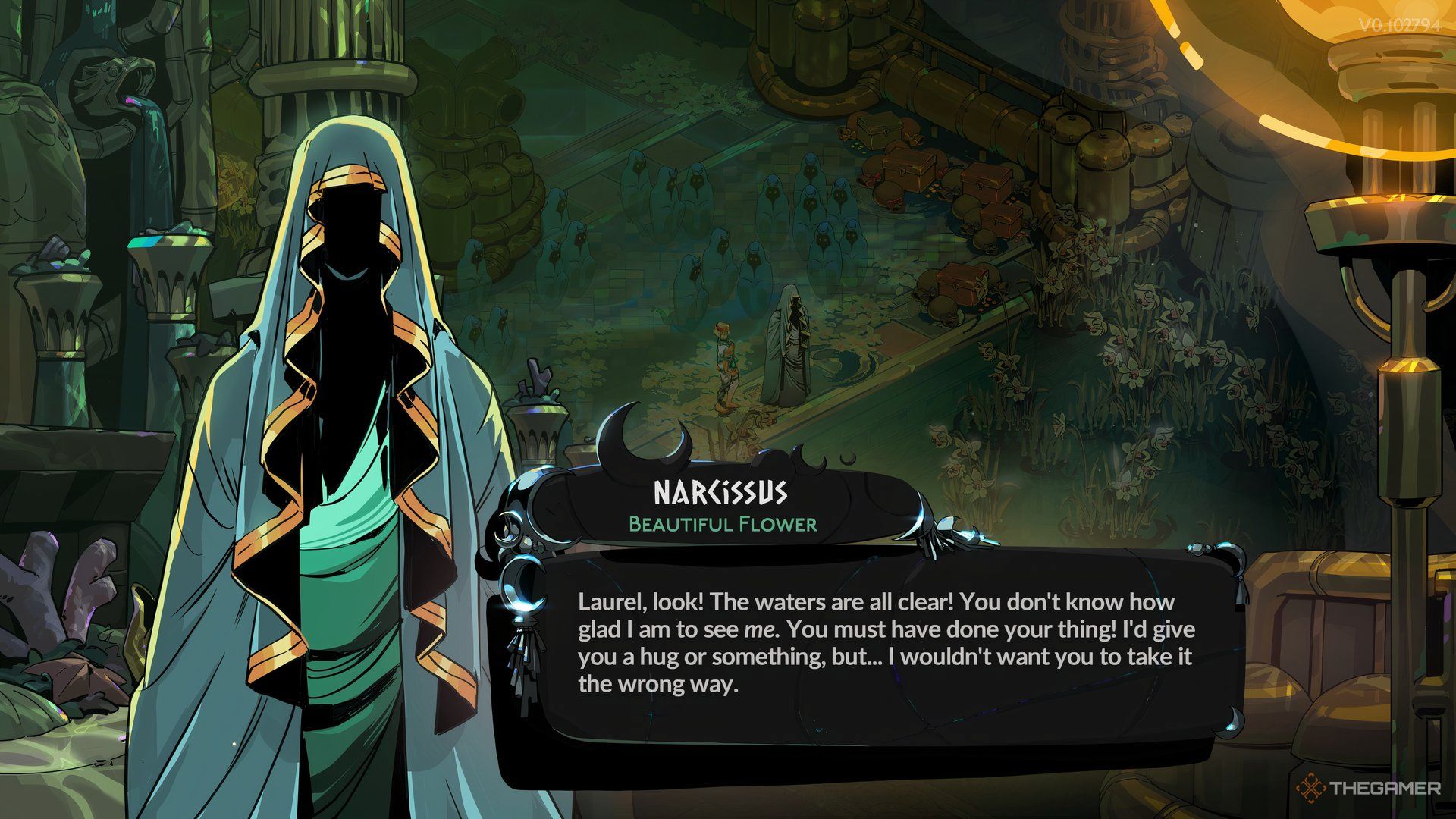
    Narcissus thanks Melinoe for clearing his pool in Hades 2.

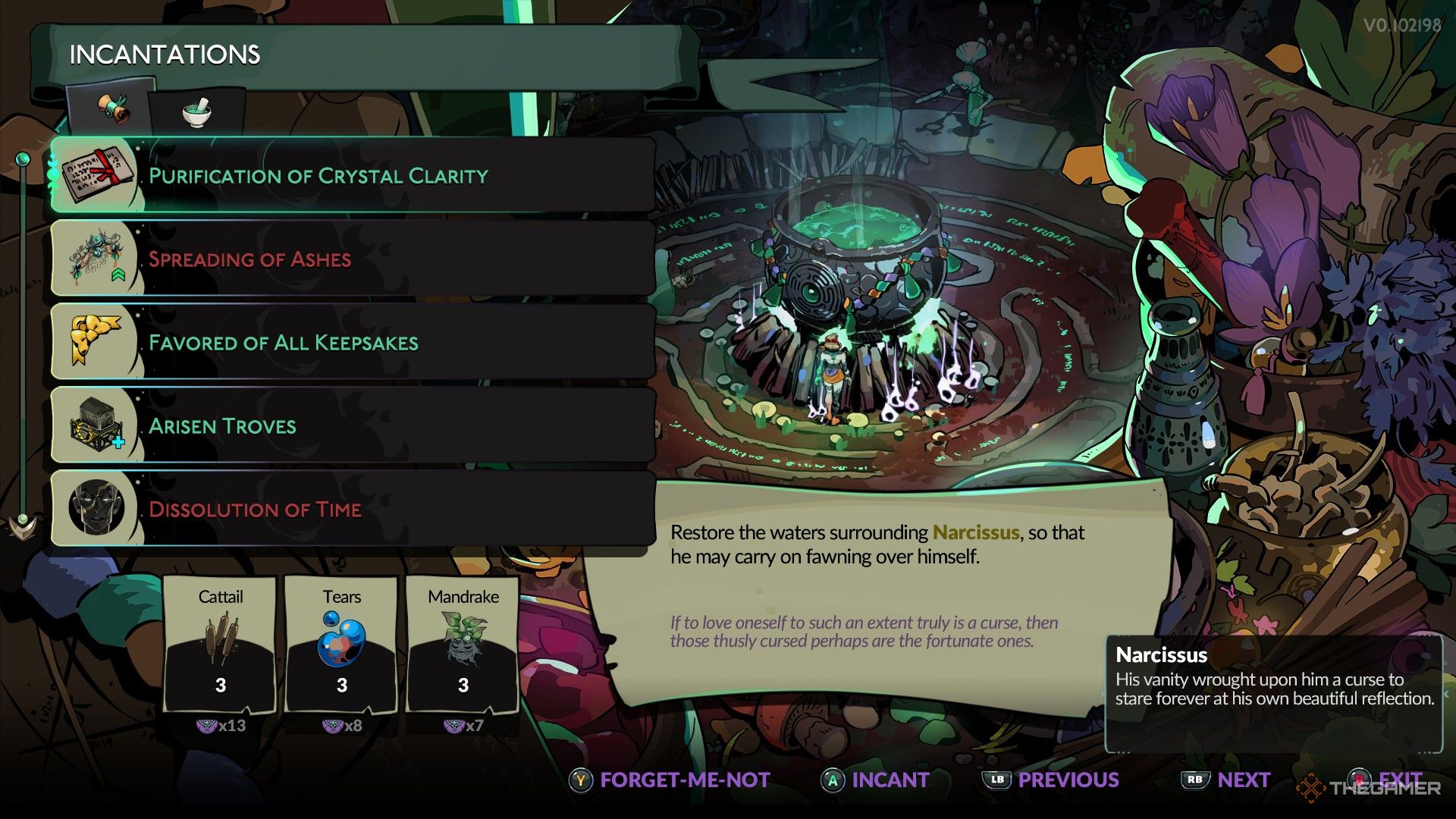
    When you return to the Crossroads, you can perform the incantation:

    Purification of Crystal Clarity

    x3 Cattails

    x3 Tears

    x3 Mandrake

    After you successfully cast this expensive incantation, Narcissus’s pond should be clear the next time you visit him.

    If you’re unsure where to collect the ingredients, Cattail seeds can be found in Oceanus, Tears are earned by defeating Cerberus, and Mandrake seeds are located in the Rift of Thessaly above.

    Finishing Narcissus and Echo’s Quest

    Echo asks to speak with Melinoe so she can thank her in Hades 2.

    Once Narcissus’s pond is clean, return to Narcissus and have a chat. After your discussion with him, you will complete the prophecy mission, unlocking his unique prophecy called “Denier of Suitors.” However, let’s not wrap things up just yet.

    Melinoe prepares to claim the reward for the Voice and Vanity quest in Hades 2.

    Finally, you should go to Echo to share Narcissus’s last request. While this step isn’t strictly necessary to conclude the quest, it is essential for unlocking (and probably completing) Echo’s personal prophecy: “Voice of Truth.”

    What Are the Rewards?

    In recognition of your hard work, you will receive 10 Nectar and the satisfaction of knowing you’ve done a good deed for the night.