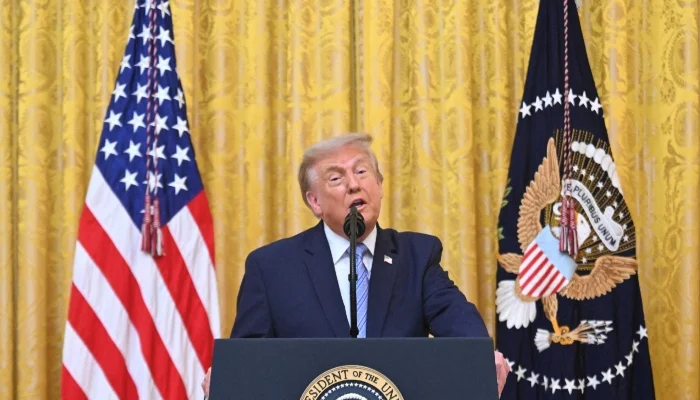
President Donald Trump announced the declassification of intelligence he claims shows Chinese interference in U.S. elections, reigniting ongoing accusations surrounding election security. This comes despite a U.S. intelligence assessment stating there is no evidence that Beijing attempted to influence or altered the outcome of the 2020 presidential vote, which Trump lost.
In a 25-minute speech, Trump emphasized his push to prioritize election security ahead of the upcoming November midterms, a period when Republicans are defending their congressional majorities amid fears of losing control of either chamber. The former president has urged his Republican colleagues in Congress to pass legislation imposing stricter voter ID laws and citizenship verification requirements, despite evidence indicating that instances of voter fraud in the U.S. are exceedingly rare.
Trump claimed he was releasing sensitive information indicating China had unlawfully obtained data on approximately 220 million U.S. voters, including personal details used for registration. He accused U.S. intelligence officials of intentionally downplaying China’s activities in this area, although the 2021 declassified intelligence report found no signs that foreign entities attempted to manipulate voter registrations, ballots, or election results in 2020.
Before his remarks, some White House officials reportedly worried that releasing the China-related information could be misleading. Trump’s rhetoric about China also threatens to disrupt a relatively stable relationship following last year’s trade conflicts. His intention to meet Chinese President Xi Jinping in September to discuss trade issues remains a goal.
In response, Liu Chang, a spokesperson for China’s embassy, denied any interference, stating, “China has never and will never interfere in U.S. presidential elections.”
Trump has long propagated baseless claims about electoral fraud, falsely asserting that his 2020 defeat was rigged. He also propagates false narratives about widespread voting machine vulnerabilities, non-citizen voting, and postal voting fraud, despite numerous courts and recounts showing no evidence of significant fraud in the last election.
He also announced he was releasing information purportedly exposing vulnerabilities in the U.S. election infrastructure, but some of the documents, like one related to Venezuela’s elections, actually referred to other countries. Other reports suggested that manipulating vote tabulation systems on a broad scale to alter results would be highly difficult, and a CIA document indicated that China currently does not plan to interfere covertly but might consider doing so in the future.
Senior Democratic officials criticized Trump for what they called false claims unsupported by intelligence agencies, which have uniformly agreed that China did not attempt to tamper with the 2020 vote. Democratic members of the House Intelligence Committee sent a letter urging intelligence officials to avoid enabling Trump to misuse classified information for false narratives about election security.
Major television networks chose not to broadcast Trump’s address live, breaking from usual practice for significant national addresses. Since returning to office in January 2025, Trump has sought to increase federal authority over election processes, which are constitutionally managed by states. Recently, he has advocated for legislation, like the SAVE America Act, which would require voter photo IDs, citizenship proof for registration, and federal access to state voter registration data. Critics argue such laws would suppress voter turnout and that voter fraud remains an extremely rare phenomenon.
Some Republican leaders advise Trump to focus on pressing issues such as economic concerns and national security rather than dwelling on the 2020 election. Meanwhile, Democrats aim to secure a majority in Congress with limited seat gains needed in the House and challenging races ahead in the Senate, with fears of election manipulation from the White House, according to Senate Democratic leader Chuck Schumer.
