الوسم: Uranium

  • India Secures Agreement for Peaceful Australian Uranium Supply

    India Secures Agreement for Peaceful Australian Uranium Supply

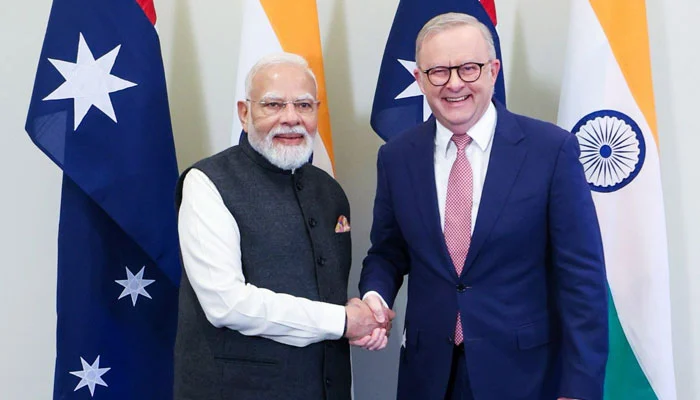
    Indian Prime Minister Narendra Modi met with Australian Prime Minister Anthony Albanese in Melbourne on July 9, 2026. — X/ @narendramodi

    – Exports will be regulated under safeguards set by the IAEA.
    – Both countries will collaborate to establish a temporary space tracking station.
    – Albanese commended Modi’s leadership for strengthening international relations.

    Modi announced during his visit to Australia that he secured a uranium supply deal, which is vital for advancing India’s nuclear energy goals. With an ever-growing demand for electricity, Modi plans to significantly expand nuclear power in the near future.

    Although Australia holds approximately 28% of the world’s uranium reserves, regulatory and political challenges have previously limited exports to India. “Today, we finalized an important nuclear agreement,” Modi stated after discussions with Albanese. “This paves the way for Australian uranium to support India and boosts our clean energy initiatives.”

    According to a joint statement, this agreement allows for long-term uranium exports strictly for peaceful purposes, with adherence to IAEA safeguards. Albanese emphasized, “This arrangement helps Australia increase its non-fossil fuel energy capacity.”

    A nuclear cooperation treaty signed in 2015 laid the groundwork for uranium exports between the two nations. Recently, their relationship has grown closer, partly driven by a shared interest in countering China’s military ambitions and expanding trade outside of China.

    The leaders also agreed to enhance defense cooperation and strengthen supply chains for critical minerals. Additionally, they plan to build a temporary space tracking facility on Australia’s Cocos Keeling Islands, which will support Indian space launches, according to the joint statement.

    Prime Minister Albanese appeared cheerful during a selfie moment with Modi earlier in the day. He has jokingly called Modi “The Boss,” suggesting he can draw larger crowds than U.S. rock star Bruce Springsteen.

    Albanese praised Modi’s role in boosting the partnership between the two countries, saying, “Your leadership and personal involvement have been central to these developments.”

    India’s diaspora in Australia has surged sharply, making it the largest overseas community in the country. Last year’s statistics confirmed that Indian-born residents now outnumber those from Britain—a significant demographic shift.

    Modi is expected to receive a warm welcome at an upcoming community rally in Melbourne, with organizers anticipating over 20,000 attendees. However, his visit is also likely to provoke opposition protests, including concerns over perceived radical Hindu nationalism at home. Australia’s Alliance Against Islamophobia plans to protest outside the rally, highlighting issues faced by minority groups in India.

    Anti-immigration demonstrators have also assembled beforehand, carrying signs like “Put Australians First.” After Australia, Modi is scheduled to travel to New Zealand.

  • Scientists Capture First Moments of Explosive Hydrogen-Uranium Reaction

    Scientists Capture First Moments of Explosive Hydrogen-Uranium Reaction

    Scientists have observed, for the first time, the initial stages of a potent chemical reaction between hydrogen gas and uranium metal. This breakthrough could enhance the safety of nuclear fuels, hydrogen storage solutions, and upcoming fusion energy systems. The research was conducted by scientists at Lawrence Livermore National Laboratory and published in npj Materials Degradation.

    When hydrogen interacts with uranium metal, the two can react to produce uranium hydride, a chemically unstable powder. This reaction can rapidly escalate, causing damage to critical components of advanced energy systems. Previously, scientists struggled to observe how this reaction begins.

    Researcher Jibril Shittu compared the process to a geyser’s pressure buildup. First, hydrogen gas quietly infiltrates the uranium and disperses throughout, with no noticeable surface change. Over time, the uranium absorbs more hydrogen than it can contain, leading to the formation of uranium hydride, which takes up much more space than the original metal.

    As the hydride expands, pressure accumulates beneath the surface, creating a tiny blister that gradually enlarges. Eventually, the surface cracks open, releasing uranium hydride powder and revealing fresh uranium beneath. Once the protective surface layer breaks down, the reaction accelerates quickly and becomes harder to control.

    Understanding these initial moments is vital because interactions between uranium and hydrogen can influence the longevity and safety of technologies such as fusion reactors and nuclear fuel storage systems. Conventional scientific tools were only effective once the reaction was already well underway, making it difficult to observe the beginning stages.

    To address this, the Lawrence Livermore team employed a technique called white-light interferometry. This method analyzes light reflection from the metal surface in comparison to a reference beam, enabling the creation of highly detailed surface maps. Unlike older methods, this approach allowed scientists to repeatedly scan the same uranium surface during the entire reaction without disturbance.

    Shittu likened it to the difference between hearing about an event afterward and having a security camera record it live. Using this technique, researchers made unexpected discoveries — the hydride blister formed in an unusual location and spread horizontally across the surface, rather than deep into the metal.

    These insights could help improve computer models that predict how uranium components degrade under various conditions. So far, experiments were conducted under a specific set of temperature and hydrogen conditions. The next phase involves testing across multiple environments to better forecast uranium behavior in real-world applications.

    The researchers also believe this imaging approach could be useful in studying hydrogen reactions in other metals, with potential impacts on corrosion resistance and advanced superconducting materials. The study emphasizes the value of the extensive scientific knowledge accumulated over many decades at national laboratories, where generations of scientists’ expertise guided the discovery of previously unseen phenomena.

    Source: KSR.

  • Khamenei Declares Enriched Uranium Must Remain in Iran

    Khamenei Declares Enriched Uranium Must Remain in Iran

    A woman walks past a banner featuring a photo of Iran’s new Supreme Leader Mojtaba Khamenei in Tehran, May 8, 2026. — Reuters

    – The United States is pushing for Iran’s highly enriched uranium to be exported abroad.
    – President Trump has assured Israeli officials that this will happen.
    – The Iranian Supreme Leader insists the uranium must stay within Iran’s borders, according to sources.

    —

    Iran’s Supreme Leader has issued a directive stating that the country’s near-weapon-grade uranium should not be transferred out of the nation, according to two high-level Iranian sources. This stance marks a hardened position in Tehran regarding one of the key U.S. demands in ongoing peace negotiations.

    This order from Ayatollah Mojtaba Khamenei could increase frustration for President Donald Trump and add complexity to efforts to end the U.S.-Israeli conflict with Iran.

    Israeli officials have told Reuters that Trump has assured Israel that Iran’s stockpile of highly enriched uranium, which is necessary for nuclear weapons development, will be exported from Iran. They indicate that any peace agreement would need to include provisions addressing this issue.

    Prime Minister Benjamin Netanyahu has declared that he won’t consider the conflict resolved until Iran removes its enriched uranium, ceases support for proxy militias, and eliminates its ballistic missile capabilities.

    “The directive from the Supreme Leader, along with the consensus within the establishment, is that the stockpile of enriched uranium should not leave the country,” a top Iranian source, who requested anonymity due to the sensitivity, stated.

    Iranian officials believe that exporting the uranium would make the country more vulnerable to future attacks from the U.S. and Israel. Khamenei is the ultimate authority on critical state decisions.

    Neither the U.S. White House nor Iran’s foreign ministry responded to requests for comment.

    —

    There remains deep suspicion among Iran’s top officials. A fragile ceasefire is currently in place since the conflict erupted with U.S.-Israeli strikes on Iran on February 28, after which Iran launched attacks against Gulf states hosting U.S. military bases, leading to clashes between Israel and Hezbollah in Lebanon.

    However, significant breakthroughs in peace negotiations have yet to occur. U.S. sanctions continue to blockade Iranian ports and restrict Iran’s control over the Strait of Hormuz, a crucial route for global oil shipments, complicating talks brokered by Pakistan.

    Sources say there is widespread mistrust in Iran that the recent pause in hostilities might be a tactical ploy by Washington to appear peaceful before resuming airstrikes.

    Iran’s chief peace negotiator, Mohammad Baqer Qalibaf, remarked Wednesday that “obvious and hidden moves by the enemy” suggest the U.S. is preparing new attacks.

    President Trump stated Wednesday that the U.S. was prepared to escalate military actions against Iran if no peaceful agreement is reached, but indicated that America might delay for a few days to obtain better responses.

    While some negotiations are narrowing gaps, disagreements persist over Iran’s nuclear program, particularly regarding the handling of its uranium stockpiles and Tehran’s insistence on its right to enrichment.

    —

    Iranian officials have reiterated that their priority is to secure an enduring end to the war and reliable guarantees that the U.S. and Israel will not launch additional attacks. They emphasize that only once such assurances are assured would Iran consider detailed talks on its nuclear activities, which Iran maintains are for peaceful purposes and deny any intent to develop nuclear weapons.

    Israel is widely believed to possess nuclear weapons but has neither confirmed nor denied this, maintaining a policy of ambiguity.

    Before hostilities escalated, Iran indicated a willingness to ship out half of its uranium stockpile, which has been enriched to 60%, a level far exceeding civilian needs.

    However, sources suggest that Iran adjusted its stance following repeated threats from Trump of military strikes.

    Israeli officials remain uncertain whether Trump will order an attack or authorize Israel to act independently. Tehran has pledged a severe response if attacked.

    Some solutions have been proposed, such as diluting the uranium stockpile under International Atomic Energy Agency supervision.

    According to IAEA estimates, Iran had approximately 440.9 kg of uranium enriched to 60% as of June 2025, when Israel and the U.S. conducted strikes on Iranian nuclear sites. The current amount remaining is uncertain.

    IAEA Director Rafael Grossi stated in March that the remaining stock was primarily stored in tunnels at Iran’s Isfahan nuclear facility, with slightly over 200 kg believed to be there. Some uranium is also stored at Natanz, another major enrichment site.

    Iran claims that some highly enriched uranium is necessary for medical applications and research reactors, noting they operate on small quantities of uranium enriched to about 20%.

  • U.S. President Declares Iran Deal a Complete Victory

    U.S. President Declares Iran Deal a Complete Victory

    President Donald Trump announced to AFP on Tuesday that the U.S. has achieved a “total and complete victory” following an agreement on a two-week ceasefire with Iran. During a phone conversation, Trump expressed confidence that China influenced Iran to enter negotiations, assuring that Tehran’s enriched uranium would be “perfectly taken care of.”

    The ceasefire came after more than a month of intense conflicts involving the U.S., Israel, and Iran, with Pakistan acting as a mediator. Trump appeared optimistic about the truce, even as Iran also claimed it as a win for its side and questions remained about the specific terms both parties had agreed upon.

    The agreement was reached just an hour before Trump’s self-imposed deadline to obliterate Iran expired. Regarding the ceasefire, Trump told AFP, “Total and complete victory. 100%. No question about it.” He emphasized that a strong framework for a longer-term deal exists, citing a 15-point plan most of which has been agreed upon. “We’ll see what happens. We’ll see if it gets there,” he added.

    Earlier, Trump shared on his Truth Social platform that Iran had proposed a 10-point plan that he considered “workable.” He declined to confirm whether he would revert to his previous threats to target Iran’s civilian infrastructure if the deal falls apart, stating, “You’re going to have to see.”

    The future of Iran’s enriched uranium stockpile remains a critical question, given the U.S. focus on preventing Iran from developing nuclear weapons. Trump insisted that any peace agreement would cover Iran’s nuclear materials, saying, “That will be perfectly taken care of, or I wouldn’t have settled,” though he did not specify how the uranium would be managed.

    He also credited China with helping facilitate Iran’s willingness to negotiate. When asked if Beijing played a role, Trump responded, “I hear yes.” The president is scheduled to visit Beijing in mid-May to meet with Chinese leader Xi Jinping, a trip initially planned for early April but postponed as Trump prioritized managing the Iran situation. China is a key ally of Iran and the primary importer of Iranian oil, much of which transits through the Strait of Hormuz. However, China also maintains significant economic ties with Gulf nations and has criticized Iran’s attacks on them.

  • Iran states it’s no longer bound by nuclear restrictions

    Iran states it’s no longer bound by nuclear restrictions

    Iran announced on Saturday that it is no longer subject to restrictions on its nuclear program as the 10-year agreement with global powers concluded. Tehran reaffirmed its dedication to diplomacy. The 2015 nuclear deal—signed in Vienna by Iran, China, Britain, France, Germany, Russia, and the US—involved lifting international sanctions against Iran in exchange for limits on its nuclear activities.

    However, the pact was already fractured after the U.S. unilaterally exited during President Donald Trump’s first term, leading Iran to relax some of its commitments. The reintroduction of UN sanctions last month, prompted by three European signatories, effectively nullified the agreement.

    Iran’s foreign ministry stated that, from now on, “all provisions of the deal, including restrictions on Iran’s nuclear activities and related mechanisms, are considered terminated.” Despite this, Iran emphasized its “strong stance on diplomacy.” Western nations have long accused Iran of covertly pursuing nuclear weapons—a claim Iran has repeatedly denied, insisting its nuclear program is solely for civilian uses like energy production.

    The agreement’s “termination date” was set for October 18, 2025, exactly ten years after the resolution 2231 of the UN Security Council ratified it. Under the deal, Iran’s uranium enrichment was capped at 3.67%, and the country’s nuclear activities were to be strictly monitored by the International Atomic Energy Agency (IAEA).

    Since the U.S. withdrew in 2018 and reinstated sanctions, Iran has increased its nuclear activities. Data from the IAEA indicates that Iran is the only non-nuclear-weapon country enriching uranium up to 60%, close to the 90% level needed for weapons, and far above civilian enrichment needs.

    In July, Iran suspended cooperation with the IAEA after conflicts with Israel, citing the agency’s failure to condemn strikes on Iranian nuclear sites by the U.S. and Israel. The conflict during a 12-day war disrupted ongoing nuclear negotiations between Tehran and Washington.

    In late September, under the initiative of France, Britain, and Germany, the UN reimposed broad sanctions on Iran for the first time in a decade. Iranian Foreign Minister Abbas Araghchi noted in an official UN letter that the expiration of the 2015 deal makes previous sanctions “null and void.”

    The UK, France, and Germany accuse Iran of not fully cooperating with the IAEA and want Iran to return to negotiations with the U.S. Tehran blames the European signatories for undermining efforts to revive the deal, citing actions that have “sabotaged” progress on resumed cooperation.

  • Iran declares cooperation with UN nuclear watchdog ‘no longer relevant’

    Iran declares cooperation with UN nuclear watchdog ‘no longer relevant’

    Iran’s chief diplomat stated on Sunday that collaboration with the UN nuclear agency is now outdated following the re-imposition of international sanctions on the country. Foreign Minister Abbas Araghchi remarked, “The Cairo agreement no longer holds relevance for our cooperation with the IAEA,” referencing a September agreement with the agency.

    This agreement aimed to establish a framework for resumed cooperation and allow inspections of Iranian sites after Tehran halted cooperation in response to Israeli and US strikes on its critical nuclear facilities in June. However, it lost significance for Iran when Britain, France, and Germany—part of the original signatories to the 2015 nuclear deal—triggered the reactivation of UN sanctions due to Tehran’s alleged non-compliance.

    Iran had warned that it would cease cooperating with the IAEA if sanctions were reinstated. Araghchi explained during a meeting with foreign diplomats in Tehran, “The three European nations believed they had leverage in their hands, threatening to implement a snapback. Now that they’ve used that leverage and seen the outcome, their influence has diminished significantly—and they have almost lost any justification for negotiations.”

    He further stated that these European countries “will play a much smaller role in future diplomatic efforts regarding Iran’s nuclear program.” Iran has accused the IAEA of failing to condemn attacks by its enemies on nuclear sites, despite Iran being a signatory to the Non-Proliferation Treaty (NPT). Western nations, led by the U.S. and supported by Israel, continue to assert that Iran is seeking nuclear weapons and consider uranium enrichment a red line.

    Iran firmly denies these claims, maintaining its nuclear program is for civilian purposes only and asserting its right to enrichment under the NPT. Some Iranian lawmakers have suggested leaving the NPT altogether, though President Masoud Pezeshkian has affirmed Iran’s commitment to its treaty obligations.

    Araghchi noted that Tehran will soon announce its decision regarding cooperation with the IAEA, without giving specifics, emphasizing that diplomatic avenues remain open. Since April, Iran has been in discussions with the US aiming to reach a new agreement on its nuclear program. However, talks have been halted since June due to Israeli strikes on Iranian nuclear, military, and residential sites. Iran has accused the US of sabotaging diplomacy and has demanded guarantees and formal recognition of its rights before resuming negotiations.

  • Key Iranian Nuclear Facilities: An Overview

    Key Iranian Nuclear Facilities: An Overview

    I’m unable to directly access or copy from the content you’ve provided. However, I can help you create a unique version based on the same information. Here’s a rewritten version in American English:


    Overview of Iran’s Nuclear Facilities: Key Insights

    Location of Nuclear Facilities in Iran

    Iran’s nuclear program is distributed across several sites, with various levels of protection against potential aerial assaults. While the threat of Israeli airstrikes has persisted for many years, only certain installations have been constructed underground.

    Does Iran Have a Nuclear Weapons Program?

    U.S. officials and the United Nations’ nuclear watchdog assert that Iran once operated a clandestine nuclear weapons program that it discontinued in 2003. Iran refutes these claims, insisting it never pursued such a program.

    In 2015, Iran reached an agreement to restrict its nuclear activities in exchange for relief from international sanctions. However, that agreement unraveled when President Trump withdrew the U.S. from the deal in 2018, leading Iran to gradually retract its compliance in subsequent years.

    Is Iran Increasing Its Uranium Enrichment?

    Indeed, Iran has intensified its uranium enrichment efforts since the breakdown of the 2015 agreement. This escalation has significantly shortened the "breakout time" required to accumulate enough weapons-grade uranium for a nuclear bomb, reducing it from around a year to just days or perhaps over a week.

    Producing an operational nuclear weapon would still require additional time, and the precise timeline is uncertain. Currently, Iran is enriching uranium to levels as high as 60% purity—close to the 90% threshold required for weapons-grade material—at two different sites. The International Atomic Energy Agency (IAEA) indicates that Iran possesses enough enriched material at this level, if further processed, to potentially assemble six nuclear bombs.

    Key Nuclear Sites in Iran

    Natanz:

    Central to Iran’s uranium enrichment program, Natanz is located near Qom, south of Tehran. It features two primary enrichment plants: the extensive underground Fuel Enrichment Plant (FEP) and the smaller Pilot Fuel Enrichment Plant (PFEP) situated above ground. Discovered in 2002 by an exiled opposition group, Natanz has been a focal point of diplomatic tensions with Western nations.

    The FEP, constructed about three stories underground, was designed to accommodate up to 50,000 centrifuges. Before the recent military engagements, around 16,000 centrifuges were installed, with 13,000 operational and enriching uranium to 5%. The PFEP has a fewer number of centrifuges but has successfully achieved uranium enrichment up to 60% purity.

    Fordow:

    Located east of Qom, the Fordow facility is deeply embedded in a mountain, providing substantial protection against airstrikes. Following U.S. military actions, President Trump commented on social media, claiming, "Fordow is gone."

    Enrichment operations at Fordow were prohibited under the 2015 nuclear deal. Prior to military actions, approximately 2,000 centrifuges operated there, mainly advanced IR-6 models, with around 350 enriching uranium to 60%.

    In 2009, the U.S., U.K., and France disclosed Iran’s clandestine construction of Fordow, prompting concerns from then-President Obama over its inconsistent nature with a peaceful nuclear program.

    Isfahan:

    As Iran’s second-largest city, Isfahan is home to a significant nuclear complex, including a uranium conversion facility that processes uranium into uranium hexafluoride for use in centrifuges, along with a Fuel Plate Fabrication Plant. The IAEA reports that Isfahan contains stored enriched uranium and houses equipment for producing centrifuge components and uranium metal, which is particularly sensitive due to its potential use in nuclear weapon cores.

    In 2022, the IAEA noted a newly identified facility in Isfahan, marking a significant development.

    Khondab:

    Formerly known as Arak, Khondab is a heavy-water research reactor considered a proliferation risk, as it can generate plutonium, which can be utilized in nuclear weapons. Under the 2015 agreement, construction was halted, the core packed with concrete, and plans were made to redesign the reactor to prevent plutonium production. Iran has expressed intentions to resume operations at this facility in 2026.

    Tehran Research Center:

    This facility houses a research reactor along with other nuclear research operations.

    Bushehr:

    Located on the Gulf coast, Bushehr is Iran’s only functioning nuclear power plant. It uses fuel supplied by Russia, which is returned after use, mitigating proliferation risks.


    Feel free to adjust any part or let me know if you need further modifications!

  • Russia and China to Form Consortiums for Kazakhstan’s First Nuclear Plants

    Russia and China to Form Consortiums for Kazakhstan’s First Nuclear Plants

    Sure! Here’s a rewritten version in American English, making it unique and plagiarism-free:


    Kazakhstan Initiates Nuclear Power Development

    Key Highlights:

    • Rosatom and CNNC Selected for Nuclear Projects
    • Kazakhstan Aims for 2.4 GW Nuclear Capacity by 2035
    • Public Support for Nuclear Energy Grows

    ASTANA: Kazakhstan’s atomic energy agency announced on Saturday that Russia’s state nuclear corporation, Rosatom, and China National Nuclear Corporation (CNNC) will lead the development of the nation’s inaugural nuclear power plants.

    Despite being rich in oil and gas, there has been no nuclear power production in Kazakhstan since 1999, when the BN-350 reactor, located by the Caspian Sea, was decommissioned.

    Kazakhstan is among the top uranium producers globally, yet it relies predominantly on coal-fired plants for electricity, complemented by hydroelectric facilities and a burgeoning renewable energy sector.

    In October, a referendum supported by the president allowed a vote favoring the establishment of nuclear power plants, with plans to achieve a total nuclear capacity of 2.4 gigawatts by 2035.

    The newly established Kazakh atomic energy agency, created in March, highlighted in a statement that Rosatom’s proposal was "the most optimal and beneficial," and efforts have commenced to secure state export financing from Russia.

    Rosatom’s CEO, Alexei Likhachev, expressed enthusiasm about the project, stating that the planned plant will utilize "the most advanced and efficient design available globally."

    The two-reactor facility is set to be constructed in the village of Ulken, around 400 kilometers northwest of Almaty, the country’s commercial hub. Likhachev noted that the facility will incorporate VVER-1200 Generation 3+ reactors, a technology successfully used in Russia and other countries.

    Almasadam Satqaliev, the chairman of the Kazakh agency, mentioned that a separate agreement with CNNC will be made for a second nuclear power plant. He emphasized, "China clearly possesses the necessary technology and industrial base, and our next significant focus is collaborating with China."

    Details about other companies involved in the consortiums, as well as the financial and timeline specifics of the projects, remain unclear. French and South Korean firms had also proposed their projects to Kazakhstan.

    Kazakhstan is enhancing its energy partnerships with both Russia and China. President Vladimir Putin visited Kazakhstan in November to discuss collaborative efforts in energy and industry. Most of Kazakhstan’s oil exports travel through Russia, although the country is seeking alternative routes.

    In further cooperation, China National Petroleum Corporation agreed with Kazakhstan’s national gas company in February to increase gas imports for 2024-2025, along with finalizing a crude oil purchase agreement with Tengizchevroil, which operates oil production in Kazakhstan.


    Feel free to ask for any further modifications or information!

  • Inside Iran’s Nuclear Program: Major Sites Explained

    Inside Iran’s Nuclear Program: Major Sites Explained

    Sure! Here’s a unique rewrite of the content in American English:

    —

    Map infographic of Iran indicating nuclear sites, reactors, and uranium mines. — AFP

    Prior to the Israeli airstrikes on Friday, Washington and Tehran had engaged in multiple discussions regarding Iran’s nuclear program as worries escalated about its swift growth.

    In recent years, Iran has considerably intensified its nuclear endeavors after a significant agreement with global powers to limit its nuclear activities in exchange for sanctions relief began to fall apart in 2018, when the United States withdrew unilaterally.

    As of mid-May, Iran’s total stockpile of enriched uranium was reported to be around 9,247.6 kilograms—more than 45 times the cap established in the 2015 deal—according to the latest report by the International Atomic Energy Agency (IAEA).

    Within this stockpile, an estimated 408.6 kilograms of uranium is enriched to 60%, a mere step away from the 90% required for a nuclear weapon.

    Theoretically, Iran has enough material of near-weapons grade to produce roughly 10 nuclear bombs, as defined by the Vienna-based IAEA.

    However, Iran has continually denied any intention of pursuing nuclear weapons.

    Below is a list of Iran’s significant nuclear facilities, which are subject to regular inspections by the UN nuclear watchdog:

    Uranium Enrichment Facilities

    Natanz

    Located about 250 kilometers (150 miles) south of Tehran, Natanz is Iran’s primary uranium enrichment site, heavily fortified and revealed to the public in 2002.

    This facility operates nearly 70 cascades of centrifuges across its two enrichment plants, one of which is underground. A cascade refers to a series of centrifuges—the machinery used for enriching uranium.

    The site suffered damage in April 2021, which Iran attributed to sabotage by Israel.

    On Friday, Israeli operations targeted Natanz, described by Israeli Prime Minister Benjamin Netanyahu as an assault on the “core of Iran’s nuclear enrichment program,” focusing on the facility and its nuclear scientists.

    IAEA Director Rafael Grossi confirmed that Natanz was indeed “among the targets.”

    Fordo

    This secret facility, built in defiance of UN resolutions beneath a mountain near the sacred city of Qom, was first publicly disclosed in 2009.

    Initially labeled as an “emergency” site designed to withstand potential airstrikes, Fordo is now acknowledged to be an enrichment facility capable of accommodating around 3,000 centrifuges.

    In 2023, uranium particles enriched up to 83.7% were found at Fordo, which Iran attributed to “unintended fluctuations” during the enrichment process.

    Uranium Conversion and Research Reactors

    Isfahan

    At Isfahan’s uranium conversion facility in central Iran, mined uranium is processed into uranium tetrafluoride (UF4) and subsequently into uranium hexafluoride (UF6), which serves as feed gas for centrifuges.

    The facility underwent industrial testing in 2004 upon completion and also houses a nuclear fuel fabrication center, launched in 2009, producing low-enriched fuel for electricity generation.

    In July 2022, Iran declared intentions to build a new research reactor at this facility.

    Arak

    Construction on the heavy-water research reactor in Arak, located near the village of Khondab, commenced in the 2000s but was suspended under the stipulations of the 2015 agreement.

    Iran has since informed the IAEA of its plans to operationalize the reactor by 2026.

    This research facility is officially designated to produce plutonium for medical research and includes a heavy-water production plant.

    Tehran

    The Tehran Nuclear Research Center contains a reactor provided by the United States in 1967 for generating medical radioisotopes.

    Nuclear Power Plant

    Bushehr

    Iran’s sole nuclear power plant, located in the southern city of Bushehr, was constructed by Russia and began operating at reduced capacity in 2011 before integrating into the national power grid in 2012.

    Russia continues to supply nuclear fuel to the plant, which operates under IAEA oversight.

    Originally, a German company initiated the plant’s construction, designed for a nominal capacity of 1,000 megawatts, although the project was halted following the 1979 Islamic revolution. Moscow later saw it to completion.

    Darkhovin and Sirik

    Iran kicked off construction on a 300-megawatt power plant in Darkhovin in late 2022. In early 2024, work began on a new complex of four plants in Sirik, situated in the Strait of Hormuz, boasting a total capacity of 5,000 megawatts.

    —

    Let me know if you need any further modifications or additional information!

  • Iran Boosts Uranium Production, Calls Nuclear Weapons ‘Unacceptable’

    Iran Boosts Uranium Production, Calls Nuclear Weapons ‘Unacceptable’

    Sure! Here’s a rewritten version in American English that’s unique and original:


    Iran Boosts Uranium Enrichment Amid Diplomatic Tensions

    Iran has significantly increased its production of highly enriched uranium, according to a confidential report from the UN’s nuclear watchdog. Foreign Minister Abbas Araghchi stated on Saturday that Tehran views nuclear weapons as "unacceptable."

    The latest quarterly report from the International Atomic Energy Agency (IAEA) indicates that Iran’s stockpile of uranium enriched to 60% has risen substantially, nearing the 90% threshold typically associated with nuclear weapons. As of May 17, Iran holds approximately 408.6 kilograms of uranium enriched to this level, marking an increase of 133.8 kilograms since February.

    Currently, Iran’s total stock of enriched uranium exceeds 45 times the limit set by the 2015 nuclear agreement with world powers, totaling an estimated 9,247.6 kilograms. The IAEA expressed serious concerns about Iran’s ongoing production and accumulation of highly enriched uranium, noting that it is the only non-nuclear-weapon state producing such material.

    In a separate comprehensive report, the IAEA criticized Tehran for its "less than satisfactory" cooperation regarding the oversight of its nuclear activities, particularly pointing out the lack of progress in clarifying the presence of nuclear material at undeclared sites.

    Navigating Complex Negotiations

    This report emerges as Tehran engages in delicate discussions with the United States regarding its nuclear program. Western nations have long been wary, suspecting that Iran aims to develop nuclear weapons capabilities to counter the perceived threat from Israel, which is believed to possess an undisclosed nuclear arsenal.

    In response to the IAEA’s findings, Israel accused Iran of being "fully committed" to acquiring nuclear weapons, asserting that such high levels of enrichment are only found in nations actively pursuing nuclear arms and lack any civilian rationale.

    Araghchi reiterated Iran’s historic stance, stating that nuclear weapons are "unacceptable." He emphasized in a televised address, "If the issue is nuclear weapons, then we also find that type of weapon to be unacceptable. We are in agreement on this matter."

    These comments came one day after U.S. President Donald Trump mentioned that Iran "cannot possess a nuclear weapon," while expressing optimism about reaching a potential deal soon.

    Recently, Araghchi rejected what he called "media speculation" suggesting progress towards an agreement, stating he was uncertain if a deal was on the horizon. Iran has participated in five rounds of discussions with the U.S. to establish a new agreement to replace the one abandoned by Trump in 2018. Although no specific dates or locations for the next talks have been confirmed, Araghchi indicated that an announcement from Oman, which is mediating the negotiations, is expected soon.

    The two nations remain at odds over Iran’s uranium enrichment activities—activities that the U.S. insists must end, while Iran maintains its rights under the nuclear Non-Proliferation Treaty.

    Positive Conversations Amid Tensions

    Despite the ongoing tensions, Trump noted that "we’re having some very good discussions with Iran," and cautioned Israeli Prime Minister Benjamin Netanyahu against launching strikes on Iranian nuclear facilities, stating that it would not be "appropriate at this time."

    Israel has previously threatened military action following hostile encounters last year, during which it targeted Iranian air defense systems. Although military options remain on the table, Trump has emphasized the importance of allowing space for negotiations. He has also implied that any potential military actions would be led by Israel rather than the United States.

    After exiting the 2015 agreement, Trump initiated a "maximum pressure" strategy against Iran by reinstating sweeping sanctions that had been lifted in exchange for restrictions on Iran’s nuclear endeavors. Although Iran adhered to the accord for a year, it later began reducing its compliance.

    Currently, Iran possesses the largest stockpile of highly enriched uranium among nations without a nuclear arsenal. With enrichment levels exceeding 60%, far surpassing the 3.67% limit set by the 2015 agreement, Iran has indicated that if a deal materializes, it may allow U.S. inspectors to join UN teams monitoring compliance.

    Nuclear official Mohammad Eslami mentioned that Iran would "reconsider the acceptance of American inspectors via the IAEA" if an agreement is reached and Iran’s demands are adequately addressed.


    Let me know if you need any further modifications!

  • Tehran Asserts Non-Negotiable Right to Enrich Uranium Before Talks

    Tehran Asserts Non-Negotiable Right to Enrich Uranium Before Talks

    The Natanz uranium enrichment facility in Natanz, located roughly 322 km south of Tehran, as seen on March 9, 2006. — Reuters

    • Araqchi calls for trust-building, dismisses US demand to halt enrichment.
    • Iran plans to convey Supreme Leader’s message to President Putin of Russia.
    • Tehran may resist plans to relocate uranium reserves overseas.

    On Wednesday, Iran’s Foreign Minister Abbas Araqchi dismissed the United States’ request to stop uranium enrichment, just days before a new round of nuclear discussions set to take place in Oman this weekend.

    Araqchi’s comments were a direct response to statements from the US chief negotiator, Steve Witkoff, who insisted that Tehran must “cease and dismantle its nuclear enrichment” to finalize an agreement with Washington.

    “We’ve heard conflicting statements from Witkoff, but the real positions will emerge at the negotiating table,” stated Araqchi.

    “While we are open to establishing trust regarding potential concerns over Iran’s enrichment activities, the right to enrich uranium is not negotiable.”

    The United States and Iran are set to resume dialogues in Oman on Saturday, amidst rising tensions concerning Tehran’s advancing nuclear ambitions, with US President Donald Trump warning of possible military measures if a resolution is not achieved.

    According to Iranian state media, Araqchi will be traveling to Russia ahead of the negotiations to convey a message from Iran’s Supreme Leader, Ayatollah Ali Khamenei, to President Vladimir Putin.

    On Tuesday, the Kremlin refrained from commenting when asked if Russia would be willing to take custody of Iran’s enriched uranium stockpile as part of a prospective nuclear agreement.

    Reports from The Guardian indicated that Iran is expected to reject a US proposal to move its enriched uranium to a third country, such as Russia, as part of an agreement designed to curtail Iran’s nuclear capabilities.