الوسم: U.S. Government

  • US Tells Foreigners: Apply for Green Cards from Your Home Countries

    US Tells Foreigners: Apply for Green Cards from Your Home Countries

    People wait in line outside the USCIS office in New York. — Reuters/File

    – USCIS announces a new policy memo.
    – The policy aims to allow the agency to focus on other cases: USCIS
    – This change is part of Trump’s efforts to tighten immigration laws.

    The US Citizenship and Immigration Services (USCIS) revealed on Friday that foreign nationals wanting to adjust their immigration status to obtain green cards will now need to do so from outside the United States through the State Department, drawing criticism from aid organizations.

    In a policy memo, USCIS instructed officers to evaluate each case individually, considering relevant factors and details to determine if extraordinary relief is justified.

    “Individuals in the U.S. temporarily and seeking a Green Card must return to their home country to apply,” stated the Department of Homeland Security, which oversees USCIS.

    “This policy aligns our immigration system with the law’s intent and helps prevent the exploitation of loopholes.”

    USCIS believes the new approach will enable the agency to allocate resources more efficiently and process other cases more swiftly.

    HIAS, an refugee assistance organization that supports various immigrant groups, criticized the policy, claiming it forces survivors of trafficking, abuse, and neglect who fled dangerous conditions to return to the countries they escaped from just to process their green card applications and gain permanent residency.

    Friday’s policy revision is the latest move in a series of steps taken by President Donald Trump over the past year to restrict migration to the U.S.

    Last year, the administration cut back on visa durations for students, cultural exchange visitors, and journalists.

    In January, the State Department announced that it had revoked more than 100,000 visas since Trump assumed office the previous year.

  • 65% of Americans Oppose Closing Department of Education

    65% of Americans Oppose Closing Department of Education

    Understanding the Push to Dismantle the Department of Education

    In a bold move that resonated across the educational landscape, President Donald Trump signed an executive order aimed at dismantling the Department of Education. This initiative is rooted in his promise to shift educational authority back to parents, states, and local communities. The directive titled “Improving Education Outcomes by Empowering Parents, States, and Communities” directly instructs Education Secretary Linda McMahon to initiate this transition, making it clear that the administration is serious about reshaping America’s educational governance.

    Trump’s Vision for Education

    The executive order reflects a long-held campaign promise by Trump, who envisioned a system where educational power is decentralized. He often expressed a desire to reduce the federal government’s role in education and believed that states and parents should play a more significant role in shaping educational policy. The appointment of Linda McMahon, who was previously the head of the Small Business Administration, was intended to facilitate this vision, with Trump stating she should "put herself out of a job."

    Linda McMahon’s Initial Approach

    Upon her confirmation, McMahon articulated an ambitious “final mission” for the Department of Education. Her speeches resonated with Trump’s core messages, emphasizing the elimination of bureaucratic hurdles, and a return of educational decision-making authority to state and local entities. She consistently referred to the department’s mission as "final," which implied a significant transformation—or even the potential elimination—of the department itself. In her address to the staff, she expressed hope that they could make "American education freer, stronger, and with more hope for the future."

    Response from Legislators

    Opposition to the dismantling of the Department of Education has emerged from various quarters, particularly from Democratic senators. A letter signed by 38 senators highlighted their concerns regarding the implications of such a move. They emphasized that during a time of considerable income and wealth inequality, the actions taken by the Trump administration could undermine access to quality education for students across the country. This sentiment reflects a broader anxiety about the impact of federal education policy changes on vulnerable populations.

    Public Sentiment on Education Policy

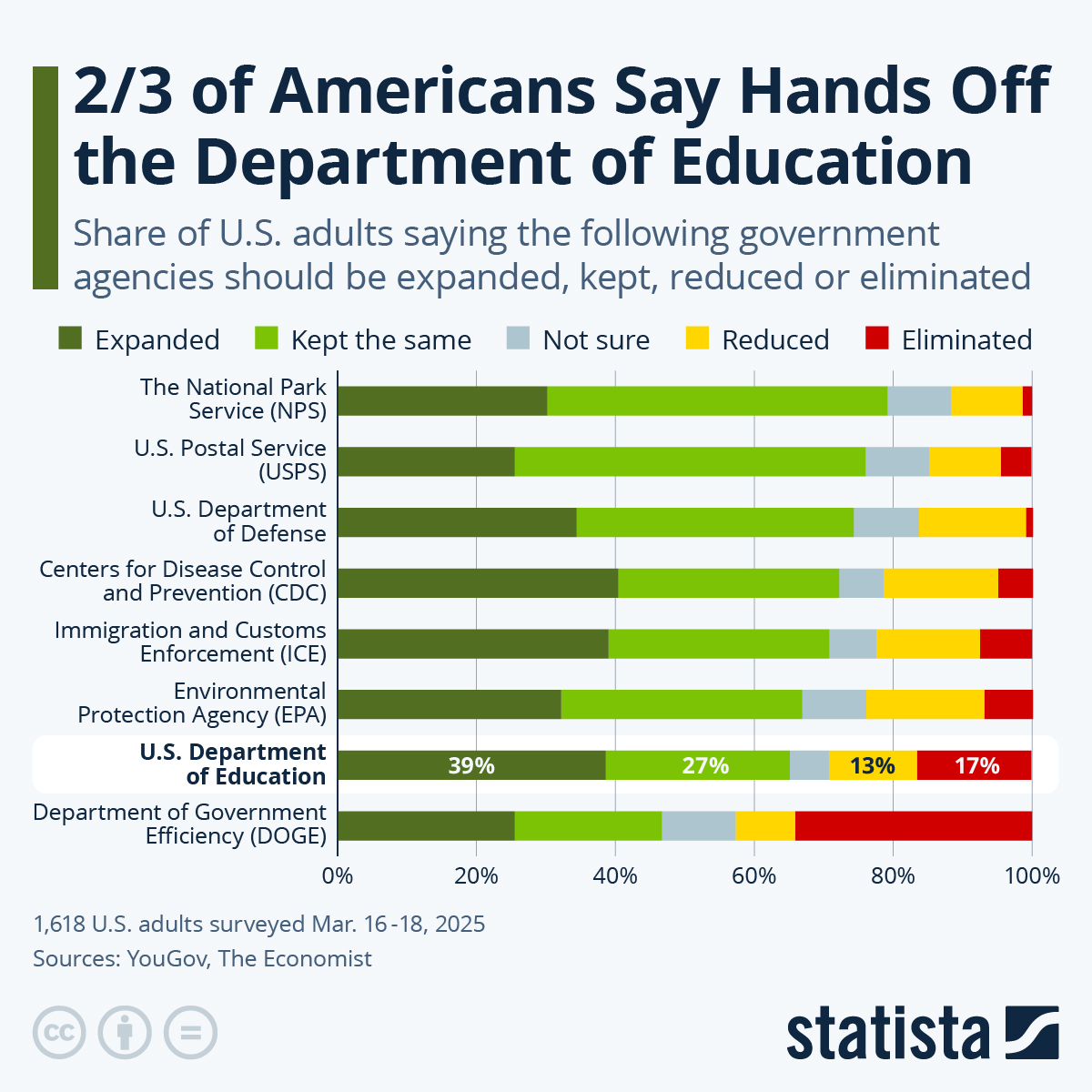
    A survey conducted by YouGov and The Economist reveals significant public sentiment against closing the Department of Education. The majority of Americans expressed a preference for either expanding the department (39 percent) or keeping it as it currently stands (27 percent). In contrast, only 13 percent supported reducing its size, while 17 percent called for its outright elimination. This divergence of opinion underscores a critical tension between the Trump administration’s goals and the general public’s expectations for educational governance.

    Insights from Survey Data

    The survey data further indicates that a notable 46 percent of U.S. adults believe that federal cuts to educational agencies, including the Department of Education, have been excessive. Only a quarter of respondents consider the cuts to be appropriate, while a minority feel that they have not gone far enough. Intriguingly, 34 percent of those surveyed suggested that the newly established Department of Government Efficiency (DOGE) should itself be abolished—a response that reflects skepticism about the administration’s efficiency reforms.

    Implications for the Future of Education

    The ongoing debate surrounding the Department of Education poses significant questions about the future of education policy in the United States. With mixed public opinion and strong opposition in Congress, the outcome of Trump’s plans remains uncertain. The broader implications of dismantling such a pivotal department could affect educational standards, equity, and access across various demographics, particularly for those who rely on federal support for education quality and funding.

    Through these developments, we are witnessing a fundamental clash of ideologies regarding the role of government in education—a debate that promises to have lasting ramifications for the American educational landscape.

  • Tariffs Only Yield $80B vs. $2.2T Income Tax Revenue

    Tariffs Only Yield $80B vs. $2.2T Income Tax Revenue

    Understanding Tariffs: A Financial Perspective

    What Are Tariffs?

    Tariffs are taxes imposed by a government on goods and services imported from other countries. They serve multiple purposes, ranging from generating government revenue to protecting domestic industries by making imported goods more expensive. While tariffs might seem like a straightforward way to address trade imbalances and foster local production, the economic implications of these taxes are more complex and nuanced.

    The Historical Context of Tariffs in the U.S.

    Tariffs have played a significant role in U.S. economic history, influencing trade policies and economic relations since the founding of the republic. With various ups and downs, the debate surrounding tariffs often centers around their effectiveness as a revenue source and their impact on consumers and businesses.

    While tariffs were once a primary source of federal revenue, their contribution has significantly diminished in modern times. In the context of the recent administration, there have been efforts to revitalize tariff usage as a means of generating income.

    The Economics of Tariffs

    Economists uniformly agree that tariffs are usually passed on to consumers in the form of higher prices. This is particularly evident in the case of the tariffs instated by the previous administration. Studies estimated that these tariffs would increase costs for the average American middle-class family by anywhere from $1,200 to $2,600 annually.

    Tariffs as Political Leverage

    One of the principal arguments put forth by proponents of tariffs is their utility as political leverage. Tariffs can be used strategically in international negotiations, providing a government with tools to compel other nations to comply with specific demands or trade regulations. This perceived flexibility is often seen as a significant benefit in a global trade landscape that is constantly evolving.

    The Reality of Tariff Revenue

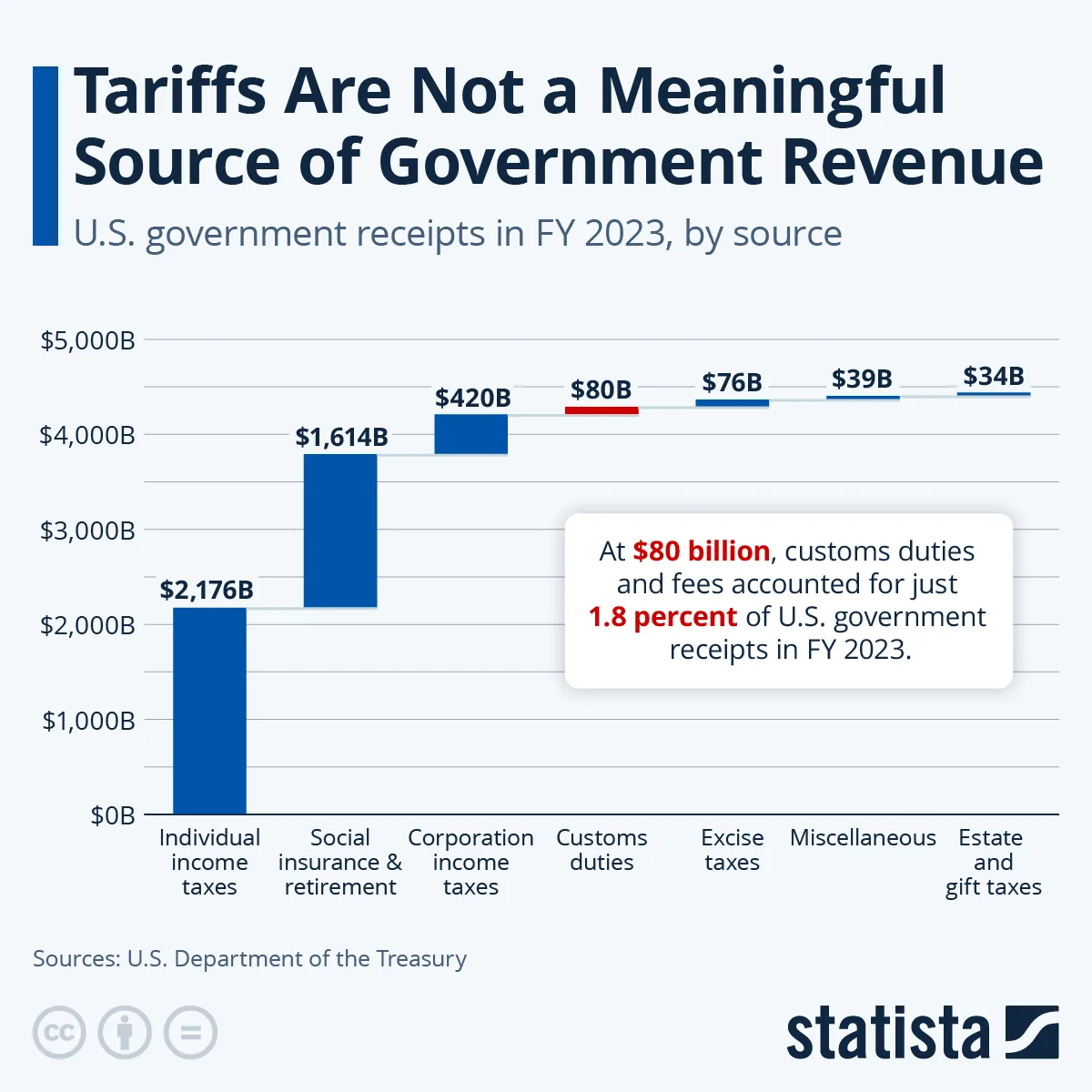
    Despite the theoretical benefits, the actual contribution of tariffs to government revenue has been modest. For the fiscal year 2023, tariffs generated approximately $80 billion. This sum is trivial compared to the nearly $2.2 trillion collected through individual income taxes during the same period.

    The Challenge of Replacing Income Tax with Tariffs

    The idea of replacing income tax with tariffs gained momentary attention during political discourse. Proponents suggested that the revenue from new tariffs could offset income tax receipts entirely. However, basic mathematical analysis indicates that a universal tariff rate of around 70 percent would be necessary to match income tax revenue. Such a drastic measure would undoubtedly have catastrophic effects on imports, negating any potential benefits.

    Projections and Predictions for Future Tariff Revenues

    The Tax Foundation has projected that proposed tariff increases could yield approximately $2 trillion in additional revenue over the next decade. However, this projection does not take into account adverse dynamic effects, such as retaliatory tariffs imposed by other countries. Such responses could drastically reduce the revenue generated from U.S. tariffs, illustrating a fundamental weakness in relying on tariffs as a lasting solution for revenue generation.

    Economic Impact on Consumers

    The implementation of tariffs has direct consequences for consumers, who often find themselves paying higher prices for imported goods. This price increase disrupts household budgets and can disproportionately affect lower and middle-income families. Understanding who ultimately bears the burden of tariffs is crucial in assessing their effectiveness not just as a revenue source, but as a tool for economic policy.

    Summary of Tariff Impacts

    In summary, while tariffs are often positioned as a pathway to bolster government revenues and protect domestic industries, their efficacy is contested. The complexities surrounding their economic impact, particularly on consumers and international trade relations, present challenges that cannot be overlooked in the broader discourse on U.S. economic policy.

    By examining tariffs in this light, we recognize both their historical significance and the nuanced effects they have on modern economics.