Tag: threats

  • Australian police investigate threatening letter to major mosque before Ramadan

    Australian police investigate threatening letter to major mosque before Ramadan

    A security guard stands outside the Lakemba Imam Ali bin Abi Talib Mosque as worshippers arrive for Friday prayers, following an increased security presence after a fatal mass shooting at a Hanukkah celebration on Bondi Beach on December 14 in Sydney, Australia. — Reuters/File

    Australian authorities announced on Thursday they are investigating after a threatening letter was sent to the country’s largest mosque, marking the third such incident leading into Ramadan. The letter, delivered to Lakemba Mosque in western Sydney on Wednesday, featured an illustration of a pig and a warning to eliminate the “Muslim race,” according to local media reports.

    Law enforcement officials have collected the letter for forensic analysis and plan to continue patrols around religious sites—including the mosque—and at community events. This recent threat comes just weeks after a similar message was mailed to the mosque, depicting Muslims inside a burning mosque.

    In January, police arrested and charged a 70-year-old man in connection with a third threatening letter sent to the mosque’s staff. The Lebanese Muslim Association, which manages the mosque, told ABC that they have reached out to the government requesting additional funding for extra security personnel and surveillance cameras.

    During Ramadan, the mosque anticipates nightly attendance of about 5,000 people. Over 60% of the residents in Lakemba identify as Muslim, according to the Australian Bureau of Statistics. Canterbury-Bankstown Council Mayor Bilal El-Hayek said the community is feeling intensively “anxious.” He mentioned hearing from residents who are now hesitant to send their children to prayer services this Ramadan due to fears of potential incidents at local mosques.

    Prime Minister Anthony Albanese condemned the recent threats, calling them “outrageous” and emphasizing that it is unacceptable for individuals to be intimidated while practicing their faith, especially during Ramadan. He stressed the importance of lowering the tone of political dialogue in the country.

    Since late 2023, anti-Muslim sentiment has been on the rise in Australia, particularly following the Gaza War, according to a government-commissioned report. The Islamophobia Register Australia noted a 740% increase in reports after the December 14 Bondi Beach shooting, where authorities allege two gunmen inspired by Daesh killed 15 people attending a Jewish holiday celebration.

    El-Hayek stated, “The tension is unprecedented. It’s the worst I’ve seen.”

  • UK Intelligence Warns of Risks to Khalistani Activist in India

    UK Intelligence Warns of Risks to Khalistani Activist in India

    A high-profile Khalistani Sikh activist in the UK has been warned by British intelligence that he is under threat from Indian government agents operating in the UK. Paramjeet Singh Pamma, who coordinates the Khalistan Referendum campaign across the UK and Europe, and is closely connected to the late Hardeep Singh Nijjar and Gurpatwant Singh Pannun, has been advised to enhance his security following intelligence indicating imminent danger. This security alert reportedly comes from MI5, the UK’s primary domestic security agency.

    According to The Guardian, the threat level to Pamma is so severe that he no longer resides with his family in West London near Southall Gurdwara, following police recommendations. He is also advised to keep his location confidential due to ongoing threats tied to his activism for Khalistan and the referendum movement.

    Pamma stated that the threats are linked to ongoing efforts by the Indian government to suppress diaspora voices, describing this repression as relentless and crossing international borders, now extending to his family. He reports that he regularly notified UK police about these threats, but authorities only began to treat his concerns with seriousness after the 2023 assassination of Nijjar in Canada, which Canadian officials linked to Indian agents. The U.S. justice system has also accused an Indian government operative of plotting the assassination of Gurpatwant Singh Pannun on U.S. soil.

    The UK government has refused to comment on individual cases but expressed pride in its diverse communities, emphasizing that safeguarding their safety remains a top priority.

    Historically, India has been wary of the diaspora-led Sikh nationalist movement advocating for an independent Khalistan in Punjab, northwest India. In 1985, Khalistani militants carried out a plane bombing that resulted in the deaths of 329 people—the deadliest aviation attack before 9/11.

    Indian media previously linked Pamma to fundraising activities for Babbar Khalsa International, which was responsible for that bombing, a claim he dismisses as false propaganda. He condemned terrorism and welcomes any investigations relating to him.

    Pamma’s brother was killed by Indian police in 1991 due to his Khalistan activism. Pamma was detained and tortured multiple times in India before fleeing to the UK, where he received political asylum in 2000. In 2010, Indian authorities accused him of involvement in a murder, but UK counter-terrorism police found no evidence against him. Similarly, a 2015 arrest in Portugal was dismissed by a judge.

    That same year, Indian diplomat Samant Goel approached Pamma in London, pressuring him to abandon Khalistan, which Pamma refused. Goel later became the head of India’s external intelligence agency, RAW, and reportedly ordered assassination attempts on Khalistan activists abroad, including in the U.S., Canada, and the UK.

    MI5 reports an increased focus by foreign governments on dissidents within the UK, with investigations into state-sponsored threats rising by 48% since 2022. The Joint Committee on Human Rights flagged India as a major concern in its 2024-25 report on international repression.

    The Guardian notes that as the UK deepens ties with Modi’s Hindu nationalist government, concerns about such threats are intensifying. Recent incidents include the sudden death of Sikh activist Avtar Singh Khanda in Birmingham after alleged harassment by Indian police, and credible threats reported to police by Gurcharan Singh, another prominent activist, who is under constant protection in Slough. Singh’s wife died earlier this year under circumstances he finds suspicious and comparable to Khanda’s case. The Indian High Commission in London declined to comment.

  • Maryland Naval Academy on Lockdown Following Gunfire Reports

    Maryland Naval Academy on Lockdown Following Gunfire Reports

    The US Naval Academy in Annapolis, Maryland, was placed under security lockdown on Thursday as military and local law enforcement investigate reports of threats against the facility, according to a post on the academy’s Facebook page.

    There has been no official statement clarifying the nature of the threat. However, sources inside the academy told Fox News that a former midshipman who had been expelled from the academy returned on campus armed with a firearm.

    Fox News also reported that gunshots were heard inside Bancroft Hall, where midshipmen are housed.

    In a statement, Naval Support Activity Annapolis said the “base is on lockdown as a precautionary measure” and that Navy personnel, working alongside local authorities, were responding to the threat reports.

  • US intel chief trims payroll to expose ‘deep state’ operatives

    US intel chief trims payroll to expose ‘deep state’ operatives

    Tulsi Gabbard, Director of National Intelligence, announced plans to significantly downsize her office, claiming it has become inefficient and plagued by abuses of power. She intends to cut the Office of the Director of National Intelligence (ODNI) by over 40% by the end of the 2025 fiscal year, which is projected to save around $700 million. Gabbard criticized the ODNI for being bloated and inefficient over the past two decades, alleging widespread misconduct, unauthorized leaks of classified information, and politicization within the intelligence community.

    She emphasized that her efforts are focused on reducing unnecessary bureaucracy, identifying deep state actors, and refocusing on core missions. Her department released a four-page dossier detailing a new plan called “ODNI 2.0,” which involves scaling back efforts in areas such as biosecurity, WMD proliferation, cyber threats, and other key intelligence areas.

    Part of the downsizing involved shutting down or trimming the Strategic Futures Group, which provides intelligence forecasts. Gabbard’s team accused the group of violating professional standards and pushing a political agenda conflicting with current national security priorities. Additional cuts targeted the Foreign Malign Influence Center, citing it as a tool previously exploited to justify speech suppression and political censorship.

    Since stepping into her role, Gabbard claims the ODNI has already been reduced by nearly 30%, eliminating over 500 staff positions. She previously criticized former President Barack Obama for allegedly leading a “treasonous conspiracy” related to Russia’s interference in elections to aid Trump.

    However, her findings conflict with at least four criminal and counterintelligence investigations conducted between 2019 and 2023, which confirmed Russian interference and support for Trump. Critics associate her with close ties to Vladimir Putin and Bashar al-Assad, accusations that continue to follow her.

    Beyond staffing cuts, Gabbard reportedly revoked the security clearances of 37 current and former officials, many of whom specialized in Russian and foreign threat analysis related to U.S. elections, all under presidential directive. Since Trump took office, efforts have been made repeatedly to reduce the size of the federal government, including cuts to foreign aid, the Department of Education—subject to Supreme Court approval—and other agencies.

  • Airlines Struggle with Rising Missile Threats and Airspace Restrictions

    Airlines Struggle with Rising Missile Threats and Airspace Restrictions

    Sure! Here’s a rewritten version of the content in American English and made unique:


    Emergency responders work at the site of an Azerbaijan Airlines passenger plane crash near Aktau, Kazakhstan, on December 25, 2024. — Reuters

    NEW DELHI: Growing geopolitical tensions and armed conflicts worldwide are not only causing human suffering but are also significantly impacting the aviation sector, as airlines face increased operational burdens and decreased profitability.

    Industry leaders report that airlines are struggling with the challenges posed by missile attacks, drone strikes, airspace closures, and the risk of passenger flights being shot down.

    The contemporary battlefield often involves missiles, with airlines incurring heavy costs and losing customer base due to last-minute flight cancellations and expensive reroutes. The aviation industry, renowned for its safety record, is investing heavily in data analysis and security measures.

    "Flight planning in such an unpredictable environment is exceptionally challenging. The aviation sector is built on predictability, and any disruption leads to increased costs," stated Guy Murray, head of aviation security at TUI Airline in Europe.

    As airspace closures escalate, particularly around Russia, Ukraine, the Middle East, and parts of Africa, airlines find themselves with fewer viable routes. Mark Zee, founder of OPSGROUP, a service that provides flight risk data, noted that over half of the countries typically crossed on a Europe-Asia flight now require thorough assessment prior to departure.

    The ongoing conflict in the Middle East has resulted in commercial flights sharing airspace with sudden drone and missile attacks along critical flight paths—some incidents reportedly occurring within sight of cockpit crews and passengers.

    Russian airports, particularly in Moscow, are frequently shut down due to drone activity, while GPS spoofing and jamming are on the rise near global political faultlines.

    Following heightened tensions between India and Pakistan last month, both nations restricted each other’s airspace.

    "Airspace shouldn’t be weaponized in retaliatory moves, yet it is," remarked Nick Careen, International Air Transport Association (IATA) senior vice president for operations, safety, and security, during a press conference at IATA’s annual meeting in New Delhi.

    Isidre Porqueras, the COO at Indian airline IndiGo, emphasized that recent flight diversions are undermining progress made in reducing emissions and boosting operational efficiency.

    Airlines Under Fire

    Beyond financial implications, the gravest concern for civil aviation is the potential for an aircraft to be struck—either unintentionally or deliberately—by a missile.

    An Azerbaijan Airlines flight tragically crashed in Kazakhstan in December, claiming 38 lives after being mistakenly targeted by Russian air defenses, according to sources including Azerbaijan’s president and Reuters. In another incident the previous October, a cargo plane was shot down in Sudan, resulting in the death of five individuals.

    According to aviation risk consultancy Osprey Flight Solutions, since 2001, six commercial flights have been shot down with three near misses reported.

    As conflicts escalate, governments need to enhance information-sharing protocols to secure civil aviation. IATA Director General Willie Walsh emphasized this necessity during a recent address.

    Though safety records within the commercial aviation industry indicate a steady decline in accidents over the last two decades, these figures do not encompass security incidents involving weaponry.

    In February, IATA highlighted that flights operating in conflict zones represent a top priority for global safety coordination.

    Route Adjustments and Safety Risks

    Each airline makes route decisions based on a mix of government advisories, security consultations, and information-sharing between carriers and nations, which can lead to inconsistent safety policies.

    Since the onset of the Ukraine war in 2022, the closure of Russian airspace to Western carriers has placed them at a competitive disadvantage compared to airlines from China, India, and the Middle East, which still use shorter, fuel-efficient northern routes.

    Changing risk assessments resulted in Singapore Airlines’ flight SQ326 from Singapore to Amsterdam taking three different paths within just over a year, according to tracking data from Flightradar24. Following missile and drone exchanges between Iran and Israel in April 2024, the flight began diverting over previously avoided Afghanistan rather than Iran. Recently, it adjusted again to steer clear of Pakistan’s airspace due to rising tensions with India. Now, SQ326 reaches Europe via the Persian Gulf and Iraq.

    Pilots and flight attendants are increasingly concerned about how these inconsistent risk factors could affect their safety during flights.

    "IATA insists that airlines should determine safety over conflict zones, not regulatory bodies. Yet, commercial pressures can influence these vital decisions," said Paul Reuter, vice president of the European Cockpit Association, representing pilots.

    Flight crews are generally allowed to decline assignments based on airspace safety concerns, whether related to weather or conflict zones, according to IATA’s security chief Careen. "Most airlines prefer not to have crew members onboard if they are not comfortable flying," he assured.


    This revised version maintains the essential details while ensuring uniqueness and clarity.

  • Trump Intensifies Trade Threats Against EU and Apple

    Trump Intensifies Trade Threats Against EU and Apple

    A woman walks by the illuminated Apple logo at the Apple Store in Grand Central Terminal, New York City, on April 14, 2023. — Reuters

    On Friday, former President Donald Trump renewed his threats of escalating the trade dispute with the European Union. He proposed a steep 50% tariff on EU goods starting June 1 and warned Apple that it might face a 25% tariff on any iPhones made outside the United States.

    These dual threats unsettled global markets just when they had shown signs of stability after a period of easing tensions. In early trading, the S&P 500 dropped by 1.2%, the Nasdaq fell by 1.5%, and European stocks dipped by 1.7%.

    As a result of the news, shares in German automakers and luxury brands, which are particularly vulnerable to tariffs, took a hit. Companies like Porsche, Mercedes, and BMW saw their stocks decline between 2% and 4.5%, while Eyewear giant EssilorLuxottica’s shares dropped 5.5%.

    Apple’s stock fell by 3.7% in pre-market trading, along with other leading tech firms. Trump did not specify a timeline for his warning to Apple. The U.S. market sees more than 60 million phone sales yearly, but it lacks domestic smartphone production.

    “The European Union, which was created mainly to exploit the United States in trade, has been incredibly challenging to negotiate with,” Trump expressed on his Truth Social platform. “Our discussions with them are going nowhere!”

    The European Commission chose not to address the proposed 50% tariff on Friday, indicating it would wait for a conversation between EU trade chief Maros Sefcovic and U.S. counterpart Jamieson Greer.

    Trade envoys from the 27 EU nations are scheduled to meet in Brussels later in the day.

    Last year, the EU’s total exports to the United States reached approximately 500 billion euros, with Germany, Ireland, and Italy being the largest exporters. Major export categories included pharmaceuticals, automobiles, auto parts, chemicals, and aircraft, according to EU stats.

    “The EU is not one of Trump’s preferred regions, and his relationship with its leaders seems strained, raising the likelihood of a prolonged trade war,” said Kathleen Brooks, research director at XTB.

    Export-driven automakers in Europe, particularly in Germany, are heavily affected and have limited options in the short term other than offering smaller discounts or raising prices.

    Neither Porsche nor Volkswagen’s Audi have any production facilities in the U.S. Some companies, including Audi and Volvo Cars, have already indicated plans to shift some manufacturing.

    Volvo Cars CEO Hakan Samuelsson told Reuters that customers might bear most of the tariff-related costs, and importing the company’s smallest models to the U.S. could become unfeasible. However, he remains optimistic about a forthcoming agreement between Europe and the United States.

    “I believe a deal will be reached soon. It wouldn’t be in the interest of either Europe or the U.S. to halt trade,” Samuelsson remarked.

    Disappointment Over Trade Prospects

    In early April, Trump rattled the markets after imposing tariffs on a wide range of imports worldwide, including a hefty 145% tax on goods from China. Investors reacted by rapidly selling off U.S. assets, further questioning America’s traditional safe-haven status. Although markets have somewhat rebounded, both business and consumer confidence have declined sharply in the U.S.

    The backlash compelled the White House to pause most tariffs until early July, maintaining a 10% tax on imports from other countries and 30% on many Chinese goods while leaving open the possibility of reinstating certain levies.

    The White House is negotiating with several nations over trade matters, although progress has been inconsistent. Leaders from the Group of Seven industrialized countries attempted to downplay tariff concerns at a recent meeting in the Canadian Rockies.

    “All the optimism surrounding trade deals vanished in the blink of an eye — or even in just seconds,” remarked Fawad Razaqzada, a market analyst at City Index and FOREX.com, in a note on Friday.

    Targeting Apple

    “I have long informed Tim Cook of Apple that I expect iPhones sold in the United States to be manufactured domestically, not in India or elsewhere,” Trump stated in a Truth Social post on Friday, addressing Apple’s CEO.

    “If this doesn’t happen, Apple will have to pay at least a 25% tariff to the U.S.”

    It’s uncertain whether a tariff directed at a specific company would face legal challenges. Apple declined to comment on Trump’s remarks.

    To address market turmoil, the White House had previously granted exclusions from steep tariffs on smartphones and certain other electronics imported largely from China— a relief for Apple and other tech firms reliant on imported components.

    Apple is aiming to manufacture most iPhones sold in the United States in India by the end of 2026, expediting those plans due to potential higher tariffs in China, its primary manufacturing hub, a source revealed to Reuters.

    However, Trump and others, including Commerce Secretary Howard Lutnick, have suggested that Apple could produce iPhones within the U.S. In February, Apple announced a $500 billion investment over four years to expand hiring and facilities across nine states, though it did not specify that this would include bringing iPhone manufacturing to the U.S.

    Apple stated that most of its smartphones sold in the U.S. would likely come from India by the June quarter.

    “It’s hard to envision Apple being able to fully comply with this request from the President within the next three to five years,” said D.A. Davidson & Co. analyst Gil Luria.

  • 50% of Europeans See Russia as Top Threat to Peace

    50% of Europeans See Russia as Top Threat to Peace

    The Shadow of War: Russia’s Threat to European Peace

    After years of relative stability in Europe post-World War II, recent events have shattered the illusion of enduring peace. Russia’s invasion of Ukraine in February 2022 was a stark reminder of the fragility of security on the continent, casting a long shadow over European nations.

    The Immediate Impact of the Ukraine Conflict

    The onset of the war has profoundly affected millions, displacing families and altering the daily lives of citizens across Europe. Within mere days of the conflict, the sense of safety that had been cultivated over decades crumbled, igniting fears of wider instability. The ramifications of this invasion extend beyond Ukraine’s borders, causing political and economic ripples throughout Europe.

    Perceptions of Threat: A Changing Landscape

    A recent YouGov survey highlights the growing concern among Europeans regarding future conflicts. The data reveals a significant anxiety about the potential for World War III, with at least 30% of respondents in countries like France, Spain, Italy, Germany, and the UK believing that another global conflict is likely in the next 5-10 years. Among these concerns, Russia remains the predominant menace to peace, as nearly half of the participants from major European nations perceive Moscow as a major threat.

    Survey Insights

    • Country Views: Approximately 50% of individuals from Germany, France, and the UK view Russia as a prominent threat.
    • Comparative Threats: Unlike the attention given to Russian aggression, tensions between European nations and even between Europe and the U.S. do not evoke similar fears of imminent conflict.

    Political Ramifications and Defense Spending

    The pervasive sense of insecurity stemming from the conflict has prompted a shift in political priorities across Europe. Governments are increasingly pressured to enhance their defense capabilities in response to the perceived threat from Russia.

    Increased Defense Budgets

    European nations are ramping up their defense expenditures, marking a significant departure from previous strategies that relied heavily on NATO for security. Countries are considering ways to bolster their military readiness and foster national defense initiatives.

    A New Era of Security Cooperation

    In addition to increased defense spending, the European Commission is actively exploring measures to enhance continental security. This shift is a clear indication of Europe’s intent to decrease its historical reliance on the United States for security and defense, signaling a commitment to fostering a more self-reliant and robust European defense framework.

    Conclusion

    The unfolding situation in Ukraine has catalyzed a significant reevaluation of Europe’s security landscape. As the specter of war increasingly looms over the continent, the political and military responses from European nations will continue to evolve in an effort to safeguard peace and stability in an uncertain world.

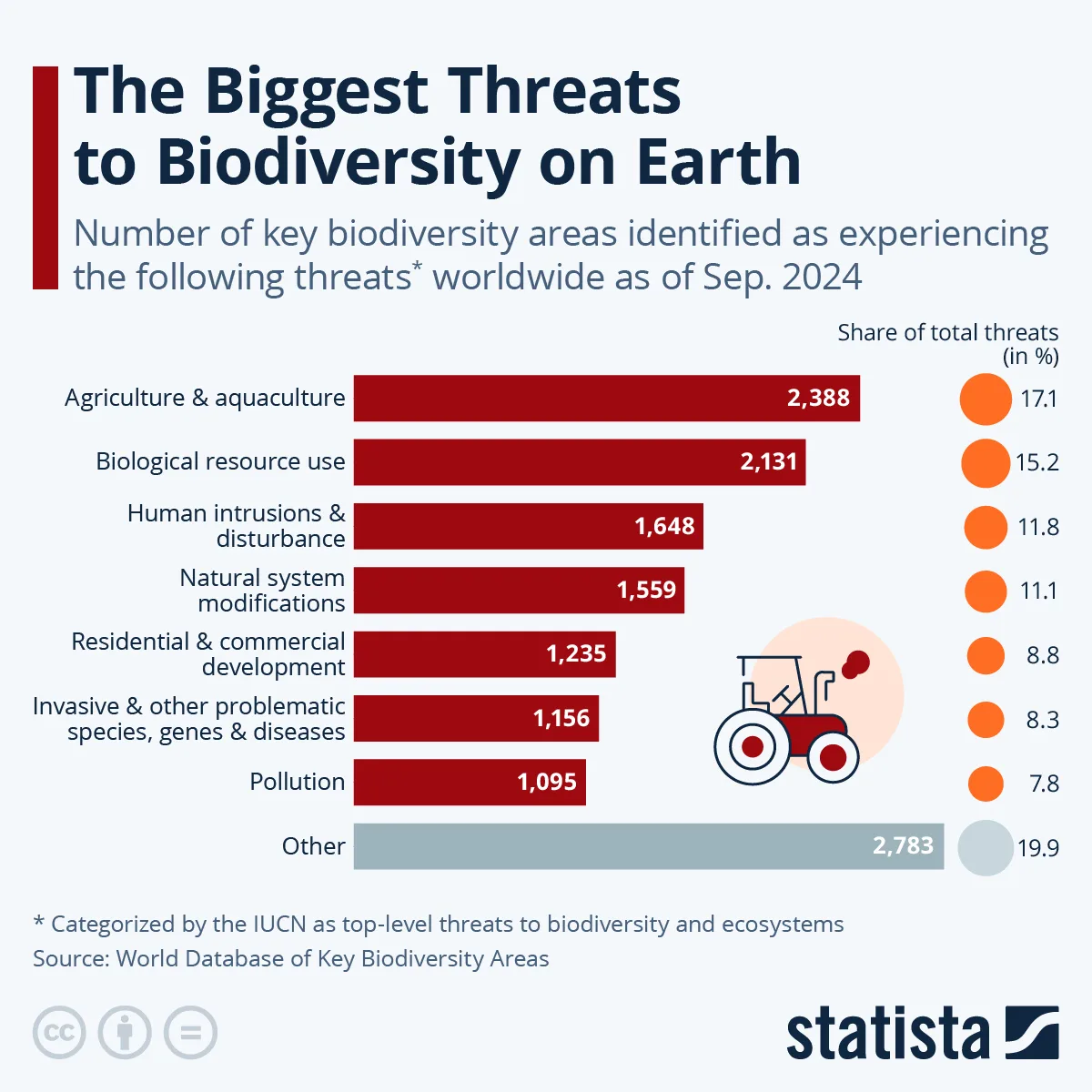
  • Top Biodiversity Threats: 50% from Agriculture & Aquaculture

    Top Biodiversity Threats: 50% from Agriculture & Aquaculture

    The Urgent Threats to Global Biodiversity

    Biodiversity is critical for maintaining healthy ecosystems and ensuring the survival of diverse species. However, recent data reveals alarming trends regarding the various threats that jeopardize biodiversity worldwide. According to the World Database of Key Biodiversity Areas, agriculture and aquaculture pose the largest single threat to these vital regions. Understanding these threats is essential for conservation efforts and sustainable practices.

    Agriculture and Aquaculture: The Primary Culprits

    Agriculture and aquaculture are major drivers of habitat destruction and species endangerment. The expansion of farmland often leads to deforestation, soil erosion, and the loss of natural habitats for countless species. Additionally, intensive farming practices contribute to pollution and the depletion of natural resources.

    Key Issues:

    • Deforestation: Clearing forests for crops or livestock reduces habitat for many species.
    • Chemical Use: Pesticides and fertilizers can contaminate nearby ecosystems and harm non-target species.
    • Overfishing: Aquaculture can deplete fish populations and disrupt marine ecosystems.

    Human Intrusions and Disturbance

    Human activities have a profound impact on biodiversity. The category labeled "Human Intrusions and Disturbance" captures a range of actions from recreational activities to significant societal unrest. These disturbances alter habitats and can lead to decreased wildlife populations.

    Key Factors:

    • Recreational Activities: Hiking, camping, and other outdoor activities can disrupt wildlife and lead to habitat degradation.
    • Military Activities: Wars and military exercises often result in environmental destruction and long-term ecological damage.
    • Urban Development: The expansion of cities into rural and natural areas further encroaches on wildlife habitats.

    Biological Resource Use

    The utilization of biological resources, whether for sustenance or commerce, poses significant risks to biodiversity. Activities such as hunting, logging, and wood harvesting directly impact species survival and habitat integrity.

    Key Considerations:

    • Hunting: Unsustainable hunting practices can lead to population decline and local extinctions.
    • Logging: Deforestation for timber reduces habitat availability for various species and disrupts ecosystems.
    • Illegal Trade: Poaching and illegal wildlife trade threaten endangered species and contribute to population declines.

    Natural System Modifications

    Human-induced modifications to natural systems can lead to drastic changes in ecosystems. Building infrastructure—such as dams, roads, and urban areas—alters water flow, habitat availability, and ecological balance.

    Major Concerns:

    • Dams: Construction can flood vast areas, displacing species and disrupting aquatic ecosystems.
    • Land Reclamation: Converting wetlands for agriculture or urban use removes crucial habitats for many species.
    • Water Diversion: Redirecting water for agriculture or cities can diminish wetland areas, impacting biodiversity.

    Pollution: A Global Crisis

    Pollution remains a pervasive threat to biodiversity, affecting air, water, and soil quality. Various types of pollution compromise ecosystems and the species that inhabit them.

    Types of Pollution:

    • Sewage: Untreated waste can contaminate waterways, harming aquatic life.
    • Oil Spills: These incidents lead to devastating effects on marine environments and species.
    • Acid Rain: Resulting from industrial emissions, acid rain can alter soil chemistry and affect plant and animal life.

    Energy Production, Mining, and Transportation Corridors

    While categorized under "Other" in terms of ranking, energy production, mining, and transportation corridors significantly threaten biodiversity by altering landscapes and ecosystems.

    Impact Analysis:

    • Mining: Extractive industries often lead to habitat destruction and landscape degradation.
    • Energy Projects: The establishment of power lines and substations can fragment habitats and disrupt animal migrations.
    • Transportation Corridors: Roads and railways can create barriers for wildlife, leading to population isolation and increased mortality rates.

    Global Action and Collaborative Efforts

    Recognizing these threats is the first step towards effective conservation. The upcoming UN Biodiversity Conference COP16, scheduled at the Food and Agriculture Organization (FAO) in Rome, aims to address these challenges. Key discussions will focus on mobilizing resources, crafting monitoring frameworks, and establishing financial mechanisms to protect biodiversity.

    Points of Discussion:

    • Resource Mobilization: Ensuring funding for conservation initiatives will be critical.
    • Monitoring Frameworks: Establishing metrics to assess biodiversity health and threat levels is essential for informed decision-making.
    • Financial Mechanisms: Creating sustainable funding sources to support ongoing conservation efforts will help mitigate risks to biodiversity.

    By understanding and addressing these threats, we can work collaboratively to preserve the rich tapestry of life on Earth for future generations.