Apple recently hosted its highly anticipated “Awe Dropping” event, which lasted just over an hour. The event showcased a variety of exciting new products, including a sleek new iPhone Air, the latest iPhone 17 series, premium AirPods Pro 3 earbuds, and updated Apple Watch models.
Immediately after the event, Apple released several videos online. One of these videos aims to guide consumers in choosing the right iPhone model for their needs.
iPhone Air
The new iPhone Air measures just 5.6mm in thickness and weighs only 165 grams, making it Apple’s slimmest and lightest smartphone to date. The promotional video emphasizes its ultra-slim profile and lightweight design.
iPhone 17 Series
Apple also announced the new iPhone 17 lineup, which includes the standard iPhone 17 with a slightly larger 6.3-inch display (the Ultra variant has been discontinued), alongside the iPhone 17 Pro and iPhone 17 Pro Max.
Choosing Your Perfect iPhone
With four models now available (plus the earlier released iPhone 16e), Apple provided a new video to help users understand the primary differences and decide which iPhone suits them best. Though the video itself isn’t embedded here, you can view it here.
AirPods Pro 3
Apple’s latest high-end earbuds feature a more compact design, enhanced noise cancellation, and, for the first time, heart-rate monitoring capabilities.
Apple Watch Updates
The company unveiled the new Apple Watch Series 11, along with the Ultra Watch 3 and Apple Watch SE 3. Instead of showcasing the new watches, the accompanying video highlights how Apple Watch’s health features have played a vital role in saving lives.
Quick Recap
For those short on time, there’s a quick 155-second summary covering all the highlights from the September 2025 event. However, if you’re eager to experience every detail, you can watch the full 71-minute presentation as well.
Samsung has been at the forefront of integrating artificial intelligence into smartphones, primarily through its Galaxy AI stack. These flagship devices not only feature standard AI capabilities like Gemini but also introduce their own innovative tools such as Now Bar, Now Brief, and Interpreter, offering users a range of unique AI-driven experiences.
The company’s ambitions extend well beyond current implementations. Samsung is actively exploring partnerships with additional AI companies to enhance their AI offerings on Galaxy smartphones. This move could potentially shift some attention away from Google’s Gemini. According to recent reports, companies like Perplexity and OpenAI, the creator of ChatGPT, are among those being considered for collaboration.
The significance of this development lies in its potential impact on the competitive landscape. Won-joon Choi, Samsung’s COO of MX Business, stated that the company is engaging with multiple vendors. As long as these AI agents can deliver superior user experiences, Samsung remains open to partnerships with various providers. This evolution is poised to give Google’s AI a run for its money, particularly within the Android ecosystem—a space where competitors are increasingly making inroads.
For context, Google’s Pixel phones showcase the impressive capabilities of AI platforms like Gemini. However, these devices don’t match Samsung’s market share, making the integration of AI features into Galaxy devices critically important for Google. The stakes are high: rival companies like Perplexity have already struck deals to offer their AI tools pre-installed on Android devices, including agreements with Motorola and partnerships with other brands.
In addition to these collaborations, Samsung has unveiled plans for an AI-focused browser called Comet, which is set to roll out on both Apple and Android smartphones. Rumors also suggest that Perplexity might be considering a partnership with Apple, especially as Apple faces challenges trying to elevate Siri to compete with ChatGPT and Gemini. To bridge the gap, Apple recently partnered with OpenAI, enabling Siri to interact with ChatGPT for more advanced queries.
As Samsung continues to explore new AI collaborations, Google’s strategies with Gemini and its overall AI ecosystem face significant challenges. The integration of more diverse AI tools into mainstream devices promises to reshape how users interact with their smartphones and could drastically influence the future direction of AI development in mobile technology.
Samsung has unveiled the Odyssey OLED G6, marking its position as the first OLED gaming monitor in the world with an impressive 500Hz refresh rate. Initially revealed at CES 2025, the 27-inch monitor is now available for pre-order and is designed for competitive gamers who prioritize ultra-responsive gameplay along with superior OLED imagery.
The Odyssey OLED G6 (G60SF) surpasses competitors like the Asus ROG Swift PG27AQDP, featuring a QD-OLED panel that provides a native QHD resolution of 2560 × 1440 and a lightning-fast 0.03ms (GtG) response time, minimizing motion blur during intense gaming sessions. This panel is VESA DisplayHDR True Black 500 certified, ensuring rich colors and deep contrasts. Additionally, it supports FreeSync Premium Pro and is compatible with Nvidia G-Sync, which helps eliminate screen tearing and stuttering.
The monitor achieves a peak brightness of 1,000 nits and is coated with Samsung’s Glare Free treatment to reduce reflections. To combat OLED burn-in, Samsung has implemented its “OLED Safeguard+” technology, which includes a pulsating heat pipe system to regulate panel temperatures and prevent overheating. It also boasts a thermal modulation system that automatically adjusts brightness as well as detection capabilities for static images like logos and taskbars.
Luke Larsen / Digital Trends
In terms of design, the Odyssey OLED G6 features a sleek, flat-screen layout complemented by Samsung’s Core Lighting+ on the back, which provides gentle RGB illumination. The ergonomic stand allows for height, tilt, and swivel adjustments, and users can choose to use a VESA mount if they prefer.
Related
Samsung’s inaugural flat mini-LED gaming monitor carries a premium price tag
The update on Samsung’s CES 2023 gaming monitors, from curved QD-OLEDs to 8K giants
Computex showcase: Featuring 500Hz displays and 48-inch OLED options
For connectivity, the monitor includes two HDMI 2.1 ports, one DisplayPort 1.4 input, and a USB hub. The G6 retains the Gaming Hub feature, enabling swift access to various game streaming platforms and console passthrough.
Samsung has stated that the Odyssey OLED G6 will first launch in regions including Singapore, Thailand, Vietnam, and Malaysia, with plans to expand to other markets later this year. The expected price in the U.S. is around $1,300, though it is currently available for pre-order in Singapore at 1,488 SGD, approximately $1,100 USD.
Concerns regarding the battery life of the iPhone 17 Air may have some validity, according to a recent report from The Information. Internal tests by Apple reportedly reveal that only 60 to 70 percent of iPhone 17 Air devices can last a full day on a single charge, compared to 80 to 90 percent for other iPhone models.
This battery issue is likely linked to the phone’s sleek design. At a mere 5.5mm thick, the iPhone 17 Air is anticipated to be the slimmest iPhone to date, and potentially among the thinnest smartphones available. Unfortunately, this reduction in thickness may mean a smaller battery capacity. To mitigate this limitation, Apple is reportedly considering the release of an optional battery case accessory to provide users with extra power throughout the day.
Initial rumors hinted that Apple might transition from lithium-ion to silicon-carbide batteries, which typically offer higher energy density and more compact designs. However, if the latest findings are correct, this shift may not be happening.
The iPhone series has consistently enjoyed popularity, but it can still be challenging to predict consumer response to design changes like this. As per the report, Apple has allocated only 10 percent of its manufacturing capacity for the iPhone 17 Air. This figure may be adjusted post-launch based on demand, but for the time being, it appears that this model will cater to a more niche audience.
The iPhone 17 Air is scheduled to debut in September alongside the rest of the iPhone 17 lineup, with a starting price estimated at $799. It is likely to feature a single rear camera and 12GB of RAM, an upgrade from the 8GB found in the current iPhone 16.
Are you in the market for a smartphone featuring a stylus but are hesitant to invest in the Samsung Galaxy S25 Ultra? Look no further, as Motorola reintroduces the Moto G Stylus 2025, a more budget-friendly option that still includes the essential stylus functionality.
Motorola
The stylus included with the Moto G Stylus 2025 is designed for various functionalities, including integration with Google’s Circle to Search feature and Motorola’s unique Sketch to Image capability, which employs AI to convert your sketches into art for the Moto Note app. Additionally, the stylus is said to be 6.4 times more responsive than its predecessor.
Users can enjoy the stylus on a 6.7-inch pOLED display, boasting a 120Hz refresh rate and an impressive peak brightness of 3,000 nits. The device is powered by a Qualcomm Snapdragon 6 Gen 3 processor, comes with 8GB of RAM, and offers storage options up to 256GB. Moreover, the phone’s body is built to withstand water and dust with its IP68 rating, as well as meeting the MIL-STD-810H military toughness standards.
A robust 5,000mAh battery with 68W TurboPower fast charging ensures extended usage, and the addition of 15W wireless charging adds extra convenience. Running on Google’s Android 15 software, the phone also features stereo speakers. Continuing its collaboration with color specialists Pantone, the Moto G Stylus 2025 is available in two exclusive colors: Pantone Gibraltar Sea and Pantone Surf the Web, both vibrant shades of blue.
Motorola
The camera setup includes a 50-megapixel main camera with optical image stabilization, a 13MP wide-angle lens offering a 120-degree field of view, and a light sensor to enhance exposure and color balance. The front features a 32-megapixel selfie camera, and a variety of AI capabilities, including Motorola’s Photo Enhancement Engine, can be utilized with the stylus.
The Moto G Stylus 2025 is set to launch on April 17, priced at $400. It will be available through Motorola’s official website, Amazon, Best Buy, and various carriers, including T-Mobile and Verizon. Following its U.S. release, the phone is scheduled to roll out in Canada on May 13. Its specifications closely mirror those of the Motorola Edge 60 Fusion, which will start selling in the U.K. and Europe around the same time but does not feature a stylus.
Who better to bring a Stephen King novel to life than one of the leading figures in modern horror?
According to Deadline, Mike Flanagan is set to create a television series based on King’s classic 1974 novel Carrie. This adaptation will consist of eight episodes and will be available for streaming on Amazon Prime Video. Flanagan will work alongside Trevor Macy as executive producers through Intrepid Pictures.
Originally released in 1974, Carrie tells the story of a young girl named Carrie who is navigating life as a high school student under the oppressive watch of her mother. Isolated and bullied, Carrie eventually uncovers her telekinetic abilities and decides to take a stand against her tormentors following a disastrous prank.
Carrie was famously transformed into a film by director Brian De Palma in 1976, featuring Sissy Spacek in the title role. The movie also starred John Travolta, Piper Laurie, Amy Irving, William Katt, Nancy Allen, and Betty Buckley. It achieved significant commercial success and received critical acclaim, leading to Oscar nominations for both Spacek and Laurie in the categories of Best Actress and Best Supporting Actress, respectively. De Palma’s adaptation is often hailed as one of the most seminal horror films in cinematic history.
The success of Carrie gave rise to various sequels and adaptations, including 1999’s The Rage: Carrie 2, a reimagining in 2013 featuring Chloë Grace Moretz, and a television movie in 2002.
This new project marks another entry in Flanagan’s expanding roster of adaptations of King’s works. He previously wrote and directed Doctor Sleep in 2019—King’s sequel to The Shining—and Gerald’s Game in 2017, a psychological horror film starring Carla Gugino and Bruce Greenwood.
Most recently, Flanagan penned and directed The Life of Chuck, an adaptation of King’s novella featuring Tom Hiddleston in the lead role. This sci-fi drama received the Audience Award at the 2024 Toronto International Film Festival, with Neon acquiring the film and planning a theatrical release in the summer of 2025.
Intel has generated significant buzz around the efficiency of its forthcoming Arrow Lake CPUs, which aim to rank among the top processors upon their release later this week. However, early benchmark results shared by HXL on social media indicate that these CPUs can consume a substantial amount of power if users deviate from Intel’s default power settings.
The benchmark results reveal that the Core Ultra 9 285K reached a peak power draw of 370 watts during the Cinebench R23 multi-core test. While the CPU is obscured in the post, the 24 cores identified by Cinebench make it clear that it is the Core Ultra 9 285K. Intel cites a maximum turbo power of 250W and a base power of 125W for this CPU.
Interestingly, there’s more to the performance picture beyond the maximum power draw. The Core Ultra 9 285K achieved a score of 46,289 points in the benchmark—one of the highest scores recorded. For comparison, AMD’s Ryzen 9 9950X scored 42,707 points in our tests. Notably, the Core Ultra 9 285K accomplishes this superior performance using 24 threads, whereas the Ryzen 9 9950X utilizes 32 threads.
As reported by VideoCardz, this peak performance shouldn’t be expected in standard configurations. The site claims that the result showcases the Core Ultra 9 285K operating without power limits, which can usually be adjusted in the BIOS. Under default power settings, the score is predicted to be just above 42,000 points, based on several leaked benchmarks.
Intel has clarified that, for the Core Ultra 9 285K, the power levels PL1 and PL2 are equivalent. PL1 represents the maximum turbo power, while PL2 denotes the peak turbo power achievable for a short duration. Therefore, for this CPU, users can anticipate a constant 250W draw under maximum boost when adhering to Intel’s default settings. Past experiences with CPUs like the Core i9-14900K suggest that motherboard manufacturers may offer options to bypass these power limits for enhanced performance.
Given that HXL’s benchmark likely involved removed power restrictions, this bodes well for high-performance PC enthusiasts with sufficient cooling solutions. Nonetheless, it’s probable that most systems won’t replicate this extraordinary level of performance.
Intel is still trying to recover from previous complications with the stability of the Core i9-13900K and Core i9-14900K, which stemmed partly from unregulated power limits in the BIOS. In light of these ongoing challenges, Intel may have encouraged motherboard manufacturers to adhere to default power restrictions for Arrow Lake CPUs, at least in retail configurations.
Get your weekly breakdown of the tech driving PC gaming
Tesla’s recent presentation titled "We, Robot" has hit a legal snag, with Alcon Entertainment, the production company behind Blade Runner 2049, filing a lawsuit against the electric car manufacturer and its CEO, Elon Musk, for alleged copyright violations.
During the high-profile event on October 10, Tesla debuted its new Cybercab and Robovan and introduced the latest version of its Optimus humanoid robot. The presentations were held at Warner Bros. Discovery Studios in Hollywood, where images presented during the event are claimed by Alcon to have been created using generative AI and incorporated still images from the vintage sci-fi film.
In its lawsuit, Alcon contends that just hours before the presentation began, Tesla and Warner Bros. Discovery requested permission to use "an iconic still image" from Blade Runner 2049. However, Alcon swiftly denied this request. In explaining its decision within the lawsuit, Alcon argued that any brand considering working with Tesla must weigh Musk’s often unpredictable behavior, which the company described as "massively amplified, highly politicized, capricious and arbitrary." The company voiced concerns about associating Blade Runner 2049 with Musk or Tesla, fearing potential reputational damage.
Following the rejection, Alcon alleges that Tesla fed content from Blade Runner 2049 into an AI image generator, resulting in a still image that was displayed on screen for ten seconds during the "We, Robot" live stream. Musk even referenced the movie during the event, expressing his aspiration for a "fun, exciting" future, in stark contrast to the dystopian themes found in many sci-fi narratives.
Alcon’s lawsuit also pointed out the ironic nature of Musk’s reference to Blade Runner 2049, as the film includes a “strikingly designed, artificially intelligent, fully autonomous car.” At this point, Tesla and Musk have not publicly addressed the allegations made by Alcon, and it remains unclear what damages the production company is seeking.
Meta has announced plans to implement facial recognition technology to combat scam ads involving celebrities that have been rampant on its Facebook and Instagram platforms.
This initiative surfaces three years after Meta discontinued its facial recognition capabilities on Facebook due to widespread opposition. The company is hopeful that this latest endeavor will be more positively embraced by its user base.
According to Meta, “Scammers frequently exploit images of well-known figures, including content creators and celebrities, to lure individuals into engaging with deceptive ads that redirect to fraudulent websites. These sites often request personal information or monetary payments.” This rationale was shared in a blog post highlighting the reintroduction of facial recognition technology.
Meta already operates a system that flags fraudulent celebrity-related ads, but it intends to enhance its effectiveness. Going forward, if an ad is flagged as potentially fraudulent and features a public figure, the facial recognition technology will be used to match the ad’s image with the profile pictures of that public figure on Facebook and Instagram. If a match is confirmed and deemed a scam, the ad will be blocked.
To avoid the backlash that led to the previous removal of facial recognition technology, which included automatic photo-tagging, Meta has stated it will erase any facial data captured for this one-time match, regardless of the outcome. The data will not be stored or utilized for any other purpose.
Initial tests with a select group of celebrities and public figures have yielded encouraging outcomes. Meta plans to expand the program, inviting more celebrities who have been targeted in these types of scams. Those chosen will be informed and can opt out at any time.
Regaining Access to Accounts
In addition to its scam-fighting efforts, Meta is trialing facial recognition technology as a means for users to verify their identities and recover access to their Facebook and Instagram accounts if they forget their passwords, lose their devices, or fall victim to phishing scams.
Currently, users with compromised accounts must verify their identities by uploading a government-issued ID or a certificate that contains their name. However, Meta is now testing a “video selfie” verification option to facilitate account recovery.
As explained by Meta, “Users will upload a video selfie, which we will compare using facial recognition technology against the profile pictures associated with the account they wish to access.” This verification method is said to resemble the identity verification tools commonly used to unlock mobile devices or access other applications.
All uploaded video selfies will be encrypted, securely stored, and will not be accessible on any Meta platform. The videos will be deleted immediately after they have been used for identity verification.
Meta noted, “Video selfie verification broadens the options for users to recover their accounts, is quick and easy to complete, and provides a simpler method for verifying their identities.” The company acknowledges that while hackers will continue to attempt to exploit account recovery, this new verification method is expected to prove more challenging for them compared to traditional document-based identity checks.
If you’re feeling adventurous, dive into the action! Twisters will start streaming exclusively on Peacock on November 15, 2024.
The film Twisters serves as a standalone sequel to the original 1996 classic, Twister, and features a dynamic cast including Daisy Edgar-Jones, Glen Powell, and Anthony Ramos. The story follows Kate (Edgar-Jones), who, after a devastating encounter with a tornado, decides to leave storm chasing behind. She takes a job in New York City studying weather patterns. However, her friend Javi (Ramos) persuades her to join him for a week of storm chasing in Tornado Alley, where they aim to utilize new technology to improve warning systems.
Initially hesitant, Kate ultimately decides to travel to Oklahoma and join Javi’s team. While hunting storms, she crosses paths with Tyler Owens (Powell), a social media influencer who has dubbed himself the “tornado wrangler.” When an unprecedented surge of storms sweeps through the region, Kate must team up with Tyler to survive the violent tornadoes and assist local residents in their time of need.
Directed by Lee Isaac Chung, Twisters features a script by Mark L. Smith and is based on a story by Joseph Kosinski. In addition to the main cast, the film includes performances from Brandon Perea, future Superman David Corenswet, Maura Tierney, and Sasha Lane.
Having premiered on July 19, 2024, Twisters received favorable reviews. Digital Trends’ Alex Welch awarded the film four out of five stars, stating, “Twisters successfully balances its lighter and darker moments, delivering the essence of a summer blockbuster.” The film exceeded its $50 million opening weekend expectations, raking in an impressive $81.3 million within its first three days. Ultimately, it concluded its theatrical run with a gross of $371 million against a production budget of $155 million.
Don’t anticipate a Steam Deck 2 hitting the market anytime soon—at least not within the next year. Valve has confirmed their plans for an official successor to its beloved handheld gaming console, but the company isn’t interested in embracing the annual hardware release trend.
During a discussion with Reviews.org (reported by The Verge), Steam Deck designers Lawrence Yang and Yazan Aldehayyat shared insights into the future of the product. While they acknowledge the value of competition and the enhancements that can be made to the Steam Deck concept, they reject the notion of releasing new iterations with only slight upgrades.
“We’re not going to do a bump every year. There’s no reason, and honestly, from our perspective, that feels kind of unfair to our customers to launch something so soon that’s only marginally better,” Yang stated. He emphasized that the team is looking for a “generational leap in computing power without compromising battery life” before they roll out a proper successor to the Steam Deck.
However, this doesn’t mean Valve lacks interest in enhancing the Steam Deck. Aldehayyat emphasized that the device addresses a significant issue for gamers, but improvements are still needed. “We aim to let you enjoy your Steam games anywhere. The Steam Deck has made significant strides in that direction, but we don’t consider this challenge completely resolved. We see plenty of opportunities for further advancements,” he said.
Other members of the Steam Deck team have speculated about the potential launch of a second-generation handheld. In September 2023, designer Pierre-Loup Griffais reiterated the company’s desire for an upgrade but mentioned they are holding out for a notable generational leap. He estimated that a Steam Deck 2 could debut in late 2025 or possibly 2026.
“It’s crucial for us that the Deck establishes a consistent performance standard for developers, and the message to customers remains straightforward, ensuring that every Deck can run the same titles. Therefore, adjusting the performance tier is a serious decision for us; we will only do so when there’s a substantial benefit,” Griffais explained.
While there might be a chance for another interim release, like the Steam Deck OLED, Valve has yet to mention any plans for it. The OLED version made a few changes, notably upgrading from LCD to OLED for the display and enhancing battery performance slightly.
Christopher Nolan, known for his work with Batman, is now shifting his focus to Spider-Man. According to The Hollywood Reporter, Tom Holland will star in Nolan’s upcoming film, sharing the screen with Matt Damon.
As is typical with Nolan’s films, details about this project are being kept under wraps. However, the report from THR suggests the setting may take place either in the past or the future, rather than the present. Filming is expected to commence in early 2025, with Universal set to distribute the movie in IMAX on July 17, 2026. This release date has become synonymous with Nolan’s productions, following the pattern established by films like Oppenheimer, Dunkirk, Inception, and The Dark Knight. Nolan will be producing the film alongside his wife, Emma Thomas, under their production banner, Syncopy.
What’s the theme of Nolan’s next project? A report from Variety has indicated what the film will not be about; Nolan won’t be directing a rumored adaptation of The Prisoner, a remake of the iconic British sci-fi series from the late 1960s.
Interestingly, rumors on Reddit imply that Nolan’s next film may draw inspiration from Blue Thunder, a 1983 action-thriller that follows a police officer (played by Roy Scheider) who uncovers a plan by the government to use a high-tech helicopter for crowd control and surveillance.
Oppenheimer | New Trailer
2023 proved to be a remarkable year for Nolan, as he not only wrote but also directed Oppenheimer for Universal. This biopic explored the life of J. Robert Oppenheimer, the theoretical physicist pivotal in developing the atomic bomb for the U.S. during World War II. Cillian Murphy portrayed Oppenheimer, featuring a stellar cast that included Emily Blunt, Matt Damon, Robert Downey Jr., and Florence Pugh. The film achieved immense success, grossing $977 million globally and winning seven Oscars, with Nolan capturing both Best Picture and Best Director.
As for Holland, he has just wrapped up a successful portrayal of Romeo in a London stage adaptation of Romeo & Juliet. The year 2025 looks to be busy for Holland, as he is also slated to begin filming Spider-Man 4 and Avengers: Doomsday.
Qualcomm has unveiled its latest flagship smartphone chip, following the highly regarded Snapdragon 8 Gen 3, which powers devices like the Samsung Galaxy S24 Ultra and OnePlus 12. This announcement comes with a lot of excitement, as this new chip has the potential to significantly impact the mobile landscape.
While discussions about smartphone processors may not always spark enthusiasm, Qualcomm has certainly provided a wealth of innovations and advancements to discuss. Let’s dive into the details.
Firstly, we have the name to discuss. Initially anticipated to be called the Snapdragon 8 Gen 4, Qualcomm’s latest mobile chip is officially named the Snapdragon 8 Elite. This renaming aligns the smartphone chips with Qualcomm’s Snapdragon X Elite chipsets for laptops, although it may create some confusion for consumers transitioning from last year’s Snapdragon 8 Gen 3 to the new Snapdragon 8 Elite.
According to Qualcomm, this name change reflects the significant advancements incorporated into this year’s chip. Chris Patrick, Qualcomm’s Senior Vice President and General Manager of Mobile, emphasized that “this is a special year” for Snapdragon, indicating a tangible shift in capabilities with the advent of this chip.
How much faster is it? A tremendous amount
Qualcomm
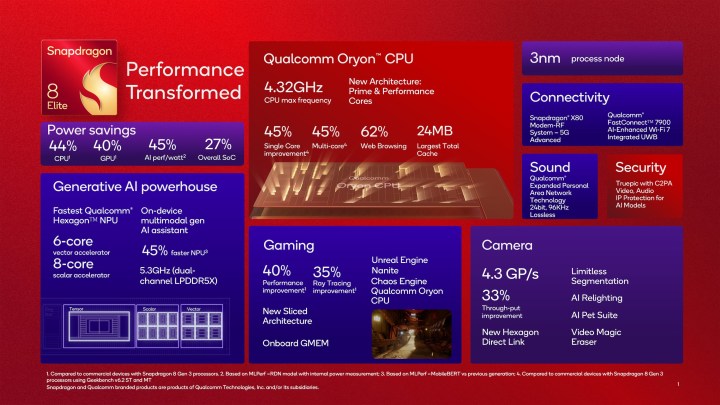
Now let’s explore the enhancements. Typically, smartphone processors feature a mix of performance and efficiency cores. Performance cores handle demanding tasks like gaming, while efficiency cores manage simpler background functions. For example, the Snapdragon 8 Gen 3 includes five performance cores, two efficiency cores, and one prime core for maximum power.
The Snapdragon 8 Elite, however, operates solely on performance cores, boasting six performance cores and two prime cores. Additionally, the clock speeds for these cores have seen a notable increase. The two prime cores can reach a clock speed of up to 4.32GHz, a sharp rise from 3.3GHz seen in the Snapdragon 8 Gen 3. Likewise, the performance cores in the Snapdragon 8 Elite are clocked at 3.53GHz, up from the Snapdragon 8 Gen 3’s 3.2GHz. According to Qualcomm, these changes result in an impressive 45% enhancement in overall CPU performance and a 44% boost in CPU power efficiency.
To underscore these claims, Qualcomm shared benchmark results comparing the Snapdragon 8 Elite with the previous generation and Apple’s A18 chip:
Geekbench 6 CPU (Single)
Geekbench 6 CPU (Multi)
Snapdragon 8 Elite
3222
10444
Snapdragon 8 Gen 3
2333
7129
Apple A18
3462
8564
In terms of single-core and multi-core performance, the Snapdragon 8 Elite significantly outperforms the Snapdragon 8 Gen 3. While Apple’s A18 chip continues to lead in single-core scores, the Snapdragon 8 Elite surpasses it in multi-core performance. We look forward to conducting our own evaluations on the Snapdragon 8 Elite soon, but the preliminary data looks promising.
This complete core design has been adopted by MediaTek with its Dimensity 9300 chip and further utilized in its newer releases. Observing Qualcomm embrace this approach is quite fascinating, and the company asserts it enables “unprecedented speeds” in the smartphone segment. On paper, this setup appears to have significant potential.
And this only scratches the surface of the Snapdragon 8 Elite’s capabilities. The new Adreno GPU features a sliced architecture for the first time, which should yield roughly 40% enhancements in both performance and power efficiency. This architecture also allows for support of Unreal Engine 5’s Nanite system, heralding a new era of high graphical fidelity for mobile gaming.
A touch of AI as well
Andy Boxall / Digital Trends
As is expected from a chip launch in 2024, advancements in artificial intelligence are also a focal point. A noteworthy enhancement is Qualcomm’s Oryon CPU, now part of the Qualcomm AI Engine, expanding the Snapdragon 8 Elite’s on-device AI capabilities that previously relied on cloud computing.
Qualcomm offered several instances, such as a multimodal AI assistant that can interpret text, voice, and images directly on the device. Additionally, improvements in photography powered by the new ISP (image signal processor) will leverage AI technology for autofocus, auto white balance, and auto exposure adjustments.
These features are intriguing, but their practical application will be dependent on manufacturers’ decisions regarding integration into their devices. For instance, while the Samsung Galaxy S25 may or may not incorporate all of these advancements, the potential is certainly impressive.
A chip to invigorate excitement
Qualcomm
Typically, discussions surrounding smartphone chips may not be the most captivating. However, when a chip like the Snapdragon 8 Elite promises such considerable improvements in both performance and efficiency, it garners attention.
The Snapdragon 8 Gen 3 has consistently showcased excellent performance during our assessments this year, being present in many of 2024’s top Android smartphones that offer impressive processing power and battery longevity. If the Snapdragon 8 Elite fulfills Qualcomm’s claims regarding enhancements, it will surely impress users.
Anticipation is building as we expect the first devices powered by the Snapdragon 8 Elite to launch in 2025, and I can’t wait to experience them first-hand.
Apple has officially announced the upcoming iPad mini, confirming its arrival less than a week ago. This new tablet is set to be loaded with features and will be driven by the powerful A17 Pro chip, the same technology found in the iPhone 15 Pro series. Not only is this device highly anticipated, but it also promises to deliver exceptional value when it comes to Apple’s latest advancements in technology.
One of the key highlights of this iPad is its emphasis on Apple Intelligence, although the service won’t be available until five days after the iPad mini’s launch on October 28. Users won’t have access to these features right out of the box, as they will need to wait for an update. The real attraction, however, is the price point. At just $349, this budget-friendly tablet is currently the most economical option available for accessing Apple Intelligence, making it a smart buy for those seeking advanced features without breaking the bank.
Bloomberg’s Mark Gurman has indicated that the main features of Apple Intelligence will not roll out until sometime between December and March. Initially, the capabilities will include summarizing notifications from various apps—a useful function, though it may not be as impressive as features like Image Creation or Smart Reply.
The long wait for this iPad refresh may be tied to the development of Apple Intelligence. The last update for the entry-level iPad was in October 2022, and fans had expected a refresh much sooner. While many anticipated the release of several new iPads featuring the A16 chip, Apple may have chosen to delay to incorporate a more powerful and compact chip that supports Apple Intelligence. Although integrating Apple Intelligence into the iPad mini at an earlier stage might have been feasible, it could also have been prohibitively expensive.
Regardless, it’s exciting to see cutting-edge features being included in a budget-friendly device, especially one priced at just $349. This iPad mini might be compact, but it promises impressive capabilities, and its functionality is likely to expand with the rollout of Apple Intelligence.
Last month, Apple unveiled iOS 18 just ahead of the iPhone 16 launch. This update rolled out several exciting features but surprisingly left out the highly anticipated Apple Intelligence, which was initially promised during the Worldwide Developers Conference (WWDC) in June. Fortunately, this omission is set to be addressed next week.
Reports from The Wall Street Journal and The Verge suggest that iOS 18.1 will be released sometime next week. Apple had indicated that this update would be available before the month ends, and this confirmation aligns with that timeframe.
The upcoming updates for iOS 18.1, iPadOS 18.1, and macOS Sequoia 15.1 will introduce the first set of Apple’s artificial intelligence capabilities, as highlighted in the spring announcements. Based on the current beta version, iOS 18.1 is expected to showcase three new features related to Apple Intelligence: enhanced writing tools, improved photo management, and streamlined notification summaries.
The writing enhancements will focus on improved autocorrect, advanced grammar and spelling checks, and predictive text features that adapt to your writing style over time. The photo cleanup feature will utilize AI to identify and recommend the removal of duplicate images, screenshots, and blurry pictures, helping to free up storage. Additionally, with the Notification Summaries, users can expect concise overviews of less critical notifications, easing the burden of managing overwhelming alerts.
Apple
In addition to iOS 18.1, a firmware upgrade for the AirPods Pro 2 will be implemented next week. This update will enable the earbuds to function as clinical-grade hearing aids for individuals with mild to moderate hearing impairments.
Additional features expected next week include sleep apnea detection for the Apple Watch Series 10 and Apple Watch Ultra 2, integration of TikTok with Apple Music, bug fixes, and more enhancements.
More features pertaining to Apple Intelligence are anticipated in future software releases before the year concludes and into 2025. Future updates may encompass enhancements to Siri, novel image creation tools, integration of ChatGPT, improved security measures, and additional features.
The following iPhones will support the Apple Intelligence: the entire iPhone 16 lineup, as well as the iPhone 15 Pro and iPhone 15 Pro Max.
Recent leaks surrounding the AMD Ryzen 7 9800X3D signal that AMD is gearing up to launch its top gaming processor very soon. Initial listings for the CPU have emerged, providing insight into potential pricing, which appears to be on the rise. While the prices vary significantly, a common theme is a notable increase. Adding to the buzz, leaked benchmark data has revealed an impressive boost clock speed.
Although the 9800X3D’s public appearance might seem premature, it’s widely believed that AMD will unveil the chip this week, right after Intel’s release of the Core Ultra 200-S. The Ryzen 7 9800X3D is expected to be officially launched in the first week of November, prompting several retailers to jump ahead and post early listings.
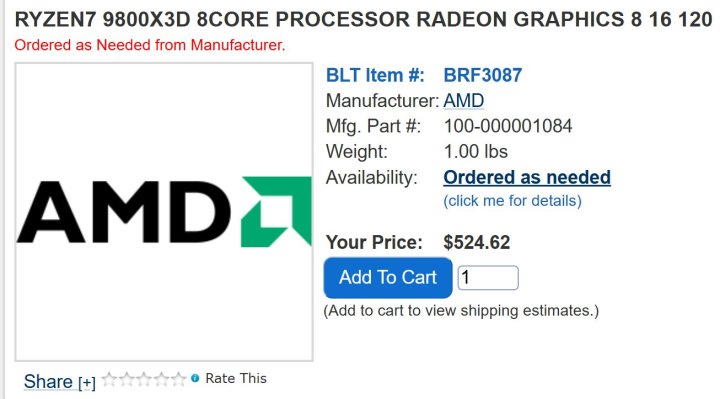
As noted by harukaze5719 on X (formerly Twitter), Shop BLT has the 9800X3D priced at $525. This marks a considerable jump from the $450 launch price of the 7800X3D. On a more positive note, Tech America (via momomo_us) lists the CPU at a more palatable $484. While this is still an increase, it’s seen as more justifiable.
Determining the perfect price for the 9800X3D is challenging, particularly since the 7800X3D is nearly sold out across many platforms, sustaining its high demand—this could pave the way for a pricier successor to the best gaming CPU available. In contrast, the 9700X debuted at $360, leaving us uncertain about the performance leap the 9800X3D will deliver in terms of synthetic benchmarks, though its gaming capabilities are expected to surpass those of its predecessor.
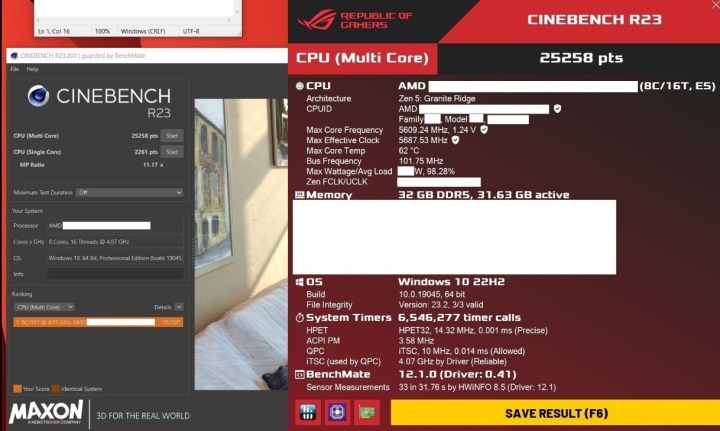
According to benchmarks shared by users such as Igor_Kavinski and itsmydamnation on the Anandtech forums, the Ryzen 7 9800X3D appears to feature a significant boost in clock speed. It’s reportedly capable of reaching 5.7GHz, a notable enhancement over the 5GHz maximum of the 7800X3D. These scores were obtained from an engineering sample utilizing Precision Boost Overdrive (PBO). The testing environment noted running Windows 10 22H2, which suggests that further performance gains may be achievable, especially following recent updates for Zen 5 processors.
The CPU also achieved 25,258 points in the Cinebench R23 multi-core test, outpacing both the 9700X and the 7800X3D, though it still trails significantly behind the Core i9-14900K. Nevertheless, the 3D V-Cache should ensure that the Ryzen 7 9800X3D excels in gaming scenarios. The key question is not its level of performance, but rather how much of an upgrade it will be over its predecessor.
Another source, uncovered by VideoCardz, indicates an advancement in the base frequency for the Ryzen 7 9800X3D as well. MaxSun has reported a base clock of 4.7GHz, significantly higher than the 3.8GHz clock of the 9700X. As the launch date approaches, further details on the CPU’s final specs will soon become available, but for now, it’s wise to approach these developments with a degree of caution.
Last week, SpaceX’s Super Heavy rocket took center stage during a thrilling test flight, successfully being captured by the massive mechanical arms of the launch tower on its first try.
Moments before that remarkable catch, the Super Heavy booster had delivered the upper-stage Starship spacecraft into orbit, marking the fifth test flight of the most powerful rocket on the planet.
Though it didn’t steal the spotlight, the spacecraft experienced a spectacular journey, traveling across the globe from its launch site in Boca Chica, Texas, to perform a landing burn before splashing down in the Indian Ocean. Impressively, it landed exactly at SpaceX’s designated spot, with a buoy equipped with a camera deployed to document its final descent and splashdown approximately 65 minutes post-launch.
Starship flip maneuver and landing burn on its fifth flight test. Vehicle improvements ensured flaps were protected from high heating, resulting in a controlled entry and high accuracy splashdown at the targeted area in the Indian Ocean pic.twitter.com/nLIQLLVMv1
According to a message from SpaceX, led by Elon Musk, “Starship performed another successful hot-staging separation, igniting its six Raptor engines and completing its ascent into space.” The spacecraft then cruised along its planned trajectory to the opposite side of the planet before executing a controlled re-entry. It navigated through peak heating and maximum aerodynamic pressure phases before performing a flip maneuver, landing burn, and ultimately splashing down in its target area in the Indian Ocean.
On its official website, SpaceX remarked that the team involved in this latest test flight should “take pride in their engineering accomplishments. The world witnessed a preview of the future when Starship begins transporting crew and cargo to destinations such as Earth, the moon, Mars, and beyond.”
Looking ahead, SpaceX has announced plans to catch the Starship spacecraft in the same manner they successfully captured the Super Heavy booster during this test. The spacecraft is also designed to land upright on solid ground, a critical capability it will need for missions to other celestial bodies, including the moon, as part of the Artemis III mission scheduled for 2026, which aims to return humans to the lunar surface.