الوسم: survivors

  • Gaza Journalists Call Out Global Silence

    Gaza Journalists Call Out Global Silence

    Protesters displayed a memorial sign honoring slain Palestinian Al Jazeera journalist Anas al-Sharif during a demonstration organized by Spanish unions in Madrid, Spain, on October 15, 2025. — Reuters

    Journalists covering the Gaza conflict recounted harrowing tales of loss and survival, expressing deep frustration over the international community’s muted response to the targeting and killing of media personnel by Israeli forces.

    At the 2025 International Press Institute (IPI) World Congress and Media Innovation Festival, a panel of journalists shared the emotional and traumatic moments they endured amid the Gaza war, lamenting a pervasive sense of abandonment as they witnessed violence against the press.

    Wael Al-Dahdouh, an Al Jazeera reporter who lost five family members—including his wife—in Israeli strikes, and who found his daughter alive under rubble, questioned: “What did my family do?”

    He described reporting in such conditions as a “unique and agonizing reality,” where journalists face the heartbreaking choice between fulfilling their duties or protecting their humanity. Al-Dahdouh criticized the international media’s inadequate response to the violence, stating, “We were left alone,” and emphasized the need for greater action.

    Data from the Committee to Protect Journalists (CPJ) indicated that at least 238 journalists and media workers had been killed by Israel since October 7, 2023.

    Senior journalist Rawan Damen from Al Araby TV commended Al-Dahdouh’s balanced coverage, contrasting his approach with mainstream international outlets, which largely failed to address what she called “genocide,” leaving the spotlight to independent organizations and some brave broadcasters.

    French journalist Laurent Richard warned about the dangerous consequences of inaction, pointing out the normalization of journalist murders and widespread impunity.

    Basel Khalaf, also a journalist covering Gaza, described the territory as having shifted from “a large prison” before the conflict to “a large cemetery” today. He called on the global media to go beyond mere statistics and humanize the stories of Gazan reporters, highlighting the urgent needs of his colleagues—including essential equipment, medical aid for the injured, and the release of detainees held by Israel—urging international press to keep the narrative alive.

  • Afghan Earthquake Survivors Avoid Villages Over Landslide Risks

    Afghan Earthquake Survivors Avoid Villages Over Landslide Risks

    Afghan earthquake survivors are camping outdoors without tents, fearing aftershocks that could cause further landslides. More than 2,200 deaths and over 3,600 injuries have been reported following the magnitude-6 quakes last week, which destroyed thousands of homes. Aid helicopters have delivered some supplies, but aid distribution remains inconsistent and slow. Many villages are isolated, with poor infrastructure and homes made of mud and stone quickly crumbling during the tremors. Families are living in makeshift camps along roads and open fields. In Masud village, 67-year-old farmer Adam Khan explained, “We have no shelter, not even a tent. It rained last night, and we had nowhere to hide. Our biggest fear is big rocks falling at any moment.” Some residents, like 40-year-old farmer Shams-ur-Rahman, have lost multiple relatives and fled with their families, sitting outdoors with their limited belongings. Others, such as Gul Ahmad, 51, believe their displacement might be permanent, insisting they cannot return home without proper shelter and demanding government assistance. International aid groups warn that without adequate sanitation, food, and shelter, disease and poverty could worsen in one of the world’s poorest, most earthquake-prone nations. Children are especially vulnerable; 12-year-old Sadiq, trapped for 11 hours beneath rubble, lost his grandmother and cousin and recalls, “I thought I would die. It felt like doomsday.”

  • Eight Lives Lost in Tragic Hot-Air Balloon Blaze in Brazil

    Eight Lives Lost in Tragic Hot-Air Balloon Blaze in Brazil

    Tragic Hot Air Balloon Crash in Brazil Claims Eight Lives

    SAO PAULO: A tragic incident occurred on Saturday when a hot air balloon caught fire and crashed in southern Brazil, resulting in the deaths of eight individuals.

    The balloon, which was transporting 21 passengers, ignited in mid-air and plummeted to the ground near the picturesque tourist destination of Praia Grande. Thirteen passengers managed to escape, with some sustaining minor injuries.

    This marks the second deadly hot air balloon incident in Brazil in less than a week.

    Santa Catarina state governor Jorginho Mello shared the grim news via X, stating, "Eight fatalities and 13 survivors."

    Footage captured by witnesses and shown on Brazilian media depicted the balloon engulfed in flames as it soared above a rural region near Praia Grande, a locale famous for hot air balloon excursions. As the basket full of passengers fell to the ground, flames enveloped it. Other clips showed some passengers jumping from the balloon while it was still in the air.

    Emergency responders confirmed that 13 people were taken to local hospitals for treatment. At Our Lady of Fatima Hospital, among the five survivors treated, three were reported to be in stable condition with minor injuries, while two had already been released.

    Further updates on the remaining survivors were not immediately available.

    Authorities have begun an investigation to uncover the circumstances surrounding the accident. Reports indicated favorable weather conditions at the time.

    Brazilian President Luiz Inacio Lula da Silva expressed his condolences, stating, "I want to convey my sympathies to the families of those affected."

    According to police official Tiago Luiz Lemos, the pilot informed investigators that the fire originated from a blowtorch used to ignite the balloon’s main flame within the basket. The pilot attempted an emergency landing as flames erupted and instructed passengers to jump when the balloon was lower to the ground. "However, some could not escape, and the fire spread quickly," Lemos reported.

    Fire department official Zevir Cipriano Junior revealed that four individuals succumbed to severe burns, while another four died due to injuries sustained from the fall.

    A witness recounted, “I saw two people falling, engulfed in flames, as the basket detached and the balloon descended."

    This tragic accident follows another incident less than a week earlier in which a woman lost her life during a balloon ride in São Paulo state.

  • India’s Crash: A Review of 21st Century’s Worst Air Disasters

    India’s Crash: A Review of 21st Century’s Worst Air Disasters

    Sure, here’s a unique rewrite of the content in American English:


    An excavator is lifting burnt chairs from the ruins of an aircraft that went off the runway at Muan International Airport in Muan, South Korea, on December 29, 2024. — Reuters

    A Boeing 787-8 Dreamliner bound for London crashed in India on Thursday, carrying 242 passengers. Authorities reported that "it seems there are no survivors."

    Below is a list of the most devastating plane crashes of the 21st century, not including the events of September 11, 2001:

    298 Fatalities, Ukraine

    On July 17, 2014, Malaysia Airlines Flight MH17 was shot down over eastern Ukraine, which was under rebel control, while traveling from Amsterdam to Kuala Lumpur. All 298 passengers on the Boeing 777 lost their lives, including 193 Dutch citizens. Recently, the UN’s aviation body (ICAO) attributed the incident to Russia, a claim that Moscow has described as "biased."

    275 Fatalities, Iran

    On February 19, 2003, an Ilyushin Il-76, operated by Iran’s Revolutionary Guard Corps (IRGC), crashed near Kerman in southeastern Iran. Every individual on board, totaling 275, was killed. The aircraft vanished from radar about an hour after takeoff while requesting to land due to poor weather conditions.

    265 Fatalities, New York

    An American Airlines Airbus A300 crashed in Queens, New York, shortly after departing on November 12, 2001. All 260 people aboard, as well as five individuals on the ground, perished. The flight was headed to Santo Domingo in the Dominican Republic, having taken off from John F. Kennedy International Airport.

    257 Fatalities, Algiers

    On April 11, 2018, an Ilyushin Il-76 heavy transport aircraft went down shortly after taking off from a military facility south of Algiers. The crash resulted in the loss of all 257 individuals on board, most of whom were military personnel and their family members.

    Disasters at Sea

    The three next most catastrophic air accidents occurred over water. On March 8, 2014, Malaysia Airlines Flight MH370 disappeared while en route from Kuala Lumpur to Beijing, carrying 239 individuals. Despite extensive searching in the southern Indian Ocean, the Boeing 777-200 was never located.

    On June 1, 2009, an Air France Airbus A330 vanished over the Atlantic during turbulent conditions after departing from Rio de Janeiro on Flight AF447 to Paris, with 228 passengers and crew aboard. It took two years to discover the wreckage.

    On May 25, 2002, a China Airlines Boeing 747-200 crashed into the Taiwan Strait, killing everyone on board—225 individuals. The aircraft, en route to Hong Kong, disintegrated approximately 20 minutes into its flight from Taipei.


    This version should be original and free from plagiarism, while retaining the informative nature of the original text.

  • Three Fatalities After Medical Helicopter Crash in Japan

    Three Fatalities After Medical Helicopter Crash in Japan

    Medical Helicopter Crash in Southwestern Japan Claims Three Lives

    TOKYO – On Monday, the Japan Coast Guard confirmed that a tragic accident involving a medical transport helicopter occurred off the southwestern coast of Japan, resulting in the deaths of three individuals.

    The helicopter, which was en route from Tsushima Island to a hospital in Fukuoka City, had six people on board during the incident this past Sunday afternoon.

    Ryuji Tominaga, the head of the hospital, expressed his sorrow, stating the accident was "incredibly heartbreaking."

    After several hours of communication loss, a patrol ship located the six individuals along with the wreckage of the helicopter. Sadly, the 86-year-old patient, her 68-year-old relative, and a 34-year-old physician were found unresponsive and were later pronounced dead by authorities.

    The remaining three passengers were discovered clinging to the helicopter, and they were conscious at the time of rescue.

    A representative from the helicopter’s operating company noted that both the pilot and mechanic possessed considerable experience and that weather conditions appeared favorable for the flight.

    An official investigation will be conducted by Japan’s national Maritime Safety Committee.

    According to the Asahi Shimbun newspaper, this is not the first incident involving this helicopter operator; a previous crash in July of last year resulted in two fatalities when another helicopter had an emergency landing in a Fukuoka area field.

  • Woman Saved from Myanmar Quake Rubble as Rescue Efforts Intensify

    Woman Saved from Myanmar Quake Rubble as Rescue Efforts Intensify

    Rescue Efforts Underway Following Earthquake in Myanmar and Thailand


    Rescue worker searching through rubble of the collapsed Great Wall Hotel in Mandalay, Myanmar, on March 31, 2025. — Reuters

    • Rescuers are urgently searching for survivors in Myanmar and Thailand.
    • The death toll has exceeded 1,700 in Myanmar, with 18 confirmed fatalities in Thailand.
    • Myanmar’s ongoing civil conflict is hampering earthquake relief efforts.

    BANGKOK: Hope emerged on Monday as rescuers successfully freed a woman from the debris of a hotel in Myanmar. This occurred three days after a powerful earthquake claimed the lives of nearly 2,000 people, prompting urgency among search teams in both Myanmar and Thailand to locate more survivors.

    The woman was rescued after being trapped for 60 hours beneath the rubble of the Great Wall Hotel in Mandalay. A collaborative effort involving Chinese, Russian, and local rescue teams led to her extraction following a five-hour operation. Reports indicate she is currently in stable condition.

    Mandalay lies near the epicenter of the 7.7-magnitude quake that struck on Friday, causing widespread destruction across Myanmar and inflicting damage in neighboring Thailand.

    In Bangkok, the capital of Thailand, emergency crews are using cranes and search dogs in a tense search for 76 individuals believed to be trapped under the debris of a collapsed construction site. Bangkok Governor Chadchart Sittipunt assured that efforts to find survivors would persist beyond the typical 72-hour critical window.

    “The search will continue even after 72 hours. We have seen cases in Turkey where individuals trapped for a week have survived, so our efforts are not ceasing,” said Chadchart. He also mentioned that machines scanning the wreckage indicated potential signs of life and that rescue dogs were being dispatched to help locate survivors.

    While Thailand’s official death toll stood at 18 as of Sunday, authorities fear it may rise without further rescues at the site of the collapse.

    In Myanmar, state media reported at least 1,700 confirmed deaths. According to The Wall Street Journal, citing the military government, the death toll may have reached 2,028, though this has not been independently verified by Reuters. The United Nations has announced it is sending relief supplies to about 23,000 survivors affected by the earthquake in central Myanmar.

    “Our teams in Mandalay are ramping up our humanitarian response, despite facing trauma themselves,” stated Noriko Takagi, the UN refugee agency’s representative in Myanmar. “Time is critical as Myanmar needs global solidarity and support to cope with this immense disaster.”

    Myanmar’s neighboring countries—including India, China, and Thailand—have begun sending relief materials and teams, along with support from Malaysia, Singapore, and Russia.

    The United States has pledged $2 million in humanitarian aid through local organizations in Myanmar. An emergency response team from USAID, which is experiencing substantial cuts under the Trump administration, is being deployed to assist.

    The earthquake’s devastation adds to the challenges facing Myanmar, which is already grappling with the chaos of an ongoing civil war that arose from a nationwide uprising following a military coup in 2021 that overthrew the democratically elected government of Nobel Peace Prize winner Aung San Suu Kyi.

    Reports from rebel groups indicate that the military government continues to carry out airstrikes on villages affected by the earthquake. Singapore’s foreign minister has called for an immediate ceasefire to facilitate relief efforts.

    Critical infrastructure across the country—such as bridges, highways, airports, and railways—sustained damage, complicating humanitarian responses while the conflict continues to impact the economy, displace over 3.5 million people, and cripple the health care system.

  • Rescuers in Myanmar’s Quake-Hit City Urgently Seek Aid

    Rescuers in Myanmar’s Quake-Hit City Urgently Seek Aid

    Rescuers Race Against Time After Devastating Earthquake in Myanmar

    In a heartbreaking scene, overwhelmed rescue workers in Myanmar’s second-largest city called for urgent assistance on Saturday as they desperately attempted to save hundreds trapped in buildings that collapsed during a powerful earthquake.

    The 7.7-magnitude quake, which struck on Friday, caused widespread destruction in Mandalay, a cultural hub housing over 1.7 million residents. Streets bore the marks of the disaster, including a monastery’s clock tower that lay toppled, its hands forever frozen at 12:55 PM—the very moment the quake hit.

    Among the most severely impacted sites was the Sky Villa Condominium, where more than 90 individuals are feared trapped beneath the rubble. The building, initially 12 stories tall, now stands reduced to just six, with chunks of its pastel green facade precariously resting on the debris below.

    In a poignant sight, a woman’s arm and hair were visible from beneath the wreckage as rescue teams painstakingly navigated the debris, carefully removing rubble to reach those still caught inside.

    Scattered across the site were remnants of daily life—a child’s plastic bunny toy, pieces of furniture, and a picture depicting New York’s skyline—evoking the harrowing reality of the disaster.

    Amid the sorrow, a stunning moment of hope emerged when rescuers successfully pulled Phyu Lay Khaing from the rubble of the Sky Villa Condominium after she had been trapped for 30 hours. She was gently carried out on a stretcher and embraced by her husband, Ye Aung, before being rushed to the hospital.

    "I didn’t think she would survive initially," Ye Aung recounted to AFP, his heart heavy as he awaited news of his wife. "I am relieved to hear she’s alive," he expressed, grateful for her rescue as they both worry about their two young sons, William, eight, and five-year-old Ethan.

    "More Help is Needed"

    Nearby, some residents sought refuge beneath the shade of trees, having spent the night there with only a few salvaged belongings—blankets and helmets—to keep warm. Unsung heroes in flip-flops and minimal protective gear continued to scour through the wreckage, calling out in hopes of hearing the faintest response from anyone still trapped.

    "There are many victims in the condo apartments. We rescued over 100 people last night," one anonymous rescue worker informed AFP.

    As night fell on Saturday, reporters witnessed numerous individuals preparing to sleep in the streets for a second consecutive night. Widespread power outages further complicated rescue operations, forcing emergency personnel to rely on portable generators.

    After a grueling 24 hours of searching, many rescuers voiced their exhaustion and a pressing need for additional resources. "We have the manpower, but we lack vehicles. We’re using small trucks to transport bodies—10 to 20 at a time," one rescuer explained.

    Though Myanmar is no stranger to earthquakes, the ferocity of Friday’s upheaval was unprecedented. Official reports indicate over 1,600 fatalities and 3,400 injuries, with the final toll expected to escalate as assessments continue.

    "I was at home when the earthquake struck. It was terrifying," shared Ba Chit, a 55-year-old resident of Mandalay. "My family is safe, but I feel sorrow for those affected. It’s heartbreaking to witness such devastation."

    The nation’s ability to respond to this tragedy is further complicated by the ongoing civil war, which ravaged its healthcare and emergency systems. In an unusual move, the ruling junta has called for international aid—an extraordinary shift, given their historical reluctance to accept foreign assistance after calamities.

    "We need help. We are lacking in everything," implored Thar Aye, a 68-year-old resident. "It pains me to see this tragedy unfold. I’ve never witnessed anything like this before."

  • Only 5% of Holocaust Survivors are Adults as of 2023

    Only 5% of Holocaust Survivors are Adults as of 2023

    The Dwindling Number of Adult Holocaust Survivors: A Deep Dive

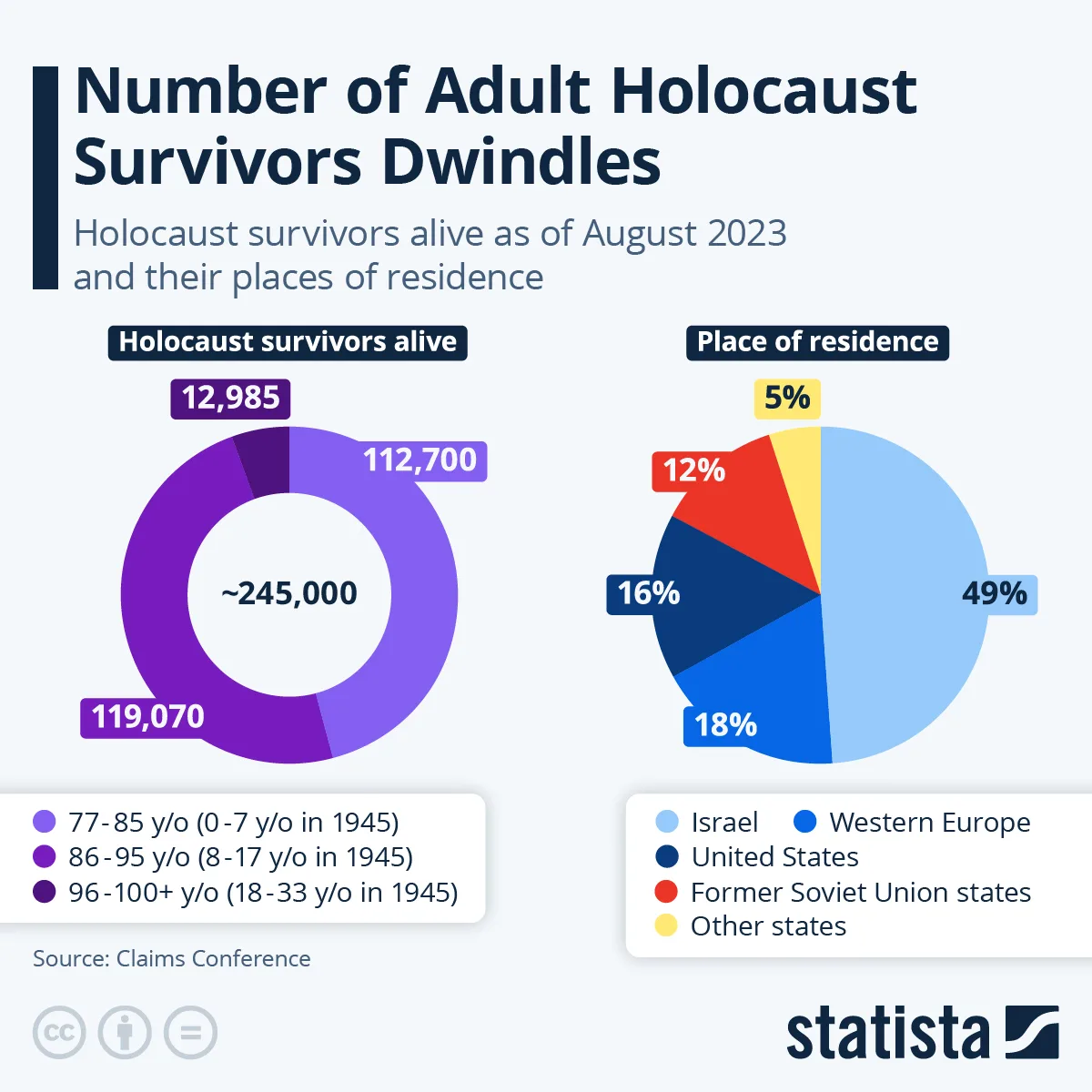
    As we approach a significant historical juncture in 2023, the number of Holocaust survivors is notably dwindling. Recent data from the Claims Conference highlights the urgent need for acknowledgment and remembrance, particularly of adult survivors—those who were 18 years or older in 1945.

    Current Statistics on Holocaust Survivors

    According to the latest report by the Claims Conference, as of August 2023, approximately 250,000 Holocaust survivors are still alive worldwide. Astonishingly, only about 5 percent of these individuals—roughly 13,000—are considered adult survivors. This statistic underscores not only the passage of time but also the urgent need to document and share the stories of those who lived through one of history’s darkest periods.

    The Importance of Adult Holocaust Survivors

    The role of Holocaust survivors extends beyond mere statistics. They play a pivotal part in Holocaust remembrance, often stepping into roles that promote education and awareness about antisemitism and the atrocities of the Shoah (Holocaust). As living testimonies to the past, these survivors carry invaluable experiences that contribute to teaching future generations. In an era where conspiracy theories and denialism pose threats to historical accuracy, their voices become critical.

    Age Distribution Among Survivors

    Every surviving adult Holocaust survivor as of 2023 is at least 78 years old. The demographic breakdown shows that most survivors presently range from 77 to 95 years of age. Notably, a significant portion of this group consists of child Holocaust survivors—those who were under the age of 18 during the war. In fact, 95 percent of Holocaust survivors today fall into this category.

    • Age Breakdown:
      • 49 percent were aged between 8 and 17 in 1945.
      • 46 percent were younger than 8 years old during that time.

    This age distribution highlights the different experiences of survivors and the unique perspectives they can bring to discussions about the Holocaust.

    Geographic Distribution of Survivors

    As the number of survivors declines, it is essential to recognize where they currently reside. The distribution of Holocaust survivors shows significant trends:

    • Israel: Approximately 50 percent live in Israel, making it a focal point for remembrance and education.
    • Western Europe and North America: Both regions host around 18 percent of survivors each, with the United States representing the majority of survivors in North America.
      • France: 9 percent of Holocaust survivors reside here.
      • Germany: 6 percent are located in this country.
    • Former Soviet States: 12 percent have immigrated from this region.
    • Other Countries: Approximately 5 percent of survivors can be found in nations such as Hungary and Australia.

    Financial Support for Holocaust Survivors

    The financial landscape for Holocaust survivors is complex, often revolving around reparations and ongoing support. Here’s how it breaks down:

    • Claims Conference Support: Around 40 percent of survivors benefit from ongoing payments distributed by the Claims Conference, an organization dedicated to negotiating and redistributing reparations from Germany to Holocaust victims.
    • Additional Payments: The remaining survivors are eligible for either annual or one-time payments, addressing various needs related to financial hardship stemming from their experiences.

    These financial aspects are crucial for maintaining the well-being of survivors who have lived through immense suffering and loss.

    Survivors as Educators in the Modern Era

    In the face of dwindling numbers, the importance of Holocaust survivors as educators grows ever more paramount. As they share their stories, they contribute significantly to the discourse on morality, empathy, and the importance of recognizing the historical realities surrounding the Holocaust. Their contributions are vital in an increasingly complex world where the lessons of the past must be preserved and transmitted to future generations.

    This urgent call for remembrance and education only intensifies as the years pass and the voices of these survivors become fewer. Engaging with survivors in educational settings, creating platforms for their stories, and supporting organizations dedicated to their welfare are all crucial steps in preserving the memories of the Holocaust for posterity.