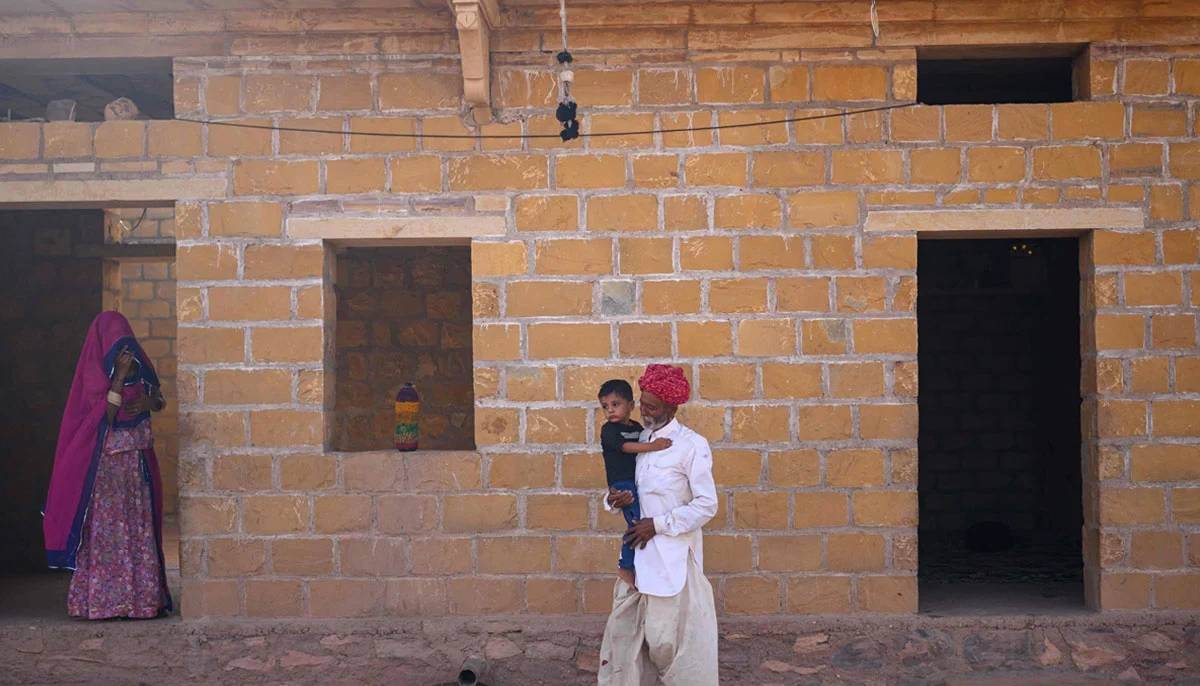
On India’s scorching plains, the increasingly intense summers make survival more challenging, pushing people to adapt and live during the cooler dark hours before the sun’s heat becomes unbearable.
“We try to adapt, but traditional methods for fighting the heat aren’t enough anymore,” said 26-year-old herdsman Sawai Bhati Singh, who lives outside Jaisalmer, a desert city in Rajasthan. “Every year, the heat keeps getting worse.”
His home, constructed from thick stone blocks with few windows, offers some relief from the intense heat, but the interior remains oppressively hot.
The country is no stranger to extreme temperatures, but decades of scientific studies reveal that climate change is causing heatwaves to last longer, occur more often, and become more severe.
In Singh’s village of Sanwata, early June temperatures reached 45°C, a common occurrence during summer. The highest recorded temperature in the area has been 49°C. Singh worries about his young children, aged two and four, who play barefoot in the dust.
He drinks water stored in bottles wrapped in handmade jute to keep it cool, a simple evaporation trick. His wife and mother struggle in a separate kitchen hut with a thatched roof for ventilation, cooking over a wood fire.
All water is drawn from a nearby well, then cooled in bottles wrapped in woven jute string to utilize evaporation. Singh’s livestock—goats and cattle—also suffer in the heat.
“They stay in the shade,” he says. “The heat affects their eating, which means less milk for us.” Temperatures in their village hit 45°C early in June, with a record high of 49°C. Last year, they bought their first air cooler, which uses wet fibers, and now they own two.
Meanwhile, on the lush floodplains of the Yamuna River near New Delhi, farmer Bhole Shankar faces a different but related crisis. The city recorded 46.5°C this summer, just below the scorching 49.9°C peak of 2024.
“Living near the floodplain feels cooler than living among houses,” said Shankar, 36, standing outside a makeshift hut made of plastic sheeting attached to bamboo poles. “But some days, it feels like day and night are the same.”
Shankar’s family—which includes his wife and three sons aged between nine and 16—live beneath the city’s power lines, though their home isn’t connected to the grid. A small solar panel powers a fan that pushes hot air around.
They adjust their routine to avoid the worst of the heat, working in the fields early in the morning, resting in the shade during peak heat, and checking their crops again at dusk.
His son, Tejpal, is fixing a portable electric fan inside their shanty, trying to stay cool in the 40°C weather. To sleep, they roll down plastic walls of their tent and lie on traditional rope lattice beds, which allow air to circulate.
Shankar pours himself fruit juice after a day of work, noting that each year seems hotter than the last. “We try to stay in the shade, but it’s tough when you’re a farmer.”