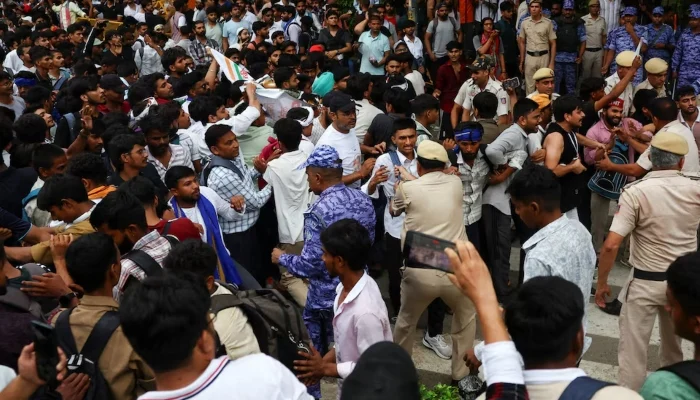
Supporters of India’s youth-led “Cockroach” movement faced police baton strikes on Monday as they attempted to march on Parliament in New Delhi, despite authorities refusing permission for the demonstration.
This movement, which has risen over several months, along with the planned protest, represents one of the most significant challenges to Prime Minister Narendra Modi during his third term. Social media contributed to rallying millions of supporters, broadening its reach.
A decision by police to forcibly transfer hunger-striking activist Sonam Wangchuk to a hospital on Saturday fueled the movement’s momentum. Thousands of supporters gathered overnight at Jantar Mantar, in central Delhi, preparing to march as Parliament launched its monsoon session.
Delhi police conducted meetings with members of the Cockroach Janta Party (CJP), but no agreement had been reached, according to Sachin Sharma, Delhi’s Deputy Commissioner of Police.
“We are out of space at the protest site, which could lead to an unsafe situation,” Sharma said, noting that around 10,000 protesters were present Monday morning.
Large numbers of police and paramilitary forces were stationed at the location, raising the possibility of a standoff if the march proceeds.
Footage aired on TV showed police striking some protesters within a heavily barricaded area. However, Delhi Police claimed that no force was employed and that the protest was being managed professionally.
Protesters arrived peacefully amid rain, chanting slogans such as “Quit, quit.” They also called for Prime Minister Narendra Modi and Education Minister Dharmendra Pradhan to resign, shouting in Hindi.
Saurav Das, the CJP’s chief spokesperson, told ANI news agency, “The government contacted us late, but we are open for dialogue. We want to resolve this peacefully.”
The CJP movement gained initial traction online, amassing 22 million Instagram followers in days, and has since received backing from opposition parties. Founder Abhijeet Dipke and supporters started a sit-in last month demanding Pradhan’s resignation. Wangchuk joined on June 28, starting an indefinite hunger strike.
In a handwritten note shared via his X account, Wangchuk stated he would end his fast if the government acknowledged its recent failures in the education system and paper leaks or allowed protesters to reach Parliament with assurances from lawmakers to address their concerns. He also said he would halt his hunger strike if political leaders visited him in the hospital and offered similar guarantees, as his health no longer allowed him to march.
The rise of the CJP underscores the growing frustration among young Indians over issues like rising youth unemployment and frequent exam paper leaks. Official data shows unemployment in 2025 stood at 3.1%, but among those aged 15 to 29, it reached 9.9%. Urban unemployment was 13.6%, while rural areas reported 8.3%.
