
Tag: storm

  • Typhoon Bavi prompts massive evacuations heading for China

    Typhoon Bavi prompts massive evacuations heading for China

    Heavy rain clouds blanketed Wenzhou’s downtown area as Typhoon Bavi drew near on July 11, 2026, in Zhejiang province, China. The storm has caused the evacuation of over 600,000 residents in China, especially in the city of Wenzhou, which is home to approximately 10 million people. This move came after Bavi pounded Japan’s Sakishima Islands with intense rainfall and fierce winds, then brushed past northern Taiwan.

    Although Bavi is gradually losing strength and moving over colder waters, it remains a significant threat due to the enormous amount of moisture contained within its rainbands—stretching roughly the length of France. Meteorologists predict the typhoon will make landfall in Wenzhou early Sunday morning.

    State media reported that more than 500,000 individuals had been evacuated in Zhejiang Province, where Wenzhou is situated, with an additional 100,000 evacuees in neighboring Fujian Province. Wenzhou resident Huang Xinghuan, 50, expressed cautious optimism while shopping at a local wet market before the storm’s arrival. “I’m a bit worried, but I believe everything will be alright. We’ve experienced typhoons before, and we’ll get through this,” he said. Huang’s family has stocked enough water to last around two to three days and feels confident that supplies are sufficient, emphasizing that there’s no need for panic buying.

    While no fatalities have been reported in Japan and Taiwan due to Bavi, the typhoon’s heavy rains contributed to the death of 17 people in the Philippines, exacerbated by the intensified southwest monsoon. Taiwan’s fire department reported injuries to 87 people, mainly from falls off motorcycles or bicycles, or from being hit by falling objects.

    Taiwan took proactive measures, evacuating over 14,000 people from mountainous regions as the nation prepared for Bavi’s approach. Although the storm did not directly make landfall, authorities issued precautions to prevent casualties, anticipating nearly 1 meter (3 feet) of rainfall in some areas.

    Most evacuations occurred in northern and eastern parts of Taiwan, resulting in the cancellation of 920 international flights and the shutdown of Taoyuan International Airport outside Taipei—the country’s main gateway—as well as all 282 domestic flights. With most schools and offices closing for the weekend, the country declared a typhoon holiday, although some restaurants and convenience stores in Taipei remained open. The primary north-south high-speed rail line continued running but with limited service.

    In Taipei, residents experienced gusty winds and rain, with some staying outdoors. Yeh Mao-hsiung, 68, dismissed the storm’s severity, saying, “It’s fine, just a bit more wind.” Nonetheless, in the Beitou district near the mountains, winds approaching 60 mph toppled trees and caused rivers to swell.

    Wenzhou resident Chen Qiuqin, in her sixties, walked through steady rain on her way to her parents’ home to help prepare for the typhoon. She was not overly worried, citing the government’s preparations. “I was concerned about the flowerpots on my mother’s balcony, so I came to help move them inside. My parents are elderly and home alone, so I wanted to make sure they’re safe,” she shared.
  • Rescue Teams Seek Missing Amid China Storms After 100,000 Evacuated

    Rescue Teams Seek Missing Amid China Storms After 100,000 Evacuated

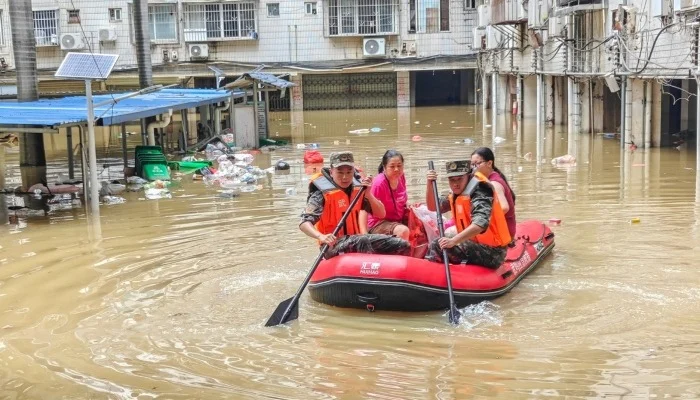
    Paramilitary police officers evacuate residents via rubber dinghy after flooding caused by Typhoon Maysak in Nanning, Guangxi Zhuang Autonomous Region, China, on July 6, 2026. — AFP

    – Severe storms and landslides have resulted in 38 fatalities.
    – Floodwaters have damaged approximately 13,000 acres of farmland.
    – Over 130,000 residents have been forced to evacuate.

    Rescue teams searched flood-affected areas in China for survivors following deadly storms that claimed 17 lives, overwhelmed numerous rivers, and caused a reservoir dam to break. Authorities warned that heavy rainfall would continue into Wednesday.

    In Guangxi’s southern region, six individuals lost their lives, and more than 130,000 people evacuated due to relentless rain and severe flooding from Typhoon Maysak, according to regional officials. Forecasts indicate that rainfall will persist not only in Guangxi but also in neighboring Guangdong Province.

    Muddy, fast-moving waters burst the banks of 40 rivers and waterways in Guangxi, ruining nearly 13,000 acres of agricultural land, reported state media. Videos broadcast by CCTV showed floodwaters rushing past the remains of a broken reservoir dam while rescue workers, equipped with life jackets, operated inflatable boats.

    Additional disaster relief supplies—including food, raincoats, and rubber boats—are being dispatched to the region, according to Xinhua News Agency.

    Guangxi’s flood control response remains at a high alert level, with authorities warning that peak water levels could exceed the warning mark by over six meters (about 20 feet) at the Wuzhou Hydrological Station early Thursday. Li Guoying, Minister of Water Resources, noted that the ongoing heavy rains and prolonged flooding pose a serious risk to reservoirs and embankments in the area.

    Thunderstorms and strong winds killed an additional 11 people and injured 331 in Hubei Province, with reports of tornadoes elsewhere late Monday, Xinhua reported. One person is listed as missing, and around 4,800 homes have been damaged or collapsed.

    China frequently experiences natural disasters during the summer, with some regions enduring intense rainfall while others face scorching heat.

    President Xi emphasized the importance of mobilizing all resources for emergency response, according to CCTV.

    In northwestern Gansu Province, the death toll from a recent landslide increased to 21, after earlier reports of 33 fatalities. The landslide struck around 6:56 a.m. Tuesday at Rencang Village in Dangchang County, and rescue efforts concluded with the confirmation of 21 deaths, according to local authorities. The cause of the landslide remains under investigation. Reconstruction funds totaling 30 million yuan (approximately $4.4 million) have been allocated for recovery efforts.

  • The Ultimate Guide to Completing the Goblin Storm Commander Deck in MTG

    The Ultimate Guide to Completing the Goblin Storm Commander Deck in MTG

    Not all Magic: The Gathering Commander decks are sold through retail stores; some are only available through Secret Lair. The newest deck released via this limited-edition service is Goblin Storm, which offers a fun, cartoon-style twist on some of our favorite goblin Commanders, including Krenko, Mob Boss, and Zada, Hedron Grinder.

    This highly aggressive Goblin deck features artwork from Wizard of Barge. Based on past Secret Lair releases, it’s expected to sell out quickly and likely surpass its $150 retail price early on.

    The complete Goblin Storm deck list is now available. As expected, it’s a Mono-Red deck with a single focus: winning as fast as possible.

    The deck includes these main cards:

    – Krenko, Mob Boss (Creature)
    – Zada, Hedron Grinder (Creature)
    – Pashalik Mons (Creature)
    – Broadside Bombardiers (Creature)
    – Conspicuous Snoop (Creature)
    – Skirk Prospector (Creature)
    – Roaming Throne (Creature)
    – Goblin Chieftain (Creature)
    – Goblin Dark-Dwellers (Creature)
    – Goblin Lackey (Creature)
    – Goblin Thashmaster (Creature)
    – Grenzo, Havoc Raiser (Creature)
    – Howlsquad Heavy (Creature)
    – Redcap Gutter-Dweller (Creature)
    – Rundvelt Hordemaster (Creature)
    – Searslicer Goblin (Creature)
    – Siege-Gang Commander (Creature)
    – Siege-Gang Lieutenant (Creature)
    – Gempalm Incinerator (Creature)
    – General Kreat, the Boltbringer (Creature)
    – Goblin Bushwhacker (Creature)
    – Goblin Matron (Creature)
    – Goblin Warchief (Creature)
    – Impulsive Pilferer (Creature)
    – Mogg War Marshal (Creature)
    – Storm-Kiln Artist (Creature)
    – Frontline Heroism (Enchantment)
    – Goblin Bombardment (Enchantment)
    – Boggart Shenanigang (Enchantment)
    – Impact Tremors (Enchantment)
    – Quest for the Goblin Lord (Enchantment)
    – Skullclamp (Artifact)
    – Sol Ring (Artifact)
    – Idol of Oblivion (Artifact)
    – Ruby Medallion (Artifact)
    – Throne of Eldraine (Artifact)
    – Swiftfoot Boots (Artifact)
    – Brightstone Ritual (Instant)
    – Chaos Warp (Instant)
    – Great Train Heist (Instant)
    – Ancestors’ Aid (Instant)
    – Battle Hymn (Instant)
    – Crimson Wisps (Instant)
    – Expedite (Instant)
    – Fists of Flame (Instant)
    – Sazacap’s Brew (Instant)
    – Seething Song (Instant)
    – Empty the Warrens (Sorcery)
    – Grapeshot (Sorcery)
    – Blasphemous Act (Sorcery)
    – Past in Flames (Sorcery)
    – Daring Discovery (Sorcery)
    – Dragon Fodder (Sorcery)
    – Faithless Looting (Sorcery)
    – Glimpse the Impossible (Sorcery)
    – Goblin Negotiation (Sorcery)
    – Haze of Rage (Sorcery)
    – Krenko’s Command (Sorcery)
    – Mana Geyser (Sorcery)
    – Renegade Tactics (Sorcery)
    – Spreading Insurrection (Sorcery)
    – Vandalblast (Sorcery)
    – Wild Ride (Sorcery)
    – Witch’s Mark (Sorcery)
    – Arena of Glory (Land)
    – Castle Embereth (Land)
    – Den of the Bugbear (Land)
    – Fountainport (Land)
    – Kher Keep (Land)
    – Spinerock Knoll (Land)
    – War Room (Land)
    – Shinka, the Bloodsoaked Keep (Land)
    – Dwarven Mine (Land)
    – Forgotten Cave (Land)
    – Goblin Burrows (Land)
    – Hidden Volcano (Land)
    – Reliquary Tower (Land)
    – Mountain (Land)

    The Goblin Storm deck will be available through Secret Lair starting May 18, 2026, at a price of $149.99. This release won’t be reprinted, so once it’s gone, it’s gone for good. These decks can be good investments if you’re willing to hold onto them for a while, as demand may not spike immediately after they sell out.

    In this deck’s Commander breakdown, the two main commanders are Krenko, Mob Boss, and Zada, Hedron Grinder.

    Krenko is one of the most popular goblin commanders across different formats. He’s a four-mana goblin warrior who can be tapped to produce X 1/1 goblin tokens, with X being the number of creatures you control. Krenko’s straightforward approach focuses on quickly filling the battlefield with goblins.

    Zada, on the other hand, is often overlooked but is very powerful. She allows you to copy any spell that targets just her, and each copy must target a different creature you control. For example, casting Ancestors’ Aid on Zada would give all your creatures +2/0 and generate a treasure for each one, potentially winning the game in a flash.

    Zada can secure quick victories in Commander games, especially with a four-mana cast cost, similar to Krenko.

    The deck’s strategy is simple: attack fast and wide. Fill your side with small, low-power creatures to deal damage in volume. While some spells can temporarily pump your creatures into bigger threats, the main goal is to end the game quickly. Think of it like a speedrun, aiming for the fastest victory possible and leaving opponents stunned.

  • Violent Storm Ravages India’s Most Populous State, 100+ Dead

    Violent Storm Ravages India’s Most Populous State, 100+ Dead

    A fierce storm swept through Uttar Pradesh, India’s most populous state, on Thursday, bringing heavy rain and hail that resulted in over 100 fatalities. Rescue officials confirmed the death toll and stated that some victims fell prey to falling trees or collapsing walls. In the wake of the disaster, authorities plan to quickly distribute relief funds to the affected residents within the next 24 hours.

    While tornadoes and storms are frequent in this region during the early hot months from March to June, before the monsoon season arrives, Wednesday’s storm was particularly destructive. It injured 59 individuals, damaged 87 houses, and caused the death of 114 livestock, according to officials.

    Most of the fatalities occurred in around a dozen districts, with the area surrounding Prayagraj—an important Hindu pilgrimage city—being the hardest hit, according to Hrishikesh Bhaskar Yashod, the relief commissioner for the state.

    Ashok Rai, a resident of Obra, a coal-rich industrial town in Sonbhadra district, described the chaos: “The whole area turned black for about half an hour. Strong winds lifted signboards and debris, including thick coal dust, and tossed them around.”

    Images broadcast on television showed uprooted trees, toppled billboards smashing into cars, and wooden furniture knocked over at roadside stalls. A video captured a man being violently pulled from a tin structure by the storm, injuring him but leaving him alive.

    Officials also noted that falling trees and walls collapsed, claiming additional lives. In response, Chief Minister Yogi Adityanath urged officials to extend aid and deliver financial assistance immediately, emphasizing the importance of swift relief efforts.

    Prime Minister Narendra Modi’s ruling party oversees the state government, which is actively engaged in providing support to those affected by this devastating storm.

  • Vivid Thunderstorms Illuminate UAE Nights

    Vivid Thunderstorms Illuminate UAE Nights

    A strong storm system rolled through the United Arab Emirates overnight, bringing intense rainfall, powerful gusts, and nearly nonstop lightning that illuminated the night for over two hours, according to residents. In some locations, the lightning was so brilliant it made the darkness look like daylight, with thunderclaps waking people up around 11 p.m. local time.

    The weather event impacted many emirates, including Dubai, Sharjah, Ajman, Umm Al Quwain, Fujairah, Ras Al Khaimah, and Abu Dhabi. Fujairah experienced 47.9 millimeters of rain, while Ras Al Khaimah faced flooding on parts of Emirates Road due to overflowing from Al Beeh and Qada’a valleys. Authorities advised drivers to take alternative routes as a result.

    The National Centre of Meteorology (NCM) issued a flash flood warning after midnight as the storm moved from the western regions into Abu Dhabi and Dubai. Dubai Police and the Ministry of Interior also issued safety advisories, including messages in Urdu, urging residents to avoid unnecessary travel, keep safe distances on the roads, and steer clear of pools of water or swiftly flowing rivers to prevent vehicle skidding. Some areas reported hail and reduced visibility.

    Travelers were advised to allow extra time for journeys to Dubai’s DXB and DWC airports due to weather-related delays. Authorities also temporarily closed Jebel Jais in Ras Al Khaimah because of dangerous conditions.

    The UAE government and NCM forecast that unstable weather, including heavy rain, thunderstorms, strong winds, and brief hail, are likely to persist through Friday. Conditions are expected to improve from Saturday, with clearer skies and cooler temperatures. Officials urged residents to stay alert and cooperate with authorities to ensure safety.

  • NYC Mayor Zohran Mamdani Implements Citywide Travel Ban Before Major US Storm

    NYC Mayor Zohran Mamdani Implements Citywide Travel Ban Before Major US Storm

    New York City Mayor Zohran Mamdani announced the closure of the city’s entire traffic system on Sunday, restricting all but emergency travel ahead of an approaching major snowstorm expected to impact the Northeast US.

    Tens of millions across the country, from Washington, D.C., to Maine, prepared for the storm, with some regions forecasting up to two feet (60 centimeters) of snow. The National Weather Service warned that blizzard conditions would develop rapidly from Maryland up through southeastern New England, making travel extremely dangerous. Snow may fall at a rate of two to three inches per hour during the storm’s peak, affecting nearly 54 million residents along its path. Heavy snow and gusty winds are likely to cause power outages.

    In New York, which is home to over eight million people, Mamdani stated that streets, highways, and bridges would be shut down from 9 p.m. Sunday until noon on Monday. He emphasized that this was the most significant storm the city has faced in a decade and urged residents to avoid all non-essential travel. Essential workers and emergency-related travel will still be permitted.

    In neighboring New Jersey, Governor Mikie Sherrill declared a state of emergency starting midday Sunday to expedite response efforts and allocate resources efficiently. Boston’s mayor, Michelle Wu, announced that all public schools and city buildings would be closed on Monday, urging residents to plan ahead and stay safe. The National Weather Service also warned of potential moderate to major coastal flooding along waterfront roads and properties from Delaware to Cape Cod, Massachusetts.

    This storm follows a recent severe weather event that caused over 100 fatalities in the region. Governor Hochul of New York advised residents that the worst was still ahead and urged them to stock up on essentials like groceries, medicines, and pet food immediately. She recommended that people prepare to stay indoors, watch more Olympics, read, catch up on news, and call family members—especially mothers—to stay connected during the storm.

  • Nearly 100 Injured by Lightning at Brazil Ex-President Rally

    Nearly 100 Injured by Lightning at Brazil Ex-President Rally

    Brazilian Federal Deputy Nikolas Ferreira gestures among supporters of former president Jair Bolsonaro during a march in Brasilia on January 25, 2026. — AFP

    A lightning strike hit near a rally of supporters of Brazil’s former far-right president Jair Bolsonaro in Brasilia on Sunday, injuring 89 people, according to the fire department.

    Thousands appeared in the rain in the Brazilian capital to support Bolsonaro, who was sentenced to 27 years in prison last year for leading a failed attempt at a coup following his narrow re-election defeat.

    Videos circulating online show crowds with colorful umbrellas and plastic ponchos caught off guard by a sudden flash of light and a thunderous sound.

    The fire department reported to AFP that 89 individuals were treated at the scene, with 47 transported to hospitals.

    Eleven of those injured “needed advanced medical attention,” added the fire department.

    The gathering was organized by Brazilian lawmaker Nikolas Ferreira to call for “amnesty” for Bolsonaro.

    Ex-president Bolsonaro is currently detained at the Papuda prison complex in Brasilia.

    He has serious health issues stemming from a stabbing incident during his 2018 campaign trail, and recently spent a week hospitalized after surgery for a groin hernia and treatment for ongoing hiccups.

    Earlier this month, he underwent tests following a fall in prison, but no serious injuries were identified.


  • Deadly Winter Storm Claims 10 Lives Across the US

    Deadly Winter Storm Claims 10 Lives Across the US

    A massive storm moving across large parts of the United States has resulted in at least 10 fatalities, prompted road closure warnings, canceled over 19,000 flights since Saturday, and caused power outages affecting more than 840,000 customers nationwide. Tennessee reports over 300,000 residents without electricity, while Texas confirms three deaths, including a 16-year-old girl in a sledding accident. Louisiana has seen two deaths due to hypothermia.

    In New York City, Mayor Zohran Mamdani announced that five individuals had been found dead outdoors during the freezing weekend. Although he didn’t specify if weather conditions were the direct cause, he emphasized the extreme cold’s dangers, stating, “There is no more powerful reminder of the danger of extreme cold.”

    The storm also brought snow, sleet, and freezing rain to densely populated cities like Philadelphia, Boston, and New York, with authorities advising residents to stay indoors whenever possible. Emergency declarations cover at least 20 states plus Washington, D.C. As the cold system advances northeast, heavy snow and ice swept through these urban centers. Federal offices in many locations have been closed preemptively for Monday, and major airports in Washington, Philadelphia, and New York have canceled nearly all flights for the day.

    President Donald Trump, sheltering at the White House, took to his Truth Social platform on Saturday, saying, “We will continue to monitor, and stay in touch with all States in the path of this storm. Stay Safe, and Stay Warm!”

    The storm originates from an expansive polar vortex—an Arctic low-pressure system that, under certain conditions, stretches into an oval shape, dispersing frigid air across North America. Experts suggest that such disruptions may be linked to climate change but acknowledge that natural variability also plays a significant role. Trump questioned this connection, asking, “WHATEVER HAPPENED TO GLOBAL WARMING???”

    The National Weather Service warns that the persistent ice and cold can cause prolonged power outages, extensive tree damage, and hazardous travel conditions, even in regions less accustomed to severe winter weather. Cold temperatures are expected to remain dangerous for up to a week in the Northern Plains and Upper Midwest, with wind chills possibly dipping below -50°F (-45°C), causing frostbite within minutes.

    Power outages continue to escalate, especially in the southern states where cold temperatures and ice have knocked out services for hundreds of thousands. State officials have advised residents to limit travel and stay indoors, emphasizing the life-threatening nature of the cold weather.

  • How to Find and Use Storm Leather in Hytale: Completing & Solving

    How to Find and Use Storm Leather in Hytale: Completing & Solving

    If you’re playing Hytale and wondering how to get Storm Leather, here’s what you need to know. You might have seen Storm Leather as part of late-game armor sets and have been waiting at your Tanning Rack for it to drop. However, during the game’s early access stage, it’s not easy to find Storm Leather naturally. It doesn’t spawn in Exploration Mode, at least for now, so you’ll need to use some tricks if you want to get it quickly.

    The best way to acquire Storm Leather is to switch your game to Creative Mode temporarily. To do this, you need to access the console commands. Type “https://www.thegamer.com/” in the game to bring up the console. Then, enter “op self” to grant your character operator privileges. Once the game confirms you’re “now OP,” type the letter “O” to set the game to Creative Mode. In Creative Mode, you’ll see a menu called the Creative Tools menu, which you can open by pressing the B key on your keyboard.

    Within this menu, there are two options to get Storm Leather. You can:

    1. Click the magnifying glass icon to search for Storm Leather directly in the build menu. It should be the first item that appears.

    2. Click the potion and shield icon at the top of the inventory menu, go into the Ingredients submenu, and scroll down until you find Storm Leather at the bottom of the list.

    Click on Storm Leather to add 100 pieces to your inventory by dragging it into your backpack. Afterward, you can close the menu and press “O” again to switch back to Exploration Mode. Keep in mind, you’ll remain in Creative Mode until you restart the game or manually disable it, but as long as you don’t re-enter Creative Mode, it won’t affect gameplay much.

    To craft items using Storm Leather, you’ll need a few pieces depending on what you’re making. For example, crafting a Mithril Helmet or Cuirass requires 4 or 8 pieces, respectively. Upgrading your backpack needs 16 pieces. Different recipes, like weapons and armor, also require varying amounts of Storm Leather at different crafting stations such as the Armorer’s Workbench or Blacksmith’s Anvil.

    Remember, to craft everything listed above in Exploration Mode, you’ll need a total of 63 pieces of Storm Leather. Using Creative Mode through the console makes gathering large amounts of Storm Leather much easier, as filling your inventory with a full stack is straightforward.

  • Heavy Rains and Flash Floods Cover Southern California Homes in Mud

    Heavy Rains and Flash Floods Cover Southern California Homes in Mud

    Several dozen homes in Wrightwood sustained mud damage. The atmospheric river receded after three days of relentless rainfall. A flood watch remains active for much of Los Angeles County.

    Three days of intense rain caused flash flooding and mudslides across Southern California before easing on Friday. Residents in Wrightwood, a mountain resort town severely affected, began removing mud and assessing the destruction. The storm dumped up to 6 inches of rain in the greater Los Angeles area, with some mountains east of the city recording over 12 inches, according to the National Weather Service.

    The storm, which started around Christmas Eve, was driven by a massive atmospheric river—an air stream laden with moisture from the Pacific moving inland. The heavy rains were accompanied by strong, gusty winds that felled trees and disrupted power lines, leading to outages. Snow also accumulated in the high mountain regions.

    Authorities had issued evacuation warnings for neighborhoods prone to flash floods and debris flows, especially near hillsides previously burned by wildfires. Drivers were advised to avoid unnecessary travel.

    Even as rainfall decreased on Friday, the flood watch persisted across much of Southern California.

    Homes in Wrightwood, a town of about 5,000 nestled in the San Gabriel Mountains northeast of Los Angeles, experienced extensive mudslides. County safety officials began inspecting property damages. Several dozen houses suffered severe damage from mud rushing through the area on Wednesday, with officials prepared for additional debris flows.

    “Evacuation warnings are still in effect for Wrightwood, and all roads in the area are closed except to residents,” said San Bernardino County Fire Department spokesperson Ryan Beckers.

    Misty Cheng, 49, an accountant and homeowner in Wrightwood, learned about her property’s fate through a neighbor’s video. “My house is buried under over 5 feet of mud,” she told Reuters via cellphone from her primary residence in Upland, where she was staying during the storm. A mudslide had broken through a wall in the attached garage, flooding the living room. When she visited the house to assess damage and retrieve belongings, the mud had hardened into a solid mound.

    “I managed to recover a truckload of personal items, mostly from the second floor, which remained intact. Without flood insurance, I’ve started a GoFundMe to fund repairs,” she explained.

    Aerial footage showed homes and vehicles coated in mud with crews beginning cleanup efforts. Emergency responders rescued about 20 people trapped in their homes or vehicles by floodwaters and debris, but no fatalities or serious injuries were reported.

    The Weather Service expects Southern California to dry out over the weekend. Meanwhile, a significant winter storm may bring record snowfall to parts of New York state starting Friday night.

  • Super Typhoon Fung-wong Hits Philippines, Two Fatalities

    Super Typhoon Fung-wong Hits Philippines, Two Fatalities

    Super Typhoon Fung-Wong made landfall in the Philippines on Sunday, resulting in two deaths and prompting the evacuation of around one million residents ahead of one of the strongest storms this year. The cyclone traversed the northern part of Luzon, the country’s most populated island, bringing torrential rains, sustained winds of 115 mph (185 kph), and gusts reaching up to 140 mph (230 kph), according to PAGASA, the local weather bureau. This marks the 21st storm to hit the Philippines in 2025, following shortly after Typhoon Kalmaegi, which caused 224 fatalities in the Philippines and five in Vietnam.

    Christopher Sanchez, 50, described evacuating early after hearing warnings about the storm’s severity. His family moved their belongings to their roof in advance of the flooding and took refuge in a sports arena filled with tents, elderly people on plastic chairs, and children playing nearby. “We’re scared. We’re here with our grandchildren and kids,” he said.

    Early damage reports indicate Luzon and Eastern Visayas bore the worst impact, with one person drowning and another trapped under debris amid the heavy rains and winds. The storm is forecast to diminish as it moves inland, heading north of the country, and is expected to remain a typhoon into Monday morning before moving out to sea, weakening near western Taiwan by Thursday.

    Pope Leo XIII expressed concern and offered prayers for the Filipino people, many of whom are Catholic. “I am close to the people of the Philippines affected by this violent typhoon. I pray for the deceased, their families, the injured, and those displaced,” he said on Sunday.

    In Aurora province, where the storm made landfall, power outages occurred but communication lines remained operational, according to civil defense officials. Several airports, including Sangley near Manila and those in Bicol, temporarily closed operations in response to the storm.

    Fung-Wong is expected to track northward, reaching coastal waters on Monday, before moving out to sea and gradually losing strength as it approaches western Taiwan on Thursday.

  • Philippines Prepares as Fung-wong Becomes Super Typhoon, Evacuates 100,000

    Philippines Prepares as Fung-wong Becomes Super Typhoon, Evacuates 100,000

    A satellite image captures Storm Fung-Wong, which has strengthened into a typhoon, as reported by the Cooperative Institute for Research in the Atmosphere (CIRA). The image shows the storm over the Philippine Sea on November 7, 2025, taken from a video feed. — Reuters

    – Winds are blowing at 115 mph with gusts reaching up to 143 mph, potentially striking Aurora Province by Sunday night.
    – Early power outages are being reported in Eastern Visayas as the weather conditions worsen.
    – Over 300 domestic and international flights have been canceled nationwide.

    The Philippines has evacuated more than 100,000 residents in its eastern and northern regions as Fung-Wong escalated into a super typhoon on Sunday. The storm threatens to bring heavy rainfall, destructive winds, and storm surges as it approaches later in the day.

    Warning signals have been issued across large parts of the country. Signal No. 5 — the highest alert level — has been issued for southeastern Luzon, including Catanduanes and coastal areas of Camarines Norte and Camarines Sur. Metro Manila and surrounding areas are under Signal No. 3.

    Super Typhoon Fung-Wong, locally called Uwan, is expected to make landfall in Aurora Province in central Luzon early Sunday evening. It boasts sustained winds of 115 mph and gusts up to 143 mph. Parts of Eastern Visayas are already experiencing power outages.

    Photos from the Philippine Coast Guard in Camarines Sur show evacuees carrying their belongings while transferring from narrow passenger boats to waiting trucks during preemptive evacuations.

    More than 300 flights have been canceled according to civil aviation authorities. A video shared by ABS-CBN News shows the storm in Catanduanes, with dark skies, trees swaying violently, heavy rain, and the loud sound of the downpour.

    This storm arrives just days after Typhoon Kalmaegi battered the Philippines, causing 204 fatalities and widespread destruction before moving into Vietnam, where it caused five additional deaths and wrecked coastal communities.

    In Vung Cheo, a fishing village in central Vietnam, vessels are piled along the main road, and many lobster farms have been destroyed or severely damaged.

  • Hurricane Melissa’s Toll Rises to 44 as Storm Moves North

    Hurricane Melissa’s Toll Rises to 44 as Storm Moves North

    Jules Marcelin shares the aftermath of Hurricane Melissa in Petit Goave, Haiti, where he lost two family members due to severe flooding. He shows the extensive damage to his home caused by the storm on October 30, 2025. — Reuters

    Confirmed fatalities include at least 25 in Haiti and 19 in Jamaica. Experts estimate damages could reach up to $52 billion. Hurricane Melissa is among the strongest storms ever recorded at landfall.

    PORT-AU-PRINCE/KINGSTON/HAVANA: The death toll from Hurricane Melissa has risen to 44, according to official reports, after it caused widespread destruction throughout the northern Caribbean and gained speed heading toward Bermuda.

    In Jamaica, the government has confirmed at least 19 fatalities, but rescue efforts continue. The hurricane knocked out power to hundreds of thousands, tore roofs off buildings, and scattered debris and wreckage across fields.

    Jamaica’s military has mobilized reserve personnel to assist with relief and rescue operations.

    Melissa struck southwestern Jamaica as a Category 5 hurricane on Tuesday, marking the country’s strongest direct hit and the first major hurricane since 1988. Wind speeds exceeded the threshold for the hurricane’s top classification. AccuWeather reports it tied for the second-strongest Atlantic hurricane on record in terms of wind speed at landfall.

    Damage estimates range from $48 billion to $52 billion, encompassing both economic losses and physical destruction across the western Caribbean.

    Haiti, which was not directly impacted but suffered days of heavy rains from the slow-moving storm, reported at least 25 deaths, mostly in Petit-Goave, where a river overflowed, causing fatalities. A local road connecting to Jacmel was damaged and partially washed away by a swollen river, further compounded by previous storm damage from Hurricane Beryl last year.

    Cuba’s eastern regions were also affected, with roughly 735,000 residents evacuated. While no fatalities have been reported there as of Thursday, homes and crops sustained significant damage.

    By 8 p.m. (0000 GMT), Melissa had downgraded to a Category 1 storm, located 409 km (254 miles) southwest of Bermuda, with hurricane conditions expected on the island by nightfall, as the storm’s eye moved northwest.

    Maximum sustained winds are recorded at 105 mph (169 kph). Authorities in Bermuda are remaining cautious, closing the causeway Thursday night and postponing schools and ferry services on Friday.

    In the Bahamas, Melissa passed through Wednesday night. Storm warnings were lifted, but officials stopped short of declaring an all-clear, stating a decision on the safety of returning residents will be made by Saturday.

    The front page of Thursday’s Jamaica Observer proclaimed “DEVASTATION” amid scenes of widespread impact. Kingston, though densely populated, avoided the worst damage and prepared to reopen its airport and port. Aid flights have begun arriving.

    Despite some areas showing less destruction, over 130 roads remain blocked by fallen trees, debris, and power lines, prompting the military to clear routes on foot. Ambulances follow behind to assist stranded residents.

    Satellite images reveal extensive damage in the hardest-hit areas: stripped trees, destroyed structures, and empty, defoliated landscapes.

    In Montego Bay, 77-year-old Alfred Hines waded through mud and debris, recalling his escape from rising floodwaters. “At one point, the water reached my waist, then around my neck, and I just made my way out,” he told Reuters. “I want to forget it and return to normal.”

    Across western Jamaica, residents flocked to supermarkets and gas stations for supplies. Tourist Chevelle Fitzgerald described her six-hour journey from Montego Bay to Kingston, noting the highway was blocked and numerous trees had fallen. Power remains out for over 70% of Jamaica’s electrical customers, with many schools lacking water and electricity.

    Scientists warn that hurricanes are strengthening and occurring more frequently due to rising ocean temperatures linked to climate change. Many Caribbean leaders call on wealthier nations to provide reparations in aid or debt relief. Despite the U.N. establishing a funding mechanism for disaster response, donations have fallen short of targets.

    AccuWeather reports Melissa as the third most intense Caribbean hurricane on record and notes its slow movement has intensified its destructive impact. U.S. rescue teams are en route to assist Jamaica, with officials pledging immediate humanitarian aid to Cuba, which was also hit hard.

    Cuba, struck by Melissa as a Category 3 storm overnight, faces ongoing recovery challenges. Over 240 communities remain isolated with disrupted communications, affecting approximately 140,000 residents. Tourists were evacuated inland, and residents in Santiago, Cuba’s second-largest city, are beginning repairs after the storm.

  • Melissa Claims 30+ Lives as this year’s fiercest hurricane hits Caribbean

    Melissa Claims 30+ Lives as this year’s fiercest hurricane hits Caribbean

    Hurricane Melissa made landfall in Jamaica as the strongest storm ever recorded on the island, with sustained winds reaching 185 mph, surpassing the threshold for a Category 5 hurricane. The storm tore through Cuba’s second-largest city, leaving hundreds of rural communities cut off and causing widespread destruction. Haiti experienced heavy rainfall, resulting in at least 25 fatalities, including 10 children, primarily due to floods in Petit-Goave, a coastal town 40 miles west of Port-au-Prince, where a river overflowed. Over 1.3 million displaced Haitians faced flooding, with more than 1,000 homes inundated. Residents in makeshift camps described the flooding as life-threatening, with many struggling to sleep or sit due to rising waters, and aid efforts perceived as slow to deliver supplies.

    Melissa made landfall in southwestern Jamaica, devastating regions previously battered by Hurricane Beryl last year. Damage estimates from AccuWeather suggest losses of around $22 billion, with rebuilding projected to take over a decade. Floodwaters washed up four bodies in St. Elizabeth, and nearly 80% of Jamaica lost power. Kingston was spared the worst, with plans to reopen its main airport shortly. Prime Minister Andrew Holness visited Black River Hospital, where staff reported significant damage, including roofs torn off buildings and fields strewn with debris. Staff recounted working through the night under flashlight amid fears for their families, describing the experience as “like missiles blowing through the glass.”

    In Cuba, Melissa, still a Category 3 hurricane at landfall, struck overnight near Guama, west of Santiago de Cuba. The storm left 241 communities isolated, affecting approximately 140,000 residents. Authorities evacuated around 735,000 people across eastern Cuba as the storm approached. The president warned of widespread damage and advised vigilance as rains persisted. While no deaths were reported immediately, the storm caused extensive damage, damaging crops and complicating an already strained supply of food, fuel, and medicine. Cuba’s ongoing shortages have fueled record migration since 2021, and the UN General Assembly recently called for an end to the US embargo, which has hindered aid delivery.

    Meteorologists ranked Melissa as the third-most intense hurricane in the Caribbean, following Wilma in 2005 and Gilbert in 1988. Experts link the increase in hurricane intensity and frequency to rising ocean temperatures driven by climate change. Many Caribbean nations have urged wealthier countries to contribute aid or debt relief. The regional Caribbean Community Climate Change Centre emphasized the urgent need to enhance the UN’s “loss and damage” fund, established in 2023 to help vulnerable nations recover from increasingly severe weather events. Despite these efforts, funding remains insufficient, with the US withdrawing from the fund’s board earlier this year.

    Global responses to Melissa’s destruction included humanitarian aid, with some countries offering financial support, food supplies, and rescue teams. In Montego Bay, a tourist hotspot, a resident recounted a harrowing rescue where rescuers broke into her home to save her and her child as floodwaters reached her waist. She mourned lost trees planted by her father, highlighting the widespread personal and communal damage caused by the storm.

  • Hurricane Melissa, Jamaica’s fiercest storm, veers toward Cuba

    Hurricane Melissa, Jamaica’s fiercest storm, veers toward Cuba

    A man herds cattle along the shoreline in Santiago de Cuba, Cuba, on October 28, 2025, as Hurricane Melissa approaches landfall. — Reuters

    – The storm has left hundreds of thousands of Jamaicans without power.
    – Some areas in western Jamaica have been submerged underwater, according to officials.
    – Hurricane Melissa follows last year’s Beryl, which heavily impacted Jamaica.

    Hurricane Melissa advanced toward Cuba’s second-largest city as a formidable Category 4 hurricane early Tuesday, just hours after making landfall in Jamaica—marking the strongest cyclone ever recorded to hit the island nation.

    Melissa made landfall near New Hope in southwestern Jamaica, with sustained winds reaching 185 mph (295 kph), according to the US National Hurricane Center. This wind speed exceeds the 157 mph (252 kph) threshold required for a Category 5 classification—the highest category on the Saffir-Simpson scale.

    In Jamaica’s St. Elizabeth parish, floodwaters overtook the area, and over 500,000 residents lost their power. Prime Minister Andrew Holness reported to CNN that damage includes destruction of hospitals, significant harm to homes and businesses, and damage to road infrastructure. While no confirmed storm-related deaths have been reported, Holness cautioned that, given Melissa’s force and destruction, some loss of life is anticipated.

    Winds have decreased slightly to 145 mph (233 kph) as Melissa drifts over the mountainous terrain of Jamaica, threatening landslides and flooding in highland communities. The storm is expected to veer northeast toward Santiago de Cuba, Cuba’s second most populous city.

    Cuban President Miguel Diaz-Canel issued a warning, stating, “We should already feel the cyclone’s main impact this afternoon and evening,” and urged residents to follow evacuation orders. Cuba has instructed approximately 500,000 people to relocate to higher ground. Meanwhile, in the Bahamas, officials ordered evacuations in southern regions as Melissa’s path takes it northeast. Some parts of Hispaniola, shared by Haiti and the Dominican Republic, have experienced days of intense rainfall, causing at least four fatalities.

    There have been reports of at least three deaths in Jamaica during storm preparations, and a disaster management official suffered a stroke during the storm’s onset and was hospitalized. Many areas remain isolated as of late Tuesday.

    Jamaica, no stranger to hurricanes, had never before been directly hit by such a powerful Category 4 or 5 storm, prompting the government to call for international aid even as they prepared for Melissa’s arrival.

    Meteorologists from AccuWeather ranked Melissa as the third most intense hurricane in the Caribbean after Wilma (2005) and Gilbert (1988)—the last major landfall storm in Jamaica. Anne-Claire Fontan, a tropical cyclone expert with the World Meteorological Organization, described the situation as “catastrophic,” warning of storm surges reaching up to four meters high. She referred to Melissa as “the storm of the century” for Jamaica.

    Aid worker Colin Bogle, based near Kingston, reported hearing a loud explosion before losing power and witnessing trees violently tossed by the storm. He described the experience as “like a roaring lion,” filled with fear and frustration over ongoing climate crises affecting Jamaica, which is often hit by such devastating weather events.

    Climate scientists warn that hurricanes are growing stronger and more frequent due to rising ocean temperatures. Many Caribbean leaders have urged wealthy nations to provide reparations, including aid and debt relief, to help these island nations cope with climate-related disasters.

    Melissa’s size and intensity increased over the unusually warm Caribbean waters, while its slow movement has the potential for significant destruction. Relief efforts will require urgent food aid, equipment, transportation parts, and seeds for farmers, especially since Melissa crossed some of Jamaica’s most productive agricultural zones, similar to last year’s Beryl.

    Prime Minister Holness stated Monday that the government has set aside a $33 million emergency budget, along with insurance and credit facilities, prepared to cover damages exceeding those caused by Beryl.

    Melissa first made landfall in southwestern Jamaica, near the boundary between Westmoreland and St. Elizabeth, regions severely affected by Beryl. Floodwaters inundated St. Elizabeth, and its sole public hospital lost power and sustained severe damage. Rescue teams managed to reach stranded families, including those with infants.

    In Portland Cottage, about 150 km (94 miles) from the epicenter, 64-year-old retiree Collin Henry McDonald reported heavy rain and winds but noted his concrete roof held firm. He described the storm as “like a roaring lion, really mad.”

    By late Tuesday, approximately 15,000 Jamaicans were in emergency shelters, with the government ordering mandatory evacuations for 28,000 residents—many reluctant to leave their homes. The Red Cross estimates that up to 1.5 million Jamaicans could be directly affected.

  • Hurricane Melissa Hits Jamaica Coastline

    Hurricane Melissa Hits Jamaica Coastline

    Hurricane Melissa made landfall in Jamaica on Tuesday as a Category 5 storm, according to the latest update from the U.S. National Hurricane Center (NHC). It ranks among the most powerful hurricane landings ever recorded in the Atlantic basin, the NHC noted.

    Earlier, the NHC reported that the storm, the maximum intensity on the Saffir-Simpson scale, was approximately 34 miles southeast of Negril, Jamaica, at 4:00 p.m. GMT. It was producing sustained winds of 183 miles per hour, with stronger gusts. The Miami-based hurricane center warned that Melissa’s path could lead to widespread structural failures.

    Anne-Claire Fontan, a tropical cyclone specialist with the World Meteorological Organization, described the situation as catastrophic. “For Jamaica, this will be the storm of the century for sure,” she said during a press briefing.

    Satellite images showed Hurricane Melissa southeast of Jamaica at 12:00 UTC on October 28, 2025. Forecasters anticipated storm surges reaching up to four meters, coupled with rainfall exceeding 27 inches, which could cause severe flash flooding and landslides.

    Haiti and the Dominican Republic have already experienced days of heavy rainfall, leading to at least four fatalities. In Jamaica, local reports indicated that three people had died during storm preparations.

    The NHC projects the storm will impact Jamaica on Tuesday, maintaining its strength as a powerful hurricane when crossing eastern Cuba, then moving over the Bahamas and Turks and Caicos by Wednesday. The Bahamian government has ordered evacuations in the southern and eastern parts of the islands, while Cuba has evacuated around 500,000 residents from vulnerable areas.

    Melissa’s slow progress over unusually warm Caribbean waters contributed to its rapid intensification, with forecasts predicting up to 30 inches of rain in parts of Jamaica and up to 12 inches on Hispaniola.

    The Red Cross estimates that approximately 1.5 million people in Jamaica could be directly affected by the hurricane. Necephor Mghendi, an official with the IFRC, highlighted the challenges ahead, noting, “Today will be very difficult for tens of thousands, if not millions, of people in Jamaica. Roofs will be tested, floodwaters will rise, and many will face isolation.”

    To facilitate effective aid distribution, essential supplies such as tarps, hygiene kits, blankets, and clean drinking water have already been pre-positioned at Red Cross facilities across the island, with over 800 shelters prepared for evacuees.

    Prime Minister Andrew Holness mandated mandatory evacuations in southern Jamaica, including the historic Port Royal. He warned of extensive damage to farms, homes, and infrastructure, emphasizing that the island’s facilities are not built to withstand a Category 5 hurricane. The government has allocated a $33 million emergency response budget, alongside insurance and credit lines to cover damages, slightly exceeding the impact of Hurricane Beryl—an early record-setter for rapid intensification into a Category 5 storm.

    Scientists continue to warn that climate change-driven warming of ocean waters is likely to produce stronger, faster-moving hurricanes. Chief Meteorologist Jonathan Porter from AccuWeather remarked, “Slow-moving major hurricanes often become some of the deadliest and most destructive storms in history. We are witnessing a dire situation unfolding in slow motion.”

  • Hurricane Melissa Strikes Jamaica as Deadly Cat 5 Storm

    Hurricane Melissa Strikes Jamaica as Deadly Cat 5 Storm

    Hurricane Melissa was intensifying, with sustained winds reaching 175 mph (282 km/h) on Monday afternoon. The slow-moving Category 5 storm was expected to strike Jamaica, potentially marking the largest hurricane on record for the Caribbean island. By 2 p.m. (1800 GMT), the National Hurricane Center classified Melissa as a “catastrophic” storm—the highest category on the Saffir-Simpson scale. Forecasts indicated Melissa would hit Jamaica late Monday or early Tuesday, then pass over eastern Cuba the next night, before moving toward the Bahamas and Turks and Caicos by Wednesday.

    The storm’s sluggish pace over unusually warm Caribbean waters had caused it to grow in size and intensity. Forecasters warned Jamaica could face days of unprecedented destructive winds and up to three feet of rain. Melissa’s wind field now spans a distance greater than the length of Jamaica, an island roughly the size of Connecticut, with its main airports perilously close to sea level.

    Hours after mandating evacuations in southern Jamaica, including the historic Port Royal, Prime Minister Andrew Holness appealed for international support. He warned of severe damage to farms, homes, and infrastructure such as bridges, roads, ports, and airports. Despite the orders, some residents hesitated to leave fearing looting, and officials announced buses would soon transport around 28,000 people forced to evacuate.

    “There’s no infrastructure capable of withstanding a Category 5 hurricane,” Holness stated. The government had prepared a $33 million emergency response fund, along with insurance and credit options for damages surpassing last year’s hurricane, Beryl. While Beryl was the earliest and fastest Atlantic hurricane to reach Category 5, scientists warn climate change is fueling stronger and faster storms due to warmer ocean waters, increasing the fuel for seasonal hurricanes.

    “Thousands of families are experiencing hours of intense winds over 100 mph and days of relentless, heavy rain,” said AccuWeather Chief Meteorologist Jonathan Porter. “The slow movement of such major hurricanes often results in some of the deadliest and most destructive storms in history. This is a slow-motion disaster unfolding before our eyes.”

    Jamaica has weathered many hurricanes, including the devastating Category 4 Hurricane Gilbert in 1988. However, a direct hit from a Category 5 has never occurred there, according to Evan Thompson of Jamaica’s Meteorological Service. Porter noted that Melissa is moving significantly slower than Gilbert, which hit Jamaica directly over three decades ago. Residents are advised to prepare for days indoors, with some areas potentially cut off for weeks.

    Damian Anderson, a teacher from Hagley Gap in the Blue Mountains, said impassable roads had already cut off his community. “We can’t move. We’re scared. We’ve never experienced a multi-day hurricane like this before,” he admitted.

    In neighboring Haiti and the Dominican Republic, days of heavy rainfall have already caused severe flooding and at least four fatalities. In Haiti’s impoverished southern regions, over 3,650 residents have sought shelter in designated safe zones, with flights suspended and maritime activities halted. Meanwhile, the Bahamas’ Prime Minister Philip Davis ordered evacuations in southern and eastern areas, and eastern Cuba prepared extensively, evacuating over 500,000 residents from vulnerable coastal and mountainous zones. Schools and transportation across eastern Cuba have been shut down, and more than 250,000 people have sought refuge in shelters around Santiago de Cuba, which is directly in Melissa’s predicted path.