الوسم: spacewalk

  • Chinese Astronauts Set Record With 9-Hour Spacewalk

    Chinese Astronauts Set Record With 9-Hour Spacewalk

    Chinese Astronauts Set Record for Longest Spacewalk

    Two astronauts from China have achieved a significant milestone in space exploration by completing the longest spacewalk recorded in history. On December 17, 2024, astronauts Cai Xuzhe and Song Lingdong spent a remarkable nine hours and six minutes outside the Tiangong space station, as reported by the China Manned Space Engineering Office (CMSEO).

    This impressive spacewalk surpasses the previous record of eight hours and 56 minutes, held by NASA astronauts James Voss and Susan Helms back in 2001.

    The CMSEO shared that at 21:57 on December 17, the Shenzhou 19 crew, which includes Cai Xuzhe, Song Lingdong, and Wang Haoze, collaborated closely to complete their mission. They received assistance from the space station’s robotic arm and support from ground research teams.

    According to the CMSEO, the astronauts engaged in various tasks, including installing devices designed to protect the station from space debris, inspecting equipment, and handling extravehicular gear. After their extensive work outside, both astronauts safely returned to the Wentian experimental module.

    The astronauts are part of the ongoing Shenzhou 19 mission, which launched in October 2024 and marks the eighth flight to China’s space station. They are scheduled to remain in space for about six months before returning to Earth in 2025.

    The Tiangong space station is modular and is set to expand over time. It already includes the core module Tianhe, launched in 2021, along with two laboratory modules, Wentian and Mengtian, both brought into orbit in 2022.

    It’s important to note that China is not involved with the International Space Station (ISS), a collaborative endeavor involving the U.S., Russia, Europe, and Japan. The ISS is planned for decommissioning in 2030, and NASA aims to transition to commercial space stations, potentially positioning China’s space station as a leading platform for research in low-Earth orbit during any interim period.

    NASA has recently outlined its strategy for maintaining a human presence in space after the ISS is retired, focusing on establishing a variety of providers to ensure continuous access to low-Earth orbit.

  • NASA Proposes Timing For Next Spacewalk After Long Break

    NASA Proposes Timing For Next Spacewalk After Long Break

    NASA astronaut Jeanette Epps (center) assists NASA astronauts Mike Barratt (left) and Tracy C. Dyson inside the Quest airlock.
    NASA astronaut Jeanette Epps (center) assists NASA astronauts Mike Barratt (left) and Tracy Dyson inside the airlock of the station on the day of the incident. NASA TV

    A glance at the spacewalk records for the International Space Station (ISS) reveals a surprising trend: only two spacewalks occurred in 2024, the most recent being in June.

    This is a significant drop compared to the average of at least twelve conducted annually from 2021 to 2023. There is, however, a valid explanation behind this decline.

    NASA put a stop to spacewalks at the ISS in June following a water leak found in the service and cooling umbilical unit of a spacesuit worn by American astronaut Tracy Dyson, which occurred shortly after the hatch was opened at the beginning of a scheduled walk.

    In light of this, NASA opted to halt all spacewalks at the station to allow engineers to investigate the problem and devise a solution.

    After the replacement of a seal and the umbilical connection linking the suit to the ISS, the previously compromised suit was successfully repressurized. However, further testing was required to ensure the reliability and safety of the suit’s design.

    With the issue seemingly resolved, Bill Spetch, manager of operations and integration for NASA’s ISS program, announced in a recent press briefing that the agency anticipates resuming spacewalks sometime in 2025, as reported by Space.com.

    While a specific date has yet to be determined, Spetch noted that the timing will depend on various factors, stating, “it’s just a matter of when is the right timing.” He explained that spacewalks are typically planned in conjunction with spacecraft arrivals and departures, as well as around the astronauts’ research schedules.

    As highlighted by Space.com, Dyson’s spacesuit is based on designs created in the 1970s that were utilized during the space shuttle missions in the 1980s. This suit has been employed for various tasks, from constructing the ISS in orbit to maintenance and upgrade activities on the station’s exterior over the past twenty years. NASA is now looking to replace this aging suit with a more modern design that offers improved mobility and comfort, similar to the one tested by Jared Isaacman during the recent Polaris Dawn mission.

    Additionally, despite utilizing different suits than those used by NASA, Roscosmos, the Russian space agency, also suspended their spacewalks at the ISS, likely as a precaution to allow time for thorough inspections of all systems and equipment involved in spacewalk operations, including their own suits, to ensure everything functions correctly.

  • SpaceX Breaks New Ground in Commercial Spaceflight

    SpaceX Breaks New Ground in Commercial Spaceflight

    WASHINGTON:

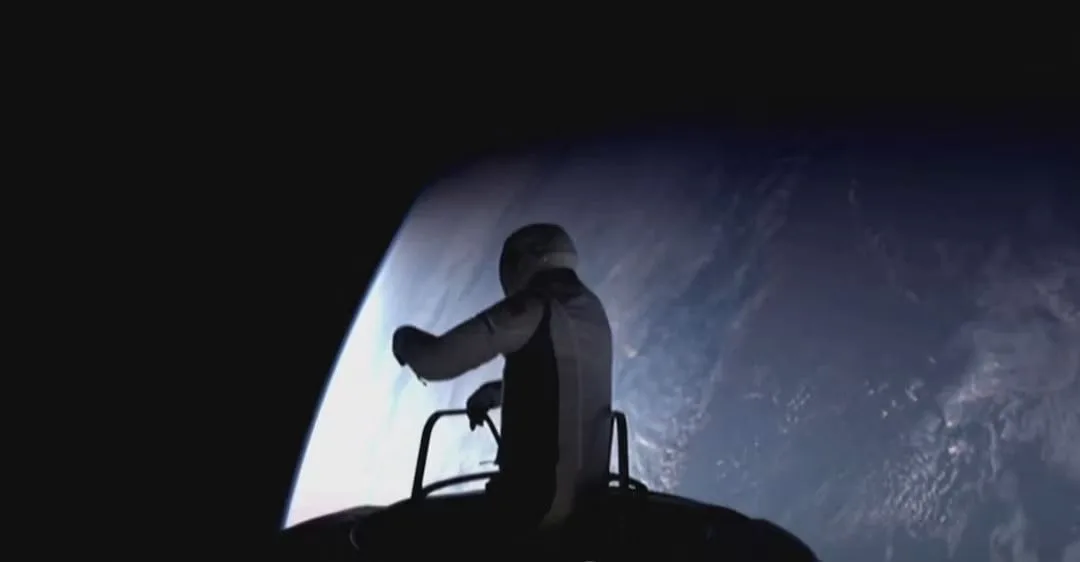
    On Thursday, two astronauts, a billionaire, and an engineer achieved a milestone by conducting the first private spacewalk in orbit outside a SpaceX capsule. This groundbreaking event involved the use of a new type of spacesuit, marking a significant step away from the previous limitation of spacewalks to only government-trained astronauts.

    As part of the Polaris Dawn mission, the astronauts spent approximately 10 minutes outside the Crew Dragon capsule, securely tethered for safety, while their two crewmates kept watch from inside. This mission, spearheaded by Elon Musk’s SpaceX, further advanced the possibilities of private space exploration.

    Jared Isaacman, founder of Shift4 and a skilled pilot, was the first to make his exit, followed closely by SpaceX engineer Sarah Gillis. Inside the capsule, their crewmates, Scott Poteet and Anna Menon, observed the historic event as they orbited around 450 miles (730 km) above Earth. The entire spacewalk spanned a total of one hour and 46 minutes.

    Isaacman, who also financed the Polaris mission, had previously funded the Inspiration4 flight with SpaceX in 2021. The mission was broadcast live on SpaceX’s website and aimed to evaluate new technologies, such as more streamlined spacesuits and a procedure for fully depressurizing the Crew Dragon cabin—innovations that Musk hopes to refine for future private missions to Mars.

    Upon returning to the spacecraft, Isaacman shared his awe at the breathtaking view of Earth from space. This endeavor was regarded as one of the riskiest undertaken by SpaceX, which is the only private company capable of consistently launching people into and returning from orbit.

    Before the spacewalk commenced at approximately 10:52 GMT, the capsule was entirely depressurized. The astronauts relied on their SpaceX-designed suits for oxygen, connected via an umbilical line to the capsule. Isaacman, 41, and Gillis, 30, assessed the flexibility of their suits and provided valuable insights for future designs.

    The mission was designed to extend the boundaries of private enterprise in space, with ground teams located at SpaceX’s California headquarters supervising the hatch closure and conducting safety checks during the astronauts’ re-entry.

    The procedure for the spacewalk closely resembled the first American spacewalk in 1965, which also involved depressurizing the capsule and tethering an astronaut in a spacesuit. NASA Administrator Bill Nelson praised the mission as a "huge advancement" for the commercial space industry and a step toward developing a sustainable U.S. space economy.

    While Isaacman has not disclosed the mission’s financial details, it’s anticipated to cost in the hundreds of millions, with individual Crew Dragon seats typically priced at around $55 million.

    Joining Isaacman and Gillis were Poteet, a retired U.S. Air Force lieutenant colonel, and SpaceX engineer Anna Menon. Throughout their mission, the spacecraft circled the Earth several times, reaching altitudes of up to 1,400 km, the farthest any humans have ventured into space since the final Apollo mission in 1972.

    Historically, spacewalks have been conducted exclusively by astronauts trained by government agencies. Since the inception of the International Space Station (ISS) in 2000, there have been approximately 270 spacewalks, with 16 occurring on China’s Tiangong space station.

    The Polaris team underwent two and a half years of training, including mission simulations and rigorous real-world experiences, in preparation for their journey, as noted by Poteet.

    Currently, a record number of 19 astronauts are in orbit, with 12 stationed aboard the ISS, following a recent Russian Soyuz mission that transported more astronauts there on Wednesday. Since 2001, Crew Dragon has successfully completed over a dozen astronaut missions, primarily for NASA.

    The capsule was created as part of a NASA initiative to develop commercial spacecraft for ferrying astronauts to and from the ISS. Boeing’s Starliner capsule is also involved in this program; it launched its inaugural crew to the ISS in June but encountered difficulties, returning empty and leaving its crew on the station until next year, when a Crew Dragon capsule is expected to bring them back.