Tag: spacecraft

  • The Future Just Got Weird

    The Future Just Got Weird

    From skin cells to eggs: scientists execute a sci-fi style fertility breakthrough

    Source: Reuters

    Move over, Hollywood sci-fi — real scientists have managed to transform human skin cells into eggs. Yes, just regular skin cells. Researchers at Oregon Health & Science University achieved this by transferring the DNA from a skin cell into a donor egg, effectively giving the cell a cellular “reset.” The outcome? Lab-created eggs that are potentially capable of fertilization.

    Some of these experimental eggs advanced to the blastocyst stage, the early embryo phase in IVF treatments, although most encountered genetic errors and failed to develop properly. Nonetheless, the prospect that skin tissue could one day replace ovaries is astonishing. It opens up possibilities for addressing infertility, aiding cancer survivors, and even helping same-sex couples conceive genetically related children.

    However, it’s not all science fiction dreams coming true just yet. The research remains distant from clinical application, with critics raising ethical concerns, questions about consent, and fears of a slippery slope toward designer babies. Whether seen as a groundbreaking breakthrough or a potential ethical minefield, one thing’s certain: the future of human reproduction just took a dramatic turn.

    2025 debates? No, we’re now in the era of AI roast battles

    Source: TruthSocialSource: TruthSocial

    In the latest chapter of “2025 Politics: You can’t make this stuff up,” former President Donald Trump released an AI-generated deepfake video featuring prominent Democrats.

    The video shows Senate Minority Leader Chuck Schumer seemingly ranting about free healthcare for “illegal aliens,” while House Minority Leader Hakeem Jeffries sports a sombrero and mustache, with mariachi music playing in the background. The punchline: Schumer’s avatar calls Democrats “woke pieces of s—.”

    The backlash was immediate. Jeffries condemned the video as “racist garbage” and challenged Trump to insult him directly, without hiding behind a computer-generated image.

    Schumer also weighed in, suggesting that the former president is more interested in trolling than governing.

    In response, Vice President J.D. Vance shrugged it off, calling it “funny” and claiming it was all in good humor. Meanwhile, the video sparked ongoing debates about how AI tools are used to intensify political divisions, manipulate culture, and spread misinformation.

    This episode serves as a stark reminder: deepfakes are no longer just a plot device for sci-fi stories—they’re now tools for satire, mockery, and increasingly, a weapon in political conflicts.

    Arc: Pioneering the future of orbital cargo delivery

    Created using GeminiCreated using Gemini

    Inversion, a space startup, has introduced Arc — a spacecraft built to deliver small payloads of up to 500 pounds anywhere on Earth in less than an hour.

    Unlike conventional rockets, Arc is a reusable vehicle designed to reenter the atmosphere at hypersonic speeds (Mach 20+), endure intense heat, and land with pinpoint accuracy. Its initial focus is on defense and hypersonic testing, where rapid, on-demand delivery of vital supplies can be crucial.

    Arc builds upon the success of Inversion’s previous spacecraft, Ray, with plans for an inaugural flight in 2026. The long-term vision involves deploying fleets of Arc vehicles in low Earth orbit, ready to provide fast, global logistics whenever needed.

    The project faces numerous challenges—from stress during re-entry to precise landing and navigating regulatory hurdles. Still, if successful, Arc could represent a significant leap toward space-based rapid delivery systems, transforming what was once pure science fiction into reality.

  • SpaceX Launches New Spaceship to ISS

    SpaceX Launches New Spaceship to ISS

    SpaceX has successfully launched a newly designed Cygnus spacecraft to the International Space Station (ISS) as part of the CRS-23 mission.

    The launch took place from Space Launch Complex 40 (SLC-40) at Cape Canaveral Space Force Station in Florida on Sunday evening. The Northrop Grumman Cygnus XL spacecraft, loaded with supplies for the ISS, lifted off smoothly.

    You can see the Falcon 9 rocket’s liftoff below:

    [Video or picture of Falcon 9 launch]

    A short time after launch, the Cygnus XL spacecraft was on its way toward the station:

    [Update tweet about separation]

    Approximately eight minutes after takeoff, the first stage of the Falcon 9 rocket landed back at Landing Zone 2 (LZ-2) at Cape Canaveral.

    This marks the fourth flight for this particular booster, which previously supported missions for Ax-4, Crew-11, and a Starlink deployment. Thanks to SpaceX’s reusable rocket technology, the booster is now ready for future launches after refurbishment.

    The Cygnus XL is scheduled to berth with the ISS around 6:35 a.m. Eastern Time on Wednesday, September 17. Unlike earlier versions, this model is larger and more capable, able to carry up to 11,000 pounds (about 5,000 kg) of cargo—33% more than the previous version, which could hold approximately 8,500 pounds (around 3,855 kg).

    This new spacecraft replaces the older Enhanced variant that first launched in 2015. Its increased size and capacity will enable it to deliver more supplies and research equipment to the station, supporting a variety of scientific and operational needs.

    Ryan Tinter, vice president of Civil Space Systems at Northrop Grumman, explained the importance of this mission, stating, “It’s really critical because we can deliver significantly more science, as well as more cargo before launch, which helps reduce costs per kilogram for NASA.” He emphasized that establishing these reliable commercial transportation options is key to the future of low-Earth orbit activities and space logistics.

    Like earlier Cygnus models, this version does not dock automatically. Instead, it is captured manually by the station’s Canadarm2 robotic arm and then attached to the Unity module.

    The Cygnus XL can remain attached to the station for up to 200 days, after which it will depart and disintegrate upon re-entry into Earth’s atmosphere.

    [Insert image of the Cygnus XL spacecraft]

    Northrop Grumman’s goal with this improved design is to enhance cargo capacity and streamline resupply missions, playing a vital role in the ongoing development of commercial space activities.

  • How To Watch SpaceX Crew-11 Launch To The ISS

    How To Watch SpaceX Crew-11 Launch To The ISS

    SpaceX and NASA are finalizing preparations for the upcoming crewed mission to the International Space Station (ISS).

    On July 31, NASA astronauts Zena Cardman and Mike Fincke, Japanese astronaut Kimiya Yui, and Russian cosmonaut Oleg Platonov will launch toward the space station aboard a SpaceX Crew Dragon spacecraft, which will be deployed by a Falcon 9 rocket.

    This mission marks Cardman’s and Platonov’s first spaceflights, Yui’s second, and Fincke’s fourth journey into space.

    This will be the 11th crew rotation mission operated by SpaceX’s human space transportation system, and its 12th crewed flight—including the Demo-2 test—to the ISS, part of NASA’s Commercial Crew Program.

    The crew is expected to stay on the station for at least six months, engaging in various scientific experiments and potentially conducting spacewalks outside the orbital facility.

    A launch from Launch Complex 39A at NASA’s Kennedy Space Center in Florida is scheduled for approximately 12:09 p.m. ET on July 31. Preparatory activities and the launch itself will be broadcast live starting several hours before liftoff.

    Viewers can follow the launch on the video feed available at the top of this page, as well as on SpaceX’s official X account and NASA’s live stream platform.

    Weather conditions or technical issues could lead to a postponement, and updates will be provided through SpaceX and NASA’s social media channels.

    If you tune in early, you’ll witness the astronauts arriving at the launchpad and boarding the Crew Dragon spacecraft atop the Falcon 9 rocket.

    Multiple cameras positioned around the launch site will track the rocket’s ascent, while inside the capsule, onboard cameras will capture the astronauts preparing for launch. Live commentary will explain each step, accompanied by real-time audio communication between Mission Control and the crew inside the spacecraft.

  • Europa Clipper Captures Stunning Thermal Images of Mars

    Europa Clipper Captures Stunning Thermal Images of Mars

    The Europa Clipper spacecraft from NASA is on a lengthy mission through our solar system, making its way to Jupiter’s ice-covered moon, Europa. Its primary aim is to investigate whether Europa could have harbored life in the past. However, before reaching its destination, the spacecraft is conducting research closer to Earth.

    Recently, scientists at NASA utilized Europa Clipper’s instrumentation to capture data on Mars, as the spacecraft flew within 550 miles of the Martian surface on March 1. This close encounter allowed Clipper to leverage Mars’ gravity for a speed boost, presenting a unique opportunity for research.

    The team tested one of Clipper’s instruments, the Europa Thermal Imaging System (E-THEMIS), by capturing images of Mars on its path. This infrared camera detects temperature variations across the planet’s surface and will also be employed to analyze features on Europa that display ridges and fractures, likely created by water from a subsurface ocean breaking through the icy crust.

    “Our objective is to measure the temperature of these geological features,” explained Phil Christensen, principal investigator for E-THEMIS at Arizona State University. “If Europa is geologically active, we expect the fractures to be warmer than the surrounding ice. Alternatively, if water has erupted onto the surface in the past, those areas might still maintain higher temperatures.”

    The E-THEMIS images highlight temperature differences on Mars, showing warmer regions near the equator and colder zones at the poles. The team captured 1,000 grayscale images, which were then combined to produce a color composite displaying temperature variations.

    These images not only showcase the features of Mars but also served as a valuable test of the instrument against established data, ensuring that all of Clipper’s onboard systems, including its radar component, are functioning properly.

    “We wanted to avoid any surprises with these new images,” stated Christensen. “The aim was to capture images of a planetary body that we understand very well and ensure that the new dataset aligns perfectly with two decades of Mars observation.”

    With all systems operational, Clipper is set to continue its journey, with an expected arrival at Jupiter in 2030.


  • NASA’s Plans For Its New SpaceX Spacecraft

    NASA’s Plans For Its New SpaceX Spacecraft

    As SpaceX prepares for its sixth major test flight of the Starship spacecraft, NASA has laid out its long-term vision for the upcoming generation of SpaceX vehicles. The company is currently working on a human lunar lander intended for use alongside Blue Origin’s lander to transport astronauts to the Moon as part of the Artemis program.

    However, it’s not just astronauts that NASA plans to send with these new vehicles. The agency revealed today that it also aims to utilize these spacecraft to deliver cargo such as tools and essential infrastructure to the lunar surface.

    “NASA is planning for both crewed missions and future service missions to the Moon beyond Artemis V,” stated Stephen D. Creech, the assistant deputy associate administrator for technical programs at NASA’s Moon to Mars Program Office. “The Artemis initiative is a cooperative effort involving international and industry partners. Having two lunar lander providers with distinct methodologies for transporting both crew and cargo allows us flexibility in mission planning while maintaining a steady schedule of Moon landings for ongoing discovery and scientific exploration.”

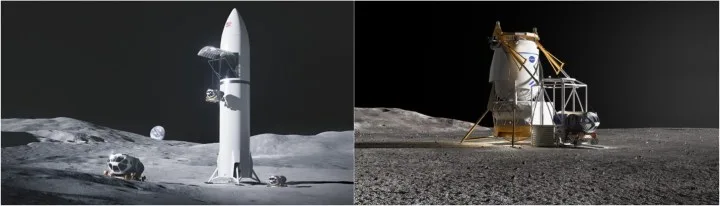
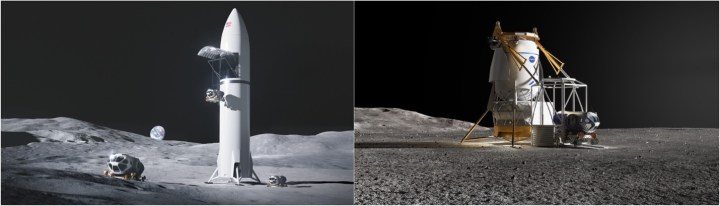
    Conceptual renderings of cargo variants of human lunar landing systems from SpaceX and Blue Origin
    Conceptual renderings of human lunar landing systems from SpaceX on the left and Blue Origin on the right, designed to transport large payloads of approximately 26,000 to 33,000 pounds to the lunar surface. SpaceX/Blue Origin

    For NASA to realize its ambitious dreams of establishing a moon base where astronauts can reside for extended periods, substantial infrastructure needs to be built on the lunar surface. This includes habitats, water filtration systems, and scientific research facilities.

    The current strategy involves at least two cargo missions aimed at delivering key equipment, including a pressurized rover via the SpaceX Starship cargo lander and a habitat through Blue Origin’s Blue Moon lander. These missions will serve as a preliminary test to ascertain the landers’ capabilities for future crewed journeys.

    “Considering the ongoing design and development phases of both the crew and cargo landers, along with the Artemis mission timelines for crewed versions, NASA has assigned SpaceX a pressurized rover mission and Blue Origin the task of delivering a lunar habitat,” added Lisa Watson-Morgan, NASA program manager for the Human Landing System. “These substantial cargo lander demonstration missions will help us leverage our resources and technical knowledge as we prepare for further deep space exploration.”

    Both SpaceX and Blue Origin are advancing their lander projects, with SpaceX planning to modify its currently tested Starship for this mission. The timeline suggests that the Starship will deliver the rover to the Moon in 2032, while Blue Moon is scheduled to transport the habitat in 2033.

  • SpaceX Crew Dragon Spacecraft Sets New Record

    SpaceX Crew Dragon Spacecraft Sets New Record

    After spending close to eight months aboard the International Space Station (ISS), members of SpaceX’s Crew-8 are finally heading home.

    The departure was initially scheduled for several weeks ago; however, unfavorable weather at the splashdown location off Florida’s coast caused mission planners to push back their return. In addition, earlier delays stemmed from the need to address issues with Boeing’s troubled Starliner spacecraft, which was docked at the ISS during the summer months.

    The Crew Dragon Endeavour, which is transporting NASA astronauts Matthew Dominick, Michael Barratt, and Jeanette Epps, along with Roscosmos cosmonaut Alexander Grebenkin, undocked from the station at 5:05 p.m. ET on Wednesday, approximately 260 miles above Earth. Their expected splashdown is slated for around 3:30 a.m. ET on Friday. NASA plans to livestream the return on NASA+.

    Though the mission was originally planned to last around six months, the Crew-8 team ended up setting a new record for the longest time spent in orbit with their Crew Dragon Endeavour, totaling 232 days.

    The previous record was set by Crew-2 in 2021, which also utilized the Endeavour spacecraft, keeping it docked at the ISS for 197 days.

    The Crew-8 mission launched atop a Falcon 9 rocket from Kennedy Space Center in Florida on March 4, 2024.

    During their time in space, the crew conducted various scientific experiments in microgravity. Astronaut Matthew Dominick also gained recognition as a skilled space photographer, sharing some breathtaking images on social media while in orbit.