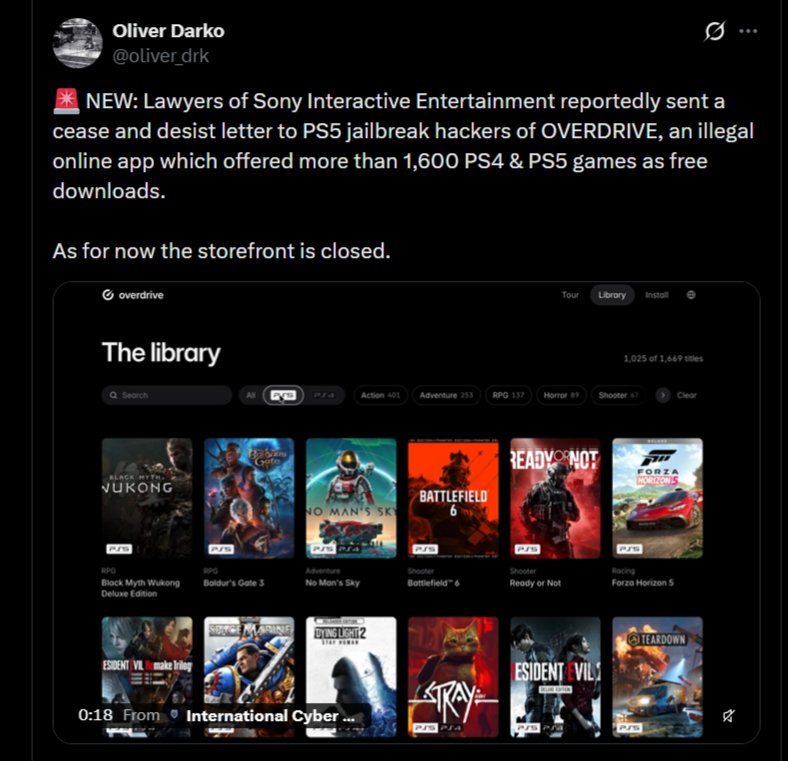
في 12 أكتوبر 2026، نجح مخترقون في كسر حماية جهاز بلايستشن 5 وأطلقوا متجر Overdrive، وهو متجر غير قانوني على متجر PS يحتوي على أكثر من 1600 لعبة مجانية قابلة للتحميل من نوع PS4 وPS5 بالإضافة إلى محتويات DLC. منذ إعلان سوني عن نيتها إنهاء دعم الأقراص المادية لـ PS5 بداية من عام 2028، حاول اللاعبون والمخترقون معًا إيجاد طرق للانتقام من الشركة. بعد مرور يومين، ورد أن شركة سوني قد أغلقت المتجر بشكل نهائي.
وفقًا لمُستخدم على منصة إكس، أرسل محامو شركة سوني للترفيه التفاعلي خطابًا رسميًا يطالب فيه بمراعاة حقوق الملكية الفكرية، مطالبين المخترقين الذين نجحوا في كسر حماية PS5 وإنشاء متجر Overdrive بالتوقف عن ذلك. كان متجر Overdrive، أو بالأحرى ما كان، أحد أكبر مواقع القرصنة على الإنترنت للألعاب على منصتي PS4 وPS5، حيث يمكن للمستخدمين تنزيل أحدث الألعاب مثل Resident Evil Requiem و007 First Light مجانًا.
صورة: تم إغلاق متجر Overdrive بعد ظهور خبر إيقافه على وسائل الإعلام الرئيسية، حيث استحوذت شركة سوني على الموضوع وطلبت من فريق العمل إغلاق المتجر الضخم في 14 أكتوبر. ولنعرض الصورة بشكل أكبر، قبل أن ترسل سوني خطاب التهديد، كانت الشركة قد أطلقت عدة تحديثات لنظام PS5 بهدف التصدي لمحاولات كسر الحماية.
قبل ظهور Overdrive، أصدر المطور ناثان فارجو نسخة علنية من كسر حماية PS5 في 29 سبتمبر 2026، دعمت إصدارات النظام من 7.00 حتى 13.60. ومع ذلك، يُقال أن تحديث النظام 14.00 الذي أصدرته شركة سوني في 16 سبتمبر قد قام بسد الثغرة الأمنية.
وفي 1 أكتوبر، أطلقت سوني التحديث 14.10 الذي أدى إلى تقييد قدرة المستخدمين على كسر الحماية بشكل أكبر. بالإضافة إلى ذلك، زعمت تقارير أن لعبة GTA 6 ستتطلب هذا التحديث لتشغيلها على PS5، وذلك في 19 نوفمبر 2026. بعد ذلك بفترة قصيرة، أطلق متجر Overdrive، مما دفع بعض اللاعبين إلى الأمل في الحصول على GTA 6 وألعاب أخرى مجانًا، لكن تهديدات القضاء السريع من سوني قضت على تلك الأحلام.
شهد متجر Overdrive شعبية كبيرة بعد توسيع كسر حماية PS5 إلى إصدارات نظام أحدث، لكنه لم يستمر طويلًا، لأنه كان غير قانوني ويخالف حقوق النشر. من ناحية أخرى، أطلقت شركة سوني مؤخرًا تقنية QSSR لجهاز PS5 الأساسي، وهي تقنية تحسين صور تعتمد على الذكاء الاصطناعي، توفر صورًا أكثر وضوحًا وثباتًا، وتشبه تقنية PSSR على إصدار PS5 Pro.
لذا، ينصح بعدم اللجوء إلى عمليات كسر حماية PS5 أو استخدام متاجر مثل Overdrive إذا كنت تريد لعب ألعاب مثل GTA 6 وGod of War Laufey عند إصدارها، بدون أن تتعرض للحظر من قبل شركة سوني.
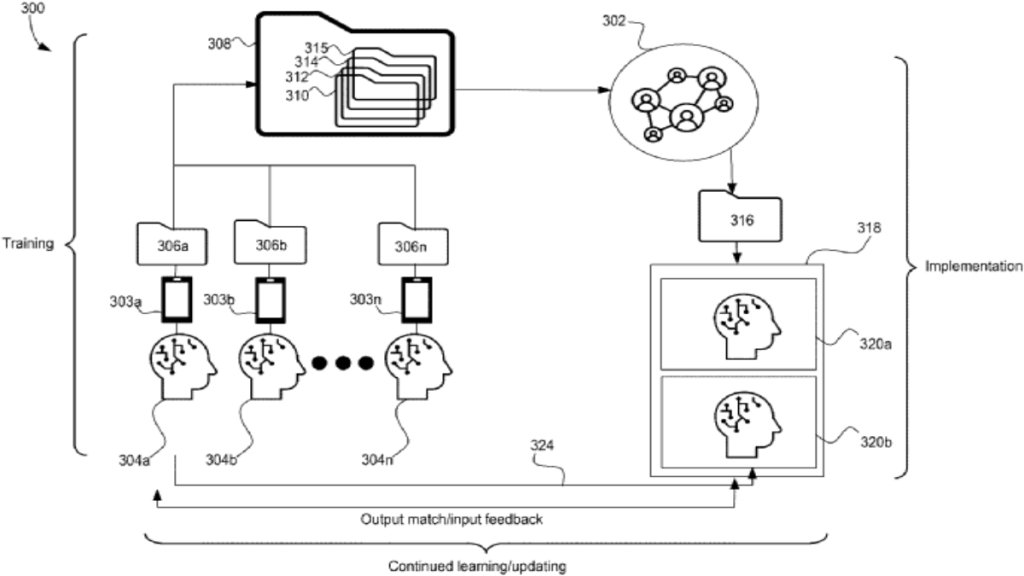
براءة الاختراع الخاصة بمطابقة الألعاب المدعومة بالذكاء الاصطناعي من شركة سوني قد تستخدم سجل بحثك لمطابقاتك مع لاعبين آخرين على جهاز PlayStation 5 أو حتى PlayStation 6، حسب موعد تنفيذ النظام من قبل سوني. قدمت سوني براءة الاختراع هذه العام الماضي ونشرتها في تاريخ 10 سبتمبر 2026. تُوضح وثيقة التسجيل عبر منظمة الويبو كيف يمكن أن تدمج سوني هذه الميزة ضمن نظامها البيئي بشكل متكامل.
بحسب ما تم تسجيله، تحمل البراءة اسم “استخدام نماذج التعلم الآلي لمطابقة اللاعبين معًا للعب”. يُشير الوصف إلى أن النظام سيعتمد على بياناتك الصريحة، سواء قبل بدء اللعب أو أثناء عملية إنشاء الملف الشخصي. وهذا يعني أن سوني ستستخدم نوعية الألعاب التي تلعبها، وطابع شخصيتك كلاعب على جهاز البلايستيشن، والألعاب التي تفضلها، وغير ذلك، بهدف مطابقة اللاعبين بشكل مناسب.
بالإضافة إلى ذلك، ستعتمد سوني على بياناتك الضمنية لجمع معلومات متنوعة مثل بيانات الوقت المرتبطة بعدة عناوين أو بيئات الألعاب، ومستويات مهارة اللاعبين، ومعلومات سلة التسوق، والبيانات من وسائل التواصل الاجتماعي، وسجل بحثك الشخصي. من الممكن أن تشمل هذه البيانات مدخلات متنوعة مثل بيانات الدردشة، البيانات البيومترية، الصوت، وأي شيء آخر يمكن أن يساعد سوني في إيجاد المطابقة المثالية لك في عالم الألعاب.
وفي هذا السياق، ستقوم سوني بمراقبة بياناتك عبر كامل نظامها، مع استخدام ملاحظاتك لتحديث وتحسين ملفك الخاص بالمطابقة باستمرار مع تغير تفضيلاتك وأسلوب لعبك. تتضمن براءة الاختراع أيضًا درجة توافق محتملة تساعد على اختيار اللاعبين المشابهين في تفضيلاتهم. يُذكر أن نظام التوافق قد يُحسب بناءً على التشابهات بين تفضيلات المستخدمين، بحيث يُظهر سوني فقط التطابقات التي تتجاوز حدًا معينًا من النسبة، مثل 80% أو 85% أو 90%.
وفي حين أن سوني قد سبق وقدمّت أفكاراً مثيرة، مثل شاشة لمسية في وحدة تحكم PlayStation 6، إلا أن هذه التقنية الجديدة قد تثير بعض المخاوف فيما يخص الخصوصية، خاصة وأنها قد تتجاوز سلوكك داخل الألعاب مثل Call of Duty أو Fortnite.
وفي النهاية، يبدو أن سوني ستتابع وتستخدم بياناتك بشكل مستمر لتحسين ودقة نظام المطابقة المدعوم بالذكاء الاصطناعي، مما قد يساهم في تقديم تجارب لعب أكثر تخصيصًا وتوافقًا. لكن يبقى السؤال، هل تعتبر ذلك خطوة مؤكدة نحو مستقبل ألعاب أكثر تفاعلية وذكاء؟
Digital Phablet – Once again, PC gamers are facing a similar situation to Helldivers 2. Recent reports have flooded social media suggesting that Sony is blocking the PC release of Marvel Tokon in 132 countries, with region-locking being the primary reason.
Many players have pointed out that the upcoming fighting game has been restricted in numerous countries due to Sony’s PSN account restrictions. Fans attempting to preorder Marvel Tokon discovered the block after visiting Valve’s Steam store.
Doomed before launch? Sony allegedly restricts Marvel Tokon in 132 countries
Sony’s ‘Marvel Tõkon: Fighting Souls’ has been unavailable in 132 countries on PC 🎮
Since the controversy surrounding Helldivers 2, Sony has launched multiple titles on PC. However, it appears the company is reintroducing the unpopular regional restrictions for Tokon just ahead of its scheduled August 2, 2026 release. According to Vice, Sony has not yet responded to questions regarding this move.
Sony shifts to fully digital with no physical disc options
Sony recently faced criticism after announcing that it plans to eliminate physical disc support for its PS5 and upcoming PS6 consoles starting in 2028. This decision raised concerns among consumers, as it impacts the ownership and sharing of physical games, along with the ability to resell titles or keep them permanently.
One user posted on X (formerly Twitter), stating, “This is a terrible business move. Why would you want to give your customers fewer options?” Another chimed in, “And this is the company we’re supposed to trust with our all-digital future? No thanks.”
Digital Phablet – Tom Holland’s Peter Parker is back with a new trailer for Marvel’s Spider-Man: Brand New Day.
Short clips of the highly anticipated sequel have recently gone viral on social media, captivating fans with a darker tone than previous installments. The trailer combines elements of drama and action while diving into the challenges of being Spider-Man, including its effects on Parker’s personal life, his relationship with MJ, and his school life.
Spider-Man: Brand New Day Trailer Unveiled: A Look at the New Villains
According to IMDb, “Peter Parker tries to focus on college and move on from being Spider-Man. But when a new threat puts his friends at risk, he has to break his promise and suit up once more, joining forces with an unexpected ally to keep those he cares about safe.”
The newly released trailer also introduces some of the movie’s villains, such as Scorpion (Michael Mando), Tombstone (Krondon), Boomerang (Fred Myers), The Punisher (Jon Bernthal), and members of The Hand ninja clan. Rumors suggest that the symbiote might also play a significant role in the film.
Marvel’s Spider-Man: Brand New Day is set to premiere in theaters on July 31 of this year. The cast includes Tom Holland as Spider-Man, Zendaya as MJ, Jon Bernthal as Punisher, Jacob Batalon as Ned, and Mark Ruffalo as The Hulk.
Fans exploded on social media with their reactions to the trailer. One user on X (formerly Twitter) said, “The comic book recreations are so dope.” Another commented, “This really feels like a Spider-Man movie rather than an MCU film.”
Sony’s latest flagship wireless headphones, the WH-1000XM6, excel in various areas, delivering exceptional sound quality, superior noise cancellation, and enhanced comfort. A unique feature of this model is its ability to access Bluetooth Auracast broadcasts, a first for the 1000X series. However, unlike other features such as spatial audio, EQ customization, and control adjustments that can easily be accessed through the Sony Sound Connect app, setting up Auracast requires a bit more effort.
Let’s explore the importance of Auracast and how you can make it work with the Sony WH-1000XM6.
Why is Auracast Important?
Bluetooth Auracast, part of the official Bluetooth 5.2 specification alongside LE Audio, transforms any compatible source device—be it a smartphone, laptop, or tablet—into a Bluetooth broadcasting station. It can stream the same audio to an unlimited number of Auracast-compatible devices, such as headphones, earbuds, and speakers, making it an ideal solution for sharing audio at social gatherings.
Unlike traditional Bluetooth devices that require a pairing process, Auracast broadcasts can be found and listened to without establishing a connection to the source device. You’ll simply need an interface, referred to as an Auracast assistant, to scan for and tune into available broadcasts nearby. If you’ve ever searched for a Wi-Fi network, the process is quite similar. Auracast broadcasts can either be open, allowing anyone to listen, or private, requiring a password or PIN.
When Might You Use Auracast?
Initially, most users will find Auracast useful for two main scenarios: sharing audio from a phone or laptop, or augmenting a Bluetooth speaker’s sound to other compatible speakers—some brands even label this as “Party Mode.” For instance, Marshall’s new Heston 120 soundbar utilizes Auracast to extend its surround sound capabilities to its compatible Bluetooth speakers.
Looking ahead, additional applications for Auracast may include:
Dual language soundtracks in movie theaters
Wireless connections for headphones and hearing aids to home TVs
Wireless headphone support for TVs in public places, like gyms or relaxation areas
Public address systems in busy environments, such as airports or stadiums
Audio tours at museums or historical sites
Virtual public addresses for seminars and conventions
How to Use Auracast with the Sony WH-1000XM6
Before we go into the steps, it’s important to note: the WH-1000XM6 does not support Bluetooth Auracast when linked to iPhones or iPads. This limitation arises from Sony’s strategy regarding Auracast; rather than incorporating the assistant functionality within its Sound Connect app, Sony depends on the smartphone’s software for this. Currently, only specific Android devices with version 13 or higher contain the necessary built-in Auracast assistant. If you want to utilize Auracast with an iPhone, consider options like JBL’s Tour One M3 or Tour Pro 3, which feature their own Auracast assistant within JBL’s Headphones app for iOS.
In this guide, we’ll use the Samsung Galaxy S23 Ultra operating One UI 7.0 on Android 15. Please verify that your smartphone and Android version support Bluetooth Auracast before continuing.
Switching to LE Audio via the Sound Connect App
To enable Bluetooth Auracast, your WH-1000XM6 must operate in LE Audio mode—a different mode from the standard Bluetooth connection. Out of the box, Sony ships the WH-1000XM6 in standard Bluetooth mode, so you’ll need to change it manually to LE Audio.
Connect the WH-1000XM6 to an Android device running version 13 or higher.
Launch the Sony Sound Connect app.
Scroll down and tap on Device Settings.
Choose the System tab.
Scroll down and click the arrow next to Classic Audio only under LE Audio connection setting for headphones.
Select the LE Audio Priority option.
Confirm the dialog box that appears, selecting OK.
You’ll receive a notification stating that the headphones must be reconnected; choose Check Operating Procedures for further instructions or Cancel.
Return to your phone’s Bluetooth settings.
Locate the WH-1000XM6 in the paired devices list.
Unpair or forget the WH-1000XM6 as needed.
Hold the power button on the WH-1000XM6 until the LED flashes blue and you hear the “Pairing” voice prompt.
Your Android device should automatically recognize the headphones and prompt you to Connect.
Once connected, select Done.
Open the settings for the WH-1000XM6 from your Bluetooth device menu.
Select the LE Audio option.
The headphones will disconnect and reconnect.
Your WH-1000XM6 should now be connected to your phone through LE Audio. To verify:
Return to the Sony Sound Connect app.
Below the image and battery life indicator, LE Audio should be shown.
If it isn’t visible, repeat steps 1-17.
Finding and Connecting to an Auracast Broadcast Using Android’s Bluetooth Settings
Open your phone’s Bluetooth settings again.
Locate the WH-1000XM6 in the list of paired devices and enter its settings (the method may differ by device).
Scroll down and select Listen to Auracast broadcast.
Any available Auracast broadcasts will be displayed on the screen.
Select an available Auracast broadcast.
You should now hear the audio through the WH-1000XM6.
Following several leaks, the announcement is finally official: the Sony WH-1000XM6 headphones are now available. As anticipated, they come with a host of upgrades compared to their predecessor, the WH-1000XM5. One notable addition is a new metal folding hinge designed to enhance both durability and flexibility. The XM6 is offered in three colors: black, midnight blue, and a unique platinum silver, which is more of an off-white sandy hue. The U.S. price for these headphones is set at $450, marking a $50 increase from the XM5, which seems to be influenced by tariffs, seeing as they retail for CAD 599 (approximately USD 428). Customers can purchase them online starting today at major retailers and on Sony’s website.
Simon Cohen / Digital Trends
Sony faced some criticism with the fold-flat design of the WH-1000XM5, which many found less convenient for travel. The XM6 addresses these concerns by maintaining the sleek look of the XM5 while introducing a second axis of motion in the hinge. Additionally, the travel case has been downsized and now features a quick-release magnetic closure in lieu of a standard zipper.
Sony WH-1000XM5 (top, black) and WH-1000XM6Simon Cohen / Digital Trends
The headband has been redesigned with a wider shape and an asymmetrical design, similar to the Sonos Ace. This adjustment is intended to help users easily identify the correct orientation of the headphones without relying solely on left/right labels. The ear cushions have also been upgraded for increased padding.
For the XM6, Sony has adopted a new finish for the plastic, moving away from the slightly rubberized texture of previous models to a more ceramic-like feel.
Sony WH-1000XM6 (left) and WH-1000XM5Simon Cohen / Digital Trends
Recognizing its reputation for top-notch active noise cancellation (ANC), Sony likely took note when Bose’s QuietComfort Ultra Headphones began winning accolades over the WH-1000XM5. In response, the XM6 introduces several enhancements, starting with a new QN3 processor that reportedly measures and reacts to noise conditions seven times faster than the previous QN1 chip in the XM5. The number of microphones has increased from 8 to 12, allowing for better external sound capture. Additionally, the older Auto NC optimizer algorithm has been replaced with a newly developed Adaptive NC optimizer, which adjusts ANC based on various factors like hair or eyeglass interference with the ear cups’ seal.
Simon Cohen / Digital Trends
When making phone calls, 6 of the 12 mics are utilized (as opposed to 4 on the XM5). Sony claims that an AI noise reduction algorithm trained on 500 million voice samples enables the XM6 to better distinguish your voice from background noise. The new model also allows users to mute the microphones during calls.
On the audio front, the XM6 features newly designed drivers, utilizing a high-rigidity carbon fiber composite dome. This enhances sound balance alongside a perforated voice coil bobbin to improve high-frequency performance. Additionally, the headphones have undergone extensive tuning by several Grammy-winning audio engineers.
The XM6 maintains the spatial audio feature, now branded as “360 Reality Audio Upmix for Cinema.” This enhancement is marketed as an immersive experience for movies, although it also functions with any stereo source on both iOS and Android devices. Unlike the XM5, which limited spatial sound to Sony’s proprietary format, the XM6’s spatial audio works across a wider range. Unfortunately, head tracking remains exclusive to Android users.
Simon Cohen / Digital TrendsSimon Cohen / Digital Trends
Battery life remains unchanged, offering 30 hours with ANC enabled and 40 hours without it. However, Sony has finally introduced the capability to charge the XM6 while in use, a feature absent in previous wireless models.
Although downplayed in their presentation, similar to the LinkBuds Open and LinkBuds Fit, the XM6 will support Bluetooth Auracast when set to LE Audio mode—assuming the smartphone runs a compatible operating system. This functionality is expected to work on most Android devices with the latest version, but not on iPhones.
A new feature called Scene-based Listening has also been added. According to Sony, this technology “automatically plays music based on the user’s activity and adjusts noise cancellation levels according to their environment and location.” This seems to expand on the existing Adaptive Sound Control feature, which currently manages ANC and transparency mode based on activity and location.
Sony has unveiled its newest flagship smartphone, the Xperia 1 VII, as anticipated by various leaks in recent weeks. This model succeeds the Xperia 1 VI, which debuted in May 2024, and it features technologies borrowed from Sony’s Alpha cameras, Walkman audio devices, and BRAVIA televisions. These innovations have been integrated through what Sony calls ‘Xperia Intelligence,’ aimed at enhancing photography, audio quality, and visual experiences.
Continuing the trend seen in previous iterations, the Xperia 1 VII places a heavy emphasis on camera performance. While the camera lenses have seen only minor updates, exciting new software enhancements for 2025 have been introduced.
The seventh generation of the Xperia 1 includes standout features like ‘AI Camerawork’ and ‘Auto Framing.’ The ‘AI Camerawork’ feature allows users to capture stable, well-composed videos without constantly watching the screen. It achieves this by keeping the main subject centered using image stabilization and posture estimation.
What specifications does the Sony Xperia 1 VII offer?
Sony / Sony
When it comes to the camera setup, the Xperia 1 VII features three rear lenses, highlighted by a new 16mm ultra-wide lens combined with a 48MP 1/1.56-inch sensor, which is reportedly 2.1 times larger than the one on its predecessor. This larger sensor aims to enhance low-light performance and reduce noise, while also enabling macro photography from as close as 5cm. The smartphone boasts a main 48-megapixel wide-angle lens offering 24mm/48mm equivalents for 2x optical zoom, complemented by a 12-megapixel telephoto lens with an optical zoom range of 85mm to 170mm.
The Xperia 1 VII employs components from Sony’s Walkman devices to improve sound quality through wired headphones. Additionally, its ‘DSEE Ultimate’ technology utilizes AI to enhance the quality of compressed streaming audio, whether wired or wireless. The phone’s stereo speakers have also been refined for clearer sound across all frequencies.
Users will find a 6.5-inch OLED display on the Xperia 1 VII, featuring a Full HD+ resolution with a 19.5:9 aspect ratio and a 120Hz refresh rate. While the display specs are similar to those of the Xperia 1 VI, it now includes an extra light sensor designed to optimize brightness and color based on the surrounding environment. This enhancement aims to improve visibility in various lighting conditions, with features like increased peak brightness and ‘Sunlight Vision’ to facilitate outdoor use in direct sunlight. However, unlike some competitors, Sony has not specified the brightness in nits, leaving comparisons somewhat vague.
At its core, the Xperia 1 VII is powered by Qualcomm’s Snapdragon 8 Elite chipset and comes with 12GB of RAM. The device is equipped with a 5,000mAh battery, which Sony claims can provide up to 36 hours of continuous video playback and achieve 50% charge in just 30 minutes.
Starting May 13, the Xperia 1 VII will be available in Slate Black, Moss Green, and Orchid Purple through Sony and select retailers. Pricing is expected to be around €1499 in Europe and £1399 in the UK, though US pricing and availability have yet to be announced.
The Xperia 1 VII will receive support for four operating system updates and six years of security patches—this is less than what Google and Samsung offer, but one year more than Motorola support.
Sony’s WH-1000XM6 Headphones Set to Debut Next Week
Sony is gearing up to unveil its latest flagship noise-canceling headphones, the WH-1000XM6, in just a week. As the launch date approaches, there hasn’t been a flood of leaks as seen with smartphones; however, one significant leak has showcased the new headphones in detail.
Following an accidental listing on Amazon Spain, a new source has revealed images of the WH-1000XM6, highlighting a subtle redesign aimed at enhancing user comfort. Notably featured are three color options for these headphones: white, black, and a striking “midnight” blue.
The leaked images show a key departure from the previous model, the XM5s—primarily the hinge design. This iteration features a refined hinge that permits a folding mechanism, which is expected to resolve issues reported by users regarding the fragility of the XM5 hinge. The new design employs a three-part configuration with a metal center element to enhance durability. Testing will reveal if wear comfort has also improved.
The updated headphones showcase a more rounded power button, while the controls for volume adjustments appear to be relocated alongside this new button. Interestingly, dedicated volume buttons are not visible, suggesting that they may be capacitive.
Additionally, the mesh covering the microphone openings suggests potential improvements in water resistance, although a formal water-resistance rating is unlikely for the WH-1000XM6. The traditional 3.5mm headphone jack remains, hinting that the transition to USB-C for audio may not occur this generation. Removable cushions, as noted in previous FCC listings, are expected, but the latest images do not provide clarity on this feature.
As confirmed by Sony Australia, the launch is set for May 16th at 2 a.m. Melbourne time, which translates to noon on May 15th in New York. The expected price for the headphones is approximately $449, an increase from the $399 price tag of the previous generation.
Internally, the WH-1000XM6 is expected to feature substantial upgrades, including the new QN3 HD chip for active noise cancellation, a Mediatek MT2833 processor, and a total of twelve microphones (six in each ear cup) dedicated to enhancing noise-canceling capabilities.
Exciting news for headphone enthusiasts: the beloved Sony WH-1000XM5 may soon be succeeded by the WH-1000XM6. With a potential launch date set for May 15, new specifications have surfaced that reveal mixed highlights.
An earlier listing on Amazon Spain indicated that the upcoming WH-1000XM6 is likely to include a cutting-edge QN3 chip, 30mm drivers, 12 noise-canceling microphones, and AI-enhanced voice mics. Notably, the headphones are expected to feature a foldable design, a reimagined headband, and soft ear cushions for extra comfort. A new carrying case is also anticipated to accompany the headphones.
Sony’s choice to reintroduce a foldable design is significant, enhancing portability compared to recent iterations.
Additional features rumored for the WH-1000XM6 include an impressive battery life of up to 30 hours, rapid charging capabilities, 360 Upmix technology for immersive sound, an improved gaming EQ, enhanced call quality, and multipoint connectivity.
Battery performance is predicted to stay at 30 hours, with a rapid charging option that can deliver three hours of listening time after just a three-minute charge.
There are speculations of a price increase to around $479, with the headphones reportedly available next month.
Amazon Spain
The WH-1000XM5, which has been on the market for nearly three years, is celebrated for its superior sound quality, comfort, call clarity, noise cancellation, and battery longevity. With a sleek, lightweight design and intuitive controls, it continues to impress.
As highlighted in our review, the WH-1000XM5 delivers clear, balanced audio with excellent bass management. Its noise cancellation is stellar, though slightly outperformed by Bose’s QuietComfort Ultra Headphones. Call quality remains exceptional, and the battery is adequate for extended journeys.
Nevertheless, the WH-1000XM5 lacks some modern amenities, such as spatial audio, USB audio output, and support for Auracast. Also, we have found the hinge connecting the headband to the earcups somewhat uncomfortable during prolonged use.
Stay tuned for the official announcement of the WH-1000XM6, and in the meantime, explore our wishlist for features we hope to see in the new model.
Currently, much of the buzz surrounding smartphone leaks centers on Apple and Samsung. The discussions are particularly lively regarding the upcoming Galaxy S25 Edge and what is likely to be dubbed the iPhone 17 Air. However, these two tech giants are not the only players prepping to unveil new devices before the year wraps up.
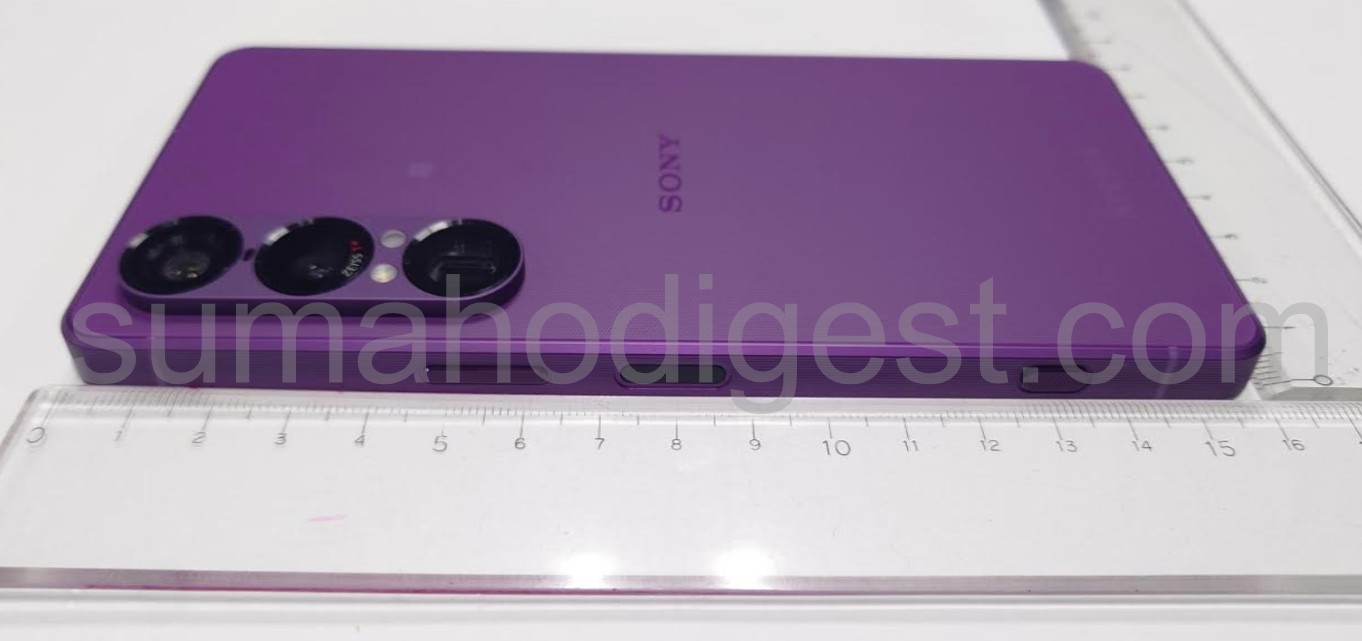
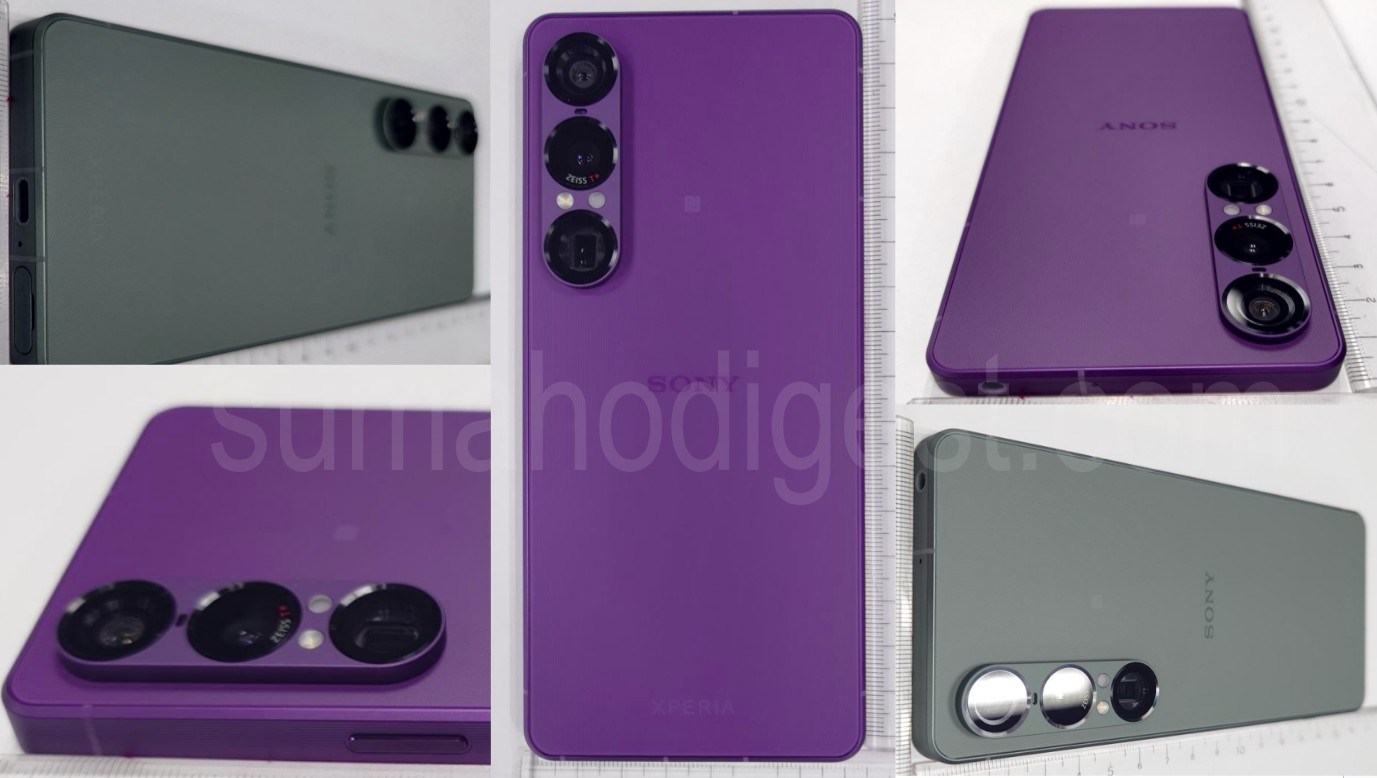
Sony is on the brink of revealing its next flagship smartphone in the coming weeks. A leak regarding the Xperia VII, which follows the Xperia VI, first surfaced in early April, and the device has since made an appearance on the Taiwan National Communications Commission (NCC) website.
According to a report from MySmartPrice, the NCC listing indicates that the Xperia VII will be available in black, navy green, and purple. It is expected to maintain a similar design aesthetic to its predecessor and will feature a pill-shaped triple rear camera layout.
The fact that purple is making a comeback is notable since the Xperia IV was released in that shade years ago. The design’s consistency will likely be appealing to fans of the Xperia line. Sony’s Omnibalance design philosophy—that emphasizes flat edges and surfaces—remains a hallmark of the brand, particularly in its iconic black finish.
Details from the NCC listing show that the Xperia VII will measure 165mm in height and 74mm in width, making it slightly taller than its predecessor, which stood at 162mm. An intriguing feature noted is the inclusion of a 3.5mm headphone jack located in the top right corner—an uncommon find in modern smartphones. The rear camera setup includes branding from Zeiss, indicating a focus on high-quality imaging.
Additional Information
Recent images of the Samsung Galaxy S25 reveal exciting new details.
The Xperia 5 IV proves Sony is not done with compact smartphones.
New Sony Xperia devices are scheduled to debut on May 11.
While this listing does not provide many additional details, earlier reports suggest the Xperia VII will feature a 6.5-inch display, similar to the Xperia VI, and will operate on Qualcomm’s Snapdragon Elite 8 platform. Although a launch date hasn’t been confirmed yet, Sony typically reveals its flagship Xperia phones in May, with availability following shortly thereafter. We anticipate more leaks in the weeks ahead as the launch approaches.
Sony is revitalizing its Bluetooth speaker collection, announcing today that three of its portable models are receiving the upgraded ULT Power Sound series branding introduced last year. These new speakers boast a modern design, dedicated bass-boost buttons, dazzling LED lighting effects, and enhanced battery life. Prices for these models range from $200 to $900, and they vary in size from compact options to large party speakers. To top it off, Sony has joined forces with Post Malone to celebrate their launch.
At the entry-level, we have the Sony ULT Field 3, a $200 cylindrical speaker that’s versatile enough to be used upright or on its side. It includes a shoulder strap for easy transport. The Field 3 replaces the older Sony SRS-XE300 and acts as a more advanced version of the ULT Field 1. Equipped with a single woofer, a tweeter, and two passive bass radiators, the speaker emphasizes powerful low-end sound. The bass boost feature, dubbed ULT1, promises deeper low-frequency performance.
Sony claims the ULT Field 3 “offers powerful sound without sacrificing clarity.” In addition to its ULT1 bass boost functionality, users can customize their audio experience with a 7-band equalizer and link multiple speakers for an expanded sound experience, including a stereo pair. With a battery life of up to 24 hours per charge (slightly reduced with bass boost), the speaker is also IP67 certified, meaning it can withstand dust and water. The Field 3 aims to compete with the newly released JBL Flip 7, which generated buzz recently.
Moving up the range, the ULT Field 5 is a $330 Bluetooth speaker that shares a similar form factor with the Field 3, capable of standing or laying on its side. However, the Field 5 features a central woofer and dual tweeters for superior sound, as well as dual passive radiators for enhanced bass. This model includes the ULT1 bass boost button plus an additional ULT2 button for "powerful punchy bass."
The Field 5 also incorporates LED lighting, making it a fun addition for parties, which can be controlled via the Sound Connect app. It has three extra bands on the adjustable equalizer, accessible through the app, and boasts up to 25 hours of battery life (which will decrease with bass boost and lighting usage). Like its counterpart, the Field 5 supports party and stereo pairing and is also rated IP67 for dust and water resistance.
Finally, we have the heavyweight, the ULT Tower 9 party speaker, which is the most powerful of the new offerings. This model replaces the Sony SRS-XV900 and is designed specifically for a party environment, competing with models such as the JBL PartyBox Stage 320 and the Soundcore Rave 3S.
Featuring a large 12.6-inch woofer for robust bass, four tweeters for clear treble, and two mid-range drivers for vibrant vocals and instruments, the Tower 9 is built to make a statement with its substantial sound. Measuring 16 x 35.8 x 17.9 inches and weighing 65 pounds, it comes equipped with sturdy wheels for portability. Both the ULT1 and ULT2 bass boost options are available, along with a 10-band equalizer and app support.
Beyond music, the ULT Tower 9 supports wireless karaoke microphones and can connect to your TV through its optical input. This feature offers a TV Sound Booster option for enhanced audio during viewing, all controllable via the Sound Connect app. As expected from a party speaker, it also includes an impressive LED light show.
The ULT Tower 9 is priced at $900, and for those looking to save a bit, there is an AC-powered variant available for $750, branded as the Tower 9AC.
Sony’s ULT Field 3, Field 5, and Tower 9 speakers are available now through various online retailers and on Sony’s official website.
Sony has made some changes to the release schedules for the upcoming Street Fighter film and Phoebe Dynevor’s latest shark thriller.
Legendary Entertainment’s Street Fighter has been taken off the release schedule entirely. Initially set to hit theaters on March 20, 2026, this live-action adaptation, co-developed with Capcom—the creator of the popular video game—has not yet announced its cast.
Recently, Kitao Sakuri was appointed as the director for Street Fighter, taking over from Danny and Michael Philippou, who stepped back due to their commitments to another project, Bring Her Back. Sakuri gained recognition for directing the 2021 film Bad Trip, featuring stars like Eric André, Lil Rel Howery, and Tiffany Haddish.
The last live-action adaptation of Street Fighter was directed by Steven E. de Souza in 1994, starring Jean-Claude Van Damme as Colonel William F. Guile, Ming-Na Wen as Chun-Li, Raul Julia as General M. Bison, Damian Chapa as Ken Masters, and Byron Mann as Ryu Hoshi. Although it received poor reviews, the film surprisingly earned nearly $100 million worldwide and has since gained a cult following.
Capcom
In addition to the changes with Street Fighter, Sony’s shark thriller, Shiver, has been pushed back to 2026. Originally slated for release on August 1, 2025, the film’s new release date is July 3, 2026. This now places its debut during the Fourth of July weekend, where it will compete with Universal’s Minions 3.
Directed by Tommy Wirkola, known for Violent Night, Shiver was previously titled Beneath the Storm. It features a cast headlined by Dynevor, alongside Whitney Peak and Djimon Hounsou, though plot details are still under wraps. Wirkola is producing the film alongside Adam McKay and Kevin Messick, with D. Scott Lumpkin serving as the executive producer.
The release of Shiver will come shortly after the 51st anniversary of Jaws, a film that set the standard for shark-based movies and is celebrated as one of the summer blockbuster icons.
Last autumn, Marvel Studios and Sony announced the arrival of Spider-Man 4, set for summer 2026. However, there is a new development regarding its release. Initially scheduled for July 24, 2026, the film’s debut has been moved to Friday, July 31, 2026.
While no official explanation for this delay has been provided, The Hollywood Reporter mentioned that this adjustment will allow Spider-Man 4 to have more space between it and Christopher Nolan’s upcoming film, The Odyssey, which is set to release on July 17, 2026. Notably, Tom Holland is slated to appear in both films, although the details of his role in Nolan’s project remain undisclosed. Holland has portrayed Spider-Man in the MCU since Captain America: Civil War in 2016 and has starred in a successful trilogy featuring the superhero.
In October 2024, Holland revealed plans to start filming the next Spider-Man installment in the summer of 2025. He previously expressed enthusiasm about the script for the upcoming sequel, stating it “really ignited a passion within me.” It’s highly expected that Holland’s co-star and off-screen partner, Zendaya, will also reprise her role, though this has yet to be officially confirmed.
The film rights to Spider-Man are in the hands of Sony Pictures, which has collaborated with Marvel Studios on the last three films through a distinctive agreement. As part of the renewal that enabled Spider-Man: No Way Home to be produced, Marvel is permitted to feature Holland’s Spider-Man in another film of its choosing. Although the studio has not yet initiated this right, it is very likely that Holland will don the Spider-Man suit for either Avengers: Doomsday or Avengers: Secret Wars, if not both.
Nearly three years have passed since Sony unveiled the WH-1000XM5, its top-of-the-line wireless headphones. However, a recent filing with the Federal Communications Commission (FCC) suggests that the successor to the XM5 may be on the horizon. The Walkman Blog identified an FCC Label and Location document filed by Sony on January 22, 2025, for a new pair of headphones with the model number YY2984. Although there is no explicit mention of “WH-1000XM6,” the sequential nature of Sony’s internal headphone model codes (YY1234) suggests a chronological release pattern rather than differences in product type. Consequently, while the timing and details in the diagram imply the presence of the XM6, definitive confirmation is still pending.
Features to Note:
The design might introduce removable ear cushions, differing from the XM5, which allows for cushion replacement but is not designed for easy removal. The FCC ID information for the XM5 is currently printed on a semi-circular label adhered to the earcup’s mesh grille.
If these headphones are indeed the WH-1000XM6, the diagram indicates that the labeling for the FCC ID has shifted to the inside of the earcup, necessitating the removal of the ear cushion for access. While the diagram does not clarify the attachment method for the cushion, magnets are commonly used in flagship models, similar to devices like the Apple AirPods Max and Master & Dynamic MW75.
Another noteworthy change concerns the junction of the headband and earcup.
A user on Reddit shared an image of a broken Sony WH-1000XM5.oidzbio / Reddit
Upon the launch of the XM5, Sony veered away from the foldable design of the WH-1000XM4, opting instead for a fold-flat aesthetic with a concealed internal yolk. This change met some criticism from fans who preferred the previous configurations. However, the XM5’s design has raised concerns more over durability than foldability. There’s an active community on Reddit’s r/SonyHeadphones that frequently posts lamentable images of their XM5 headphones, broken at the vulnerable joint where the headband slider meets the pivoting earcup.
Comparison of the right earcup design of the Sony WH-1000XM5 (left) versus the FCC illustration of the new model.Sony
From the diagram, it appears Sony is maintaining the concealed yolk but potentially reinforcing the joint connection, possibly through a folding hinge design similar to their ULT Wear headphones introduced in 2024.
The Walkman Blog has also indicated other possible advancements, including:
Upgraded Bluetooth version 5.3 (BR/EDR/LE), suggesting potential support for LE Audio — consistent with Sony’s recent earbuds like the LinkBuds Open and LinkBuds Fit, both of which feature LE Audio and Auracast capabilities.
Rapid charging capabilities,
An enhanced antenna design.
Reports suggest that these new headphones might be scheduled for a launch in May 2025, aligning with the release schedule of the XM5, which debuted in May 2022.
For the moment, we await further developments. As we approach May, it’s likely that we will start seeing leaked images of these new headphones, whether they are the WH-1000XM6 or another model from Sony.
Nearly a year following its launch, Sony implemented a region lock on the PC version of Horizon: Forbidden West. However, in a surprising turn of events, the company lifted the restriction without any official communication. While there has been no public explanation about the region lock, Sony has remained firm in its requirement for PlayStation Network accounts, which can hinder access for players in countries where PSN accounts aren’t permitted.
A user known as Mocha Joe on Resetera was the first to spot the new restriction on SteamDB, igniting a wave of discontent among the gaming community. One user commented, “It’s been frankly baffling watching Sony choose to continually score own goals from the sidelines this gen.”
This incident isn’t isolated—Sony has a history of making controversial decisions that affect players after their purchases. In May 2024, similar restrictions were applied to Helldivers 2, leading to negative reactions on its Steam page. Shortly thereafter, the PC ports of Ghost of Tsushima and God of War: Ragnarok also faced similar limitations.
Despite the backlash, Sony remains steadfast on the necessity of PSN accounts. In some contexts, this requirement may be justifiable, especially for live-service games where online features are critical. Nevertheless, players are questioning why this need extends to purely single-player titles, with many expressing their frustrations.
While specific PlayStation PC games feature PSN trophies, others simply track achievements via Steam. An account is indeed necessary for unlocking trophies, yet some believe the primary purpose is to restrict game purchases in markets where currency fluctuations could lead to significantly lower prices than in the United States.
I can comfortably use Sony’s flagship WH-1000XM5 wireless noise-canceling headphones for about three hours before feeling the need for a break. However, some users report that even after just 20 minutes, the headband can create an uncomfortable pressure point. If you find yourself in this situation and fear you might have to sell your $400 headphones for a loss, there’s a simple and inexpensive solution that could cost you less than two Starbucks Frappuccinos.
the exact fix he needed.
TinkerF / Makerworld.comreplacement headband for SteelSeries Arctis 7, which is available for only $9 on Amazon.
TinkerF / Makerworld.comshared the 3D model on Makerworld, under the username TinkerF, and it’s available under a Creative Commons license. This means you can download it for free as long as you do not sell the printed parts.
Xometry, spending around $18 CAD (approximately $13 USD) for his order. He placed the order in November 2024, so while he can’t speak to the long-term durability of the adapters yet, he’s incredibly happy with the results so far.
In the wake of the Concord debacle, Sony has made the decision to discontinue two live-service projects, including a potential entry in the God of War franchise. On a brighter note, amidst the layoffs affecting the gaming sector, Sony has assured that neither of the involved studios will be shutting down.
According to Jason Schreier from Bloomberg, Bend Studio and Bluepoint Games, two of Sony’s PlayStation teams, were developing separate live-service games—a category Sony has heavily invested in. The previous year saw Sony experience significant setbacks with Concord, following the success of Helldivers II. While live-service offerings can be risky, they can yield substantial profits when executed effectively.
One of the cancelled projects was reportedly related to the God of War series, which has disappointed fans who were eager for more content from this beloved franchise, especially since details about the game’s narrative or mechanics were not shared. While the company emphasized that these cancellations wouldn’t result in layoffs at the studios, the potential effects on employment within those teams remain somewhat unclear. An internal memo obtained by Bloomberg indicated that Sony is “working closely with Bend and Bluepoint to outline future projects and aims to minimize any business disruption.”
Sony Interactive Entertainment
Sony has been striving to replicate the success seen with titles like Fortnite and Destiny through its own live-service games, but achieving that level of success has proven to be complex and challenging. In an era where nearly every game features some form of subscription service or battle pass, live-service titles must carve out a unique identity to attract players. Originally, Sony aimed to release a dozen live-service games by March 2026, but that target has since been cut down to six as of November 2023.