الوسم: Sonos

  • Sonos Reportedly Cancels Streaming Box to Compete With Apple

    Sonos Reportedly Cancels Streaming Box to Compete With Apple

    Sonos has encountered a challenging few months, facing issues with a problematic app redesign and changes in its leadership team. As a result, some product initiatives appear to have been sidelined. Reports indicate that the company had plans for a streaming device, but those plans have now been halted.

    During an all-hands meeting today, company leaders shared that the product, known internally as Pinewood, would have represented Sonos’ next significant hardware introduction, according to a report from The Verge.

    The interim CEO has conveyed to employees that the streaming device is currently not on the company’s agenda. This now-obsolete gadget was expected to deliver features like content aggregation from various streaming services and a comprehensive universal search function.

    Sonos Arc Ultra System vs. Sony Bravia Theater Quad
    Chris Hagan / Digital Trends

    The anticipated streaming box was projected to retail for between $200 and $400. Sonos had even developed a complete user interface in partnership with an advertising agency called The Trade Desk.

    At present, there aren’t many premium alternatives to the Apple TV 4K, yet Sonos’s intended pricing was notably high. Competitors like Roku Express 4K Plus, Nvidia Shield TV, Amazon Fire TV Stick, and Google TV Streamer offer significantly lower prices.

    Nevertheless, Sonos aimed to provide distinctive features with its streaming product. The design included a dual-mode control system that would combine a physical remote with their proprietary Voice Control technology.

    Furthermore, the device was designed to include multiple HDMI ports, enabling the passthrough functionality. The goal was to allow seamless connectivity with various devices like 4K players and gaming consoles, while also addressing latency challenges associated with wireless transmission. Sonos Arc Ultra and Sonos Arc.

    Sonos was also considering a surround sound functionality for the streaming box, developed under the codename “Pinewood.” On the connectivity front, the company sought to utilize Wi-Fi 7 as well as gigabit ethernet outputs. According to The Verge, “the box will be capable of wirelessly transmitting lag-free TV audio to Sonos soundbars and other products.”

    Following the decision to cancel its streaming box plans—intended to compete with devices like the Apple TV 4K—Sonos appears to be refocusing its efforts on enhancing its software and developing new audio products.

  • Sonos Introduces Zones For Managing Rooms With Multiple Speakers

    Sonos Introduces Zones For Managing Rooms With Multiple Speakers

    Sonos has announced that the Era 100 Pro, their inaugural speaker specifically designed for the professional installation market, is now available for order and shipping. This innovative speaker utilizes an Ethernet cable for both power and connectivity and is sold exclusively in pairs through select Sonos partners that focus on professional setups. Pricing for the Era 100 Pro is determined by these partners, and Sonos has not disclosed any pricing guidelines. I have contacted a few professional installers to obtain an estimated price range.

    It’s important to note that the Era 100 Pro requires a powered Ethernet connection (PoE), which means it won’t operate on a standard wired home network without additional equipment.

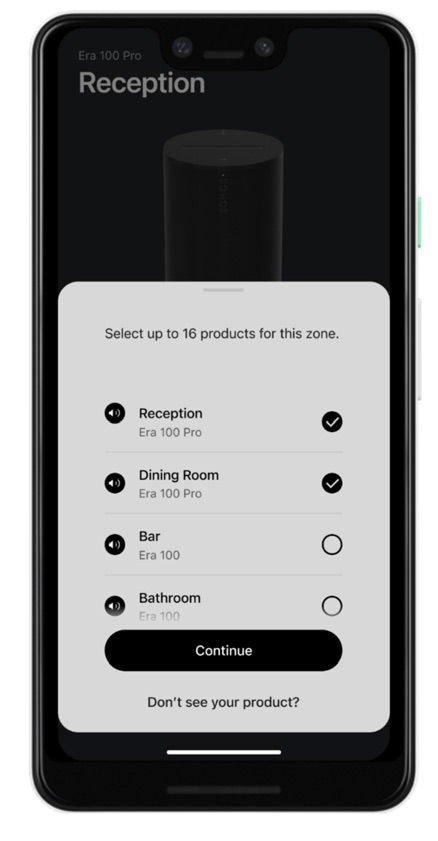
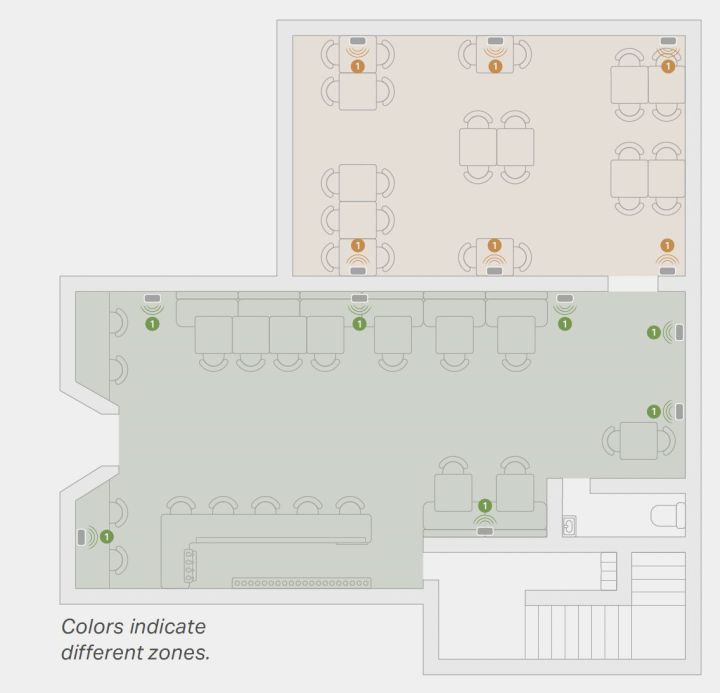
    To coincide with the launch of the Era 100 Pro, designed for commercial environments such as restaurants where numerous speakers may be used in a single area, Sonos has also updated its app, introducing a feature called “zones.”

    A diagram of two zones of Sonos products in a commercial space.
    A diagram of two zones of Sonos products in a commercial space. Sonos

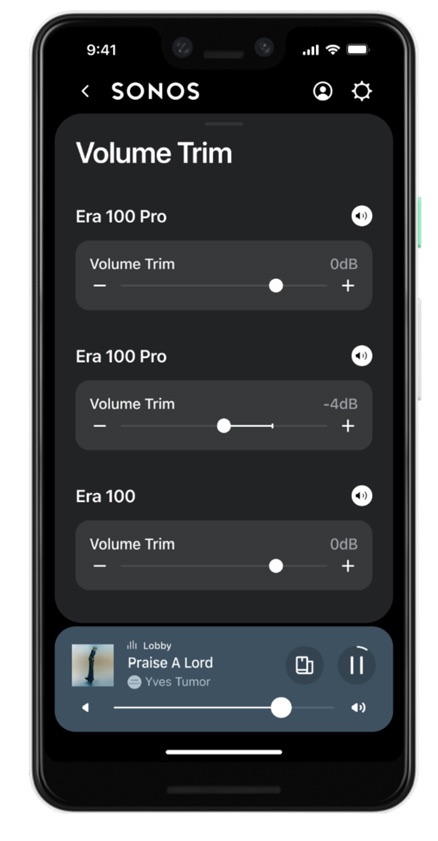
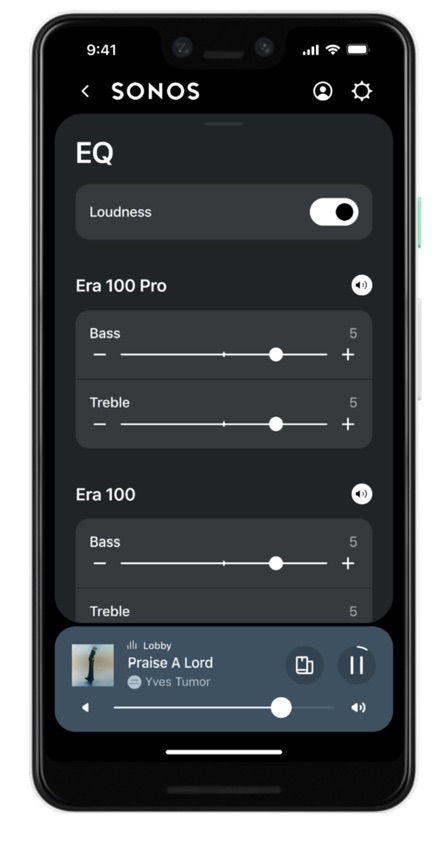
    The new zones feature resembles the existing Groups function, allowing users to add up to 16 compatible Sonos devices to create a “semi-permanent” grouping of speakers. All devices within a zone will play the same audio at the same volume level, unless the “volume trim” settings on individual speakers are adjusted to vary from the zone level. Additionally, users can fine-tune the EQ settings for each speaker individually.

    A key advantage of zones is their ability to combine with other zones or individual Sonos speakers. Since groups can’t be nested inside one another, this feature enables users to manage specific collections of speakers as a cohesive unit, allowing for easy reconfiguration without creating new groups each time.

    Users can add, modify, or remove zones through the Sonos app. There’s also a chime feature to help identify a specific speaker within a zone, which can be useful when the name alone isn’t sufficient to pinpoint its location.

    However, there are certain limitations for the zones feature. Unlike groups, it is only compatible with specific Sonos components, namely the Era 100 Pro, Era 100, Era 300, Sonos One SL, Sonos One (all models), and Sonos Five. Other components such as Sonos soundbars, portable speakers, headphones, and devices like the Port and Amp are not currently compatible with zones.

    Sonos emphasizes the importance of an Ethernet connection for every speaker within a zone. If that’s not feasible, it’s advisable to limit zones to a maximum of six Wi-Fi-connected devices for optimal performance.

    Alongside the Era 100 Pro and the zones update, the Sonos app has received a series of fixes and enhancements as the company works to address issues stemming from the problematic redesign launched in May 2024.

    Notable updates include:

    • New option to snooze alarms directly within the app
    • Changes to System Settings for easier access to key settings
    • Visibility of battery charge percentage in the System view
    • Upgrades to parental controls on iOS
  • Sonos Arc Ultra First Impressions Bigger Bass Noticed

    Sonos Arc Ultra First Impressions Bigger Bass Noticed

    The Sonos Arc Ultra I’ve been evaluating arrived yesterday afternoon. Typically, I would meticulously go through the unboxing, setup, and document each step with photographs before embarking on a multi-day review process. However, this launch has been anything but conventional. I know many of you are eager to find out one critical detail: How does it sound?

    While I do plan to provide a comprehensive review of the Arc Ultra, detailing all the standard information, I want to share my initial impressions after just a few hours of use.

    First, a few disclosures.

    I rushed through the setup as quickly as possible. I powered it up, connected it to my Sonos system, performed the usual software update, and connected it to my TV via HDMI. I left the equalizer settings unchanged, didn’t adjust the height channel levels, ignored prompts for voice assistant setup, skipped Sonos’ TruePlay room calibration, and refrained from connecting it to my Sonos Sub 3 or Era 300 surrounds.

    In fact, I disconnected my original Sonos Arc from the system and restored it to factory settings, so I could objectively compare the sound of both soundbars before making any adjustments.

    Sonos Arc Ultra in black, partially covered by protective felt.
    Simon Cohen / Digital Trends

    The difference was striking. The Ultra delivers noticeably clearer and more defined audio compared to the standard Arc. Whether it’s music or movies, there’s a tangible precision in how mid- to high-frequency sounds are articulated both forward and laterally. Dialogue is sharper and more comprehensible, even without activating the Ultra’s speech enhancement mode, which offers three adjustable levels.

    But you might be curious about that cutting-edge “Sound Motion” driver featuring four motors, dual diaphragms, and dual amplifiers. Does it really pack a punch when it comes to bass? The answer is yes.

    This new driver delivers powerful bass.

    While I haven’t yet put the Ultra through all of my standard Dolby Atmos scenes, I did stream a selection of bass-heavy tracks from my regular playlist, including Billie Eilish’s bad guy, Hans Zimmer’s Warming Up My Instruments, and two recent favorites: Shaboozey’s Bar Song and Bad Bunny’s Tití Me Preguntó.

    This new driver delivers powerful bass. It’s remarkable not just for its volume compared to the Arc but also for its clarity. You can genuinely perceive a distinct component producing the bass notes, rather than a series of full-range drivers struggling to manage everything from midrange to the deepest lows.

    Sonos Arc Ultra: top controls close-up.
    Simon Cohen / Digital Trends

    Is it comparable to a dedicated subwoofer? Not exactly—these speakers likely won’t rattle your windows. However, the Ultra has earned a place among the select soundbars that can perform well enough on their own while still benefiting from the addition of a separate subwoofer.

    That’s a wrap on my initial impressions, but there’s more to come. In my full review, I’ll evaluate:

    • Stereo and spatial audio rendering
    • The Ultra’s claimed 9.1.4 processing capabilities—can a single speaker create that many distinct channels?
    • The performance limits of the Sound Motion driver—how deep can the bass go?
    • Effectiveness of the speech enhancement mode
    • Control options—both physical and voice-based
    • Integration with a Sub 3 and Era 300 surrounds
    • Sonos app functionality—has it finally improved?

    Stay tuned for more updates!

  • Sonos Arc Ultra May Not Require A Separate Subwoofer

    Sonos Arc Ultra May Not Require A Separate Subwoofer

    The newly launched Sonos Arc Ultra boasts an impressive configuration of 15 amplifiers and 14 drivers, enabling this Dolby Atmos soundbar to deliver 9.1.4 channels of sound, as stated by the manufacturer. This marks a significant upgrade from the original Sonos Arc, which featured an 11-driver, 5.1.2 setup. While the increase in surround channels (from 5 to 9) and height channels (from 2 to 4) is noteworthy, the singular “1” at the center of the Arc Ultra’s channel arrangement may have the most substantial impact.

    This middle .1 refers to the low-frequency effects (LFE) channel, traditionally managed by a dedicated subwoofer if available. This channel is crucial for creating the deep, immersive rumble we often associate with cinematic audio. Although the original Sonos Arc manages low frequencies reasonably well, it does so using the same drivers responsible for mid-range sounds. These drivers are not specifically tuned for LFE, which is why many Arc owners opt to purchase a Sonos Sub or Sub Mini, adding up to $799 to their overall system expense.

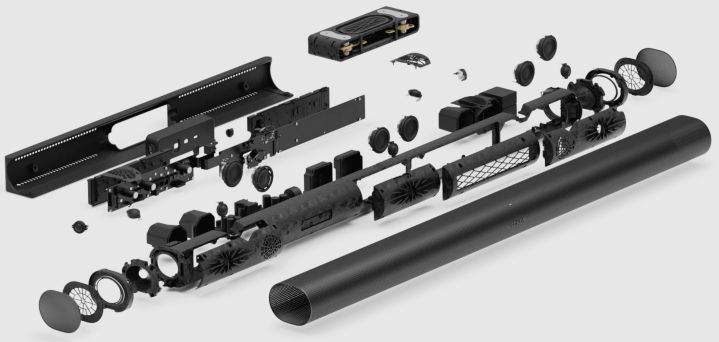
    Sonos Arc, exploded view.
    The Sonos Arc (exploded view) Sonos

    The Arc Ultra introduces an innovative “Sound Motion” driver, which features a four-motor, dual-membrane woofer. This design incorporates two membranes in a space typically allotted for one, enhancing its ability to produce bass. According to Sonos, this unique configuration provides the Ultra with “twice the bass” compared to the standard Arc.

    The Sound Motion driver is built on proprietary technology that Sonos acquired through its purchase of Mayht, a Dutch audio company, in 2022. A 2020 article from audioxpress.com explains the mechanisms behind Mayht’s driver innovation.

    Sonos Arc Ultra, exploded view.
    Sonos Arc Ultra Sonos

    What does “double” entail in this context?

    Sonos elaborated to Digital Trends, stating, “When we refer to the Arc Ultra producing up to twice as much bass as the Arc, it indicates that at maximum volume, there is 6dB more low-end output. This enhancement means that the Arc Ultra can deliver richer dynamics and a more realistic sound experience.”

    Interestingly, both the Arc and Arc Ultra maintain a low-end frequency response limit of 50Hz. While the bass won’t go lower in the Ultra, it will be amplified, providing a more impactful experience.

    A promo shot of the Sonos Arc Ultra.
    The Sonos Arc Ultra may not eliminate the need for a dedicated subwoofer, but it promises improved low frequency performance compared to its predecessor. Sonos

    To gain further insight, I spoke with Hilmar Lehnert, who has extensive expertise with both Sonos and Mayht. He spent nine years at Sonos, serving as the audio technology manager for the last two years there. Following his departure in 2020, he advised Mayht until the acquisition.

    I inquired whether directing lower frequencies towards the Sound Motion driver would enhance the performance of the other drivers. He agreed with confidence.

    “Absolutely,” he confirmed. “This minimizes the movement required from the mid woofers, allowing their design and tuning to focus on enhancing spectral and spatial performance.”

    Can the Sound Motion driver take the place of a subwoofer? Not quite. While it would be revolutionary if a single soundbar could fulfill both roles simultaneously, we aren’t there yet. Nevertheless, Sonos’ new driver technology is certainly closing that gap. For some users, it could transition the perception from merely wanting a subwoofer to genuinely needing one.

    This isn’t unfamiliar territory for soundbars—other brands have made strides, such as the impressive bass output of the Klipsch Flexus Core 200—but it marks a milestone for Sonos soundbars. This advancement could help justify the Ultra’s higher price point.

  • Sonos Arc Ultra May Also Be Sonos TV

    Sonos Arc Ultra May Also Be Sonos TV

    I believe there are plenty of real products available, which is why I don’t focus much on those that are still just ideas. However, two upcoming Sonos projects have caught my attention for their undeniable potential.

    To clarify, my observations are purely speculative. Yet, they seem reasonable, particularly since Sonos has indicated that there are two products on the brink of announcement and release, currently delayed by issues surrounding its 2024 app.

    Let’s begin with the Sonos Arc Ultra soundbar, which has recently had several leaks. There was a post on X in September featuring marketing materials, alongside a hidden Best Buy listing that surfaces in Google searches but leads to a non-functional product page. This scenario often suggests a product that’s been prepared for launch but has been temporarily shelved.

    A Google search result for the Sonos Arc Ultra soundbar.
    A Google search result on October 7, 2024, for the Sonos Arc Ultra soundbar that leads to a non-functional Best Buy page.
    Screenshot

    Most recently, what appears to be specifications for the Arc Ultra surfaced on Reddit. Generally, the features outlined are standard: seven tweeters, six woofers, Trueplay technology, and all the Dolby formats you would expect. The inclusion of a microphone isn’t shocking either; Sonos has integrated them into their speakers for years. There’s also a unique feature that allows users to switch seamlessly between the soundbar and the Sonos Ace headphones. The touted addition of a quad-core A55 processor is hardly groundbreaking—after all, the original Sonos Arc also boasted a quad-core CPU.

    What really piqued my interest? The mention of 16GB of RAM and 8GB of non-volatile memory (ROM). In comparison, the first-generation Arc only packs 1GB of RAM and half the NV memory. Coupled with a marketing image from September showcasing a Sonos interface, this suggests a strong likelihood that when the Sonos Arc Ultra finally launches, it will coincide with the introduction of Sonos TV. A noticeable omission in the rumored specs is a remote control, which could present challenges.

    As for Sonos TV, that’s an entirely different conversation. One could surmise it will resemble the functionality provided by Roku in its soundbars, likely featuring a fully integrated operating system. It’s probable that it may be a variant of Android, but there’s always room for surprise.

    So, what does all this imply? First and foremost, it’s time to stop labeling Sonos TV as a traditional “set-top box.” This term is outdated and doesn’t quite apply anymore, given that modern TVs are too slim to accommodate such devices on top. I am guilty of this as well. During a recent interview with Sonos executive Eddie Lazarus, when I asked about the so-called set-top box, he replied, “I don’t have any idea what you’re talking about.”

    In hindsight, I should have inquired about the Sonos Arc Ultra instead.

  • Sonos Arc Ultra Soundbar and Sub 4 Images Leak

    Sonos Arc Ultra Soundbar and Sub 4 Images Leak


    Sonos enthusiasts might be feeling a bit underwhelmed as the company works to resolve issues stemming from its May app update. However, excitement is brewing over the anticipated release of the Sonos Arc Ultra. Recently, high-quality images of this upcoming Dolby Atmos flagship soundbar emerged on X (formerly Twitter) on September 17, showing a design similar to previously leaked, lower-resolution photos.

    Arc Ultra ($999) https://t.co/z6sXvj2dAg pic.twitter.com/iuwG2vGXDv

    — Arsène Lupin (@MysteryLupin) September 17, 2024

    The individual behind the leak, known as Arsène Lupin (@MysteryLupin), named after the famous fictional French burglar, has consistently shared accurate leaked images in recent months, adding credibility to these recent Sonos revelations.

    In the images, you can also spot another impending product, the Sonos Sub 4, which appears to mirror the current third-generation Sub, but sports a fresh matte finish.

    Leaked images of the purported Sonos Arc Ultra and Sub 4.
    Arsène Lupin / X

    Though Sonos hasn’t officially acknowledged the Arc Ultra, there have been reports suggesting it was inadvertently listed on the company’s website before being quickly removed. A report earlier this year by Bloomberg described a new soundbar under the code name “Lasso,” which is said to improve upon the existing Sonos Arc. Sources refer to the advanced technology behind this product as stemming from Dutch audio firm Mayht, acquired by Sonos in 2022.

    The leaked photos depict a soundbar that closely resembles the existing Sonos Arc but appears slightly larger and features new top-mounted controls alongside a rectangular rear module that serves as the speaker base. This design allows the sides of the soundbar to seem to float when mounted on a surface.

    Another image illustrates how the soundbar would appear when wall-mounted, accompanied by two Sonos Sub 4 units.

    According to Lupin, the expected price for the Sonos Arc Ultra is $999, which reflects a $100 increase over the current Arc’s cost. However, Chris Welch from The Verge speculates it could be even higher, potentially reaching $1,199, a figure that aligns with the previous accidental listing on Sonos’s site.

    As for when the Sonos Arc Ultra will be released, it might be soon. That said, it would be unwise for Sonos to introduce a new soundbar—or any fresh product—while still dealing with significant issues related to their app. Customer dissatisfaction stemming from the problematic update lingers, and any new product announcements could be met with skepticism. This isn’t the ideal environment companies aim to cultivate for a product launch.

  • Sonos’ New Video Streamer May Use Giant’s Software

    Sonos’ New Video Streamer May Use Giant’s Software

    Sonos is reportedly collaborating with online advertising firm The Trade Desk on a soon-to-be-announced video streaming device, which has likely faced delays. This information comes from Janko Roettgers in his September 12 Lowpass newsletter, where he referenced multiple sources familiar with the partnership.

    The Trade Desk, a publicly traded company valued at over $50 billion, positions itself as an omnichannel advertising platform for the open internet. In a previous report from August, Roettgers revealed that The Trade Desk has been developing its own smart TV operating system since 2019, aiming to compete with established players like Roku, Amazon, and Google. However, this has been disputed by The Trade Desk’s CEO, as reported by Digiday.

    While discussions have circulated about Sonos possibly venturing into the video streaming sector—sparked by a 2023 report from Bloomberg—there has been little clarity regarding the software Sonos intends to use. Sonos primarily focuses on music streaming and has experienced significant challenges since a troublesome app update in May. Although the company produces soundbars akin to those from Amazon Fire TV and Roku, these devices are limited to audio playback and do not feature a comprehensive operating system like typical streaming devices. Although Sonos has developed apps for various platforms, it has not directly engaged with the streaming ecosystem occupied by Roku, Google TV, Amazon Fire TV, and Apple’s tvOS. The recent introduction of the Sonos Ace headphones marked the company’s initial step beyond traditional speakers. CEO Patrick Spence mentioned that two new products set for launch this year have been postponed until improvements are made to their app and platform.

    Roettgers indicates that teaming up with a third-party like The Trade Desk could address several challenges at once. By licensing a pre-existing platform, Sonos could sidestep the need to create one from the ground up. Given the company’s ongoing struggles with its app—along with considerable expenditures aimed at rectifying these issues and recent staff reductions intended for sustainability—resources for new software projects are limited.

    Building relationships with major streaming services such as Netflix, Disney+, Amazon Prime Video, and HBO is notoriously difficult. However, The Trade Desk reportedly has established connections with these platforms. According to Roettgers, the company has recently begun selling advertisements for Netflix and collaborates with significant media entities like NBCUniversal, Fox, and CBS. Sources suggest that The Trade Desk has secured agreements with various well-known streaming services for participation on its platform.

    Moreover, The Trade Desk appears willing to allow Sonos significant influence over the design and feel of the software. This is likely an attractive aspect of their partnership, as streaming platforms operated by Roku, Google, and Amazon maintain strict licensing requirements that can affect the interface, branding, and even remote control layout of the devices they license.

  • Sonos One SL vs. Sonos Roam SL – Pros and Cons

    Comparing the Sonos One SL and Sonos Roam SL? Check out our post for a detailed analysis of their pros and cons! Learn which one is better for you.

    Are you trying to decide which Sonos speaker is right for you: the Sonos One SL or the Sonos Roam SL? Here, we offer a detailed comparison of the two speakers’ features, sound quality, and price points to help you choose.

    Performance

    Both the Sonos One SL and Sonos Roam SL are powerful, impressive devices. The Sonos One SL has slightly more oomph and clarity than the more compact Sonos Roam. At six, it delivers a higher wattage and features larger woofers and tweeters to produce deep bass and clear highs. However, both speakers have the same digital audio processing that ensures your sound is always perfect.

    Setup and Connectivity

    Sonos One SL offers a traditional speaker setup, meaning you connect the device to a power source, and it joins your home’s Wi-Fi network. It’s compatible with both Apple AirPlay and Android devices. The Sonos Roam has a much easier setup process thanks to Bluetooth connectivity. All you have to do is turn it on and connect it to your smartphone or laptop using Bluetooth. This makes it perfect for traveling and staying connected even when you’re outside of your home network.

    Audio Quality

    One of the key differences between the Sonos One SL and the Sonos Roam SL is the audio quality. The Sonos One SL has superior sound, with crisp clarity and deep bass – it also has two amplifiers that are able to accommodate a larger soundstage. The Sonos Roam has a softer treble without a full range of frequencies, which can lead to muffled sound at higher volumes.

    Design and Portability

    When it comes to design, the Sonos One SL is bigger and heavier than the Roam SL, while Roam SL is smaller, more compact, and more portable. The One SL has a larger body that allows you to use any wall mount available. In addition, it’s linked to thread-based sensors which enable sound and voice control with Alexa or Google Assistant. Finally, the Sonos Roam is easy to take on the go due to its lightweight design – perfect for listening to your music wherever you are!

    App Compatibility and Features

    Both the Sonos One SL and Sonos Roam SL are compatible with a wide range of music streaming services like Spotify, Apple Music, Google Play Music, Amazon Music, Pandora, and many more. Both speakers allow you to customize your sound levels with their equalizer so you can make sure the music is just right for you. The One SL has additional features such as multi-room audio linking and Trueplay, which allows you to tune your speaker to any location in order to get the most out of its sound.