A customs officer handles snakes that were captured and had their teeth removed. — Reuters
Customs officials in Mumbai announced that they intercepted a passenger arriving from Thailand carrying a wriggling load of live snakes, marking the third such incident this month.
“Customs officers successfully thwarted another attempt at wildlife smuggling, seizing 16 live snakes from a passenger returning from Thailand,” stated the customs agency at the Indian financial capital’s airport.
The passenger, who landed on Sunday, has been arrested, and the customs agency is conducting a further investigation.
The snakes included species commonly traded in the pet market, and most were non-venomous or had weak venom that poses no threat to humans.
Among the seized were garter snakes, a rhino rat snake, and a Kenyan sand boa, among others.
Earlier in June, customs officers caught a passenger trying to smuggle several venomous vipers from Thailand.
A few days later, another traveler was detained while carrying a mix of 100 animals, including lizards, sunbirds, and tree-climbing possums.
TRAFFIC, a wildlife trade monitoring organization, has expressed concern over a “very troubling” increase in trafficking driven by the exotic pet market.
In the past three and a half years, more than 7,000 live and dead animals have been seized on flights between Thailand and India.
While snake seizures are less common in Mumbai, customs officers frequently share images of confiscated gold, cash, cannabis, or suspected cocaine concealed by passengers.
In February, customs agents also apprehended a smuggler attempting to transport five Siamang gibbons, a small ape native to the forests of Indonesia, Malaysia, and Thailand.
The endangered animals were cleverly hidden in a plastic crate inside the passenger’s luggage, according to customs officials.
In November, customs seized a passenger transporting a wriggling load of 12 turtles, while the month before, four hornbills were confiscated from another arriving passenger from Thailand.
In September, two individuals were arrested with five juvenile caimans, a type of reptile related to alligators.
Taliban forces patrol near the entrance of Hamid Karzai International Airport in Kabul, Afghanistan, on August 31, 2021, just one day after the withdrawal of U.S. troops. — Reuters
The Taliban acquired roughly 1 million U.S. weapons in 2021.
The arsenal included American-made firearms such as M4 and M16 rifles.
The Taliban government spokesperson claims, “All light and heavy weapons are securely stored.”
Reports indicate that around 500,000 weapons, part of the extensive arsenal the Taliban seized upon regaining control of Afghanistan in 2021, are now unaccounted for, sold, or smuggled to militant organizations, according to anonymous sources speaking to the BBC.
This troubling information, confirmed by the United Nations, implies that some of these U.S.-funded arms may have reached affiliates of Al-Qaeda.
When the Taliban took over Afghanistan in 2021, they gained possession of approximately one million pieces of military equipment and weapons, most of which were supplied and financed by the U.S., a former Afghan official disclosed under anonymity to the BBC.
This stockpile included advanced American-made firearms like M4 and M16 rifles, as well as older weapons remaining from years of conflict.
During a closed session of the UN Security Council’s Sanctions Committee in Doha late last year, it was revealed that the Taliban admitted at least half a million of these items — a shocking figure of 500,000 — are now “missing.”
This number was corroborated by a source from the committee and verified with others.
Furthermore, a UN report published in February indicated that affiliates of Al-Qaeda, including Tehreek-e-Taliban Pakistan (TTP), the Islamic Movement of Uzbekistan, the East Turkestan Islamic Movement, and Yemen’s Ansarullah movement, are gaining access to these Taliban-captured weapons either directly or through a burgeoning black market.
In response to these allegations, Hamdullah Fitrat, the Taliban government’s deputy spokesman, firmly denied any claims of smuggling or lost weaponry.
“All light and heavy weapons are securely stored. We completely reject accusations of smuggling or loss,” he stated.
However, a 2023 UN report contradicted this assertion, revealing that the Taliban permitted local commanders—who often act with significant autonomy—to retain 20% of the captured U.S. weapons, thereby fueling the underground arms market.
The UN also commented that the “gift culture” of weapons between local commanders and fighters is prevalent, helping solidify the black market as a “rich source of armaments for the Taliban.”
Adding to the concerns, a former journalist from Kandahar disclosed that a flourishing arms market existed in the city for a year after the Taliban’s takeover, only recently transitioning to discreet operations via WhatsApp.
This social media platform allows for the trading of both new and used American weapons and equipment, primarily from those abandoned by U.S.-backed forces, between affluent individuals and local leaders.
While figures from the U.S. agency overseeing Afghan reconstruction (Sigar) report a lower total of weapons supplied, a 2022 Sigar report acknowledged its challenges in obtaining precise information due to the various U.S. departments and organizations involved in funding and supplying equipment over the years.
The Sigar report criticized the Department of Defense (DoD) for failing to track equipment accurately in Afghanistan over the past decade.
Sigar also called out the State Department for providing “limited, inaccurate, and delayed information” regarding the equipment left behind—a claim the department has denied.
The situation continues to carry heavyweight political implications, with former U.S. President Donald Trump pledging to retrieve the weaponry valued at approximately $85 billion, although this figure is contested.
“I want to investigate this. If we need to compensate them, that’s acceptable, but we want our military equipment back.”
In response to Trump’s remarks, Taliban spokesperson Zabiullah Mujahid emphasized that they would utilize these weapons, which they often display as symbols of victory over the U.S., to safeguard their nation.
“We acquired these weapons from the previous regime and will employ them to defend the country and counter any threats,” he communicated to Afghan media.
Despite claims that equipment would be disabled at the time of withdrawal, the Taliban have successfully constructed a formidable military using these armaments.
Sources indicate that numerous advanced vehicles and helicopters remain unused in Taliban facilities; however, the group’s ability to operate sophisticated machinery is limited. More straightforward equipment, like Humvees, is utilized effectively.
Former Sigar chief John Sopko has deemed any efforts to reclaim these weapons as “futile,” arguing that the expenses would outweigh the benefits.
While it remains uncertain if Trump will take any action, the pressing concerns surrounding the proliferation of weapons in the region and the access gained by militant groups persist.
Call of Duty: Warzone 2 DMZ features many locations for players to discover, whether to locate specific vehicles like the MRAP or to fulfill certain faction missions. Some places can be quite difficult to find, so it’s beneficial to do some research for guidance.
The Smuggling Tunnels is one such spot that you may find challenging to locate on your own. Furthermore, since there’s a White Lotus faction mission connected to it, knowing its location is essential.
Finding the Smuggling Tunnels
The Smuggling Tunnels are located northeast of Zarqwa Hydroelectric and can only be found on the Al-Mazrah map. A tall tower nearby serves as a helpful landmark when navigating toward the location of the Stronghold.
If you spawn on the southern side of Al-Mazrah, it’s advisable to use a boat to navigate up the river to the hydroelectric plant.
When you drop into the DMZ, mark the stronghold on your map so you can find it later. Upon reaching the area outside the Smuggling Tunnels Stronghold, there are a few concealed entrances.
The simplest entrance to locate is on the left side of the Stronghold icon, where you will find a tree leaning over a rocky hollow. The entrance is partially hidden by bushes, but as you get closer, you’ll spot a metal fence and an industrial door leading into the Smuggling Tunnels.
Unlocking the Smuggling Tunnels
Access to the tunnels requires a Stronghold Keycard, similar to other Strongholds in the DMZ. However, there isn’t a key specifically for the tunnels, unlike some other areas where individual keys are needed.
Before heading to the Smuggling Tunnels, it’s important to come fully prepared. It’s advisable to approach this Stronghold with a team, as the tunnels are filled with enemies and the tight spaces can lead to quick ambushes.
How to Obtain a Stronghold Keycard
To acquire a Stronghold Keycard, you have a few options. One method involves . This approach can be lengthy and is not typically advisable.
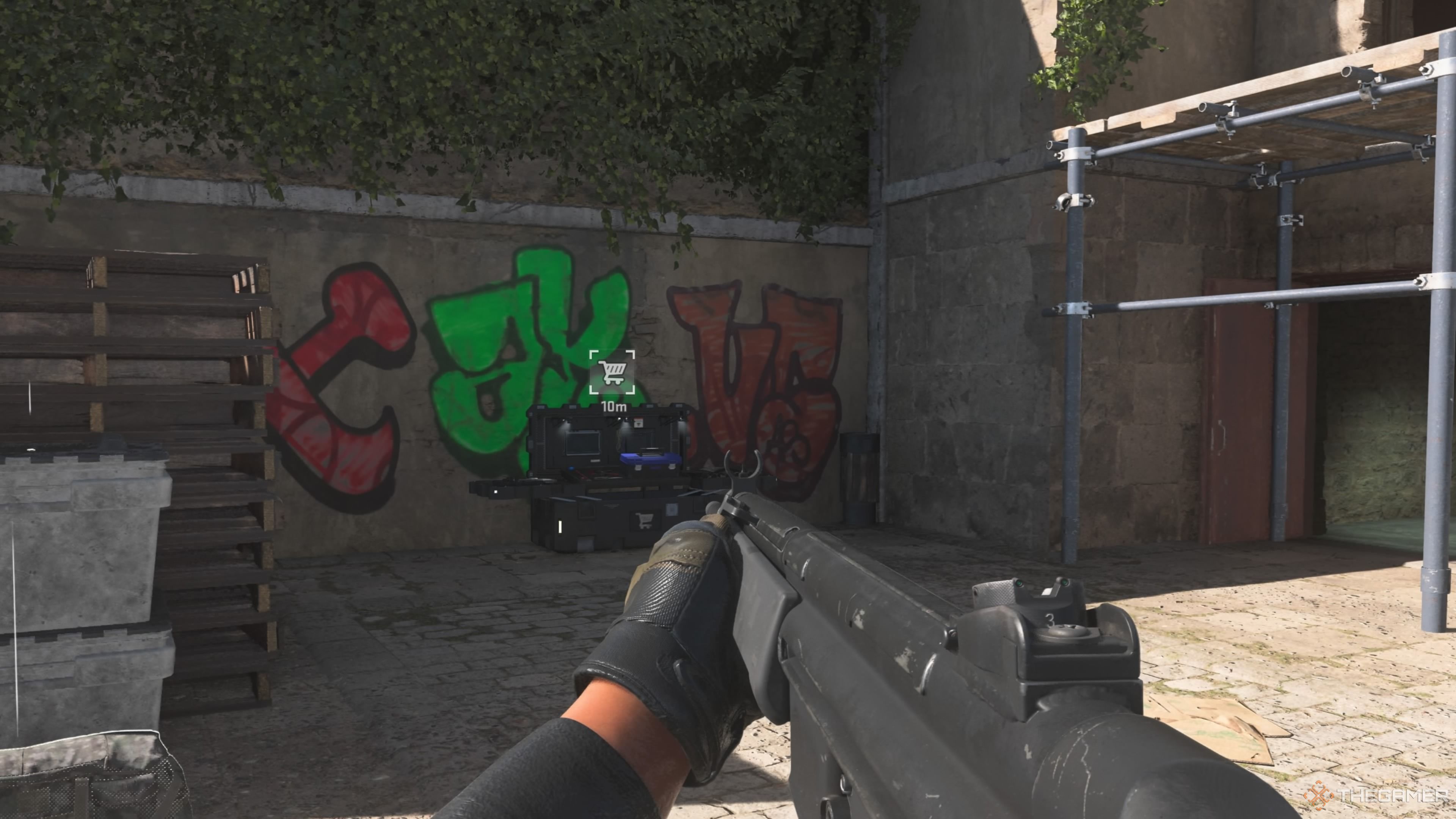
Instead, you can purchase a keycard from a Buy Station for $5,000. While that may seem like a hefty amount, if you’ve been completing contracts and looting items throughout the match, gathering that cash should be manageable. Plus, there’s a faster way to earn significant cash without completing contracts.
Keep in mind that not every Buy Station will have a Stronghold Keycard available, but by checking multiple stations across the map, you’ll find one that does.
The train that circles around Al-Mazrah (visible on the map) is an excellent spot for collecting cash early in the game. While looting the train, it’s common to discover over $3,200 in scattered cash. To maximize this tactic, aim for the train immediately after spawning on the map.
After collecting items, you can sell valuables at a Buy Station or loot cash registers in shops to quickly reach that $5,000 you need for the keycard.
With the cash in hand, you’ll be ready to access the Smuggling Tunnels much more efficiently than relying on enemies to drop a keycard.