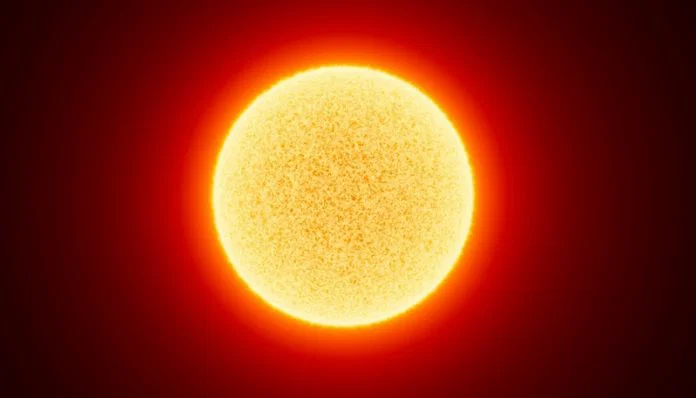
Scientists have found that the Sun contains approximately 55% more silver than previous estimates indicated, settling a long-standing question about the element’s abundance in our solar system. This breakthrough comes from researchers at Uppsala University in Sweden, who developed a more precise method for analyzing the Sun’s chemical composition.
This new insight enhances our understanding of the Sun and could offer valuable clues about the formation of stars, planets, and the elements that make up the universe over billions of years. Although the Sun is massive, it is composed mainly of hydrogen and helium, with only about 1.5% of its mass consisting of heavier elements like carbon, iron, oxygen, and silver. Despite their small proportion, these elements help scientists uncover the history of cosmic evolution.
Since the Sun serves as a benchmark for studying other stars, knowing its exact chemical makeup is crucial. Accurate measurements allow astronomers to compare different stars and gain deeper insights into the evolution of galaxies.
The research was led by Sema Caliskan during her Ph.D. work at Uppsala University. To determine the silver content, her team used spectroscopy, a technique that examines how sunlight interacts with the Sun’s outer atmosphere. When light passes through this layer, atoms absorb specific wavelengths, creating dark lines—spectral fingerprints unique to each element. By analyzing these patterns, scientists can identify elements present and estimate their quantities.
Previous studies depended on simplified models of the Sun’s atmosphere, but this research employed a more sophisticated computer simulation that closely reflects the Sun’s dynamic outer layers. The study also incorporated improved calculations of how silver atoms behave amidst interactions with light and other particles.
Unlike earlier approaches, the new model accounts for complex effects where sunlight influences the behavior of silver atoms, enabling a much more accurate measurement. This refinement helps resolve a longstanding puzzle: prior measurements of solar silver were significantly lower than levels found in some ancient meteorites, which are remnants of the early solar system. Both the Sun and these meteorites originated from the same gas and dust cloud around 4.6 billion years ago, and they were expected to have similar chemical compositions.
The updated calculations now reveal that the silver levels in the Sun match those in primitive meteorites, solving the discrepancy. The researchers believe their improved method can also be applied to study other stars. By measuring silver and other elements across stars of different ages and types, scientists aim to understand where these elements originated—whether in stellar explosions like supernovae—and how they have dispersed throughout the Milky Way over cosmic history.


