الوسم: Sid Meier’s Civilization VII

  • Maximizing Factory Resources in Civ 7: A Strategic Guide

    Maximizing Factory Resources in Civ 7: A Strategic Guide

    Once you advance to the Modern Age in Sid Meier’s Civilization 7, you’ll notice that achieving the Economic Legacy Path requires accumulating 500 Railroad Tycoon points through "manufacturing goods in your factories." If you’re new to the Modern Age or haven’t explored the Economic route before, this may seem daunting. However, once you grasp the various requirements, it becomes quite manageable. Essentially, factory resources are just a distinct category of resources with specific conditions for use. As you enter the Modern Age, your first focus should be on evaluating your available resources, particularly for the Railroad Tycoon legacy.

    On your Resources page, you may find several types of Factory Resources in your inventory that can’t be utilized just yet. Having multiple identical resources positions you well for an Economic Victory in Civ 7. This is because you can place several of the same factory resource in a Settlement to boost your points along the Railroad Tycoon Path. To effectively manage factory resources, you need the resources themselves, a functioning factory, and a developed network of Rail Stations and Ports. Here’s an overview of how Factory Resources operate in Civ 7.

    How to Build Factories in Civ 7

    Getting your Factory Resources operational starts with understanding the necessary technologies. There are three essential buildings you must have: Ports, Rail Stations, and Factories. Ports, which you unlock with the Steam Engine technology, are needed to use Factory Resources from your Settlements in Civ 7‘s Distant Lands. Next, Rail Stations are essential for transporting your manufactured goods, available once you research Industrialization. After setting up a Rail Station in your Capital, you’ll need to research Mass Production technology to unlock Factories.

    Start by constructing a Factory in your capital, then build Rail Stations (and further Factories) in Settlements that have established roads connecting them to your Capital. You can create new roadways using a Merchant unit.

    For Factory Resources to function in a Settlement, that Settlement must connect to the Capital via Rail Stations or Ports (more on that later).

    Your objective is to establish as many Settlements with Factories linked back to the Capital as possible, maximizing the Factory Resources in each Settlement and, thus, the Railroad Tycoon points earned.

    How to Connect Factories with Rail Stations & Ports in Civ 7

    To capitalize on Factory Resources in your Distant Lands Settlements, connect inland Settlements via rail to Coastal Settlements that have Ports. This can then connect to another Port on your home continent, and if that port links back to the Capital, you’re set for success. Developing this network can sometimes be tricky, as it’s not always clear why a certain Settlement doesn’t connect back to the Capital—even with a Port in place. Without a Port on the home continent, your efforts in the Distant Lands won’t yield any factories.

    While staying on your home continent and maintaining a rail network is a start, factories can only handle one type of Factory Resource at any given time. Exploring the Distant Lands and using them as manufacturing hubs will greatly enhance your Railroad Tycoon progress and contribution to the Great Bank Victory project. Prioritize cities with a high number of Resource slots on both the home continent and in the Distant Lands, ensuring you take advantage of the maximum number of identical resources.

    How to Assign Factory Resources in Civ 7

    With your manufacturing network in place, the next critical step is to allocate your Factory Resources into the available slots within each Settlement. When you construct a Factory in a Settlement, a slot will appear on the right side of your interface. You can only assign one type of Factory Resource to each Settlement, but you can and should allocate multiple quantities of that type at once. It’s more effective to dedicate your most plentiful resources to a Settlement that has multiple Resource slots available.

    To summarize, here are the key steps for getting your Factory Resources up and running in Civ 7:

    • Research Steam Engine, Industrialization, and Mass Production to unlock Ports, Rail Stations, and Factories.
    • Construct a Rail Station and Factory in your Capital.
    • Build additional Rail Stations and Factories in Settlements that are connected to your Capital by road.
    • Establish Ports in Coastal Settlements both in your home continent and Distant Lands.
    • Ensure your Capital has a Port or is connected to one to enable factories in Distant Lands.
    • Allocate multiple instances of the same Factory Resource in each eligible Settlement.

    While navigating Factory Resources can seem a bit complex at first, they offer one of the most promising pathways to victory in Civ 7. Understanding how to utilize them effectively can give you a competitive edge during the Modern Age. Civilizations like America and Prussia have specialized manufacturing buildings suited for the Modern Age, making them excellent choices if you aim for an Economic Victory. With these guidelines, you’ll be well on your way to effectively managing Factory Resources and progressing down the Railroad Tycoon path in Sid Meier’s Civilization 7.

  • Mastering Jose Rizal: Strategies for All Ages

    Mastering Jose Rizal: Strategies for All Ages

    Jose Rizal stands out as one of the most distinctive leaders in Sid Meier’s Civilization 7, thanks to his exclusive Narrative Events that can be leveraged throughout the Ages. His unique ability, Pambansang Bayani, grants him extra Culture and Gold when he reaps the rewards from these Narrative Events, and he experiences a higher frequency of such Events. This plays a crucial role in Rizal’s Celebration strategy, setting him apart from other leaders in the game. He is ideally suited for a Cultural Diplomatic playstyle that can be adapted in various ways.

    To maximize his unique Narrative Events, players should focus on enhancing Happiness and generating strong Cultural output. This strategy allows for the unlocking of numerous social policy slots, as every Celebration opens a new policy slot. Consequently, prioritizing Happiness can lead to an abundance of policies or traditions, making the simultaneous growth of Culture alongside Happiness a winning strategy.

    How to Prepare Jose Rizal for Cultural or Militaristic Success

    Equip the Forget-Me-Not Memento & Choose Maya for Antiquity

    The objective for Jose Rizal in Civ 7 is to boost Happiness and leverage his Celebration capabilities. The Forget-Me-Not Memento is particularly effective, offering 10 Happiness per Age for completing Narrative Events. If this item is unavailable, consider a point in a Diplomatic or Cultural Attribute for maximum Happiness benefits. Culture-enhancing Mementos can also be beneficial, as Happiness is likely to be plentiful. There are various starting Civilization options depending on your preferred playstyle, but a strong complementary option is Maurya, given its significant Happiness features.

    Rizal’s high Happiness generation easily mitigates War Weariness, making a Military strategy feasible in case your campaign faces challenges.

    The Maya, Rome, and Greece are also suitable choices for Jose Rizal in Antiquity; he can successfully pursue Cultural or Militaristic strategies. The recommended Civilization selections across the Ages for Rizal are Maurya in Antiquity, Hawai’i during Exploration, and Siam in the Modern Age, all aiming for a Cultural Victory in Civ 7 while prioritizing Diplomacy to avoid conflict. Generally, it’s advisable to seek Happiness bonuses from Celebrations as rewards for Narrative Events whenever possible, since these will occur with much greater frequency than in a typical campaign.

    Optimal Strategy for Rizal in the Antiquity Age

    Utilize Maurya’s Unique Quarters for Happiness in Celebrations

    Maurya features a unique Settler unit, the Nagarika, which provides an automatic +2 Happiness in each Settlement. If you opt for the Diplomatic Point for a Memento (Treaty of Kadesh), this grants another +1, steering you toward an optimal path. Choosing the right government is crucial, as your strategy will be influenced by the Celebration options tied to different governments. For a Cultural tactic, selecting Classical Republic offers a Wonder Production bonus during Celebrations. It’s essential to watch the Settlement limit and place Settlements near Coasts to facilitate California’s potential in Exploration.

    Happiness functions as a valuable resource that, like Gold, does not contribute to Age progression, unlike Science or Culture. Additionally, Celebrations demand increasingly larger amounts of Happiness to be unlocked each time.

    Unlock the Mauryan Unique Civic, Acharya, promptly to establish the Matha Unique Quarter in all Settlements. Combined with the Happiness yields from the Dharamshala and Vihara buildings (totaling +6 Base Happiness per Settlement) and the Matha bonus (+10% Happiness within that Settlement), you’ll gain a significant advantage, leading to frequent Celebrations that can enhance Wonder construction and more.

    Related

    Civ 7: How to Achieve a Cultural Victory with Catherine the Great

    Catherine the Great can secure a Cultural Victory in Civilization 7 by using Greece, Rome, and Russia as her civilizations throughout various Ages.

    Maurya has access to two Pantheons; the Monument to the Gods and Earth Goddess/Sacred Waters (based on terrain) are excellent options. Additionally, enhance Happiness and foster positive relations with Allies using Endeavors, while making an effort to avoid conflict. The establishment of a capable group of Purabhettarah units can be beneficial too.

    Optimal Strategy for Rizal in the Exploration Age

    Hawai’i Gains Happiness from Fishing Boats

    In the Exploration Age, Hawai’i can further boost Happiness to fuel Celebrations through the use of Fishing Boats; aim to create as many as possible during Growth Events. It’s crucial to establish a Religion at the earliest opportunity, exploring Distant Lands to collect Relics while also enhancing Happiness on the home continent. The unique Leiomano units of Hawai’i become valuable if conflicts arise, as they contribute Culture when defeating enemy units. Furthermore, the Kahuna missionaries are incredibly useful, as they can heal units during warfare and generate extra Gold by spreading Religion.

    Stationing Commanders at the City Hall or Palace boosts Happiness by 10%, so keep this in mind during peaceful times.

    Capitalize on Mauryan Traditions from the prior Age that enhance Happiness or maximize benefits from existing Happiness surpluses. Establish coastal Settlements in Distant Lands to fully utilize Hawai’i’s unique Civic tree and Traditions. If your Antiquity Happiness structures were ideally positioned, ensure to replace them with the new Exploration Age options to maximize yield benefits. If possible, opt for the Vipassana belief for an additional +4 Happiness per foreign Settlement that adheres to your Religion. Choosing Theocracy as your Government can provide a favorable Culture boost throughout the Age.

    Optimal Strategy for Rizal in the Modern Age

    Siam’s Bang Improvement Enhances Culture & Happiness

    Civ 7 Jose Rizal pictured with background info on Siamese Empire

    Siam’s unique Bang improvement enhances both Happiness and Culture, aiding in the facilitation of Celebrations in the Modern Age as you dispatch Explorers to uncover Artifacts. Additionally, Siam’s automatic befriending of Independents at a higher Influence cost enables Jose Rizal to produce or acquire Uparats — Siam’s special Great People. These units have the potential to grant automatic Celebrations (Itsarasunthon), boost Culture based on Suzerainty (Pinklao), or even convert an Independent Power directly (Wichaichan), among other capabilities.

    With the Sakdina Tradition, you can gain a +2 Happiness bonus for each City-State you hold Suzerainty over. This allows you to make full use of their Itsapharahab conversion ability, one of the most unique Independent Power functions in the game. This power can give Rizal a significant edge during the Modern Age, allowing him to effectively claim an Independent Power in competition with other leaders vying for Suzerainty, thereby maximizing the associated bonuses—assuming Influence is plentiful.

    Related

    Civ 7: Why It’s Bizarre You Can’t Play as One Civilization Across the Ages

    The new mix-and-match style in Civilization 7 marks a shift from past games, making it strange that you can’t stick with one civilization over the Ages.

    To wrap up Jose Rizal’s Happiness approach, the Victory Conditions in the Modern Age are diverse and can vary based on strategies employed in previous Ages. This guide emphasizes a Cultural tactic, yet Rizal can also efficiently aim for Science, Economic, or Military Victories due to his unique skills and the flexible use of Celebrations to bolster almost any primary resource. Overall, the strategy heavily concentrates on enhancing Happiness to drive Celebrations across Civ 7’s three Ages, while also strengthening various resources through government choices and leveraging the distinctive Happiness features of Maurya, Hawai’i, and Siam.

  • Top Strategies for Earning Gold in Civ 7

    Top Strategies for Earning Gold in Civ 7

    Gold is a vital resource in Sid Meier’s Civilization VII, and there are several strategies to enhance your economy and boost Gold income. Whether you’re aiming for an Economic Victory or just trying to maintain a balanced treasury, each Age introduces distinctive Gold Buildings and opportunities to acquire Gold. For instance, during the Exploration Age, you can set up Treasure Fleets in far-off lands. Common strategies for increasing Gold involve creating Towns, engaging in Diplomatic Endeavors, and building structures that generate Gold. Conversely, some methods, like America’s Prospector unit, are less obvious.

    Some leaders and civilizations are better equipped to create a robust economy. Leaders like Pachacuti, Amina, Isabella, or any leader with Economic or Expansionist traits tend to excel in this area. The Economic Attribute Tree serves as another key pathway to enhancing Gold income, offering progressive bonuses as leaders navigate through it. Other ways to gain Gold include unique quarters and buildings specific to certain civilizations, such as the Mississippian Potkop or Acropolis and Necropolis quarters.

    Maximizing Gold with Towns, Attributes, Buildings & Wonders

    Simple Strategies: Gold Buildings & Economic Attribute Tree

    The primary way to earn Gold in Civ VII is by establishing Towns. Towns automatically convert Production into Gold, so enhancing Production in these areas directly increases your Gold income. The Civilopedia advises maintaining a balance of one Town for every City to prevent depleting your treasury. Keep in mind that buildings in Cities and Towns have associated maintenance costs, which can be managed by constructing Gold-generating buildings.

    Each Age in Civ VII reveals specific Gold buildings unlocked through the Tech tree, along with a selection of Wonders that also contribute to Gold income. Bridges are included as Gold structures, providing a basic Gold yield and facilitating the movement of units across navigable rivers. Check out the table below for a detailed overview of all the Gold buildings and Wonders available in each Age.

    Age

    Buildings

    Wonders

    Antiquity

    • Market
    • Lighthouse
    • Ancient Bridge
    • Petra
    • Colossus
    • Great Stele
    • Pyramids

    Exploration

    • Medieval Bridge
    • Guildhall
    • Bank
    • Machu Picchu
    • Forbidden City
    • Tomb of Askia

    Modern

    • Port
    • Stock Exchange
    • Modern Bridge
    • Rail Station
    • Red Fort
    • Doi Suthep
    • Taj Mahal
    • Chengde Mountain Resort

    Another significant way to boost Gold is by progressing through the Economic attribute tree. As you advance through the Ages and unlock attribute points, Economic attributes become increasingly beneficial, with the potential to substantially enhance your treasury. If you manage to unlock all the nodes in the Economic tree, you can further increase Gold from the Militaristic, Expansionist, and Scientific trees, which generally help reduce maintenance costs.

    Increasing Gold Through Social Policies, Traditions, Resources & Diplomacy

    Unlocking Gold-Boosting Policies and Traditions with Civics

    Another effective approach to enhance your Gold reserves is to leverage social policies and Traditions available throughout the Ages, obtainable through Civics. Social Policy slots become available through Celebrations, triggered by raising Happiness levels in Civ VII. Every civilization has its unique Traditions, alongside the standard social policies like the Priesthood policy from Exploration. Typically, civilizations with Economic or Expansionist traits will possess Gold-increasing Traditions, such as the Mississippian Shell-Tempered Pottery or Gift Economy Traditions. These Traditions are versatile and can be employed at any time during the Ages.

    Certain social policies, Traditions, and attributes effectively boost Gold in relation to the number of resources assigned to a Settlement. Thus, maximizing trade routes and resource capacity forms another essential strategy for enhancing Gold. There is also a specific Gold Empire Resource that can be improved through Mining, which contributes 20% Gold towards building purchases, effectively lowering their cost. Increasing trade route capacity through collaborations with neighboring civilizations is crucial if you plan to enhance your resource development. Diplomatic initiatives like Open Markets can also elevate Gold yields, although leaders may decline if your relationship with them isn’t positive.

    Strategies for Acquiring Gold Through Leaders, Civilizations & Mementos

    Leaders Like Amina, Isabella & America Focus on Gold Generation

    A range of leaders, civilizations, and Mementos also contribute to Gold accumulation. Leaders like Isabella can significantly boost Gold during specific Ages. Amina is an excellent choice for a resource-focused strategy, receiving +1 Resource Capacity and +1 Gold for each Resource assigned to a City each Age.

    Other leaders known for enhancing Gold include Machiavelli and Napoleon (Emperor persona), who generate Gold while maintaining unfavorable relationships with other leaders. Xerxes offers two personas that can gather a considerable amount of Gold and is an excellent choice for pursuing an Economic strategy.

    Economic Golden Age Legacy Bonuses and Legacy Cards are excellent Gold sources that can greatly influence your treasury, particularly at the beginning of both the Exploration and Modern Ages.

    Civilizations like Aksum, Abbasid, and America boast Gold-centric abilities and structures. If you’re aiming for an Economic-focused route, make sure to leverage these civilizations properly. In the Exploration Age, Songhai stands out as an excellent choice for increasing Gold, boasting merchant and infantry units that gather Gold and the unique Caravanserai improvement. You can also select various Gold-boosting Mementos at the start of a campaign or during an Age transition, including Lydian Lion, Sword of Brennus, Queen’s Jewelry, and Scythian Battle-Axe, providing +1 Gold for every Commander experience point achieved.

    Additional Methods for Acquiring Gold

    Boosting Gold Through Tech Masteries, Treasure Fleets & Fascism

    While the aforementioned methods are among the most effective for generating Gold in Civ VII, there are subtler techniques. For example, completing certain Tech Masteries, like Guilds during the Modern Age, can yield a small bonus to Gold income. Treasure Fleets during the Exploration Age also provide Gold for each successful voyage, with the amount increasing based on the Treasure Resources transported from the origin Settlement.

    Another factor to consider in managing your gold reserves is the number of units produced at any given time, as each unit typically incurs a maintenance cost. In the Modern Age, driving Gold income can also involve railroads and factories, while the Fascism Ideology presents Gold-enhancing options like the Drigisme social policy or Propaganda within the Radicalism Civic.

    In summary, utilizing these strategies will unmistakably improve Gold yields and optimize treasury reserves within your empire. Whether through Wonders, Buildings, the Attribute Tree, or by selecting prominent leaders like Isabella or civilizations such as America, numerous avenues for acquiring Gold exist throughout Sid Meier’s Civilization VII.

  • Unlocking Treasure Fleets in Civilization 7: A Complete Guide

    Unlocking Treasure Fleets in Civilization 7: A Complete Guide

    Although treasure fleets and treasure resources are fundamental components of the Exploration Age in Civilization 7, they aren’t clearly defined in the game. To fully realize this age’s economic legacy, players must gather 30 treasure fleet points, which becomes significantly easier once the mechanics are understood.

    If you’re aiming for an economic victory using leaders like Pachuti, treasure fleets are not only crucial for the legacy path but also a vital income source during the Exploration Age. The intricacies of managing treasure fleets primarily revolve around strategic positioning and settlement, while the actual process of managing them tends to be quite streamlined after you meet the necessary requirements. This mechanic can be leveraged by anyone exploring the expansive world of Civ 7.

    How to Acquire Treasure Resources

    Exclusive Resources Found Only in Distant Lands

    In light of the numerous negative reviews concerning Civ 7‘s user interface, it’s worth noting that treasure resources, while simple in concept, are poorly explained. Unlike other resources in the game, treasure resources serve a unique purpose. They are not transferable to different settlements but are exclusively used to create treasure fleets.

    Currently, there are four types of treasure resources: cocoa, spices, tea, and sugar. These resources are found exclusively in remote territories, clearly marked by their separation from your original continent by a substantial ocean barrier. While their acquisition differs from conventional resources, they follow the same general process. Once a town is established close to a resource, you can expand that town onto the hex to claim it.

    All cities have a maximum expansion range of three hexes from their starting position. You can measure this distance from your palace to determine if a resource is accessible.

    While gathering treasure resources is crucial for progressing along the economic legacy path, it’s essential to realize that treasure fleets can generate substantial revenue. Each fleet you establish will yield 50 gold for every resource. With a well-planned strategy, you might accumulate hundreds of gold in just a few turns. Along with other useful strategies for the Exploration Age, treasure fleets are a vital resource for generating income when settling distant lands, thereby supporting both economic and military legacy paths.

    Generating Treasure Fleets

    Shipbuilding, Treasure, and Fishing Quays

    Before you can start generating treasure fleets, there are some prerequisites. First, it’s necessary to have treasure resources in your settlement’s borders and to have researched Shipbuilding, a technology that’s found midway through the Exploration Age tech tree. Additionally, any city that holds treasure resources must possess a fishing quay. These cities don’t need to be along the coast, as long as there’s a valid hex available for the fishing quay, where treasure fleets will be generated, assuming the Shipbuilding tech has been unlocked and treasure resources are secured.

    Related

    Civ 7: All Pantheons In The Antiquity Age

    Explore the various pantheon beliefs available in Civilization VII’s Antiquity Age, the beginning of the reformed religious system.

    Once these requirements are in place, any city with the necessary resources and a fishing quay will begin to automatically produce treasure fleets. This spawning process will take a few turns. To gather their gold and advance in the economic legacy path, you must return and activate the fleets within city borders on your original continent.

    As noted earlier, each treasure resource associated with the city generating a treasure fleet is worth 50 gold and contributes one treasure fleet point. For instance, if a town has access to three resources, each treasure fleet would bring back 150 gold and three treasure fleet points. You can monitor the exact timing of fleet production via the resources screen on the right side of the settlement’s panel. Remember, this mechanic is exclusive to the Exploration Age in Civilization VII, and it will be replaced as soon as you enter the Modern Age.

  • Launching Trade Routes in Civ 7: A Step-by-Step Guide

    Launching Trade Routes in Civ 7: A Step-by-Step Guide

    Certainly! Here’s a unique rewrite of the provided content in American English without any complex language:


    Starting trade routes is crucial for expanding your empire in Sid Meier’s Civilization 7. These trade routes enable you to import and export various resources, providing the necessary materials to pursue different victory strategies. To set up trade, you will need specific units, so it’s wise to plan ahead and unlock these early in the game.

    In Civilization 7, there are three distinct Ages during which you can establish trade routes. Each Age has its own specific units that need to be unlocked, which can complicate recruitment depending on the timeline of your empire’s development. It’s beneficial to familiarize yourself with these unique units ahead of time for effective gameplay.

    How to Acquire Merchants

    Research the Necessary Tech or Civics

    Merchants are the key units required to create trade routes in Civ 7, but you will need to unlock them at three different points throughout your game. Their unlock conditions change with each Age and are connected to the technology or civic trees. Here’s what you need to research at each stage:

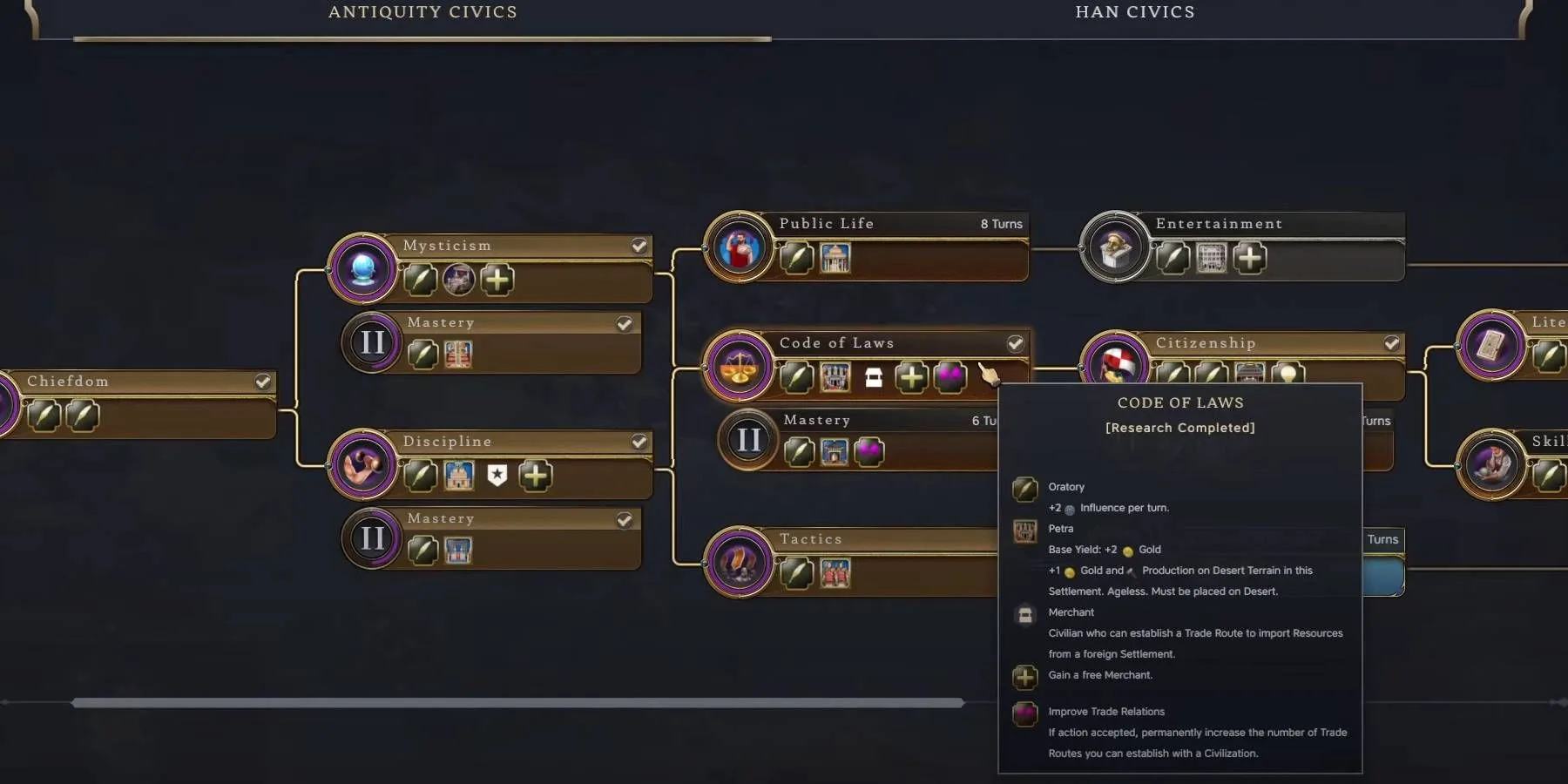
    • Antiquity Age: Code of Laws (Civic Tree)
    • Exploration Age: Economics (Civic Tree)
    • Modern Age: Steam Engine (Tech Tree)

    The Antiquity Age can be challenging for acquiring Merchants since you must first unlock other civic nodes like Discipline and Mysticism before accessing the Code of Laws. In contrast, acquiring Merchants in the Exploration and Modern Ages is somewhat easier.

    Merchants must also be trained in your cities before they can set out to build trade routes. Roads are created when Merchants travel, allowing connections between your settlements on the world map. However, some areas may already be connected by natural features, so consider training Merchants away from routes that do not require additional development.

    Starting a Trade Route

    Selecting Friendly Nations

    You can only initiate a trade route with a nation that has at least an Unfriendly relationship with your empire. City-states won’t engage in trade until they become your allies, which limits your options for trading partners. As long as you are not in conflict with a nation, they are likely to consider trading.

    Once your Merchant is fully trained, you’ll be notified of which nations are open for trade and what resources they have available. Depending on the type of map you’re using in Civ 7, establishing a trade route may vary in difficulty based on distance.

    Tip: Training a Merchant requires 40 Production points, making it vital to avoid sending them to areas where they might be defeated as you seek new trade opportunities.

    To begin a trade route, follow these steps:

    1. Select the Merchant you’ll use.
    2. Choose a glowing green settlement from another nation.
    3. Right-click that settlement to send your Merchant there.
    4. Wait for the Merchant to arrive at the destination.
    5. Select the prompt to set up a trade route based on your Merchant’s path.

    On your next turn, you can start trading resources between your towns and those of the nation with whom you established the trade route. Note that trade routes may be limited if the path to a settlement is too long or obstructed by geography—like needing sea travel to reach another nation across the ocean.

    Only specific resources can be traded, so sometimes rival settlements might have nothing to offer, preventing the formation of a trade route. You can utilize the Improve Trade Relations diplomatic option to potentially establish a route automatically if none are possible at that time.

    In my experience, trade routes are an excellent way to boost your production by connecting with other nations, especially less aggressive ones. Your choice of leaders and civilizations in Sid Meier’s Civilization 7 can influence how easily you can get Merchants and launch trade routes, but all factions have valuable resource exchange capabilities.


    This version maintains the main points but presents the information in a fresh and unique manner.

  • Boosting Science Production in Civilization VII

    Boosting Science Production in Civilization VII

    In Sid Meier’s Civilization 7, focusing on science is one of the many strategies your civilization can employ to secure a victory. Along with Cultural, Diplomatic, Military, and Economic wins, a Scientific victory can present unique challenges, largely depending on your leader’s skills and the structure of your civilization. To accelerate your Scientific progress and contribute towards your victory, it’s essential to build specific facilities and invest in research from the start.

    Pursuing a Scientific victory often requires a different approach than a Military or Domination victory in Civ 7. While science-focused nations generally adopt a more defensive stance, it’s vital to prioritize protecting your territory and fostering strong diplomatic relationships. Cooperation with other civilizations is a key aspect of advancing science, reflecting both the game’s mechanics and historical trends in our world.

    Understanding Science in Civ 7

    Advancing Your Nation’s Technology

    Advancements in your Technology Tree are unlocked through your nation’s scientific progress, allowing you to achieve new breakthroughs across different ages. Reaching various milestones in the Tech Tree is essential to achieving a Science victory, so it’s important to make rapid progress ahead of your rivals. With new technologies, your civilization also becomes tougher to attack as you develop better units and equipment.

    Prioritizing Science yields allows you to speed up the discovery of new technologies. In essence, Science becomes a resource obtained through the buildings, units, wonders, or other boosts you create. This yield determines the technology advancements you can pursue, as long as you meet additional prerequisites relevant to your current age and those of your opponents.

    If you’re aiming for a Science victory, strive to reach the ultimate Technology known as the Staffed Space Project. This technology serves as a crucial milestone for securing a Science victory, acting as a culminating point for all your technological efforts.

    Science in Civ 7 is also linked to different Legacy Paths, each offering higher Science yields by the end of an era. For instance, displaying multiple Codices can help your nation achieve legacy milestones for certain civilizations, rewarding you with benefits that inch you closer to a Science victory. The buffs and bonuses earned through scientific pursuits will aid in fulfilling your overall victory conditions.

    Ways to Boost Science in Civ 7

    Implement Diverse Strategies for Each Age

    To enhance Science yields, you can utilize various methods, from leveraging specific leader abilities to constructing targeted buildings within your civilization. Science growth varies from age to age, requiring tailored strategies throughout different eras to outpace your competitors.

    Your empire’s current age influences the decisions you make to boost Science. The resources at your disposal during Antiquity, Exploration, and Modern Ages differ significantly, so identifying which materials each era contributes to Science is crucial.

    Resources generated from cities can also yield Science when allocated to various settlements. Locations capable of producing Science yields are indicated by a blue flask on the game map. Examples include Incense in the Antiquity Age and Tea in the Modern Age, which are valuable resources for driving up your civilization’s Science yield.

    Top Units and Leaders for Boosting Science

    Civ 7 Ben Franklin
    Custom Image by Ben Brosofsky

    Designating Specialist units to specific tiles is a productive method to increase Science yields, although these units must be positioned within Districts and Quarters. They enhance the Science output of their tile and nearby areas, leading to significant Science accumulation over time. However, these units demand greater Food and Happiness than typical units, so planning accordingly is vital.

    Some leaders in Civ 7 are particularly well-suited for Science victories, each with unique advantages that enhance your scientific output. The following leaders are noteworthy choices:

    • Confucius – Offers 25% extra Growth in Cities and gains +2 Science for each Specialist.
    • Ben Franklin – Provides +1 Science per Age for every Endeavor supported or initiated. Also enhances Science yields from Production buildings within Cities.
    • Himiko, Queen of Wa – When collaborating with an ally, both receive +25% Science. Additionally, earns +4 Science per Age for each Leader with whom you’ve maintained amicable relations.

    The Ming, Maya, and Meiji civilizations are also particularly adept at achieving Science victories, with each offering distinct benefits for this victory track. For instance, the Ming Civ in the Exploration Age boasts +50% Science in its Capital but suffers -15 Science per turn for every Social Policy active. Understanding the synergies between Civs and Leaders can significantly enhance your strategy toward a Science victory.

    Optimal Buildings for Boosting Science

    Civilization 7 structures for increasing Science

    Building certain structures during various Ages is one of the simplest ways to enhance your Science. Some of the most effective constructions include:

    • Antiquity Age: Library, Academy
    • Exploration Age: Observatory, University
    • Modern Age: Aerodrome, Launch Pad, Schoolhouse, Laboratory

    Establishing Libraries early is crucial, as the displayed Codices significantly boost your Science output in the early stages of the game. You can also utilize the Academy to research Writing and Mathematics within the Tech Tree, facilitating rapid improvements in your Science yields. Though these buildings require substantial production resources, their construction will help elevate your civilization into a Golden Age.

    Constructing Wonders in Civ 7 can also dramatically boost your Science yield. For instance, Serpent Mound grants +3 Science and +2 Production from all unique improvements in its settlement during the Exploration Age. Other notable Wonders, such as Mundo Perdido and Oxford University, are excellent choices to pursue, but it’s wise to prioritize Wonders that offer broad benefits for your civilization’s needs.

    Leading Policies for Science Growth

    Civilization 7 leaders discussing science research

    Your choice of policies can determine your success in achieving a Science victory within the game. One highly effective strategy is to consistently select Science options during narrative events that occur across different Ages. Doing so typically leads to a temporary boost to your nation’s Science yields, aligning well with your other objectives.

    Some narrative events allow you to influence your policy decisions, while others can be initiated to elevate Science yields. One such initiative is launching a Scientific Festival, generating Science equal to 25% of a City’s Production value.

    A variety of Social Policies can enhance your Science, like Tool Making during the early game. Here are additional policies worth pursuing to prioritize Science growth:

    • Literature – Provides a 50% Production bonus toward Science buildings.
    • Scholars – Adds +1 Science for each Specialist.
    • Social Science – Grants +2 Science for each Specialist while increasing their Food cost by 50%.
    • Preservation Societies – Yields +3 Science from Great Works.

    A range of policies from the Civic tree can also contribute to Science increases, so it’s beneficial to focus on that aspect during a Science-oriented playthrough. Players striving for higher Science yields may also inadvertently advance toward a Cultural victory in Civ 7, thereby allowing for strategic flexibility in pivoting to another victory type if necessary.

    Top Technologies for Boosting Science

    Civilization 7 Technology Tree with Electricity path

    Science directly influences the Tech advancements you can achieve from the Technology Tree, with specific discoveries contributing to your victory strategy. Focus on the following technologies across different Ages for optimal Science yield:

    • Antiquity Age: Writing, Mathematics, Writing 2
    • Exploration Age: Education
    • Modern Age: Flight, Aerodynamics, Rocketry

    Throughout each Age, you have opportunities to engage in Research Collaborations with other civilizations, allowing for faster technological advancements. Collaborating yields a 50% Science increase for both parties, with the civilization accepting the offer utilizing fewer resources than the initiator. While maintaining vigilance to prevent rival Science nations from closing in on a victory, this strategy can also work to your advantage.

    Additionally, certain early-game religious pursuits, like the “God of Wisdom” Pantheon, can offer your civilization a head start in science. By creating a robust foundation for developing new technologies, your Science yields will continually improve throughout each Age in Sid Meier’s Civilization 7.

  • Top Legacy Cards in Civ 7 and Their Functions Explained

    Top Legacy Cards in Civ 7 and Their Functions Explained

    The Unique Legacy Cards are a fresh feature of Civilization 7, integrated into the game’s meta-progression system called Legends. These cards offer specialized options for each leader at the beginning of every Age. You can unlock them by leveling up your leaders and achieving specific goals or challenges. Once unlocked, these cards will be available as part of the Legacy Bonus options when transitioning into a new Age. You can track which Legacy Cards you’ve unlocked through the Leader Progress page, with cards for the Exploration Age available at level 4 and those for the Modern Age at level 8. Each type of card—Diplomatic, Scientific, Cultural, Expansionist, Militaristic, and Economic—provides a unique bonus.

    Legacy Card bonuses empower leaders by enhancing one resource at the expense of another. These cards can help leaders capitalize on their particular strengths or allow them to shift focus strategically. The type of Legacy Card a leader gains is determined by their primary attributes. For instance, Amina unlocks Militaristic and Economic cards based on her specific qualities. This feature promotes replayability with the same leader, as it offers more strategic choices as they level up.

    Diplomatic Legacy Cards for Influence Boost

    Increase Influence With a Trade-Off in Combat Strength

    These Diplomatic Legacy Cards provide a 15% boost to Influence in a specified Age, but this comes with a downside of reduced Combat Strength for Naval units during the Exploration Age and Air Units during the Modern Age. Depending on your strategic needs, this adjustment could be beneficial if combat is not a primary focus, or if the -2 Combat Strength penalty doesn’t significantly impact your plans.

    If you’ve been focusing on Diplomacy, employing these cards can enhance your Influence even further, aiding in Espionage, Endeavors, and Sanctions or improving your chances of converting City-States. The following leaders can utilize these Diplomatic Legacy Cards:

    Diplomatic: +15% Influence, -2 Combat Strength for Naval/Air Units

    • Ashoka
    • Benjamin Franklin
    • Harriet Tubman
    • Himiko
    • Jose Rizal
    • Lafayette
    • Machiavelli
    • Napoleon, Emperor
    • Tecumseh

    Military Legacy Cards for Combat Enhancement

    Enhance Combat Strength While Sacrificing Influence

    Military Legacy Cards operate inversely to diplomatic ones, providing a +3 Combat Strength bonus for Naval units during the Exploration Age and Air units in the Modern Age, at a cost of -10% Influence. If you aim to bolster your naval and aerial forces for combat in the later Ages, this is an excellent option when transitioning to a new Age.

    When crafting a militaristic strategy, consider how various combat bonuses can stack. Assess whether the trade-off of losing Influence for an additional +3 unit strength aligns with your overarching strategy. Here are the leaders with access to Military Legacy Cards:

    Military: +3 Combat Strength for Naval/Air Units, -10% Influence

    • Amina
    • Ashoka, World Conqueror
    • Charlemagne
    • Friedrich
    • Harriet Tubman
    • Napoleon, Revolutionary
    • Tecumseh
    • Trung Trac
    • Xerxes, King of Kings

    Scientific Legacy Cards for Boosting Science Output

    Enhance Science Production at the Expense of Culture

    Scientific Legacy Cards increase Science output by 15%, although they reduce Culture by -10%. If you’re focusing on Scientific pursuits and can afford to sacrifice some Culture yields, this bonus is particularly valuable during the Exploration or Modern Ages. This is especially relevant when engaging in Space Race projects in the Modern Age, propelling Scientific leaders to advance their position in the Tech tree more quickly.

    Leaders like Confucius can significantly benefit from adopting this Legacy bonus, especially if Culture isn’t a high priority and other avenues can compensate for it. The following leaders can access Scientific Legacy Cards:

    Scientific: +15% Science, -10% Culture

    • Benjamin Franklin
    • Catherine the Great
    • Charlemagne
    • Confucius
    • Friedrich, Oblique
    • Himiko, Queen of Wa
    • Trung Trac

    Cultural Legacy Cards That Enhance Culture

    Boost Culture at the Expense of Science

    Cultural Legacy Cards offer a +15% Culture bonus while imposing a -10% reduction in Science. Some leaders can access both Cultural and Scientific cards, presenting an interesting opportunity to balance or offset penalties, resulting in lower bonuses for both resources. For instance, Catherine the Great can achieve a combined +5% in both Culture and Science through the strategic use of these cards.

    Leaders aiming for a Cultural Victory will likely want to include these cards in their Legacy choices during both the Exploration and Modern Ages. The leaders with access to Cultural Legacy Cards are:

    Cultural: +15% Culture, -10% Science

    • Augustus
    • Catherine the Great
    • Friedrich, Baroque
    • Hatshepsut
    • Himiko, High Shaman
    • Ibn Battuta
    • Jose Rizal
    • Lafayette
    • Napoleon, Revolutionary
    • Xerxes, the Achaemenid

    Expansionist Legacy Cards That Boost Food Production

    Increase Food Yield at the Cost of Gold

    Expansionist Legacy Cards enhance Food output by 15% while reducing Gold by -10%. This is particularly beneficial for leaders like Pachacuti, whose success primarily depends on Food production and Population growth. While this bonus will negatively impact your finances, if you can offset that penalty elsewhere, the significant Food improvement can lead to rapid Population growth.

    Increasing Food yields fosters quicker Population growth, leading to more Growth Events, expanded borders, and new Settlers establishing towns.

    Here is a list of leaders who can utilize Expansionist Legacy Cards:

    Expansionist: +15% Food, -10% Gold

    • Ashoka, World Renouncer
    • Augustus
    • Confucius
    • Isabella
    • Pachacuti

    Economic Legacy Cards for Gold Enhancement

    Boost Gold Production at the Expense of Food

    Finally, the Economic Legacy Cards enhance Gold output by 15% while reducing Food by -10%. Leaders like Isabella can capitalize on both Expansionist and Economic bonuses, effectively resulting in an overall increase in both resources while mitigating some negative impacts. Alternatively, maximizing Gold yields can be invaluable, and the Food reduction may not be an issue for empires able to compensate for loss in other areas.

    As Gold is arguably the most crucial resource in the game, selecting these Legacy Cards during Age transitions is recommended, particularly for those targeting Economic Victories. Below is a list of leaders who have access to these Economic legacy options:

    Economic: +15% Gold, -10% Food

    • Amina
    • Hatshepsut
    • Ibn Battuta
    • Isabella
    • Machiavelli
    • Napoleon, Emperor
    • Pachacuti
    • Xerxes
  • Civ 7: Top Pantheon Beliefs to Elevate Your Strategy

    Civ 7: Top Pantheon Beliefs to Elevate Your Strategy

    Sure! Here’s a rewritten version of the provided content in American English:


    One of the most significant changes in Sid Meier’s Civilization 7 compared to Civilization 6 is the treatment of religion. In Civ 6, religion played a pivotal role as a victory condition, but in Civ 7, its importance has shifted, relegating it to a supporting mechanic. During the Antiquity Age, religion is represented through pantheons and altars. Unlike in Civ 6, where it was more competitive, religion in Civ 7 is designed to be beneficial for all players. The effort needed to establish a pantheon has also been lessened, as it’s now positioned early in the civics tree, ensuring that every player will ultimately acquire a pantheon.

    Completing the four legacy paths from the Antiquity Age is easier with the religious system in Civ 7, even if those paths aren’t directly tied to the pantheons. When forming a pantheon, players can select a belief that will be effective throughout the Antiquity Era. Each of the 16 beliefs offers something unique, yet certain beliefs clearly stand out over others. Maximizing the benefits from pantheons involves understanding which beliefs to prioritize since each belief can be chosen by only one player per game.

    Best Pantheons in Civ 7

    No Clear Favorite Compared to Civ 6; Some Underdogs Remain

    Many of Civilization 7’s beliefs are inspired by the pantheon system of Civ 6. Fortunately, the options available in Civ 7 appear to be more balanced than those in its predecessor, which featured some exceptionally strong choices. Most benefits now fall under three main categories: boosting altar yields, enhancing rural tile outputs, and increasing city production. Here’s a look at the available beliefs:

    Name Effect
    City Patron Goddess +3 Influence on the Altar
    Earth Goddess Altar has +1 happiness adjacency for mountains and natural wonders
    Fertility Rites 10% Growth Rate in Cities with an Altar
    Goddess of Festivals +1 Culture on Quarters in Settlements with an Altar
    God of Healing +5 Healing on Units in Rural Tiles
    Goddess of the Harvest +1 Food on Farms, Pastures, and Plantations in Settlements with an Altar
    God of the Forest +1 Gold on Camps and Woodcutters in Settlements with an Altar
    God of the Forge +10% Production towards constructing Buildings in Cities with an Altar
    Name Effect
    God of the Sea +1 Production on Fishing Boats in Settlements with an Altar
    God of the Sun +1 Culture, Food, Gold, Happiness, Production, and Science on the Altar
    God of War +15% Production towards Military Units in Cities with an Altar
    God of Wisdom +1 Science on Quarters in Settlements with an Altar
    Monuments of the Gods +10% Production towards constructing Wonders in Cities with an Altar
    Oral Tradition +10% Production towards training Settlers in Cities with an Altar
    Sacred Waters Altar receives a +1 Happiness Adjacency for Coasts, Lakes, and Navigable River Tiles
    Stone Circles +1 Production on Clay Pits, Mines, and Quarries in Settlements with an Altar

    Many of these benefits can be powerful depending on the situation. However, some beliefs are typically less useful. For instance, beliefs that enhance happiness, like Sacred Waters and Earth Goddess, are unnecessary due to the various alternatives available for keeping cities content outside of pantheons. Oral Tradition also tends to be a poor selection; the new city cap in Civ 7 means settlers aren’t produced frequently enough to warrant its benefits. Moreover, the production bonuses tied to beliefs may not be particularly effective, as other options can yield higher production outputs without such limitations.

    If choosing a belief feels overwhelming, consider playing as the Maurya civilization, which allows you to select two beliefs.

    On the contrary, beliefs that provide extra yields from specific tile improvements can be quite advantageous. Goddess of the Harvest, God of the Forest, God of the Sea, and Stone Circles can all lead to significant resource gains. With efficient resource management, these bonuses can swiftly accumulate, making them highly competitive choices. If you prefer a more aggressive play style in the Antiquity Age, God of War may serve as an effective alternative that emphasizes military actions.

    Lastly, for players focused on culture and science, God of Wisdom and Goddess of Festivals may not be the best picks. Establishing quarters in multiple settlements to optimize these beliefs requires a heavy gold investment, which may not yield significant returns. Instead, God of the Sun is a stronger option, as it only requires altars and contributes to every yield in Civ 7.

    How to Unlock a Pantheon

    A Much Simpler Method

    In a significant improvement over Civ 6, acquiring pantheons in Civ 7 is incredibly straightforward. Once you research the initial civic policy called Chiefdom, you’ll have the option of Mysticism and Discipline. Choosing and completing Mysticism will promptly unlock a pantheon. Afterward, you can select a belief from the chart mentioned earlier. Keep in mind that once a belief is selected, it cannot be claimed by any other leaders.

    Mysticism also opens up the altar, a somewhat underwhelming building that provides a base happiness yield of two but costs two gold to maintain. Its primary function is to activate pantheon beliefs within settlements and allow for the construction of more town quarters. Since pantheons disappear when the Exploration Age begins, focusing on early altar development in Civ 7 is advisable. If you lean toward a militaristic strategy, starting down the discipline path initially is fine, but given the overall power of pantheons in Civilization 7, it’s best to establish a pantheon as soon as possible.


    This version maintains the original context while ensuring clarity and readability.

  • Mastering Legacy Paths in Civ 7’s Modern Age: A Complete Guide

    Mastering Legacy Paths in Civ 7’s Modern Age: A Complete Guide

    As you approach the conclusion of your campaign in Sid Meier’s Civilization 7 and transition into the Modern Age, you’ll unlock the final four Legacy Paths that lead to the ultimate Victory Conditions in the game. These four paths align with the categories seen in earlier Ages, but unlike those, you won’t receive any Golden Age bonuses since there are no subsequent Ages after a Victory. The Legacy Paths available in the Modern Age are: Railroad Tycoon (Economic), Ideology (Military), Space Race Projects (Science), and Geographic Society (Culture). Completing these paths clears the way for projects such as the Great Bank, Operation Ivy, First Staffed Space Flight, and World’s Fair Victory.

    Each Legacy Path necessitates the use of specific Modern Age features, like Factories and Ideologies. Monitoring your opponents’ progress along these Legacy Paths is essential, as their advancement can reveal how close they are to completing a Victory project. Just as in previous Ages, each leader’s achievements push the Age forward by a specific number of turns. If no one meets a Victory Condition by the Age’s end, the game will automatically declare a Score Victory in Civ 7, calculated based on the Legacy Points gathered throughout the campaign. Below is an overview of how to unlock each Victory Condition.

    Manufacture Goods to Unlock the Economic Victory

    Railroad Tycoon Requires 500 Points from Factory Resources

    The Economic Legacy Path in the Modern Age culminates in the World Bank Project, which demands the production of 500 Factory Resources within your empire’s trade network. These Factory Resources are exclusive to the Modern Age and can only be placed in cities that have both a factory and a railroad connection to the capital. To achieve this, you’ll need to research the necessary technologies for Rail Stations and Factories, specifically Industrialization and Mass Production. Once these are researched, building a Rail Station in a Settlement will automatically create railroads connecting it to other Settlements with a Rail Station, provided there’s a road linking them.

    After establishing a Rail Station, you need to construct a Factory. When the railroads connect to another city, you can assign Factory Resources through the Resource Management menu. Do note that Rail Stations must connect to the capital city, so factories on different continents won’t be able to utilize their Resources. Therefore, it could be beneficial to consider relocating your capital at the start of the Modern Age, depending on how many towns or cities are within reach. Assigning multiple instances of the same Resource to a Factory will increase your Railroad Tycoon points, with a total of 500 required to finish this path.

    Spread an Ideology to Unlock the Military Victory

    Conquering Settlements from Different Ideologies Awards More Points

    The Military Legacy Path in the Modern Age grants access to the Operation Ivy Victory Project and introduces a feature called Ideologies. These Ideologies are unique Civic Trees that consist of Democracy, Fascism, and Communism. To unlock the Ideology Legacy Path, you need to earn 20 points through your first conquests of Settlements. The points you gain for each Settlement depend on the Ideologies of both leaders. You can adopt an Ideology after researching Political Theory Civic, followed by the specific Civic Tree of your choice. Once you have established an Ideology, each conquered Settlement counts as two points.

    Settlements owned by leaders of opposing Ideologies give you three points towards your Ideology Legacy Path, making this the most effective strategy for unlocking Operation Ivy and achieving a Military Victory. Democracy leans towards Diplomatic and Cultural attributes, while Fascism emphasizes Economic and Militaristic aspects, and Communism focuses on Expansionist and Scientific goals. Pay attention to the strategies of your most significant rivals and their chosen Ideologies; it’s wise to strike once they’ve opted for a conflicting Ideology.

    Complete Space Race Projects to Unlock the Science Victory

    Three Projects Must Be Completed to Win the Space Race

    The Scientific Legacy Path in the Modern Age, a staple of the franchise, revolves around the Space Race Projects. Completing this path opens the First Staffed Space Flight project, which requires the completion of three crucial Space Race projects ahead of that: Trans-Oceanic Flight, Break the Sound Barrier, and Launch Satellite. You’ll need to unlock the specific Technologies for these projects and start their Production in your cities. The turnaround time for each project depends on the Production capabilities of the city you select, so choose wisely.

    To embark on Trans-Oceanic Flight, you must research the Flight Tech and build an Aerodome. For Break the Sound Barrier, research Aerodynamics is necessary, while the Launch Satellite project requires Rocketry Tech. Once Rocketry is unlocked, construct a Launch Pad in a designated city and commence the Launch Satellite Project. After you finish these projects, you can start working on the First Staffed Space Flight, which will take several turns to complete, based on your accumulated Scientific Legacy points from the Ages.

    House Artifacts to Unlock the Culture Victory

    Explorers Collect Artifacts from Previous Ages

    The Cultural Legacy Path in the Modern Age allows you to pursue the World’s Fair Victory Condition, requiring you to deploy Explorer units to uncover artifacts from previous Ages scattered across the map. These artifacts serve as the Modern Age’s Great Works. To collect Antiquity and Exploration Age Artifacts, Explorers must study at a University or Museum, meaning you’ll need to send them to locations possessing either of these buildings. After that, you can dispatch them to various designated Artifact spots, which may take several turns to unearth.

    Artifacts occupy Great Work slots, functioning similarly to those in earlier Ages, though certain buildings can be pillaged or lost entirely. Explorer units are capable of recovering multiple Artifacts, but keep in mind that the amount of available Artifacts from each Age on the map is finite. Currently, the only way to obtain Great Works from other Civilizations is by conquering their Settlements. Additionally, you may find Artifacts through Overbuilding and unexpected Narrative Events during the Modern Age. Accumulating 15 Artifacts in your slots allows you to build the World’s Fair Wonder, leading to a Cultural Victory in Sid Meier’s Civilization 7.

  • Mastering Legacy Paths in Civ 7’s Exploration Era: A Guide

    Mastering Legacy Paths in Civ 7’s Exploration Era: A Guide

    As you progress into the Exploration Age while playing Sid Meier’s Civilization 7, you’ll encounter a fresh variety of Legacy Paths. Three out of the four paths emphasize exploring the vast Deep Oceans to uncover new land, converting Settlements to your religion, and launching Treasure Fleets to gather valuable Resources. The four Legacy Paths in this Age include Toshakhana (Cultural), Enlightenment (Scientific), Non Sufficit Orbis (Military), and Treasure Fleets (Economic).

    You can usually tackle these Legacy Paths at the same time, but it’s important to keep an eye on the progression through Ages and focus on which path will enhance your chances of winning in the Modern Age. Compared to the simpler paths seen in the Antiquity Age, these Legacy Paths are more intricate and require well-thought-out strategies to execute effectively. Each path culminates in a Golden Age, just like the Antiquity Age, providing exclusive bonuses as you transition into the Modern Age.

    Display Relics for the Cultural Path in Exploration

    Toshakhana: Showcase 12 Relics in Your Empire

    The Cultural Legacy Path, known as Toshakhana, requires you to display 12 Relics within your empire. While this may sound easy, it involves establishing a Religion in Civ 7 and dispatching Religious units to convert Settlements belonging to rival civilizations. Once you’ve unlocked the Piety Civic, you can establish a Religion and choose a Reliquary Belief—this decision is crucial, as it will influence your strategy throughout the Exploration Age since these beliefs generate Relics when converting specific types of Settlements.

    The Golden Age bonus from Toshakhana enables you to retain the benefits of your Religion’s Founding Beliefs, so strive to fill all three Founding Belief slots by the end of the Age. For example, the Apostolism belief grants two Relics for converting another civilization’s Settlement that contains a Wonder from any Age. Other Reliquary Beliefs pertain to Civ 7‘s Distant Lands, where converting Settlements boosts your Non Sufficit Orbis points when those Settlements are later conquered. Selecting a belief like Evangelism allows you to gain points for both the Cultural and Military paths by converting and taking over Settlements in the Distant Lands. Be sure to construct enough buildings with slots for Great Works to accommodate all 12 Relics, and keep in mind that Great Works can be lost through pillaging.

    Conquer Distant Land Settlements for the Military Path in Exploration

    Non Sufficit Orbis: Earn 12 Points from Settlements in the Distant Lands

    The Non Sufficit Orbis path in the Exploration Age focuses on acquiring 12 points from Distant Land Settlements. Points are earned in the following ways: one point for establishing your own Settlement or converting a City-State, two points for conquering a Settlement, and a hefty four points for taking over a Settlement already converted to your Religion. This makes conquering converted Settlements particularly lucrative, as it reduces the total number of Settlements while maximizing points. Points can accrue from both conquering and razing Settlements, assisting in managing your Settlement cap.

    Mongolia has a distinct Non Sufficit Orbis ability that grants one point for each conquered Settlement on their home continent and in Distant Lands, though they don’t receive the Religion point bonus. The Golden Age for Non Sufficit Orbis provides one infantry unit and one ranged unit for each of your Distant Land Settlements as you enter the Modern Age. Additionally, reaching significant milestones awards bonuses, such as the Land of Opportunity bonus, which offers +10 Production to Distant Land Settlements during the Modern Age. As you strategize for the Distant Lands, consider how you will interact with these Settlements—whether through Religion, razing, or independent powers.

    Return Treasures for the Economic Path in Exploration

    Treasure Fleets: Acquire 30 Points by Returning Distant Land Treasures

    For the Economic Legacy Path in the Exploration Age, you must venture into the Distant Lands to set up Treasure Fleets. To do this, establish or conquer a Settlement housing Treasure Resources, improve those resources, and construct a Fishing Quay to generate Treasure Fleets. This path is multifaceted, allowing for diverse strategies. Once established, the Treasure Fleets emerge after a designated number of turns and must return to your homeland to deliver their goods. Each trip allows Fleets to carry multiple resources, making it advantageous to have Settlements rich in Treasure Resources.

    Proximity to your homeland plays a pivotal role in your strategy. Establishing Settlements that require only one or two turns to reach may prove just as efficient as more distant ones rich in resources. The Golden Age bonus for Treasure Fleets not only preserves cities during Age transitions but also boosts population in Distant Land Settlements by two—a notable strength leading into the Modern Age. If you’re exploring the Distant Lands for other Legacy Paths, it’s certainly beneficial to return some Treasure Fleets, as they also grant Gold.

    Place Specialists for the Scientific Path in Exploration

    Enlightenment: Maintain 5 Districts with 40 Yield Each

    The Enlightenment Legacy Path aims for 40 yield in five non-City Center Districts. Achieving this milestone requires the placement of Specialists in Urban Tiles to maximize yields, primarily through adjacency bonuses. This path uniquely promotes urban density rather than exploration, requiring players to research Technologies that expand the Specialist Limit in cities to optimize tile yields.

    The Enlightenment Golden Age transforms all your Universities into Golden Age Universities, allowing them to maintain their yields, bonuses, and effects as you progress into the Modern Age. This grants a significant Science advantage at the start of the Modern Age, especially if you establish Universities across multiple cities. Each of the Legacy Paths in Sid Meier’s Civilization 7 demands specialized strategies, yet many can be pursued simultaneously for a more varied gameplay experience.

  • Maximizing Opportunities in the Dark Ages

    Maximizing Opportunities in the Dark Ages

    Understanding Dark Ages in Sid Meier’s Civilization 7

    In Sid Meier’s Civilization 7, an essential aspect of the Ages framework includes four primary Legacy Paths that grant significant bonuses at the beginning of the Exploration and Modern Ages. However, there are also exclusive Dark Age bonuses that emerge when players do not meet any milestones along their chosen paths. These Dark Age bonuses offer notable advantages but also come with certain drawbacks. Players can plan strategically to utilize these bonuses, or they may find them helpful in desperate situations.

    Dark Ages are only possible during the Antiquity and Exploration Ages, as subsequent Ages do not provide opportunities for Dark Age bonuses after the Modern Age—at least for the time being. Each Dark Age bonus has specific applications and may not suit every scenario, but they can help you regain your footing if you fall significantly behind your opponents. Familiarizing yourself with each Dark Age’s features can be beneficial when transitioning between Ages, offering an alternative if Golden Age bonuses are unavailable.

    Antiquity Dark Ages & Their Strategic Use

    Selecting Dark Ages and Golden Ages

    If you fail to reach any milestones in the four Legacy Paths, a Dark Age can be chosen at the start of the next Age. Players can only select one Dark Age or Golden Age bonus at a time, and each Dark Age carries some penalty. For instance, the Cultural Dark Age in Antiquity gives Missionaries an extra charge in the Exploration Age but also inflicts a Happiness penalty on all Settlements once a Religion is established in Civ 7. This bonus can be advantageous if you did not build any Wonders during the Antiquity Age, have excess Happiness, and want to pursue the Cultural Legacy Path.

    Failing to gain a single Codex in the Antiquity Age unlocks the Scientific Dark Age, which awards a free Technology every five turns in the Exploration Age but halves your Science output. Depending on your situation or strategy, Science may not be a primary concern; thus, you might actually unlock more technologies in the Exploration Age with this Dark Age. The Scientific Dark Age from Antiquity ensures access to technologies, even if they are random, which can be a great help if you struggle with Science production.

    The Military Dark Age presents a tough decision, providing three fully equipped cavalry armies at the start of the Exploration Age; however, this comes at the cost of losing all existing armies and settlements except for your Capital.

    If playing as Charlemagne or starting as Mongolia, this sacrifice could yield significant benefits. Unlike other civilizations, Mongolia accrues Military Legacy Points on its home continent, making the loss of all but the capital and a host of cavalry units a potentially strategic move.

    Overview of Antiquity Dark Ages

    Dark Age Type Bonus Penalty
    Cultural Missionaries receive +1 charge and +1 movement. -3 Happiness in all Settlements after establishing a Religion (doubled if the Settlement doesn’t follow your Religion).
    Scientific Gain a random Technology boost every five turns. -50% Science output.
    Military Receive three fully stacked cavalry armies. Forfeit all existing armies and all settlements except your Capital.
    Economic Naval Commanders gain a charge for establishing new Settlements for every two levels earned. Settlers cost 100% more.

    The Economic Dark Age allows Naval Commanders to create settlements based on their level advancements. However, each Settler will cost twice as much. Establishing Settlements can be vital, especially if you intend to engage in military conquests. Alternatively, this approach allows for quicker establishment of Treasure Fleets, leading to a shift from a militaristic to an economic focus. Each Antiquity Dark Age essentially sets the stage for unique gameplay styles during the Exploration Age.

    Exploration Dark Ages & Their Strategies

    New Opportunities for Victory

    Once you transition to the Modern Age, the Exploration Dark Ages serve as a potential saving grace, similar to their role at the end of Antiquity but with higher stakes. In Civ 7, the path to victory is often achieved by completing numerous milestones along a Legacy Path in each Age. If other players are neglecting a particular path, this might be an ideal moment for an unpredictable shift. For example, the Cultural Dark Age in the Exploration Age enables Explorers to discover Artifacts more quickly, albeit at the expense of Influence—a viable route to the World’s Fair Wonder.

    The Scientific Dark Age introduces Flight early in the Technology tree (with Combustion), raising the cost of airplanes while providing a boost toward Space Race Projects. Early access to Flight means you can jump-start your progress in the Space Race. Alternatively, you might establish an aerial force earlier in the Modern Age, provided Gold or Production resources are sufficient—though you should note that the Exploration Scientific Dark Age penalty increases airplane costs.

    Overview of Exploration Dark Ages

    Dark Age Type Bonus Penalty
    Cultural Explorers gain +1 movement and discover Artifacts 50% faster. -50% Influence.
    Scientific Flight unlocked with Combustion. +50% cost for all airplanes.
    Military All Commanders receive two additional promotions and new Commanders begin with two extra levels. All military units cost 25% more.
    Economic +100% Production and Gold for Rail Stations and Ports, and +1 resource slot in all Settlements. -25% Culture.

    The Military Dark Age in Exploration enhances your Commanders’ capabilities but raises everyone’s unit costs by 25%. This makes it a practical step toward the Ideology Legacy Path if Gold or Production isn’t an issue. Meanwhile, the Economic Dark Age facilitates railroad and port establishment in your trade network, working toward a Great Bank victory. If the Cultivation of Culture isn’t a concern, this can be a beneficial strategy.

    In conclusion, various scenarios exist in which Dark Ages could become helpful in Sid Meier’s Civilization 7. They may not be part of a typical strategy for most players, but understanding their features can provide unique advantages and opportunities for a comeback.

  • Complete Guide to Unlocking All Attribute Tree Legends

    Complete Guide to Unlocking All Attribute Tree Legends

    Civilizations 7: Understanding the New Legends and Mementos Meta-Progression System

    Civilization 7 has introduced an engaging new system called the Legends and Mementos meta-progression, which features the Attribute Tree Legend Unlocks. This essentially means that specific attributes within each leader’s Attribute Trees remain inaccessible until players advance their Legend levels. Each leader has their own set of skill trees categorized into six distinct areas: Economic, Militaristic, Diplomatic, Expansionist, Cultural, and Scientific. By selecting a "node" from one of these trees, players can gain unique bonuses or advantages, such as enhanced city growth or increased settlement limits. Notably, every leader in Civ 7 starts with two locked nodes, which users can unlock as they elevate their Legend levels.

    At first glance, the locked nodes might seem puzzling, as the game doesn’t clearly indicate how to access them. To unlock these nodes, players must undertake multiple playthroughs with each leader because it requires reaching level 7 for the second unlock. The specific locked nodes correspond with each leader’s attribute profile, which players can view before selecting their leader. For instance, Catherine the Great possesses Cultural and Scientific attributes; she will unlock the Cultural node at level 3 and the Scientific node at level 7. Below is an overview of all the Attribute Tree Legend Unlocks, their features, and the leaders who can unlock them.

    Economic Attribute Tree Legend Unlock & Leaders

    Economic Unlock: Grants a Gold Bonus for Trade & Treasure Fleets

    The Economic Attribute Tree Legend Unlock provides a valuable bonus that proves advantageous in the Exploration Age, and remains beneficial throughout all Ages, especially for those aiming for an Economic Victory. This upgrade offers +25% Gold from Trade and Treasure Fleets, significantly increasing a leader’s treasury following the establishment of Treasure Fleets in distant areas.

    Leader Unlock Level
    Amina Level 3
    Hatshepsut Level 7
    Ibn Battuta Level 3
    Isabella Level 7
    Machiavelli Level 7
    Napoleon, Emperor Level 3
    Pachacuti Level 3
    Xerxes, King of Kings Level 3
    Xerxes, the Achaemenid Level 7

    Isabella is particularly good at making the most of this bonus because her Seven Cities of Gold ability grants extra Gold for discovering Natural Wonders in distant lands. Any leader or civilization with Economic traits stands to benefit greatly.

    Militaristic Attribute Tree Legend Unlock & Leaders

    Militaristic Unlock: Enhances Combat Strength for Siege Warfare

    The Militaristic Attribute Tree Legend Unlock gives all units a +5 Combat Strength against Districts, enhancing siege strategies for players pursuing a Military Legacy Path throughout the Ages. When aiming for a Civ 7 domination victory, selecting a leader with access to this node simplifies objectives, as conquering a Settlement requires dismantling all associated districts.

    Leader Unlock Level
    Amina Level 7
    Ashoka, World Conqueror Level 7
    Charlemagne Level 3
    Friedrich, Baroque Level 3
    Friedrich, Oblique Level 3
    Harriet Tubman Level 7
    Napoleon, Revolutionary Level 3
    Tecumseh Level 3
    Trung Trac Level 3
    Xerxes, King of Kings Level 7

    When paired with other buffs for siege warfare, this additional damage can substantially influence battle outcomes. Candidates like Napoleon, Charlemagne, and Friedrich greatly benefit from this node.

    Diplomatic Attribute Tree Legend Unlock & Leaders

    Diplomatic Unlock: Improves & Worsens Relationships Faster

    The Diplomatic Attribute Tree Legend Unlock affects relationships in two significant ways: it increases relationships by 25% when initiating or supporting an Endeavor and decreases relationships by 25% when imposing Sanctions or rejecting Endeavors. This dual effect can be crucial in various contexts, as different leaders respond uniquely to positive or negative relationships.

    Leader Unlock Level
    Ashoka, World Conqueror Level 3
    Ashoka, World Renouncer Level 3
    Benjamin Franklin Level 3
    Harriet Tubman Level 3
    Himiko, High Shaman Level 7
    Himiko, Queen of Wa Level 3
    Jose Rizal Level 7
    Lafayette Level 7
    Machiavelli Level 3
    Napoleon, Emperor Level 7
    Tecumseh Level 7

    For instance, Himiko’s Queen of Wa persona awards +4 Science for each friendly relationship, whereas Napoleon’s Emperor persona gains Gold from hostile or unfriendly relationships. This node is beneficial for establishing allies and adversaries more swiftly.

    Expansionist Attribute Tree Legend Unlock & Leaders

    Expansionist Unlock: Makes Converting a Town to a City Cheaper

    The Expansionist Attribute Tree Legend Unlock provides a +50% Gold discount for converting a Town to a City, a vital aspect of Civ 7’s new empire development system. Striking the correct balance between towns and cities is crucial for any civilization’s growth.

    Leader Unlock Level
    Ashoka, World Renouncer Level 7
    Augustus Level 7
    Confucius Level 3
    Ibn Battuta Level 7
    Isabella Level 3
    Pachacuti Level 7

    This discount is particularly advantageous early in a new Age when players need to transform their towns back into cities, minimizing the Gold investment required.

    Cultural Attribute Tree Legend Unlock & Leaders

    Cultural Unlock: Increases Production Based on Great Work Slots

    The Cultural Attribute Tree Legend Unlock enhances production of Buildings and Wonders capable of holding Great Works. This aspect is essential since Great Works undergo changes with each Age, and various buildings or Wonders can accommodate different types.

    Leader Unlock Level
    Augustus Level 3
    Catherine the Great Level 3
    Friedrich, Baroque Level 7
    Hatshepsut Level 3
    Himiko, High Shaman Level 3
    Jose Rizal Level 3
    Lafayette Level 3
    Napoleon, Revolutionary Level 7
    Xerxes, The Achaemenid Level 3

    The diversity of Great Works across Ages makes this node beneficial for those pursuing Cultural Victories, but it also contributes to other victory conditions.

    Scientific Attribute Tree Legend Unlock & Leaders

    Scientific Unlock: Boosts Gold, Production & Science Yields

    The Scientific Attribute Tree Legend Unlock boosts adjacency bonuses for standard Gold, Production, and Science Buildings, which is pivotal for creating densely populated urban centers, particularly for leaders like Confucius and Trung Trac. These bonuses are cumulative and can work in concert with other bonuses available through the same attribute tree and other game elements.

    Leader Unlock Level
    Benjamin Franklin Level 7
    Catherine the Great Level 7
    Charlemagne Level 7
    Confucius Level 7
    Friedrich, Oblique Level 7
    Himiko, Queen of Wa Level 7
    Trung Trac Level 7

    Gold, Production, and Science are essential for achieving a Scientific Victory over successive Ages, making this node highly versatile for various playthroughs.

    Overall, Attribute Tree Legend Unlocks are among the most potent bonuses available in Civ 7. They are designed to give certain leaders a competitive edge. Achieving these unlocks requires completing campaigns with each leader, promoting repeated gameplay. Given the structure of the Legends system, players won’t fully access a leader’s potential until reaching max levels. If you’re aiming for an advantage in Civilization 7, focusing on leveling up leaders and unlocking their complete attribute trees is an effective strategy.

  • Achieving Economic Success Through Pachacuti’s Strategies

    Achieving Economic Success Through Pachacuti’s Strategies

    In Civilization 7, the Economic Legacy Path is an excellent victory strategy for Pachacuti, given his remarkable ability to build a robust economy and enhance population growth through rich food resources. To effectively pursue an Economic Victory, it’s best to utilize the Mississippi civilization in the Antiquity Age, move to the Inca during the Exploration Age, and then switch to America in the Modern Age. The overarching plan should focus on completing the Silk Roads, Treasure Fleets, and Railroad Tycoon Legacy Paths in their respective eras while forging solid alliances to swiftly establish World Banks in the game’s late stages.

    Pachacuti should capitalize on his strengths, especially the various Food adjacency bonuses that align with his Earth Shaker ability. If possible, equip him with food-enhancing Mementos, such as Poteskwate, or ideally, Topayauri if it’s available. His abilities shine in mountainous terrain, granting a +1 Food Adjacency bonus to Mountains and eliminating the Happiness penalty for Specialists placed next to them. Each civilization choice supports his capability to create an extensive trade network, ultimately leading Pachacuti to an Economic victory.

    Top Economic Strategy for Pachacuti in Civ 7’s Antiquity Age: Mississippi

    Pachacuti & Mississippi: Building Flourishing Cities

    The Mississippi’s unique qualities work well with Pachacuti, significantly boosting population growth throughout the era. The optimal approach for Pachacuti in the Antiquity Age is to focus on expanding towns and cities while cultivating strong relationships with allies and Independent Powers. To foster these alliances, be strategic about where Pachacuti settles and how he spends his Influence. Use Diplomatic Treaties and Endeavors wisely, with options like the Farmers Market and Open Market Endeavors enhancing relationships. Assigning 20 Resources to Settlements for the Silk Roads Legacy Path can be easily achieved through trade and expansion.

    Pachacuti’s Antiquity Overview: Mississippi

    Civics

    Code of Laws, Earthworks (Mastery), Cah-nah-ha

    Techs

    Irrigation, Bronze Working

    Government

    Oligarchy

    Unique Units

    Burning Arrows, Watonathi

    Pantheon

    Goddess of the Harvest, God of the Sun, God of the Forest

    Wonders

    Hanging Gardens, Monks Mound

    The Mississippian Watonathi trader unit provides a Gold bonus based on how many Resources are collected from the target Settlement, making it more profitable to trade with Settlements rich in Resources. To ensure there are sufficient Resource slots available (after researching Code of Laws to unlock the Watonathi), exploring the Mississippian Civic tree is a viable strategy to create multiple Resource slots and access the Potkop Improvement, which increases Settlement Resource limits. Building Monks Mound early in the Capital is strategic for maximizing Resource capacity.

    In case of conflict, Mississippian Burning Arrows serve effectively on defense, dealing additional damage to Siege units.

    Establishing towns—and eventually cities—will be crucial for success. It’s advisable to do this in mountainous regions with ample Resources to leverage the Goose Societies ability, which offers a +1 Food adjacency bonus to Resources. Various Wonder and building options can significantly enhance Food production and population growth. These include Potkop, Monks Mound, the Hanging Gardens, and Bath and Garden buildings. Social Policies and Traditions like Clan Networks (Mysticism Mastery) and Castes (Citizenship) can further amplify these effects.

    Ensure all desired cities are established before transitioning to the next Age, as this will allow them to benefit from the Silk Roads Golden Age bonus. At least one coastal city should be positioned to facilitate a swift venture into the Distant Lands, while maximizing trade routes before the end of the Age will further boost Gold through the Master Caravaneer Legacy Bonus.

    Optimal Economic Strategy for Pachacuti in Civ 7’s Exploration Age

    Inca & Pachacuti: A Shared Advantage in Mountainous Terrain

    With the Silk Roads Golden Age in play, all cities established during the Antiquity Age remain intact, providing Pachacuti with an Economic edge in the Exploration Age, as he won’t need to spend Gold on city upgrades immediately. Concentration should be placed on the Treasure Fleets Legacy Path in this Age, necessitating settlements in the Distant Lands and prioritizing research in Cartography (and Shipbuilding). For Civics, Economics and the unique Incan Civics will be particularly beneficial. Mit’a, for instance, unlocks the Terrace Farm and the Tirakuna Tradition, which boosts Food yields by 15% for cities located next to Mountains.

    Pachacuti Exploration Overview: Inca

    Civics

    Economics, Mit’a, Qhapaq Nan

    Techs

    Cartography, Urban Planning

    Government

    Feudal Monarchy, Plutocracy

    Beliefs

    Dawah, Conversion, Tithe

    Units

    Chasqui, Warak’aq

    Wonders

    Machu Pikchu

    When settling in the Distant Lands, one useful strategy for Pachacuti is to send a Chasqui unit to scout potential locations right away. Ideal locations are mountainous areas rich in Strategic Resources that are also near the coast to take advantage of as many Treasure Resources as possible.

    Securing a well-placed settlement not far from the homeland continent could alone suffice to complete the Treasure Fleets Legacy path, although Pachacuti may opt for a few more sites if competition for territory is fierce. Should the need arise, City-State conversion or the Warak’aq, formidable military units, can be considered in the event of conflict.

    Throughout this period, maintaining a focus on food production remains essential to support population growth in towns and cities, especially in the Distant Lands. Pachacuti will unlock a unique Narrative Event quest called Sweat of the Sun, which rewards +2 Gold in every Settlement for reaching a total population of 50 across all Settlements in the empire. The Machu Pikchu, Terrace Farm improvements, and the Qullqa and Tirakuna Traditions, alongside the Indenture and Yeomanry Social Policies, Inns, Hospitals, and Banks, will prove incredibly beneficial while gathering Treasure Fleets during this Age. Building and maintaining positive relationships throughout the Exploration Age will facilitate the establishment of World Bank offices.

    Top Economic Strategy for Pachacuti in Civ 7’s Modern Age

    America’s Industrial Park Fuels Population Growth

    Similar to the Exploration Age, Pachacuti enters the Modern Age with all cities intact thanks to the Treasure Fleets Golden Age bonus. He can leverage America’s industrial and production focus to secure his Economic Victory. The primary objective in this age centers on producing Factory Resources and ultimately generating the World Banker in Pachacuti’s Capital. America’s unique components, such as the Railyard and Steel Mill buildings that make up the Industrial Park Unique Quarter, aid in efficiently completing the Railroad Tycoon milestones. It’s important to prioritize this quarter wherever feasible, as it will enhance Food production for every Resource allocated to that city.

    Pachacuti Modern Overview: America

    Civics

    Yankee Ingenuity, Captains of Industry

    Techs

    Industrialization, Mass Production

    Government

    Bureaucratic Monarchy

    Units

    Prospector, Marine

    Ideology

    Communism, Fascism

    Wonders

    Statue of Liberty

    America’s unique ability, Frontier Expansion, also offers 100 Gold for every Resource improved. Using the Prospector unit for this task can help expand borders and award Gold in the process. Traditions like the Gold Rush and Robber Baron will also positively influence Resource assignments. The Statue of Liberty Wonder rewards 4 Migrants, boosting rural population numbers. For Ideology, Communism includes effective Food-increasing Social Policies while Fascism enhances Gold production. Trade routes in the Distant Lands can supply Factory Resources and facilitate progress toward an Economic Victory.

    Once the World Banker is spawned, establishing World Bank offices will require less Influence based on the Economic Legacy Points earned and alliances with allies. Thus, Pachacuti should find himself in a favorable position. Ultimately, maximizing Food and Population Growth is essential for achieving the Economic Victory as Pachacuti in Sid Meier’s Civilization 7.

  • Achieving Scientific Victory with Trung Trac: A Guide

    Achieving Scientific Victory with Trung Trac: A Guide

    One of the most effective strategies for Trung Trac in Sid Meier’s Civilization 7 is pursuing a Scientific Victory, leveraging her Military-Scientific traits. With her Hai Ba Trung ability, Trung Trac can achieve a Science Victory through aggression. This ability grants her initial Commander three automatic promotions, increases the experience of all Commanders by 20%, and boosts Science output by 10% in Tropical cities, which can double while at war. By selecting Maurya during the Antiquity Age, Majapahit during the Exploration Age, and Meiji Japan during the Modern Age, Trung Trac can utilize Happiness advantages to mitigate War Weariness and maximize Science production, ultimately achieving the completion of Space Race Projects.

    Before beginning the campaign, Trung Trac should equip Science-oriented Mementos like Brush & Scroll and plan to settle in Tropical areas. A broader strategy focusing on invasion tactics can enhance her Science output. By the Modern Age, her Commander units will become formidable, and any civilization nearing Space Race completion is likely to face defeat. Trung Trac can also capitalize on both Science and Military Legacy bonuses early in the Exploration and Modern Ages to simplify her path to victory.

    Top Scientific Strategy for Trung Trac in Civ 7’s Antiquity Age

    Maurya’s Dual Pantheon Establishment

    To kickstart a Scientific Victory in Civ 7 with Trung Trac, take full advantage of Maurya’s diverse benefits, particularly the ability to establish two Pantheons. The God of Wisdom Pantheon grants +1 Science to Settlements with an Altar, and Fertility Rites boost Growth Rate by 10% from the Altar. Trung Trac should also unlock the Acharya unique Mauryan Civic, access to the Dharamshala and Vihara buildings, which contribute to the Matha Unique Quarter. Maurya’s unique Settler unit also proves advantageous in expanding her empire while enhancing Happiness to combat future War Weariness.

    Overview: Trung Trac in Antiquity Age with Maurya

    Civics

    Mysticism, Acharya

    Techs

    Writing, Mathematics, Tech Mastery for Codices

    Government

    Despotism

    Pantheons

    Fertility Rites, God of Wisdom

    Wonders

    Mundo Perdido, Nadala, Sanchi Stupa

    Given Trung Trac’s unique ability, it’s essential to acquire a Commander early on and identify opponent locations on the map to strategize for an official war. Maurya’s Purabhettarah Cavalry unit is formidable against cities, particularly when supported by adjacent units and a Level 3 Commander. Prior to launching a formal war, ensure Settlements have ample Happiness and try to align the war’s start with a celebration. This strategy will maximize Science gains for at least six turns and facilitate the acquisition of 10 codices swiftly.

    Ensure there are adequate Codex slots available beforehand to prevent loss, as they can disappear due to pillaging, disasters, or lack of space. Focusing on maximizing Settlements and establishing Academies in the Exploration Age remains the best strategy for Trung Trac during Antiquity, effectively utilizing her unique abilities. Additionally, guard buildings holding Codices, as they may be vulnerable to various risks.

    Optimal Scientific Strategy for Trung Trac in Civ 7’s Exploration Age

    Majapahit’s Ability to Enhance Specialist Limit During Exploration Age

    With the Great Library Golden Age in play, all Academies within Trung Trac’s empire will become Golden Age Academies, maintaining their base yields, effects, and adjacency bonuses. This is the opportune moment to leverage the Majapahit’s unique ability, Negara, which increases the Specialist Limit by +1 in all cities (except the Capital). While this limit can be raised through various avenues, notably by researching Education and Urban Planning, establishing half of Trung Trac’s Settlements as cities will allow her to maximize this potential. Although the priority should lie in enhancing city growth and placing Specialists, it’s essential not to overlook Distant Lands in Civ 7, particularly with the Majapahit’s Pedanda religious unit.

    Overview: Trung Trac in Exploration Age with Majapahit

    Civics

    Aliran Kepercayaan, Wayang, Gamelan, Society (Mastery)

    Techs

    Education, Urban Planning, Feudalism

    Government

    Feudal Monarchy

    Beliefs

    Reincarnation, Interfaith Dialogue

    Wonders

    Borobudur, House of Wisdom

    Majapahit can produce substantial Happiness outputs, and with the Mauryan Traditions active, additional Happiness leads to further boosts. Happiness and Science production from the previous Age should remain high, while Specialists will amplify the bonuses from these Traditions. The Aliran Kepercayaan Civic unleashes the Meru building, providing a base yield of +5 Happiness, and the Borobudur Wonder significantly boosts both Food and Happiness. Opting for the Food Celebration from Feudal Monarchy will greatly enhance City growth, facilitating early Specialist placement in the Exploration Age.

    The Reincarnation Belief works harmoniously with Trung Trac’s Tropical Terrain bonuses, while Interfaith Dialogue contributes +1 Science for every foreign Settlement practicing that Religion.

    Trung Trac can effectively wage war during the Exploration Age with Majapahit, much like in the Antiquity Age with Maurya. The Cetbang naval unit can pillage within two tiles at the cost of a single movement. Trung Trac’s ability enables quick leveling of Commanders, which can be employed to enhance Settlement yields during peacetime. Achieving over 40 yield in five districts will be a straightforward task for Trung Trac, and Specialists from Majapahit will persist on their tiles as the Specialist limit expands into the Modern Age.

    Premier Scientific Strategy for Trung Trac in Civ 7’s Modern Age

    Meiji Japan’s Production Advantages Perfect for the Space Race

    Having laid a solid Science foundation and with the Enlightenment Golden Age bonus transitioning into the Modern Age, Trung Trac can swiftly unlock Flight, providing her with an edge in the Space Race. Keep a close watch on the progression of other civilizations along their Legacy Paths; it may be necessary to impede their progress through espionage or direct conflict. If funds are available, utilize gold to purchase the Aerodrome, streamlining Production, and unlocking the Trans-Oceanic Flight project. Focus on assigning this project to a single city, if possible, while using others to boost Science, Production, and Happiness yields.

    Overview: Trung Trac in Modern Age with Meiji Japan

    Civics

    Bunmei Kaika, Oath in Five Articles, Capitalism

    Techs

    Flight, Electricity, Aerodynamics, Rocketry

    Government

    Elective Republic

    Ideology

    Communism

    Wonder

    Dogo Onsen

    Meiji Japan offers fantastic features that can secure a Science Victory, such as the Oath in Five Articles Civic, which enhances production of Science buildings and introduces the O-yatoi Gaikokujin Tradition, granting Specialists +1 Production and Science. Emphasizing naval and air warfare during the Modern Age is crucial, particularly with the Mikasa naval unit and the Zero air unit. Developing the Zaibatsu Unique Quarter across as many cities as possible provides Trung Trac a significant boost in Gold and Production. Although pursuing Flight should be a top priority in terms of Techs, consider unlocking Electricity first to expand the Specialist limit.

    As Trung Trac makes her way through the Tech tree and finalizes the last Space Race projects, remain vigilant to potential espionage tactics aimed at thwarting her progress, utilizing Counterspy espionage as needed. Ensure the Dogo Onsen Wonder is also prioritized, given the excess Happiness and recurring celebrations expected throughout the Modern Age. Assuming she successfully completes the Great Library and benefits from the Enlightenment Golden Ages, Trung Trac is on a direct path to Civilization 7 Science Victory with the First Staffed Space Flight not too far off.

  • Achieving Economic Success with Amina’s Insights

    Achieving Economic Success with Amina’s Insights

    One of the top leaders for achieving an Economic Victory in Civilization 7 is the formidable Amina. She possesses a strong talent for trade, resource management, and enhancing her Gold reserves, especially when utilizing her strategic civilization choices. Throughout the Ages, Amina can generate substantial Gold outputs and will thrive at creating trade routes, nurturing amicable trading partnerships with allies, and overpowering anyone who dares challenge her coin with a dominant military presence. An Economic Victory can be secured through completing the Silk Roads, Treasure Fleets, and the Railroad Tycoon Legacy Paths, along with the World Bank project.

    The civilizations that Amina can best leverage for this purpose are Aksum in the Antiquity Age, Songhai in the Exploration Age, and Mughal in the Modern Age. Each of these civilizations comes with distinct Economic advantages that can catapult Amina toward ultimate triumph. Her Warrior Queen of Zazzau ability not only increases each city’s resource capacity by +1 but also grants +1 Gold per Age for each Resource allocated to those Cities. These attributes alone provide her a significant advantage, but when combined with each Civ’s unique capabilities and enhancements, Amina becomes an unstoppable force destined for an Economic win.

    Optimal Economic Strategy for Amina in Civilization 7’s Antiquity Age

    Aksum’s Tankwa Trade Units: Indestructible

    Aksum is a clear and fitting choice for Amina as she pursues an Economic Victory. The Aksumite’s Kingdom of Natural Wealth ability grants her +2 Gold on Resources, perfectly complementing Amina’s skill set. She can take full advantage of the Dhow Naval units and create numerous naval trade routes early on in the game with their ability to instantly establish a trade route. Aksum’s naval trade units, the Tankwa, are invulnerable to being pillaged and boast a +10 trade route range, crucial for Amina to dominate the Silk Roads Legacy Path.

    Overview of Amina in the Antiquity Age: Aksum

    Civics Code of Laws, Commerce, Periplus of the Erythraean Sea, Monumentum Adulitanum
    Techs Sailing, Currency, Navigation
    Government Oligarchy, Classical Republic
    Pantheon God of the Forest, God of the Sun
    Wonders Great Stele, Colossus, Monks Mound

    To get started, unlock the Code of Laws as quickly as possible to access trade routes and incorporate new Resources into Amina’s cities. Use Influence to build friendly relations with Independent Powers and engage in trade with them after establishing them as City-States, as well as fostering trade relations with other civilizations. Keep an eye out for Camel Resources, which can enhance City Resource limits and are often located near Desert tiles. Utilize the Hawilt, a unique Aksum improvement that provides +2 Gold and +1 Culture for adjacent Wonders and other Hawilti. As Amina advances along the Silk Roads path, consider investing in Military units as Gold becomes more plentiful.

    Optimal Economic Strategy for Amina in Civilization 7’s Exploration Age

    The Songhai emerge as a straightforward choice for Amina during the Exploration Age, especially with the Silk Roads Golden Age activating. Focus on forming Treasure Fleets in Distant Lands during this stage, prioritizing research in Cartography (and eventually Shipbuilding), acquiring or producing a Settler, and sending out a Scout or Cog to navigate the Deep Ocean terrain in search of a prime settlement (or invasion) location. If inclined towards a more militaristic approach, the Songhai’s Gold Bangles Infantry units can pillage trade routes for 100% Gold and receive a +5 combat bonus when fighting on Resource tiles.

    Overview of Amina in the Exploration Age: Songhai

    Civics Ships of the Desert, Colonialism
    Techs Cartography, Guilds, Shipbuilding
    Government Plutocracy
    Beliefs Tithe, Dawah
    Wonder Tomb of Askia

    Once Settlements with Treasure Resources are established, build a Fishing Quay to start creating Treasure Fleets immediately. The closer these are to home territory, the better, and maximizing Treasure Resources will increase the yield from each Fleet. Amina should continue forming trade routes and unlock the Songhai Ships of the Desert Civic early to construct the Tomb of Askia, an excellent Gold-boosting Wonder, alongside the Caravanserai improvement. While establishing a Religion isn’t paramount, the Tithe belief can be beneficial if used wisely.

    In summary, during the Exploration Age, Amina should set up Settlements in Distant Lands along Navigable Rivers leading to Oceans to make the most of the Songhai’s Tarikh Al-Sudan ability, which boosts Resource Capacity in Cities situated on Navigable Rivers. Caravanserai improvements will also benefit from adjacency bonuses provided by Navigable Rivers. To prepare for the Modern Age, Amina will need to unlock Mughal by establishing at least four trade routes to unique civilizations, which should be an easy task for her.

    Optimal Economic Strategy for Amina in Civilization 7’s Modern Age

    Mughal’s Unique Civic: Purchase Wonders

    With Tap the Source Legacy and Treasure Fleets Golden Age in effect, Mughal will be ideal for Amina to secure a decisive Economic Victory. She will enter the Modern Age with all Cities from the Exploration Age intact, along with a significant Economic boost from the Mughal’s Paradise of Nations ability. This feature grants Amina +75% Gold from all sources, albeit with a -25% yield penalty, which can be easily balanced by being able to purchase buildings—and even Wonders. The top priority in the Exploration Age is to get Factories operational right away.

    Overview of Amina in the Modern Age: Mughal

    Civics Gardens of Paradise, Globalism, Capitalism
    Techs Combustion, Industrialization
    Government Bureaucratic Monarchy
    Ideology Fascism
    Wonders Red Fort, Taj Mahal

    Aim to unlock the Mughal Gardens of Paradise Civic as soon as possible for significant discounts on all purchases, including Wonders. Gold should be flowing throughout this Age, and Amina should consider mending any negative relations with other civilizations to reduce the costs of establishing World Banks in their capitals. Once the Railroad Tycoon Legacy Path is completed, a World Banker will appear in the capital. Send this unit out to every major capital in the game to secure Amina’s Civilization 7 Economic Victory.

  • Mastering Legacy Paths in Civ 7’s Antiquity Age: A Complete Guide

    Mastering Legacy Paths in Civ 7’s Antiquity Age: A Complete Guide

    In Civilization 7, one of the key strategic decisions players face early on is which Legacy Path to follow starting from the Antiquity Age. Each Legacy Path presents distinct challenges organized into milestones. Achieving these milestones earns Legacy Points, which can be spent at the beginning of the next Age. The paths fall into four categories: Cultural, Scientific, Military, and Economic, each guided by historically significant ideas or concepts. Successfully completing a Legacy Path grants a bonus for entering a Golden Age, while not fulfilling any milestones opens up the option for a Dark Age.

    During the Antiquity Age, the four Legacy Paths in Civ 7 might seem straightforward, yet they can be quite challenging for new players. Although it’s feasible to work on all four paths at once, doing so may hinder your ability to complete any of them fully due to the Age Progression meter. The Age progression is determined by the milestones reached by all leaders in the game, which imposes a limit on how many milestones and bonuses you can attain. The Legacy Paths in the Antiquity Age include the Wonders of the Ancient World (Cultural), the Silk Roads (Economic), Pax Imperatoria (Military), and the Great Library (Scientific).

    Build Wonders for the Cultural Path in Antiquity

    The Cultural Legacy Path in Civ 7, titled Wonders of the Ancient World, is quite clear-cut: you must construct seven Wonders before the Age concludes. However, if you’re not familiar with the mechanics of Wonder construction, here are a few important points. Wonders are unlocked through Civics or Technology research and are specific to the Age, meaning only Wonders from the Antiquity Age will be available during this time. Additionally, there is a limit to the number of each Wonder that can be built—if other civilizations are competing to construct the same Wonder, it becomes a race to see who can finish it first.

    If you miss the opportunity to build a Wonder, your Production is redirected to the next available project, but that particular Wonder cannot be reconstructed. When deciding which Wonders to pursue, remember that each civilization has a unique Wonder that they can build with increased Production speed—this is an advantage worth leveraging as you aim for the Wonders of the Ancient World Legacy Path. Successfully completing the construction of seven Wonders grants a Golden Age bonus, leading to Golden Age Amphitheaters that maintain their base yields, adjacency bonuses, and effects into the Exploration Age. Each milestone you achieve also provides a Legacy Point, which can bolster Production towards a Cultural Victory in Civ 7‘s Modern Age.

    Allocate Resources for the Economic Path in Antiquity

    The Economic Legacy Path known as the Silk Roads requires you to collect and assign 20 Resources to your empire. You can obtain resources from various sources; however, the slots available for these resources are limited. You may need to expand your Resource capacity by constructing buildings, adopting Civics, and more. Resources can be gathered by developing a settlement and placing population on it, but alternative methods also exist. Establishing trade routes with other civilizations or City-States can yield additional resources, and Economic City-State bonuses provide unique resources like Lapis Lazuli.

    Limited Resource slots can be a concern, and assigning Camels in settlements is beneficial as they can increase the Resource limit. Specific Wonders, like the Monks Mound and the Colossus, can also raise Resource capacity. Buildings like the Market and Lighthouse can enhance Resource limits, and certain unique Civics can do the same—Mississippi’s Cah-nah-ha is one such example. Achieving the Silk Roads Golden Age is highly advantageous in the Antiquity Age, allowing a leader’s cities to retain their status in the next Age when they usually revert to towns.

    Expand Your Empire for the Military Path in Antiquity

    The Military Legacy Path, Pax Imperatoria, requires you to maintain 12 Settlements in your empire, counting conquered Settlements as double. While it is technically possible to fulfill this requirement without warfare, it is generally more efficient to capture Settlements through conquest. To earn points for Pax Imperatoria, players can deploy Settlers to create Towns. An alternative strategy involves befriending Independents City-States, gaining Suzerain status, and absorbing these City-States into your empire.

    The best approach is to deploy siege units to conquer opponents’ Settlements since exceeding your Settlement cap results in a -5 Happiness penalty for each additional Settlement. Conquering Settlements counts as two points towards the goal, meaning if you strategically take six Settlements, you can comfortably reach the target (five and a half if you count your Capital). It’s advisable to work on increasing your Settlement limit through research options like Irrigation and by adopting Entertainment and Organized Military Civics.

    Showcase Codices for the Scientific Path in Antiquity

    The final Legacy Path, known as the Great Library in the Scientific category, requires you to collect and display 10 Codices. Codices can be obtained through various means and are key Great Works for the Antiquity Age, necessitating designated slots for display. Mastering Technologies is the primary method for obtaining Codices, as many of these awards yield one Codex, with Mathematics Mastery providing two. You can also earn Codices through Narrative Events, Scientific City-States, unlocking the Literacy Civic, or by constructing the Nalanda Wonder, which grants a Codex and two Codex slots.

    Besides the Nalanda and the Palace, the Library and Academy can provide two and three slots, respectively, for Codices. Importantly, Codices may be lost if there are no available slots for them or if the buildings they occupy are plundered or destroyed in a disaster. This makes thoughtful placement of these buildings essential to avoid running out of space for Codices.

    In conclusion, regardless of which Legacy Path you choose to focus on, the bonuses derived from completing these paths are invaluable. Each milestone provides significant advantages, facilitating the accomplishment of your ultimate victory objectives. Understanding the intricacies of the four Legacy Paths in the Antiquity Age is crucial to forging a winning strategy in Sid Meier’s Civilization 7.

  • Unlocking Artifacts in Civ 7: A Complete Guide

    Unlocking Artifacts in Civ 7: A Complete Guide

    Artifacts represent an exciting new category of Great Works to obtain in Sid Meier’s Civilization 7, yet the game doesn’t provide clear guidance on how to acquire them. Unlike other collectibles, like Codices, the Civlopedia in the game lacks a dedicated section explaining the purpose of Artifacts and how to find them. Since Artifacts are crucial for achieving a cultural victory in Civ 7, knowing where to search for them and how to utilize them is important.

    Similar to other victory methods within the game, Artifacts only become available during the Modern Age. This is because they showcase remnants from past civilizations in the Exploration and Antiquity Eras. You will need a specific Civic, the right unit, and suitable buildings to both discover and store Artifacts. Typically, you will also need to pinpoint an artifact on the map, although there are a few exceptions. This process makes acquiring them a bit more challenging compared to Codices, which can be obtained by advancing through specific Technologies.

    What Are Artifacts In Civ 7?

    Artifacts Are Great Works That Help You Achieve A Cultural Victory

    Artifacts are a distinct type of Great Work in Civ 7, essential for securing a cultural victory. They are linked to progressing along the Culture Legacy Path during the Modern Age. Once you collect and display 15 Artifacts within your empire, you unlock the World’s Fair Wonder. Upon its construction, this Wonder allows you to win the game. Artifacts can be housed within specific buildings that have available slots for them, just like other Great Works.

    Beyond completing the Cultural Legacy Path, you can earn additional milestone rewards by housing Artifacts and fulfilling other criteria, such as studying the Hegemony Civic. Each milestone rewards you with a Cultural Legacy Point and boosts your progress toward the Modern Age. Artifacts also provide a Culture bonus when they are successfully stored in a dedicated slot within a building, aiding your pursuit of a cultural victory. To employ this strategy effectively, knowing how to actually find Artifacts is crucial.

    How To Get Artifacts In Civ 7

    Artifacts Can Be Discovered By Explorers

    You can find Artifacts on the map in Civ 7 through the new Explorer unit. Explorers are a Modern Age unit that becomes available after researching the Natural History Civic. Once you create an Explorer, it must visit either a University or Museum to begin researching artifacts before they can be discovered. When you click on your Explorer, a magnifying glass icon and a vase icon will appear over any tile with one of the necessary buildings. Have your Explorer journey there, and then select the Research Artifact action displayed in the unit HUD at the bottom right of your screen.

    Once research is complete, Explorers will be able to locate Exploration Age Artifacts on the map. The game indicates which tiles to move toward to discover Ruins containing these Artifacts. Furthermore, Explorers can conduct additional research to uncover Antiquity Age Artifacts, expanding your options for finding Artifacts. You can also receive Artifacts through narrative events, selecting them as rewards when prompted in the dialogue box. While using Explorers is the most reliable way to find them, keeping an eye out for these events can also be beneficial.

    How To House Artifacts In Civ 7

    Artifacts Are Housed In Dedicated Slots Through The Great Works Page

    Once you’ve collected some Artifacts in Civ 7, you’ll need to house them in order for them to count towards your progress in the Legacy Path. Your Palace automatically includes one slot for an Artifact, but you will need many more to reach the goal of 15 required for a cultural victory. Museums offer three slots for storing Artifacts and provide additional Culture bonuses, making them a key component of your strategy. Additionally, Russia’s unique Hermitage Wonder offers three slots and an even greater Culture increase.

    To place an Artifact in an open slot, click the View Great Works option at the top of your screen, depicted as a white vase against a dark blue background. When you access the Great Works page, you will see empty Artifact slots on the right side, corresponding to your cities and their buildings. Click the available slot you’d like to fill and then select the Artifact you wish to place there. Repeat this process for all 15 slots, and you will be one step closer to achieving a Civ 7 cultural victory.