الوسم: satellite image

  • Saudi Arabia reports fire extinguished at Jazan Aramco refinery

    Saudi Arabia reports fire extinguished at Jazan Aramco refinery

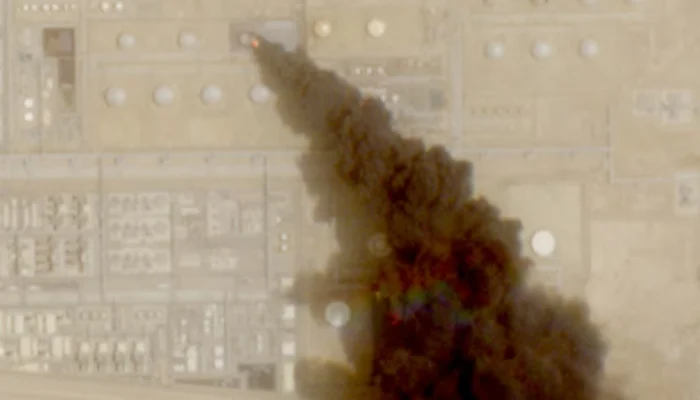
    A satellite composite image captures a plume of smoke emanating from an oil facility in Jizan, Jazan Province, Saudi Arabia, dated July 26, 2026. — Reuters

    – An fire has occurred at Aramco’s Jazan refinery site.
    – Fire crews managed to extinguish the blaze; no injuries have been reported.
    – The Saudi Energy Ministry has not revealed the cause of the fire.

    The Saudi Energy Ministry announced that firefighters successfully put out an early Sunday fire at an Aramco facility located in the southwestern part of the country. They confirmed there were no casualties. Aramco’s security teams contained the fire, and authorities are now completing the necessary procedures to handle the incident, although the cause remains undisclosed.

    Jazan is situated along the Red Sea near Yemen’s border. The refinery there handles around 400,000 barrels of crude oil daily and produces products such as gasoline and ultra-light sulfur diesel.

    Following an attack by Yemen’s Houthis, Aramco temporarily shut down the Jazan refinery on July 27. The attack damaged the plant’s Integrated Gasification Combined Cycle (IGCC) unit and tank farm. According to a note from consulting firm IIR seen by Reuters, the Houthis claimed responsibility for targeting Aramco sites in Jazan and Yanbu past attacks raised concerns that threats to shipping routes in the Red Sea and Saudi oil infrastructure could intensify, potentially disrupting global supply chains amid ongoing tensions involving Iran and U.S. military actions around the Strait of Hormuz.

    Last week, Aramco CEO Amin Nasser stated that although recent attacks caused some disruptions to production, he remains optimistic that operations can be quickly restored without significant operational or financial impact.
  • US and Saudis strike Iran-backed groups in Iraq, risking escalation

    US and Saudis strike Iran-backed groups in Iraq, risking escalation

    A satellite image captured on July 26, 2026, reveals a trail of smoke emanating from an oil facility in Jizan, Jazan Province, Saudi Arabia. Meanwhile, the United States and Saudi Arabia targeted Iran-supported groups in Iraq, claiming responsibility for recent drone strikes on Saudi oil installations. Iran responded by warning that accusing it of such attacks is a “major miscalculation.”

    The strikes inside Iraq occurred shortly after the U.S. military announced it thwarted an unexpected Iranian assault on American troops in the region. The Iranian Revolutionary Guards (IRGC) claimed responsibility for launching several ballistic missiles at U.S. military sites in Jordan. These back-and-forth assaults have ended a brief lull in hostilities that followed President Trump’s sudden decision to halt a bombing campaign, with Iran seemingly pausing its actions as well.

    Saudi Arabia reported that its air defenses intercepted multiple drones aimed at its Eastern Province oil facilities, launched from Iraqi territory by Iran-backed militias. In response, the U.S. Central Command and Saudi officials stated they struck multiple locations in eastern Iraq used by Iran to direct drone attacks. Iraq’s Popular Mobilization Forces reported that some of its facilities were attacked—causing casualties and damage.

    Oil prices surged by over $3 per barrel amid fears of escalating conflict. An Iranian defense official denied any Iranian involvement in recent projectile attacks targeting Saudi Arabia, calling allegations “a major miscalculation.” The U.S. military also reported intercepting multiple ballistic missiles launched by Iran attempting a surprise attack on U.S. forces in the Middle East.

    As part of efforts to de-escalate tensions over the Strait of Hormuz—a crucial artery through which approximately 20% of global oil and liquefied natural gas passes—Oman proposed a regional management plan. This approach would involve collecting voluntary fees from ships transiting the strait, similar to arrangements in Asia’s Strait of Malacca. The Gulf Cooperation Council discussed the situation via video call, but a U.S. official rejected the idea of tolls, emphasizing that the strait is an international waterway that should remain free of Iranian control or restrictions.

    The ongoing tensions follow recent Iranian missile tests and attacks on maritime vessels, with both sides warning against further escalation. Diplomatic efforts continue, but the situation remains volatile amid these regional and international maneuvers.