الوسم: RTX 5080

  • RTX 5080 Could Shine in Future Gaming Laptops

    RTX 5080 Could Shine in Future Gaming Laptops

    As Nvidia’s RTX 50-series laptops prepare to hit the market in just a month, exciting leaks have emerged, showcasing the anticipated performance of the RTX 5080 laptop GPU. Data from a recent 3DMark Time Spy benchmark posted on Bilibili indicates a significant boost in synthetic testing performance compared to its predecessor, the RTX 4080.

    The RTX 5080 achieved an impressive score of 21,948 in the 3DMark Time Spy graphics test, overtaking the RTX 4080’s typical score of 17,601 points, which translates to a 24% increase in performance (noted by Notebookcheck). Given that the desktop version of the RTX 5080 is approximately 10-15% more powerful than its desktop counterpart, the laptop variant appears to deliver a much better advantage based on preliminary benchmarks. This performance positions the RTX 5080 laptop on par with the RTX 4090 laptop in terms of capabilities.

    Leaked 3DMark Time Spy result of RTX 5080 laptop GPU
    Bilibili

    About a month ago, another benchmark surfaced on Geekbench OpenCL, highlighting the performance metrics of the RTX 5080 in a 175-watt configuration on an Alienware Area-51 laptop. The results indicated that the RTX 5080 exceeded the 190,000-point threshold, vastly outperforming its predecessor, which hovered around 160,000 points. Even the RTX 4090 Laptop GPU, generally achieving an average of 180,000 points, fell behind, although higher scores could be obtained with laptops featuring exceptional cooling systems.

    It’s crucial to understand that actual performance may vary based on aspects such as power limits, thermal management solutions, and specific configurations by laptop manufacturers. While synthetic benchmarks serve as a helpful benchmark, actual gaming tests and professional workloads will ultimately ascertain the RTX 5080’s real significance in the gaming laptop domain.

    Get your weekly dive into the tech behind PC gaming


    Check your inbox!

    The RTX 5080 laptops are set to be available in March, alongside the RTX 5090, RTX 5070 Ti, and RTX 5070. This GPU will sport 7680 CUDA cores, with a Total Graphics Power (TGP) ranging from 80 to 150 watts (+25 watt overhead), and will come equipped with 16GB of GDDR7 VRAM, similar to the desktop variant. Nvidia is expected to launch laptops featuring the RTX 5080 starting at a price of $2,199.

  • Nvidia RTX 5080 Repeats Past Generation’s Mistakes

    Nvidia RTX 5080 Repeats Past Generation’s Mistakes

    The arrival of Nvidia’s RTX 5080 is just around the corner, with various retailers beginning to unveil early listings, revealing its actual pricing. Set to debut with a suggested retail price (MSRP) of $999, this GPU aims to contend with some of the leading graphics cards on the market. However, it seems poised to repeat a previous mistake that contributed to the initial lackluster reception of the RTX 4080.

    Both the RTX 5090 and the RTX 5080 will be available for purchase this Thursday, January 30. While the RTX 5090 commands a steep price of $2,000, the RTX 5080 appears more accessible at $999. Nevertheless, that price point is likely only applicable to Nvidia’s Founders Edition cards, according to recent listings from Best Buy that have since been removed. The source VideoCardz caught a glimpse of Gigabyte’s plans for the RTX 5080, shedding light on what consumers can expect.

    The RTX 5080 pricing spectrum spans from $999 for the compact Gigabyte Windforce OC model to around $1,400 for the Xtreme Waterforce model, which comes with integrated liquid cooling. Among the eight variants listed, including the Founders Edition, only two fell at the MSRP. The subsequent option jumps to $1,200, which mirrors the introductory cost of the RTX 4080.

    Various listings for Nvidia's RTX 5080.
    Best Buy / VideoCardz

    This price disparity is likely to impact the perceived value of the RTX 5080. If acquiring it at MSRP proves challenging, the situation could resemble that of the RTX 4080, where consumer sentiment dictated that the price was excessive compared to the performance offered. Over time, market adjustments resulted in the RTX 4080 being commonly available below its MSRP, and Nvidia later rectified its mistake by introducing the RTX 4080 Super at the more appealing price of $999.

    However, the suggested price holds little significance if Nvidia’s partners decide to mark it up by an additional $400. There are whispers suggesting that Nvidia may be selling these GPUs to its add-in board (AIB) partners at prices close to the MSRP, forcing them to increase retail prices to maintain profitability. While this remains unverified, skepticism is warranted. Furthermore, reports indicate that the cards may be available in limited quantities, raising concerns that scalpers could purchase them en masse before regular consumers get the chance.

    The RTX 5080 does have one potential advantage compared to its predecessor — gamers might not have many alternatives in this performance tier. The RTX 5090 is significantly pricier, and current listings indicate that the RTX 4090 exceeds $2,700. Additionally, AMD’s RDNA 4 lineup currently lacks a competitor that could rival the RTX 5080, leaving consumers with the choice of either the RTX 5080 or the lower-tier RTX 5070 Ti priced at $750.

  • Asus Zephyrus G14 Upgraded With RTX 5080 Graphics

    Asus Zephyrus G14 Upgraded With RTX 5080 Graphics

    CES 2025
    Explore our in-depth coverage of CES here.
    Updated just now

    The Asus ROG Zephyrus G14 continues to shine as one of the top gaming laptops available. In my review, I described it as “almost flawless.” At CES 2025, Asus is enhancing its slim portable gaming line by introducing a slightly larger model that can now accommodate an RTX 5080 graphics card.

    Measuring only 0.63 inches in thickness and weighing 3.46 pounds, this 14-inch laptop can house both the RTX 5080 and the AMD Ryzen AI 9 HX 370. Last year’s version maxed out with an RTX 4070 to maintain its ultra-slim profile, which was even thinner than a MacBook Pro. With this year’s model, Asus has managed to increase the size by just 2mm while accommodating the more powerful RTX 5080, a minimal change indeed.

    Maintaining the strengths of its predecessor, the upgraded Zephyrus G14 includes the potent RTX 5080, which can consume up to 110 watts, alongside options for up to 2TB of PCIe 4.0 storage, 32GB of LPDDR5X-7500 RAM, and the same impressive 2,880 x 1,800 resolution ROG Nebula OLED display, known for its speedy 240Hz refresh rate. Additionally, it features the latest in wireless technology, including Wi-Fi 7 and Bluetooth 5.4.

    Get your weekly breakdown of the tech powering PC gaming


    Check your inbox!

    Even with the slight increase in dimensions, the 2025 ROG Zephyrus G14 appears nearly identical to its predecessor. It retains its all-aluminum chassis and customizable Slash Lighting light strip. However, some drawbacks from the prior model remain, such as soldered memory, which prevents upgrades or replacements, and the potential for heat issues due to its slim design. I’ll reserve final judgment until I’ve had the chance to thoroughly test the device.

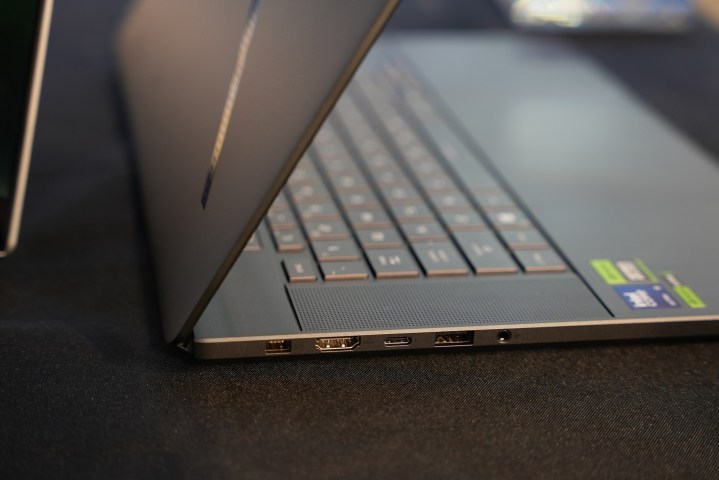
    Ports on the 2025 Asus ROG Zephyrus G16.
    Chris Hagan / Digital Trends

    In addition, the 16-inch Zephyrus G16 is set to receive an upgrade, now featuring next-gen Nvidia components and the option to include an RTX 5090 capable of up to 130 watts. Asus mentions that you can configure it with up to 64GB of memory along with an Intel Core Ultra 9 285H. However, any enhancements made to the 16-inch model are limited to internal upgrades, with the external design remaining unchanged except for a repositioning of one USB-C port.

    Asus has yet to announce the release dates and pricing for these new laptops. This is a significant factor, as last year, the company raised prices slightly to reflect the premium materials like the aluminum chassis and OLED display. Here’s hoping there won’t be another price increase this time around.

  • Nvidia RTX 5080 Could Be Extremely Costly

    Nvidia RTX 5080 Could Be Extremely Costly

    The countdown is on for Nvidia’s official announcement of the RTX 50-series, which is just a few days away. Information regarding the specifications of Nvidia’s latest graphics cards has already surfaced from various sources, but the pricing details have largely remained under wraps—until now. Recently, YouTuber Vex shared insights about the price of the Nvidia RTX 5080, hinting at a déjà vu from the previous generation, but potentially with even higher costs.

    Before we delve deeper, it’s essential to note that we can’t independently verify the authenticity of this leak. Vex claims to have received information from a person associated with an Australian retailer, who allegedly sent a screenshot displaying multiple Asus RTX 5080 graphics cards along with some basic specifications and pricing details. This information may be accurate, or it could be fabricated—at this moment, we can’t say for certain. However, if this is true, it may not bode well for gamers.

    The RTX 5080 is indicated to feature 16GB of memory, consistent with earlier leaks, although there’s uncertainty regarding whether it will utilize faster VRAM modules, as some have speculated. The listing includes the Asus Prime GeForce RTX 5080 16GB OC, suggesting that it’s an overclocked variant.

    A screenshot detailing the pricing for RTX 5080.
    Vex

    Now, let’s discuss the prices. According to the leak, the first price listed refers to the amount the Australian retailer paid to acquire the graphics card from Asus. The second figure represents the retail price, or how much customers would actually pay for the GPU. The purchase price is reportedly 2,544 Australian dollars, while the listed price is a staggering 2,799 Australian dollars.

    Fortunately, the currency exchange rates soften the shock of these prices to some extent. When converted from Australian dollars to U.S. dollars, the purchase price equates to approximately $1,581 and the retail price is around $1,740 at the current exchange rate. It’s also worth noting that these prices already include sales tax, which would typically not be included in U.S. pricing.

    Regardless of how you look at it, $1,740 for an RTX 5080 is a substantial investment. Some rumors suggest that the performance of the 5080 could be comparable to that of the 4090, but if it doesn’t quite meet expectations, the high cost may be difficult for many to justify.

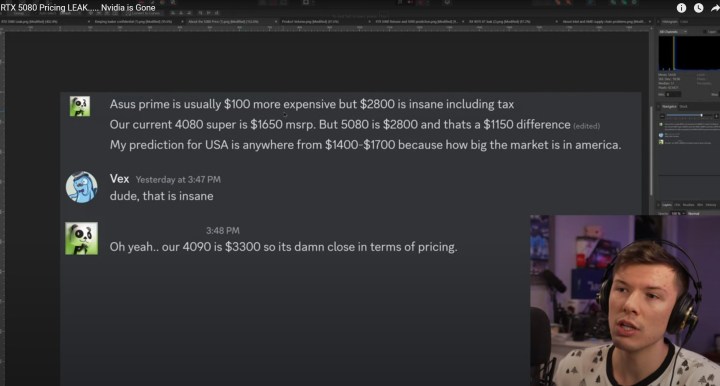
    A screenshot of a Discord conversation discussing RTX 5080.
    Vex

    There are already signs that the RTX 5080 might be on the pricey side. For instance, a leaked listing for an Acer Predator Orion featuring the RTX 5080 showed a price tag nearing $3,640. However, not all hope is lost.

    Even if we take these prices at face value and assume the unnamed Australian retailer will be offering the RTX 5080 for the U.S. equivalent of $1,740, we must remember that this is an Asus card, specifically an overclocked model. Nvidia typically sets a more conservative MSRP for their Founders Edition and non-overclocked variants, which means they will likely cost less.

    Nvidia’s RTX 4080 was originally priced at $1,200, which many considered excessive. The subsequent Super variant brought it down to $1,000. Could Nvidia possibly revert to a price range of $1,200 to $1,500 for the RTX 5080? One can only hope that this isn’t the case. We’ll learn more when Nvidia officially unveils the graphics card on January 6.