Tag: renovation

  • US Judge Rules Trump’s Name to Be Removed from Kennedy Center

    US Judge Rules Trump’s Name to Be Removed from Kennedy Center

    President Donald Trump announced his administration would transfer control of the Kennedy Center to Congress after a judge ordered the removal of Trump’s name from the Washington venue and blocked his plan to shut it down for renovations.

    On social media, Trump said he directed the U.S. Commerce Department to coordinate with Congress to facilitate a full transfer of the institution, making lawmakers responsible for its operation, upkeep, and management. It’s unclear how this directive might be implemented. Established by Congress in 1958, the Kennedy Center is managed by a trustee board, which Trump has influenced during his second term.

    This comes after a judge ruled last Friday that the center, which Trump tried to rename the “Trump Kennedy Center,” cannot be renamed without Congressional approval. U.S. District Judge Christopher Cooper in Washington ordered the removal of all signage bearing Trump’s name and the elimination of references to a “Trump Kennedy Center” from official documents within two weeks.

    Cooper emphasized that the Kennedy Center’s founding statute clearly states it must bear President Kennedy’s name, and no other official name or memorial can be assigned without Congress’s approval. The ruling also halts Trump’s proposed two-year shutdown for extensive renovations, though the judge acknowledged that critical repairs to the aging facility could still proceed. Cooper clarified that his decision does not dictate how the Center should be managed or its future plans.

    In a post on Truth Social, Trump claimed that the upcoming renovations starting next month would be impossible without a closure and criticized Cooper’s ruling to keep the Center open, calling it “dangerous.” He stated, “I cannot be involved in a situation where public safety is allowed to be compromised openly.”

    The lawsuit was filed by Ohio Democrat and Kennedy Center trustee Joyce Beatty, who stated after the ruling that the Center is a national institution belonging to the American people, not to Trump.

    Trump’s efforts to renovate the Kennedy Center are part of a broader strategy to reshape Washington’s iconic landscape. His plans also include constructing a 250-foot arch and building a 90,000-square-foot ballroom on the site of the demolished East Wing of the White House. These initiatives are also facing legal challenges, with a federal appeals court permitting the construction to move forward amid a lawsuit seeking to prevent it.

    Beatty criticized the renaming effort, calling it a “flagrant violation of the rule of law” and asserting it undermines constitutional principles. Cooper noted that the Kennedy Center’s board could still decide to close the facility if they independently determine it’s necessary after weighing all options.

    The Kennedy Center has been a memorial to President John F. Kennedy since it opened in 1971.

  • Trump Grooves to His Beat Amid White House Demolition Rage

    Trump Grooves to His Beat Amid White House Demolition Rage

    President Donald Trump dismissed backlash on Tuesday over the partial demolition of the White House to make way for a new ballroom, claiming the noise from construction was “music to my ears.” Critics, including Democrats, accused him of showing disrespect to the historic residence after images surfaced of excavators tearing away the East Wing’s facade.

    As journalists from AFP watched the demolition continue throughout Tuesday, Democratic leaders also criticized him for advancing a $250 million renovation plan amidst a backdrop of a government shutdown and rising living costs. Trump, 79, emphasized that the renovation was necessary and insisted that taxpayers wouldn’t bear any of the costs. He mentioned that he is partially funding the project himself, with private and corporate donors covering the remaining expenses.

    Last week, Trump hosted a lavish dinner for donors, featuring guests from major tech companies, though the White House has yet to release a guest list or financial details. The White House responded dismissively to the criticism, describing it as “manufactured outrage” by “unhinged leftists and their Fake News allies” over the addition of a large, privately funded ballroom.

    They defended the project as a “bold and essential” upgrade that continues a tradition of presidential renovations intended to keep the White House a symbol of American excellence. The White House also highlighted previous renovations by past presidents, including Barack Obama’s upgrade of the tennis court into a full basketball court.

    In his second term, Trump has overseen a significant overhaul of the White House, including paving over the Rose Garden, where he previously held Republican senator meetings. Democrats sharply condemned the demolition, equating it to Trump’s broader efforts to overhaul the federal government and target his political rivals. Hawaii Senator Mazie Hirono remarked, “The demolition of the East Wing feels very symbolic of what Trump is doing to our democracy. He’ll claim to protect it, then tear it apart before your eyes.” Elizabeth Warren added that amidst America’s rising costs of living, Trump appears to be deaf to the concerns while bulldozing part of the White House to build a new ballroom.

  • Trump’s Journey: From Gold Dreams to $200M Ballroom Powerhouse

    Trump’s Journey: From Gold Dreams to $200M Ballroom Powerhouse

    WASHINGTON: Donald Trump is making unprecedented efforts to reshape the architecture of Washington, from a gold-accented White House to extensive city renovations. Earlier this month, the former real estate mogul announced his plans for a $200 million ballroom at the White House, emphasizing his pride in creating and building large-scale projects. Known for his glittering hotels and casinos, critics argue that his White House upgrades reflect a similar flamboyant style, reminiscent of his Florida resort, Mar-a-Lago, with features such as the newly paved Rose Garden decorated with picnic tables and umbrellas.

    During his first term, stylist Peter York called his aesthetic “dictator chic,” comparing it to the decor favored by foreign autocrats. Recently, Trump unveiled broader ambitions for the nation’s capital, linking his efforts to beautify Washington with a tough-on-crime approach, including deploying troops to the city—a Democratic-run area—where he also held a military parade on his birthday.

    Peter Loge, director at George Washington University’s School of Media, commented, “This is a demonstration of power. Trump often puts his name on bibles and casinos, so the logic follows—except now he’s affecting lives, the nation’s reputation, and its democratic legacy.”

    In the 225-year history of the White House, Trump is among the few presidents to undertake such extensive renovations. Past updates include Franklin Roosevelt’s 1934 Oval Office construction, Harry Truman’s overhaul completed in 1951, and John F. Kennedy’s 1961 creation of the modern Rose Garden. The White House Historical Association notes that the building remains a dynamic symbol of American democracy, evolving over time as a national landmark.

    Stewart McLaurin, the association’s president, stated that while renovations have historically attracted criticism for costs and preservation concerns, they have ultimately become integral to the White House’s identity. However, Trump’s current modifications are among the most extensive in nearly a century. His recent additions include gold trim, decorative objects, and a transformed Rose Garden turned patio, which he justified as a response to women’s high heels sinking into the grass. Visitors now often hear music from his playlist emanating from the patio, which also features oversized U.S. flags and a giant mirror on the West Wing colonnade—allowing Trump to see himself leaving the Oval Office.

    Trump claims to finance these upgrades himself, but larger projects like the new East Wing ballroom will rely on outside funding. The White House indicated the $2 billion plan to revamp Washington, including a marble-clad Kennedy Center for the Performing Arts and city infrastructure repairs, will seek support from Trump and patriotic donors. Meanwhile, Trump envisions a gleaming capital similar to Saudi Arabia’s skyline, with plans for extensive beautification, graffiti removal, and infrastructure repairs, such as fixing roads and barriers.

    His political rhetoric also involves a crackdown with the National Guard, which he has threatened to extend to other cities like Chicago. He has publicly suggested that Americans might “prefer a dictator,” despite denying any authoritarian tendencies. His imagery is also on display in the form of enormous posters of his face in prominent government building entrances, including the Department of Labor.

    Secretary Lori Chavez-DeRemer extended an invitation to Trump, saying, “Mr. President, I invite you to see your big, beautiful face displayed on a banner outside the Department of Labor.”

  • Trump plans $200M White House ballroom to cement legacy

    Trump plans $200M White House ballroom to cement legacy

    WASHINGTON: Donald Trump is making an unprecedented effort to leave a distinctive architectural footprint in Washington, D.C., with ambitions of transforming the city, much like he did with his properties elsewhere. From a white House infused with gold accents to a lavish redesign of the capital, Trump’s vision includes bold, opulent changes intended to make an impact.

    Earlier this month, the former real estate mogul boasted about his talent for construction, revealing plans for a $200 million ballroom at the White House—arguably his most ambitious project yet. Trump’s wealth was built through the development of high-end hotels and casinos bearing his name, and critics say his White House renovations echo that flamboyant style.

    Certain sections now evoke the feel of his opulent Mar-a-Lago estate in Florida, especially the reimagined Rose Garden, which features picnic tables, yellow and white umbrellas, and freshly paved paths. During his first term, British style commentator Peter York dubbed his aesthetic “dictator chic,” comparing it to the decor favored by foreign autocrats.

    He has also laid out broader plans to revamp the entire city, explicitly linking his beautification efforts to stricter law enforcement, including deploying troops to the city—controlled by Democrats—where just two months ago he led a military parade for his birthday. Political analyst Peter Loge commented, “This is a show of power escalation. It’s typical of him—branding bibles, casinos, and now, playing with lives and national reputation. It’s about legacy and control.”

    In the history of the White House, major renovations have occurred multiple times. Franklin Roosevelt built the current Oval Office in 1934, Harry Truman led a comprehensive overhaul finished in 1951, and John F. Kennedy developed the modern Rose Garden in 1961. According to the White House Historical Association, the building remains a “living symbol of American democracy, evolving with the nation.” Stewart McLaurin, president of the association, noted that historical changes often drew criticism over costs and preserving the building’s integrity but emphasized that many have become essential to its identity. Trump’s modifications are the most extensive in nearly a century.

    Since returning to office, Trump has added lavish touches—gold trim and ornaments in the Oval Office, which foreign leaders have publicly complimented. He transformed the grass of the Rose Garden into a patio, citing sinking heels as his motivation, and installed a sound system, with music often echoing from it. His additions also include two large American flags on the White House lawns and a giant mirror on the West Wing colonnade, enabling him to see himself as he departs the Oval Office.

    Trump asserts that he is personally financing these upgrades. However, his larger projects, such as the new East Wing ballroom scheduled to be completed before his term ends in January 2029, are expected to be funded through donations, with estimates reaching $2 billion for wider improvements across Washington.

    During a May visit to Saudi Arabia, Trump admired the city’s gleaming skyline, signaling his interest in creating a similarly dazzling capital. His plans include a marble-finished redesign of the Kennedy Center and efforts to clean up graffiti, repair road barriers, and lay fresh asphalt.

    Additionally, Trump’s vision for Washington involves a significant security presence—threatening to extend deployment of the National Guard to other cities like Chicago—and he has openly speculated about the possibility of Americans “maybe liking a dictator,” despite denying such intentions. His face now looms large above the city, showcased on posters at government departments, symbolizing his ongoing influence and desire to imprint his image on the nation’s capital.

  • Trump Reshapes Kennedy Center, Announces Winners & Major Renovation

    Trump Reshapes Kennedy Center, Announces Winners & Major Renovation

    Digital Phablet – Donald Trump Announces Kennedy Center Honorees, Plans Renovations, and Hosts Ceremony.

    On Wednesday, President Donald Trump revealed the initial list of Kennedy Center Honors nominees during his tenure as chairman of the center. The honorees include country music icon George Strait, actor Sylvester Stallone known for “Rocky,” singer Gloria Gaynor, the rock band Kiss, and actor-singer Michael Crawford. Trump will also serve as the host for the awards event.

    Trump expressed his intention to completely overhaul the Kennedy Center’s infrastructure, aiming to transform it into a premier arts and culture destination in the U.S.

    “We’re going to elevate it above anything it’s ever been,” the president stated, adding that the venue would play a prominent role in next year’s celebrations of America’s 250th anniversary.

    President Trump making an announcement at the Kennedy Center

    Even though Trump initially expressed reluctance to host the event, he eventually agreed when invited.

    During his first presidential term, the Republican leader skipped the Kennedy Center Honors, citing protests from artists who refused to attend. This year, he took on the role of chairman, dismissing the former board of trustees and appointing supporters.

    In a Tuesday post on Truth Social, Trump hinted that the center—formerly known as the John F. Kennedy Center for the Performing Arts—might receive a new name and restore its former grandeur.

    “Great nominations for the TRUMP/KENNEDY CENTER, oops, I mean, KENNEDY CENTER, AWARDS,” Trump wrote. He further mentioned ongoing efforts to bring it “back to the absolute top level of luxury, glamour, and entertainment.”

    Trump's announcement at the Kennedy Center

    He declared, “It had fallen into hard times, physically, BUT WILL SOON MAKE A MAJOR COMEBACK!!!”

    The Kennedy Center’s social media channels expressed their “honor” in meeting with Trump, who has visited the venue three times since January.

    “Thanks to his advocacy, our beautiful building will undergo renovations to restore its prestige and grandeur,” the center stated.

    During a March visit, Trump voiced concerns about the physical state of the building, describing it as being in “tremendous disrepair.”

    He claimed to have been “about 98% involved” in selecting this year’s honorees, despite earlier statements about wanting more involvement. Trump also mentioned that he rejected numerous nominees for being “too woke,” a term used to describe left-leaning perspectives. Among those he praised are some of his favorites and prominent figures like George Strait, Michael Crawford, Sylvester Stallone, Gloria Gaynor, and Kiss.

    Historically, honorees have been selected by a bipartisan advisory group, with past recipients including George Balanchine, Tom Hanks, Aretha Franklin, and Stephen Sondheim. The Kennedy Center press office did not respond to inquiries about the selection process for this year’s winners.

    A tweet from CSPAN highlighted this year’s honorees, including George Strait, Michael Crawford, Sylvester Stallone, Gloria Gaynor, and Kiss, with a link to the full video.

    Previously, Trump has mentioned giving singer-songwriter Paul Anka and actor Sylvester Stallone Kennedy Center Honors in the past. Stallone was among the stars Trump appointed as Hollywood ambassadors earlier this year. Anka was scheduled to perform “My Way” at Trump’s inaugural, but she withdrew last minute.

    Since the awards’ inception in 1978, many distinguished artists across genres have been honored. Until Trump’s first term, presidents from both parties routinely attended the ceremony, regardless of their public opinions. For example, George W. Bush honored liberals like Barbra Streisand and Warren Beatty, while Clinton honored conservatives such as Charlton Heston.

    In 2017, honoree Norman Lear declined to attend a White House event due to disagreements over arts funding cuts. Subsequently, Trump and Melania Trump also opted out during his first term. Notable vocal opponents to Trump, including Cher, Lin-Manuel Miranda, and Sally Field, were among the honorees.

    Since returning to office, Trump has taken a more aggressive stance on the Kennedy Center, involving himself directly in its leadership and programming decisions, and has even proposed halting events featuring drag performers.

    Some artists have criticized these moves; notably, the producers of Broadway’s “Hamilton” withdrew plans to stage the show in 2026, citing Trump’s influence on the institution.

    Additionally, in July, House Republicans included a provision in a spending bill signed by Trump to rename the Kennedy Center’s Opera House after Melania Trump. However, the official renaming has yet to occur. Democrat and Kennedy family member Maria Shriver called the idea of renaming the entire center after Trump “insane.”

  • How To Upgrade Your House in Tales of the Shire by Completing and Solving

    How To Upgrade Your House in Tales of the Shire by Completing and Solving

    Tales of The Shire creates a cozy atmosphere, allowing players to settle in and build a relaxing home. When starting out, your house is small with limited space and minimal furniture, giving off a somewhat worn appearance. There’s a lot of work involved if you want to create the perfect dream home.

    Initially, you can’t even access your house through the front door. The back door works, but going all the way around can become frustrating. By befriending a carpenter named Willow Took, you can get basic upgrades and turn your house into a true home.

    How To Upgrade Your House

    You can upgrade your house after developing a friendship with Willow Took, who lives south of your home in the forest. However, you’ll need to increase your relationship level with her before she offers to help.

    Willow will renovate your house for free at relationship levels three, six, and ten. Each upgrade unlocks previously blocked doors and adds new rooms. The rooms start off empty, leaving you free to furnish and decorate them as you like.

    Willow also sells furniture and home decorations while she works in the woods.

    How To Fix The Front Door

    To repair your front door, you first need to get closer to Willow by inviting her to meals often. Once your relationship reaches level three, spend the night in your home. The next day, you’ll find a letter in your mailbox.

    The letter will ask you to meet Willow. When you speak with her, she will upgrade your house at no cost. Your front door will be fixed, and your home will be expanded, making it easier to enter directly through the front without taking the long way around.

  • Hagia Sophia Readies for Future Earthquake in Istanbul

    Hagia Sophia Readies for Future Earthquake in Istanbul

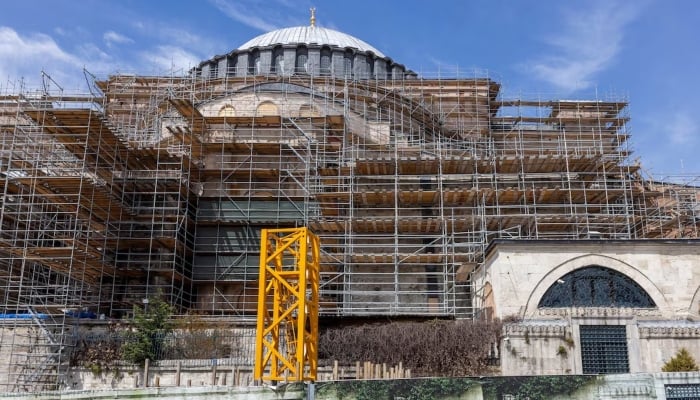
    An aerial view of scaffolding on the Hagia Sophia Grand Mosque in Istanbul, Turkey, taken on April 14, 2025. — AFP

    ISTANBUL: The Hagia Sophia in Istanbul is no stranger to transformations. Over its long history, this architectural masterpiece has transitioned from a church to a mosque, then to a museum, and back to a mosque once more.

    The current renovation project is designed not only to preserve the marvelous structure that has stood for 1,488 years but also to fortify it against the next earthquake that may strike this ancient city.

    From a distance, its magnificent dome, radiant stone, and elegant minarets continue to grace the Istanbul skyline, as they have for centuries.

    However, as visitors approach, they notice scaffolding enveloping its eastern facade and one of the minarets.

    While “the renovations do somewhat disrupt the exterior atmosphere” and “the scaffolding detracts from the monument’s aesthetics… repairs are crucial,” commented Abdullah Yilmaz, a tour guide.

    Hagia Sophia, a UNESCO World Heritage Site, is Turkey’s most frequented landmark. However, it “constantly faces various challenges,” noted Hasan Firat Diker, an architecture professor involved in the restoration efforts, in an interview with AFP. This is why the structure has undergone numerous repairs throughout the centuries.

    A ‘Global’ Restoration

    This renovation marks the first instance of a comprehensive restoration, affecting the dome, walls, and minarets, Diker explained.

    Scaffolding on the Hagia Sophia Grand Mosque in Istanbul, captured on April 14, 2025. — Reuters
    Scaffolding on the Hagia Sophia Grand Mosque in Istanbul, captured on April 14, 2025. — Reuters

    Upon its completion in AD 537, built on the site of previous churches, the Hagia Sophia became a beacon of Byzantine architectural excellence during the era when the city was known as Constantinople.

    It functioned as a church until the city fell to the Ottomans in 1453, and it was then converted into a mosque.

    In 1935, Mustafa Ataturk, the architect of modern Turkey who transformed the nation into a secular state, designated the building as a museum.

    This status persisted until 2020, when President Recep Tayyip Erdogan, a practicing Muslim associated with an Islamist-rooted party, restored its function as a mosque.

    Prepared for the Next Earthquake

    The Hagia Sophia, like many structures in this historically rich city, is not only influenced by its rulers but also faces the persistent threat of earthquakes. The last significant quake occurred in 1999.

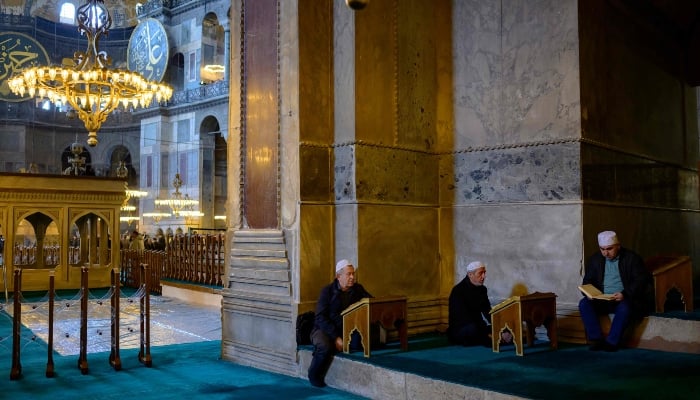
    Visitors reading the Holy Quran in Hagia Sophia Grand Mosque, April 14, 2025. — AFP
    Visitors reading the Holy Quran in Hagia Sophia Grand Mosque, April 14, 2025. — AFP

    Located just a few kilometers from a seismic fault line, Hagia Sophia does not adhere to modern earthquake safety standards. The dome collapsed during an earthquake in 558, and the building has since suffered damage from subsequent quakes.

    The primary objective of the ongoing restoration is to “strengthen the structure in preparation for the next major earthquake,” ensuring that the ancient monument “endures with minimal damage,” stated Ahmet Gulec, a member of the scientific committee overseeing the project.

    At this stage, experts are examining the dome to devise the best strategies for reinforcement and restoration, according to Diker.

    The interior currently remains free of scaffolding, but eventually, four large pillars will be installed inside to support a platform for specialists to repair the dome’s paintings and mosaics.

    “Once you’re inside, it’s amazing,” exclaimed Ana Delgado, a 49-year-old tourist from Mexico, as she absorbed the lively ambiance filled with laughter and conversation following afternoon prayers.

    “It’s enchanting,” added her friend, Elias Erduran, who hails from the Dominican Republic.

    A Popular Destination

    Last year, Hagia Sophia welcomed a remarkable 7.7 million visitors.

    Visitors admiring Byzantine mosaics in Hagia Sophia Grand Mosque on April 14, 2025. — AFP
    Visitors admiring Byzantine mosaics in Hagia Sophia Grand Mosque on April 14, 2025. — AFP

    Approximately 2.1 million were international tourists, many of whom paid 25 euros for an entry ticket, contributing to substantial annual revenue.

    Officials are hopeful that the construction work won’t discourage people from visiting during this extensive renovation, which is expected to last several years. The total cost of the project has not been disclosed.

    “Our aim is for visits and prayers to continue throughout the renovation,” Gulec emphasized.

    Even if some visitors are disappointed that they cannot fully appreciate the building’s grandeur, the key takeaway is that “one day, my children will also get to experience the beauty of Saint Sophia,” said Yana Galitskaya, a 35-year-old visitor from Russia.

  • Europe: 250,000 New Hotel Rooms vs. 74,000 Renovations

    Europe: 250,000 New Hotel Rooms vs. 74,000 Renovations

    The Surge of New Hotel Constructions in Europe

    The European hotel sector is witnessing a remarkable transformation, driven by an upswing in travel demand. As we delve into the various facets of this growth, one striking trend emerges: the dominance of new hotel constructions over renovations and conversions.

    Current Landscape of Hotel Developments

    According to data from Lodging Econometrics, by the end of the first quarter of 2024, Europe had over 250,000 hotel rooms under construction. This figure starkly contrasts with the 74,000 rooms currently undergoing renovation or conversion. The sheer volume of new projects indicates a robust optimism among investors and developers in the hospitality industry.

    The Shift Towards New Builds

    Building new hotels, while often more expensive, is increasingly favored for several compelling reasons:

    1. Long-term Investment Potential: Investors understand that creating a hotel from the ground up is often more aligned with contemporary consumer expectations and industry standards.
    2. Modern Design Features: Newly constructed hotels can incorporate cutting-edge designs and amenities that resonate with today’s travelers, offering greater comfort and luxury.
    3. Sustainability Initiatives: Many new constructions are built with sustainability in mind, featuring energy-efficient technologies and eco-friendly materials. This focus not only meets regulatory standards but also appeals to a growing demographic of environmentally conscious guests.

    The Economic Impact of Hotel Transactions

    The financial landscape supporting this construction boom is equally impressive. In 2023, Europe saw hotel transactions reach €16.9 billion, covering 787 properties and almost 106,000 rooms. This surge indicates a vigorous recovery post-pandemic, demonstrating renewed confidence among stakeholders in the hospitality sector.

    Positive Trends Continuing into 2024

    The momentum has carried into early 2024, where an additional €10.6 billion in hotel transactions were recorded. This represents an astounding 123% increase year-on-year. Such growth in capital investment clearly highlights the sector’s resilience and the inclination toward establishing new hotel properties rather than revitalizing existing ones.

    The Role of Renovations and Conversions

    While new constructions steal the spotlight, renovations and conversions still hold significant value, particularly in historical and rural settings. These projects often seek to blend modern amenities with traditional aesthetics, offering unique experiences that attract certain types of travelers. However, the primary trend remains a shift towards investing heavily in new builds, reflecting changes in consumer preferences and market demands.

    Future Outlook of the Hotel Industry

    The landscape of the hotel industry in Europe is set for continued growth. As travel demand rebounds, the focus on constructing new hotels will likely persist. This development not only enriches the hospitality offerings in various destinations but also contributes positively to local economies through job creation and increased tourism.

    The eBook, The Titans of Travel: How Small Businesses Shape Europe’s Accommodation Industry in 50 Charts, provides further insights into the evolving market dynamics, illustrating how local businesses are pivotal in navigating these changes. This resource is freely available for download, ensuring that stakeholders in the industry have access to the vital data needed to make informed decisions.