الوسم: recognition

  • PM Modi under criticism for ‘engineered’ overseas honors

    PM Modi under criticism for ‘engineered’ overseas honors

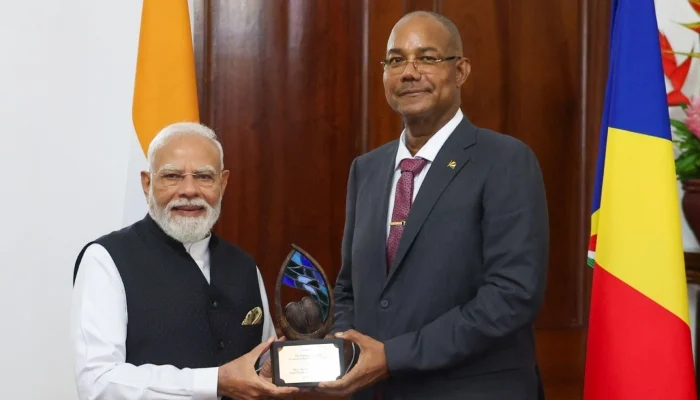
    Indian Prime Minister Narendra Modi was awarded the “Guardian of the Blue Horizon” by President Patrick Herminie during his recent visit to Seychelles on June 28, 2026. The award was presented alongside a trophy and a certificate, which surprisingly contained spelling errors in “Republic” and “Seychelles.” The award had been established just three days prior to Modi’s visit, making him the first recipient. Further scrutiny revealed that the certificate was identified by multiple AI detection tools as likely generated by artificial intelligence.

    The incident sparked a political backlash in India, with opposition leader Khawaja Asif criticizing the awards and questioning Modi’s actions. Social media users also highlighted the errors, with one Congress representative mocking the haste in preparing the award materials, pointing out the misspelling of “Seychelles” and “Republic of Seychelles.”

    The Seychelles foreign ministry later clarified that the recognition was authentic, attributing the mistake to a clerical error. They emphasized that the “Guardian of the Blue Horizon” award was legitimate. This isn’t the first time Modi has been the sole recipient of an award during a foreign visit. During his recent trip to Israel, the Israeli parliament created a special honor and awarded it to him upon landing—he remains the only recipient to date. Additionally, last year, Modi became the first foreign leader to receive Ethiopia’s Nishan Great Honour and the Order of the Republic of Trinidad and Tobago.

    Pakistani Defense Minister Khawaja Asif responded critically, labeling the recognition as either “cheap popularity” or “malicious gratification.” He pointed out that these awards, created just days before Modi’s arrival and accompanied by possibly AI-generated certificates with spelling mistakes, only serve to bring shame to India, especially given Modi’s personality-driven political approach.

  • OIC: Israel’s Recognition of Somaliland Illicit, Warns Against Palestinian Displacement

    OIC: Israel’s Recognition of Somaliland Illicit, Warns Against Palestinian Displacement

    The Organization of Islamic Cooperation (OIC) has issued a strong statement condemning Israel’s recent decision to recognize the so-called “Somaliland” as an independent nation, calling it a clear violation of Somalia’s sovereignty, territorial integrity, and recognized borders. This condemnation was made during the 22nd Extraordinary Session of the OIC Council of Foreign Ministers on Saturday at the organization’s headquarters in Jeddah, Saudi Arabia. The meeting was convened to address the serious developments in Somalia following Israel’s announcement on December 26, 2025.

    OIC Secretary General Hissein Brahim Taha highlighted that this period is particularly sensitive. He emphasized that Israel’s recognition of “Somaliland” sets a dangerous precedent, blatantly breaches international law, and threatens regional stability and security in the Horn of Africa.

    Pakistan’s Deputy Prime Minister and Foreign Minister Ishaq Dar attended the session, during which two resolutions were approved: one condemning Israel’s recognition of Somaliland and another opposing efforts to displace Palestinians. The organization’s resolution firmly supported Somalia’s sovereignty and expressed solidarity with the Somali government and its people. It rejected any actions or measures attempting to undermine Somalia’s unity or territorial integrity and condemned Israel’s move as a breach of international law and the UN Charter.

    The OIC’s resolution warned that recognizing “Somaliland” threatens peace and stability in the Horn of Africa and the Red Sea, with potential repercussions for broader regional and international peace. It reaffirmed that “Somaliland” is an inseparable part of Somalia and holds no independent legal status. Any attempt to recognize or separate from Somalia is considered blatant interference in Somalia’s internal affairs and a severe violation of its sovereignty.

    The organization also denounced a visit by an Israeli official to Somaliland on January 6, 2026, describing it as a serious breach of Somali sovereignty. It further condemned any foreign military, security, or intelligence presence on Somali soil without the government’s approval, particularly Israeli presence, declaring such actions as crossing a “red line.”

    The OIC urged member states and international organizations to avoid any official or unofficial engagement with Somaliland outside the framework of Somalia’s sovereignty. It also issued a stern warning against cooperating with Israeli efforts to forcibly displace Palestinians, including those in Gaza, condemning such actions as violations of international law and humanitarian standards.

    The organization called on its Secretary General to solicit the support of the UN Security Council, General Assembly, and Secretary General to address Israel’s actions. It emphasized the need for the international community, especially permanent members of the Security Council, to uphold their responsibilities to maintain peace and security in the Horn of Africa.

  • Somalia Labels Israeli Foreign Minister’s Somaliland Visit as ‘Incursion’

    Somalia Labels Israeli Foreign Minister’s Somaliland Visit as ‘Incursion’

    Somalia has declared that it reserves the right to pursue diplomatic and legal actions. The president of Somaliland commended Israel’s “brave” decision. Meanwhile, an Israeli minister stated that recognizing Somaliland was “the morally right move.”

    The Israeli foreign minister recently visited the Somaliland region of Somalia, a move Somalia condemned as an “unauthorized invasion.” Israel announced last month that it was officially recognizing Somaliland, a historic step for this self-declared republic since its 1991 declaration of independence from Somalia.

    Despite having its own currency, passport, and military, Somaliland struggles to gain international recognition and fears that such recognition could provoke Somalia or encourage other separatist efforts across Africa. Israeli Foreign Minister Gideon Saar, welcomed by senior Somali officials at the airport, said the recognition aligned with Israel’s moral principles. Somaliland’s leader, Abdirahman Abdullahi Mohamed, praised Israel’s “brave” stance and expressed that this could lead to new economic and developmental opportunities. “It advances our strategic partnership,” he stated during a joint press briefing.

    Somalia responded with strong anger, calling the visit an “illegal” and “unauthorized invasion.” Somalia’s foreign ministry issued a statement affirming that they reserve the right to take appropriate diplomatic and legal steps to protect their sovereignty, unity, and territorial integrity. The African Union’s Peace and Security Council also condemned Israel’s recognition, demanding its immediate revocation in the strongest terms.

    The Arab League echoed concerns, condemning any official dealings with Somaliland as a clear violation of Somalia’s sovereignty. The League emphasized that such moves threaten regional peace and security, adding tension to Somalia, the Red Sea, the Gulf of Aden, and the Horn of Africa.

    In response to Israel’s decision, the militant group Al-Shabaab, which has fought the Somali government for nearly 20 years, declared it would oppose any attempt by Israel to establish Somaliland as a base.

    Experts suggest the recognition could give Israel improved access to the Red Sea, potentially facilitating operations against Houthi rebels in Yemen. Somaliland’s strategic position next to one of the world’s busiest shipping lanes makes it an attractive partner for various countries.

    While the United States voiced support for Israel’s recognition, several nations, including Egypt, Turkey, members of the Gulf Cooperation Council, and the Organization of Islamic Cooperation based in Saudi Arabia, criticized the move. The European Union called for respect for Somalia’s sovereignty.

    Somali President Hassan Sheikh Mohamud labeled Israel’s decision a threat to the stability of the already unstable Horn of Africa. He claimed that Somaliland accepted three conditions from Israel: the resettlement of Palestinians, the establishment of a military base on the Gulf of Aden, and joining the Abraham Accords to normalize relations with Israel. Somaliland’s foreign ministry denied that the first two conditions had been agreed upon.

    Historically, Somaliland briefly achieved independence in June 1960 upon seceding from Britain but voluntarily united with Italian-controlled Somalia days later. Its leaders argue that the union was never properly ratified and became null when Somalia’s government collapsed in 1991. Since then, Somaliland has maintained a level of stability distinct from the rest of Somalia, despite lacking formal international recognition.

  • Pakistan, Others Reject Israel’s Recognition of Somaliland at OIC

    Pakistan, Others Reject Israel’s Recognition of Somaliland at OIC

    A joint statement from the Organization of Islamic Cooperation (OIC) and several other nations condemned Israel’s recognition of Somaliland, labeling it a threat to regional and international stability. The coalition, supported by countries like Pakistan, Saudi Arabia, Turkey, Iran, Egypt, and Qatar, emphasized the severe consequences of this action on peace in the Horn of Africa, the Red Sea region, and globally, highlighting Israel’s blatant disregard for international law.

    This declaration comes in response to Israel becoming the first nation to officially recognize Somaliland as an independent state. Israeli Prime Minister Benjamin Netanyahu announced plans to work with Somaliland in areas such as agriculture, healthcare, technology, and the economy, congratulating Somaliland’s leader, President Abdirahman Mohamed Abdullahi, and inviting him to visit Israel. Netanyahu framed this move within the context of the Abraham Accords, initiated during President Trump’s administration.

    President Abdullahi expressed that Somaliland views its recognition as a step toward peace both regionally and worldwide, aligning with the Abraham Accords. Conversely, the joint statement from Muslim countries strongly denounces Israel’s recognition, calling it a serious breach of international principles enshrined in the UN Charter, which mandates respect for sovereignty and territorial integrity. It also condemns any measures that threaten Somalia’s unity and territorial sovereignty, asserting that recognizing parts of a state sets a dangerous precedent that jeopardizes peace and violates key international legal frameworks.

    Furthermore, the joint statement explicitly rejects any association between Israel’s recognition and efforts to forcibly displace Palestinians. The previous day, the Foreign Office also denounced Israel’s acknowledgment of Somaliland’s independence, reaffirming the stance against unilateral recognition that undermines sovereignty and stability.

  • Israel Recognizes Somaliland as Independent Nation for the First Time

    Israel Recognizes Somaliland as Independent Nation for the First Time

    Israel officially recognized the self-declared Republic of Somaliland as an independent nation on Friday, marking a historic move that could alter regional power dynamics and challenge Somalia’s longstanding opposition to secession. Prime Minister Benjamin Netanyahu announced that Israel aims to collaborate immediately with Somaliland in areas like agriculture, healthcare, technology, and economic development. He extended his congratulations to Somaliland’s President, Abdirahman Mohamed Abdullahi, praising his leadership and inviting him to visit Israel.

    Netanyahu framed this recognition within the context of the Abraham Accords, which were signed at the initiative of President Trump. These agreements, brokered in 2020, led to formal diplomatic relations between Israel and countries like the UAE and Bahrain, with more nations joining later. The Israeli government also signed a joint declaration of mutual recognition with Somaliland, alongside President Abdullahi.

    The Somaliland leader described their move as a step toward regional and global peace, emphasizing Somaliland’s commitment to building partnerships, fostering prosperity, and promoting stability across the Middle East and Africa. However, Somalia’s government condemned Israel’s action as unlawful, accusing it of deliberately violating Somalia’s sovereignty and reaffirming their commitment to defend their territorial integrity through diplomatic and legal means.

    In response to Israel’s recognition, Egypt, Turkey, and Djibouti held discussions about the escalating tensions in the Horn of Africa. They condemned the move, supported Somalia’s unity, and warned that recognizing breakaway regions threatens regional and international peace and stability. The African Union also rejected Somaliland’s recognition, reaffirming its dedication to Somalia’s sovereignty and warning that such moves could undermine peace efforts across the continent.

    Since gaining effective autonomy in 1991 amid Somalia’s civil war, Somaliland has maintained relative peace and stability but remains unrecognized by other nations. Somalia has consistently opposed countries recognizing Somaliland’s independence, arguing it undermines sovereignty. Somaliland hopes that this recognition by Israel might encourage other countries to follow suit, enhancing its diplomatic influence and access to international markets.

    Earlier this year, both Somalia and Somaliland categorically rejected any proposals from the U.S. or Israel to resettle Palestinians from Gaza, asserting their opposition to such plans.

  • Impacts of Greater Recognition of Palestine on Palestinians and Israel

    Impacts of Greater Recognition of Palestine on Palestinians and Israel

    Several additional nations have officially recognized Palestinian statehood at a global summit hosted by France and Saudi Arabia, following previous steps by Australia, the UK, Canada, and Portugal, which sparked displeasure from Israel.

    Status of Palestinian Statehood
    The Palestine Liberation Organization declared an independent Palestinian state in 1988, a move quickly acknowledged by most countries in the Global South. Currently, approximately 150 out of the 193 UN member states have granted recognition.

    While the U.S., Israel’s main ally, has long expressed support for a Palestinian state, it insists that recognition should come only after negotiations between Palestinians and Israelis establish a two-state solution. Until recently, major European nations shared this stance.

    However, no Israeli-Palestinian negotiations have taken place since 2014. Israeli Prime Minister Benjamin Netanyahu has recently declared that a Palestinian state will never happen. The Palestinians hold observer status at the UN, but without voting rights. Though many countries recognize Palestinian independence, full UN membership requires Security Council approval, where the U.S. holds a veto.

    Diplomatic Presence and Governance
    Worldwide Palestinian missions are overseen by the Palestinian Authority, which is recognized as the legitimate representative of the Palestinian people. The PA, led by President Mahmoud Abbas, manages limited self-rule in parts of the West Bank under agreements with Israel, issuing passports, and operating the health and education systems.

    Since 2007, Gaza has been controlled by Hamas, which ousted Abbas’s Fatah movement following a brief civil war.

    Embassies and Diplomatic Missions
    In countries recognizing a Palestinian state, diplomatic missions are expected to upgrade to full embassies. However, establishing new embassies in Palestinian territories remains unlikely due to Israeli control over access points.

    About 40 countries have consulates or representations in Ramallah, in the West Bank, or parts of Jerusalem captured by Israel in 1967, which Palestinians aim to designate as their capital. Israel considers all of Jerusalem its undivided capital, with most embassies located in Tel Aviv. The U.S. moved its embassy to Jerusalem during Donald Trump’s presidency.

    Goals of Recognition
    Countries moving to recognize Palestine seek to pressure Israel to cease its aggressive actions in Gaza, halt the expansion of Jewish settlements in the West Bank, and renew negotiations for peace.

    French President Emmanuel Macron, the first major Western leader to endorse recognition, stated that this move would be accompanied by Palestinian reforms to improve governance and strengthen their capacity to act as a credible partner in the aftermath of any conflict.

    Implications of Recognition
    Some argue that recognition is merely symbolic, as countries like China, India, Russia, and many Arab states already acknowledged Palestinian independence decades ago.

    Since Palestine lacks full UN membership and control over borders, its ability to conduct bilateral relations remains limited. Israeli restrictions hinder access to goods, investment, and cultural exchanges. The West Bank can only be reached via Israel or the Israeli-controlled border with Jordan, and Israel controls all access to Gaza since capturing its border with Egypt during recent conflicts.

    Despite this, countries endorsing recognition and the PA believe it would be more than just symbolic. Husam Zomlot, head of Palestine’s mission in the UK, suggests it could foster partnerships based on equality.

    Vincent Fean, a former British diplomat in Jerusalem, notes it might prompt nations to reconsider their relationships with Israel, potentially leading to measures such as boycotting products from Israeli settlements. Though impactful, such actions would minimally affect Israel’s economy.

    Reactions from the U.S. and Israel
    Israel criticizes these recognition efforts, accusing them of rewarding Hamas for the attacks that led to the October 2023 war. PM Benjamin Netanyahu stated that a Palestinian state will not be established west of the Jordan River.

    The U.S. opposes European recognition moves, having imposed sanctions on Palestinian officials and revoked visas for Abbas and other PA figures, barring them from attending the UN General Assembly.
  • Who Recognizes Palestine? Who Doesn’t & Why It Matters

    Who Recognizes Palestine? Who Doesn’t & Why It Matters

    Pro Palestine protesters carrying flags and banners gathered during a demonstration in Madrid, Spain, on September 14, 2025. –Reuters

    Britain, Australia, Canada, and Portugal announced on Sunday they have officially recognized a Palestinian state following nearly two years of conflict in Gaza. Meanwhile, France, Belgium, and other nations are preparing to follow suit at the UN General Assembly.

    Currently, only about 75% of United Nations member states recognize Palestine as a state. An AFP count shows at least 145 countries out of 193 UN members have extended recognition. However, recent confirmations from three African nations are still pending.

    This recognition list includes the UK and Canada—the first G7 countries to do so—along with Australia and Portugal. During a summit at the United Nations headquarters in New York, chaired by France and Saudi Arabia, several countries such as France, Belgium, Luxembourg, and Malta are expected to follow suit.

    Recognition largely spans across Russia, most Arab nations, nearly all African and Latin American countries, and numerous Asian countries like India and China. The first country to officially recognize a Palestinian state was Algeria on November 15, 1988, shortly after Yasser Arafat, then leader of the Palestine Liberation Organization (PLO), declared independence unilaterally.

    In the weeks and months that followed, dozens more nations recognized Palestine. A second wave of recognitions occurred between late 2010 and early 2011. The recent escalation of violence in Gaza has prompted an additional 13 countries to acknowledge Palestine.

    On the other hand, over 45 countries do not recognize Palestine. This group includes Israel, the United States, and their allies. Israeli Prime Minister Benjamin Netanyahu’s government firmly rejects the idea of a Palestinian state. Countries like Japan, South Korea, Singapore, Cameroon, Panama, and most nations in Oceania also do not recognize Palestine.

    Europe remains highly divided on this issue, split nearly evenly in support and opposition. Until the mid-2010s, only Turkey and countries from the former Soviet bloc recognized Palestine, but that trend has shifted over recent years. Some former Eastern European nations, such as Hungary and the Czech Republic, now do not recognize Palestine bilaterally. Western and northern Europe, once united in non-recognition, have seen several countries like Norway, Spain, Ireland, and Slovenia recognize Palestine in 2024, with the UK and Portugal doing so this past Sunday. Italy and Germany have expressed no plans to follow suit.

    Recognition signifies a country’s acknowledgment of Palestinian statehood but does not automatically establish a new state in legal terms. According to Professor Romain Le Boeuf of the University of Aix-Marseille, recognition is a complex issue that sits somewhere between political choice and legal status. Countries can recognize Palestine at different times and ways, often without formal documentation. The Palestinian Authority maintains its own list of recognitions; other states may claim recognition without explicitly declaring it.

    International law clarifies that recognition does not directly create a state nor prevent the existence of one in the absence of recognition. However, gaining widespread recognition is seen as a symbolic and political milestone. About three-quarters of countries believe Palestine fulfills the necessary conditions to be considered a state. As Philippe Sands, a lawyer and law professor, noted in the New York Times, recognizing Palestinian statehood elevates their status under international law, putting Palestine and Israel on equal legal footing.

  • Britain, Canada, Australia Recognize Palestine State

    Britain, Canada, Australia Recognize Palestine State

    British, Canadian, and Australian leaders all announced the recognition of a Palestinian state on Sunday, driven by frustration over the Gaza conflict and aiming to promote a two-state resolution. However, this move is expected to provoke anger from Israel and its primary supporter, the United States.

    This decision places these countries alongside approximately 140 other nations that support Palestinian aspirations for an independent homeland beyond Israeli-occupied lands.

    Prime Minister Starmer stated, “Today, to foster hope for peace between Palestinians and Israelis and to support a two-state solution, the United Kingdom officially recognizes the State of Palestine.” Both Canada and Australia also confirmed their recognition of Palestine today, with additional countries anticipated to follow during this week’s United Nations General Assembly session in New York.

    Canadian Prime Minister Mark Carney announced that Canada now recognizes Palestine, emphasizing, “Canada recognizes the State of Palestine and stands ready to work together toward a peaceful future for both Palestine and Israel.”

    Australian Prime Minister Anthony Albanese noted that recognizing Palestine is part of an effort to re-energize negotiations for a two-state solution, which begins with a ceasefire in Gaza and the release of hostages.

    In July, Britain issued Israel an ultimatum, stating that unless Israel took measures to end the dire situation in Gaza, it would recognize a Palestinian state. This stance put Starmer at odds with U.S. President Donald Trump.

    Husam Zomlot, head of Palestine’s London mission, described the recognition as a “long-overdue acknowledgment” that fulfills Britain’s responsibility. He added, “This marks an irreversible step toward justice, peace, and righting historic wrongs.”

    Starmer had previously set conditions for recognition, including a ceasefire with Hamas, increased aid into Gaza, no annexation of the West Bank, and a commitment to a peace process leading to a two-state outcome. However, since that declaration, the situation has worsened, with Israel advancing settlement plans and the assault on Gaza continuing, leading many lawmakers to criticize the move amid rising civilian suffering.

    Israeli Prime Minister Benjamin Netanyahu has declared that a Palestinian state will never be established. Public opinion in London remains divided. Some see recognition as a necessary acknowledgment of Palestinians’ right to a homeland, while others believe it could undermine Israel or support militant groups like Hamas.

    Historian Victor Kattan argued that Britain’s recognition should be accompanied by an apology and reparations, citing historic responsibilities dating back to the 1917 Balfour Declaration. This acknowledgment could lead to upgrades in the Palestinian mission’s status in London and possibly restrictions on products from Israeli settlements.

    Palestinian Foreign Minister Varsen Aghabekian Shahin emphasized that recognition is a vital step toward Palestinian sovereignty, bringing the goal of independence closer. “This is not the end but a significant move forward,” she said, amid ongoing conflicts and military campaigns in Gaza.

  • US Warns Recognition of Palestinian State Could Threaten Ceasefire

    US Warns Recognition of Palestinian State Could Threaten Ceasefire

    The United States has informed other nations that recognizing a Palestinian state could lead to increased challenges and potentially intensify conflicts. U.S. Secretary of State Marco Rubio made these remarks on Thursday during his visit to Ecuador. Speaking from Quito, where he met with President Daniel Noboa and the Ecuadorean Foreign Minister, Rubio stated, “We’ve advised all these countries—if you go ahead and recognize a Palestinian state, it’s not genuine, it’s superficial, and it will cause problems.”

    He warned that such recognition might provoke reactions that could hinder the pursuit of a ceasefire and might even trigger certain actions seen previously. Rubio refrained from commenting on Israel’s plans to annex parts of the West Bank, emphasizing that the plans are not yet finalized.

  • Impacts of Greater Palestine Recognition on Palestinians and Israel

    Impacts of Greater Palestine Recognition on Palestinians and Israel

    Displaced Palestinians seeking shelter in a tent camp as Israeli forces intensify operations around Gaza City, September 2, 2025. — Reuters

    European major powers have recently announced their intention to recognize an independent Palestinian state in the coming weeks. What impact would this have for Palestinians and Israel?

    Current Status of Palestinian Statehood

    The Palestine Liberation Organization declared a Palestinian state in 1988, which was quickly recognized by many countries, especially in the Global South. Today, 147 out of 193 United Nations member states acknowledge a Palestinian state, with Mexico being the most recent in January 2025.

    The United States, a key ally of Israel, has long indicated a willingness to recognize Palestine, but only after successful negotiations between the two sides on a two-state solution. Until recently, Europe maintained a similar stance. Since 2014, negotiations between Israel and Palestinians have been halted.

    Palestinian diplomatic missions worldwide, including the UN mission, are managed by the Palestinian Authority (PA), which is recognized internationally as the representative of the Palestinian people. The PA has observer status at the UN but lacks voting rights. Full UN membership for Palestine would require Security Council approval, where the U.S. holds a veto.

    The PA, led by President Mahmoud Abbas, operates limited self-rule in parts of the West Bank under agreements with Israel, issuing passports and managing health and education systems. Conversely, Gaza has been controlled by Hamas since 2007, after ousting Abbas’s Fatah party, though the PA still funds many salaries there.

    Who Promises to Recognize Palestine and Why?

    Countries like Britain, France, Canada, Australia, and Belgium plan to recognize Palestine at the upcoming UN General Assembly. Britain has indicated it might hold back if Israel makes progress in easing Gaza’s humanitarian crisis and commits to renewed peace efforts.

    These declarations aim to pressure Israel to cease its Gaza assault, stop building settlements in the West Bank, and re-engage in peace negotiations. French President Emmanuel Macron, the first Western leader to endorse recognition, stated that this move would be accompanied by reforms by the PA, enhancing governance and credibility for post-conflict Gaza.

    What Has Recognition Achieved So Far?

    Many consider recognition as symbolic since countries like China, India, Russia, and numerous Arab states have recognized Palestinian independence for decades without significant on-the-ground impact.

    Without a seat at the UN or control over borders, Palestine’s ability to conduct bilateral relations is limited. No Palestinian embassies exist, and countries cannot easily send diplomats to Palestinian territories. Israel maintains strict restrictions on trade, investment, and cultural exchanges, with no airports in Palestine. Access to the West Bank is only through Israel or Israeli-controlled borders, and Israel controls all access to Gaza.

    Despite this, recognition still holds importance. Recognition could pave the way for strategic partnerships, and countries might revisit their relationships with Israel, for instance by banning products from Israeli settlements in occupied territories, although such measures would likely only have a symbolic economic impact.

    Reactions from Israel and the U.S.

    Israel has responded angrily to recognition moves, accusing them of rewarding Hamas for its October 2023 attacks that triggered the latest Gaza conflict. Israel’s government, now the most far-right in its history, including parties opposed to Palestinian independence, insists it will never relinquish control over Gaza or the West Bank. Prime Minister Benjamin Netanyahu has affirmed that Israel will maintain ultimate security authority in these areas.

    The U.S. strongly opposes recognition efforts by European allies, responding with sanctions on Palestinian officials, including visa bans to prevent Abbas and others from attending the UN General Assembly in New York.

  • Australia to Recognize Palestinian State at UN in September

    Australia to Recognize Palestinian State at UN in September

    Australia plans to recognize a Palestinian state at the upcoming United Nations General Assembly in September, according to Prime Minister Anthony Albanese. This move aligns with similar declarations from France, the UK, and Canada, and aims to bolster global efforts for a two-state solution, a ceasefire in Gaza, and the release of hostages. Albanese explained that the recognition depends on commitments from the Palestinian Authority, including assurances that Hamas will not be involved in any future state.

    He emphasized that a two-state solution remains the best hope for ending violence in the Middle East and bringing peace to Gaza. Albanese also mentioned that he spoke with Israeli Prime Minister Benjamin Netanyahu last Thursday, urging a political resolution over military action. The decision to recognize Palestine was influenced by Israel’s recent plans to take military control of Gaza and Netanyahu’s refusal to heed international calls or abide by legal and ethical obligations in the region.

    Albanese pointed out that Netanyahu’s government is undermining the two-state solution by expanding settlements, threatening annexation of Palestinian territories, and explicitly opposing Palestinian statehood. The timing of recognition is also influenced by Palestinian Authority reforms, steps toward governance, demilitarization, general elections, and Arab League demands for Hamas to relinquish control in Gaza.

    Meanwhile, New Zealand is considering recognizing a Palestinian state. Prime Minister Christopher Luxon’s cabinet plans to make a formal decision in September, with their approach to be presented during the UN Leaders’ Week. Foreign Minister Winston Peters stated that New Zealand, although aligned with some close partners on recognizing Palestine, maintains an independent foreign policy. The government intends to carefully assess whether sufficient progress has been made toward establishing a viable and legitimate Palestinian state before granting recognition, reaffirming that recognition is seen as a matter of when, rather than if.

  • UN Gathering: A New Approach to the Palestinian Deadlock

    UN Gathering: A New Approach to the Palestinian Deadlock

    A rally took place outside the United Nations headquarters in New York City, with participants protesting under the banner “Stop Starving Gaza Now” on July 25, 2025. — Reuters

    France is revitalizing efforts toward a conference, with analysts noting it as a significant move. Currently, at least 142 of the 193 UN member states recognize a Palestinian state. No new normalization agreements are anticipated at this time, according to sources.

    Next week, UN member nations will gather to renew focus on resolving the Israeli-Palestinian conflict through a two-state solution, despite Israel’s expected absence due to ongoing fighting in Gaza. This meeting follows French President Emmanuel Macron’s announcement that France will officially recognize the State of Palestine in September. According to Richard Gowan of the International Crisis Group, Macron’s statement is expected to inject new urgency into an otherwise seemingly declining conference. Other delegates may now consider recognizing Palestine themselves, shifting the diplomatic landscape.

    An AFP database shows that, as of now, 142 UN countries recognize the Palestinian state declared by the Palestinian leadership in exile in 1988, including France.

    In 1947, the UN General Assembly adopted a resolution partitioning Palestine—then under British mandate—into separate Jewish and Arab states. The following year, Israel was proclaimed. For decades, the overwhelming majority of UN members have supported a two-state approach, envisioning peaceful coexistence for Israelis and Palestinians. However, the conflict in Gaza, now over 21 months long, the expansion of settlements in the West Bank, and Israeli officials’ talk of annexation threaten the feasibility of creating a viable Palestinian state.

    The recent burst of conflict originated from a Hamas attack on Israel, prompting a large-scale military response that has resulted in thousands of Palestinian deaths. The upcoming UN conference is a response to the crisis, with Palestinian Prime Minister Mohammad Mustafa and numerous international ministers expected to attend.

    This gathering presents an unprecedented chance to reshape international law and consensus, with a focus on formal recognition of Palestine, reform of the Palestinian Authority, disarmament of Hamas, and normalization of relations between Arab states and Israel—although no normalization deals are expected to be announced at this time. Britain has declared it will wait for a broader peace plan before recognizing Palestinian statehood, and Germany has not yet been convinced to follow suit.

    Palestinian envoy Riyad Mansour stated the meeting could be a historic turning point to end decades of occupation and conflict, urging participants to show courage. The United States and Israel will not participate; Israel’s UN ambassador, Danny Danon, cited unresolved issues like Hamas’s designation and hostage recovery as reasons for their absence.

    Throughout the conference, speeches from over 100 countries are expected to highlight the humanitarian crisis in Gaza, with many likely to criticize Israel’s military actions. International pressure continues to mount for a resolution to the prolonged conflict.

  • President Macron Praised as France Plans to Recognize Palestine State

    President Macron Praised as France Plans to Recognize Palestine State

    French President Emmanuel Macron announced on Thursday that France intends to officially recognize a Palestinian state at the upcoming UN General Assembly, making it the leading European nation to do so. Currently, at least 142 countries have either recognized or are planning to recognize Palestinian statehood, though both Israel and the United States strongly oppose this move.

    Since Israel intensified its military campaign against Gaza nearly two years ago in response to Hamas attacks, several countries have expressed their intention to recognize Palestinian independence. Hussein al-Sheikh, a senior official of the Palestinian Authority, welcomed Macron’s announcement, stating it demonstrates France’s dedication to international law and support for Palestinians’ right to self-determination and an independent state. Hamas also praised Macron’s pledge, calling it a positive step toward justice for Palestinians and affirming their right to self-determination.

    Reactions from various nations include:

    United States:
    Secretary of State Marco Rubio criticized Macron’s decision, calling it reckless. He stated, “This reckless move only propagates Hamas’ narrative and hampers peace efforts. It is a direct insult to the victims of October 7th.”

    Israel:
    Prime Minister Benjamin Netanyahu argued that recognizing Palestine under current conditions would enable terror activities and could produce yet another Iranian proxy, similar to Gaza. He warned that such a state could serve as a stepping stone to destroy Israel rather than coexist peacefully.

    Spain:
    Prime Minister Pedro Sanchez, whose country already recognizes Palestine, welcomed Macron’s stance. He emphasized that the two-state solution remains the only viable path toward lasting peace and called on the international community to protect what Netanyahu seeks to undermine.

    Saudi Arabia:
    The Saudi Foreign Ministry described Macron’s move as historic, urging other countries that have not yet recognized Palestine to follow suit and foster peace based on the legitimate rights of Palestinians.

    Jordan:
    The Ministry of Foreign Affairs expressed appreciation for Macron’s decision, describing it as a positive step toward realizing a two-state solution and ending occupation.

    Palestinian Authority:
    Senior official Hussein al-Sheikh reaffirmed that recognizing Palestine symbolizes France’s commitment to international norms and supports their quest for self-determination and independence.

    Hamas:
    The group hailed Macron’s pledge as an encouraging development and called on other European nations and countries still hesitant to recognize Palestine to follow France’s lead, emphasizing their support for Palestinian self-determination and justice.

  • Afghans Feel Hope and Disappointment Over Russia’s Taliban Acknowledgment

    Afghans Feel Hope and Disappointment Over Russia’s Taliban Acknowledgment

    Afghanistan’s Foreign Minister Amir Khan Muttaqi meets with Russia’s Ambassador to Afghanistan Dmitry Zhirnov at the Foreign Ministry in Kabul. — AFP

    The recent move by Russia to officially recognize the Taliban government has sparked mixed reactions among Afghans. While some believe this development could lead to greater economic opportunities, others remain doubtful about any positive changes in their lives.

    On Thursday, Russia became the first nation to acknowledge the Taliban regime, following a series of diplomatic efforts. These included lifting the Taliban’s designation as a “terrorist organization” and accepting their ambassador.

    Since the Taliban took control in 2021, after the withdrawal of U.S.-led troops, no other country had recognized their authority. This period has seen Afghanistan struggling as one of the world’s poorest nations, attempting to recover from decades of conflict.

    “Given the current circumstances in Afghanistan, everyone is apprehensive. We’re concerned that if the world accepts us, it may help, even in the smallest way,” said Gul Mohammad, 58, speaking from Kabul.

    Despite his painful memories of the Soviet invasion in 1979, which left him a refugee in Pakistan, he acknowledges that “the situation has changed.”

    Jamaluddin Sayar, 67, is optimistic, claiming that “trade and economic opportunities will flourish now.” The retired pilot urged both Western and Eastern countries to recognize the Taliban’s government and cease their negative portrayals of the Islamic Emirate—as the Taliban refers to their regime.

    Russian and Afghan officials heralded this recognition as a promising start for enhanced cooperation, especially in areas like economy and security. The need for coordination around security has been pivotal, as there are concerns that Afghanistan might become a breeding ground for extremist activities.

    The Taliban has emphasized its commitment to maintaining security and has assured the international community that Afghan territory will not be used for attacks against other nations.

    However, tensions have arisen with Pakistan after a notable rise in militant activities since the Taliban took over, and a deadly attack attributed to ISIS in Afghanistan claimed 137 lives at a concert in Moscow last year.

    In a country where expressing dissent is severely restricted, some residents of Kabul hesitated to voice their criticisms of the Taliban government. One young man, who preferred to remain anonymous, expressed skepticism about the benefits of improved relations with Russia for everyday Afghans. “I worry that Afghanistan will again fall into Russian traps, and the challenges will only multiply. The struggle for the people will continue, regardless of recognition,” said the 25-year-old who is currently unemployed.

    For activists advocating for women’s rights in Afghanistan, especially those who have pushed for isolating the Taliban regime, this recognition is seen as a setback that may further legitimize the restrictions placed on women.

    Hoda Khamosh, an Afghan women’s rights activist based in Norway, pushed back against the idea that this recognition would lead to positive change. “Human rights organizations are currently working to highlight gender apartheid in Afghanistan, as the Taliban continues to suppress women. Therefore, such recognitions will accomplish nothing for us,” she stated.