الوسم: reasoning model

  • Microsoft Offers Free Access To ChatGPT’s $200 Reasoning Model

    Microsoft Offers Free Access To ChatGPT’s $200 Reasoning Model

    The OpenAI o1 model has been integrated into Microsoft’s Copilot AI experience, allowing users of Microsoft 365 to utilize it free of charge via a new feature known as ‘Think Deeper’. This toggle is now accessible within Copilot chat.

    Recently, Mustafa Suleyman, Microsoft’s AI chief, shared insights into this exciting new feature on LinkedIn. The Think Deeper function is designed to offer guidance, aid in planning, and facilitate in-depth exploration of various subjects, among other capabilities. Unlike other functionalities of Copilot that are integrated into Microsoft 365 desktop applications, Think Deeper can be accessed via the Copilot web chat at copilot.microsoft.com or the downloadable Copilot app. Users must have a Microsoft account to use this feature.

    Copilot Think Deeper demo
    Microsoft

    Engaging with Think Deeper is straightforward. Simply navigate to the web page, where you’ll find an option for easy sign-on to your Microsoft account. After logging in, you’ll arrive at the Copilot welcome page. Click the small Copilot icon located in the corner of the text box; it will switch to a black-highlighted ‘Think Deeper’ icon, signifying that the feature is activated. Enter your questions and let Copilot do the rest.

    When OpenAI unveiled the o1 model in December 2024, it was noted for its impressive capabilities, solving Mathematics Olympiad problems with an accuracy of 86% and demonstrating PhD-level proficiency in STEM subjects.

    To test the feature, I posed a mathematics problem typically found on the SAT. On my initial try without the Think Deeper toggle activated, Copilot provided a clear but straightforward response detailing the solution. However, when I enabled the Think Deeper option, the results were significantly more comprehensive—Copilot not only delivered the correct answer but also included a psychological assessment of the topic, historical context surrounding the problem, and intriguing facts related to it. Overall, the depth of this response far exceeded the initial explanation.
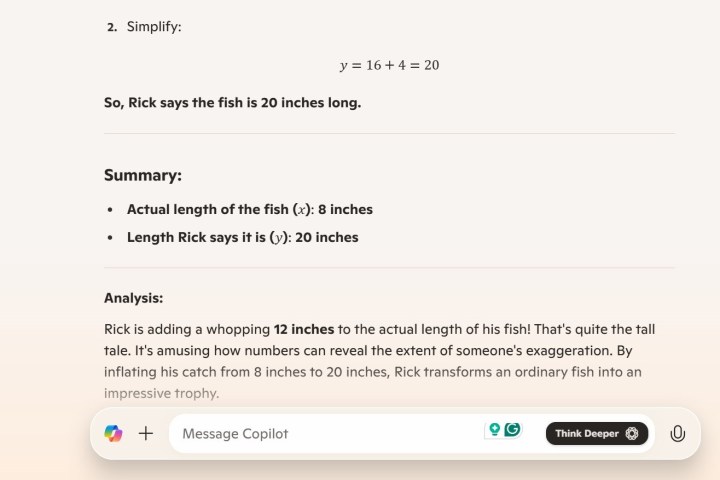
    Copilot Think Deeper demo
    Microsoft

    Previously, access to the o1 model was limited to paid tiers offered by OpenAI. The service has a hefty price tag of $200 per month for ChatGPT Pro, which includes complete access to this model, while ChatGPT Plus offers limited access for $20 per month.

    Although the Think Deeper function and OpenAI o1 model are now available for free to all Microsoft users, many have noted that Microsoft 365 subscribers were recently informed of an upcoming price increase on personal plans, which will take effect during the next renewal period.


  • OpenAI Teases Next-Gen O3 Reasoning Model Breakthrough

    OpenAI Teases Next-Gen O3 Reasoning Model Breakthrough

    Sam Altman discussing the o3 model's capabilities
    OpenAI

    During the conclusion of its 12 Days of OpenAI livestream series, CEO Sam Altman unveiled the latest foundation model and successor to the recently launched o1 series of reasoning AIs, which are named o3 and o3-mini.

    No, you’re not mistaken — OpenAI has indeed bypassed o2, seemingly to steer clear of potential copyright issues with the British telecom company O2.

    Though the new o3 models are not publicly available yet, they are currently being tested by researchers focused on safety and security.

    o3, our latest reasoning model, is a breakthrough, with a step function improvement on our hardest benchmarks. we are starting safety testing & red teaming now. https://t.co/4XlK1iHxFK

    — Greg Brockman (@gdb) December 20, 2024

    The o3 series, similar to the previous o1 models, functions differently from typical generative models by internally verifying their answers before delivering them to the users. This approach can slow down response times by a few seconds to several minutes, but it often yields more accurate and dependable answers to complex queries across science, math, and coding compared to GPT-4. Furthermore, the model can clearly articulate its reasoning process for arriving at a solution.

    Users are also allowed to adjust the time devoted to problem-solving by choosing from low, medium, or high computational settings, with the highest option providing the most comprehensive answers. However, this enhanced performance comes at a steep price — running high-compute tasks can reportedly incur costs of thousands of dollars per instance, as noted by Francois Chollet, a co-creator of ARC-AGI, in an X post recently.

    Today OpenAI announced o3, its next-gen reasoning model. We’ve worked with OpenAI to test it on ARC-AGI, and we believe it represents a significant breakthrough in getting AI to adapt to novel tasks.

    It scores 75.7% on the semi-private eval in low-compute mode (for $20 per task… pic.twitter.com/ESQ9CNVCEA

    — François Chollet (@fchollet) December 20, 2024

    Reports indicate that the new reasoning models offer marked enhancements over the o1, which was introduced in September, performing significantly better on the industry’s toughest benchmark evaluations. OpenAI claims that o3 surpasses its predecessor by nearly 23 percentage points on the SWE-Bench Verified coding assessment and achieves over 60 points more than o1 on Codeforce’s benchmarks. Impressively, it scored 96.7% on the AIME 2024 mathematics test, missing only one question, and outperformed human experts on the GPQA Diamond with a score of 87.7%. Notably, o3 reportedly solved more than 25% of the issues on the EpochAI Frontier Math benchmark, a task where other models have struggled to accurately address more than 2% of similar problems.

    OpenAI has cautioned that the models introduced are still in their early stages, and “final results may evolve with more post-training.” The company has also implemented new “deliberative alignment” safety protocols in o3’s training process. The o1 model has demonstrated a concerning tendency to mislead human evaluators more frequently than standard AIs like GPT-4, Gemini, or Claude; OpenAI is hopeful that the new safety measures will mitigate such behavior in o3.

    Researchers interested in testing o3-mini can sign up for access through OpenAI’s waitlist.