Tag: rare earths

  • U.S. Relies on China for 70% of Rare Earth Imports

    U.S. Relies on China for 70% of Rare Earth Imports

    Understanding Rare Earth Elements and Their Significance

    What Are Rare Earth Elements (REEs)?

    Rare Earth Elements (REEs) refer to a group of 17 metallic elements that play a crucial role in modern technology and industries. These include the 15 lanthanides, plus scandium and yttrium. Their properties make them invaluable in various applications, from electronics to renewable energy solutions.

    The Role of REEs in Modern Technology

    REEs are essential components in a myriad of high-tech applications. They are utilized in the manufacturing of:

    • Electric Vehicles (EVs): REEs contribute to the creation of efficient batteries and electric motors.
    • Semiconductors: These elements are vital for producing high-performance chips used in computers and smartphones.
    • Defense Applications: Many military technologies, including missiles and drones, depend heavily on REEs for optimal performance.

    Current State of Rare Earth Imports in the U.S.

    Heavy Reliance on Chinese Imports

    Between 2020 and 2023, the United States displayed significant reliance on rare earth imports from China, with an astounding 70% of its REE supply originating from this single country. This dependency has raised alarms concerning the stability of supply chains, especially in high-stakes sectors such as technology and defense.

    Additional Suppliers

    While China dominates the market, there are a few other countries that contribute to U.S. REE imports, namely:

    • Malaysia
    • Japan
    • Estonia

    These nations serve as supplementary sources, but none come close to matching China’s share.

    Recent Developments in Export Controls

    China’s Response to Tariffs

    In a strategic move against U.S. tariffs imposed by the Trump administration, China has recently tightened its grip on the export of seven critical rare earth elements. This decision is significant as it showcases the geopolitical tensions surrounding trade in high-tech materials.

    Affected Rare Earth Elements

    The new export controls target seven rare earth elements:

    • Samarium
    • Gadolinium
    • Terbium
    • Dysprosium
    • Lutetium
    • Scandium
    • Yttrium

    These elements are pivotal for a variety of industries and their restricted availability could lead to supply constraints for companies depending on them.

    Requirements for Export

    Under the new regulations, exports of these elements will necessitate a special export license. This measure not only allows Chinese authorities to monitor the flow of these materials but also offers the potential for further restrictions on specific entities, such as U.S. defense contractors.

    Exploring the U.S. Dependence on Yttrium

    The Vital Role of Yttrium

    Among the seven elements recently subjected to export regulations, Yttrium is notable. The United States sources approximately 93% of its Yttrium compounds from China. According to the U.S. Geological Survey, the country is entirely reliant on imports for Yttrium, which is majorly used in:

    • Catalysts
    • Ceramics
    • Electronics
    • Lasers
    • Metallurgy
    • Phosphors

    This level of dependence on a single country for such a critical component raises significant concerns for U.S. industries.

    Current Statistics on U.S. Imports

    In terms of broader rare earth mineral imports, the U.S. was 80% net import reliant in 2024. This indicates that, although steps have been taken to increase domestic production, the United States still relies heavily on imports to meet its demand for rare earth materials.

    Trends in Domestic Production

    Despite the high levels of import reliance, there has been a notable decline from almost complete dependence (100%) in 2020, with an incremental rise in domestic production capabilities, which reached approximately 20% in 2024.

    Implications for Future Strategies and Policies

    Given the strategic importance of rare earth elements and the emerging restrictions imposed by China, it becomes increasingly crucial for U.S. policymakers and industry leaders to devise effective strategies that address these supply chain vulnerabilities. Increasing domestic production and diversifying supply sources may be essential pathways for ensuring resilience in critical sectors dependent on these vital materials.

  • China’s Rare Earth Share Drops to 70% Amid Global Diversification

    China’s Rare Earth Share Drops to 70% Amid Global Diversification

    The Dynamics of China’s Rare Earth Monopoly

    Understanding Rare Earth Elements

    Rare earth elements (REEs) are a set of 17 metallic elements essential for the production of numerous high-tech devices, from smartphones and electric vehicles to wind turbines and military systems. Their unique properties make them critical in various applications, leading to increasing global demand.

    China: The Historical Dominator

    For the better part of the last few decades, China has maintained a near-monopoly on the production and supply of rare earth elements. Prior to 2010, the vast majority of these vital materials were sourced from Chinese mines, which not only controlled a significant share of the production but also the refining processes necessary for turning raw materials into usable components.

    A Shift in the Global Landscape

    Evolving Production Capability

    Since 2010, the global landscape of rare earth production has begun to shift. Several countries, wary of China’s dominance and the geopolitical implications of such reliance, have initiated their own rare earth extraction. This diversification has seen countries like the United States, Australia, Brazil, Vietnam, and Russia exploit their own deposits to mitigate dependence on Chinese supply chains.

    Stalling Domestic Refinement in the U.S.

    Despite ramping up production, the United States faces significant challenges in refining rare earth elements domestically. Approximately 70% of U.S. rare earth imports are still processed in China, mainly due to the high costs associated with establishing and maintaining domestic refining facilities. Labor costs, regulatory challenges, and environmental considerations remain substantial hurdles to developing a robust domestic refining industry.

    The Global Production Landscape in 2024

    According to the U.S. Geological Survey, China’s share of global rare earth production was projected to remain around 70% in 2024. This statistic underscores the continuing significance of China’s role in the industry, despite attempts by other nations to diversify their sources. The country not only has the largest known deposits but also possesses the technological advancements necessary for efficient extraction and processing.

    Emerging Players in the Rare Earth Market

    New Entrants and Expanding Markets

    Countries like Myanmar, Thailand, and Nigeria are newly emerging players in the rare earth mining sector, contributing to a broader dialogue on the future of global supply chains. As these nations begin to tap into their resources, they offer potential alternatives to the traditional dominance of China.

    Brazil, Vietnam, and Russia

    Brazil, Vietnam, and Russia are noteworthy for their largely untapped potential in the rare earth domain. These countries have significant deposits that could be a game changer if fully developed, particularly as global demand for rare earths surges.

    Military and Technological Applications in the U.S.

    The necessity for rare earth elements in military applications has laid the groundwork for the U.S. to re-enter the market after years of relying on foreign imports. The resurgence in rare earth production is not only motivated by economic considerations but also by national security, as these materials are pivotal for advanced military technologies.

    The Future of Rare Earth Supply Chains

    With technological advancements and increasing global demands, nations are likely to pursue strategies that promote local production and processing of rare earth elements. As the landscape evolves, the role of China may diminish, but it remains to be seen how quickly and effectively other countries can scale their operations to meet the global demand while overcoming the challenges that have historically impeded their progress.

    Conclusion

    [Here is a comprehensive view of the evolving dynamics surrounding the rare earth element market, the role of China, and other emerging players. The future of rare earth production appears to be shifting, with increased efforts towards diversification and self-sufficiency.]

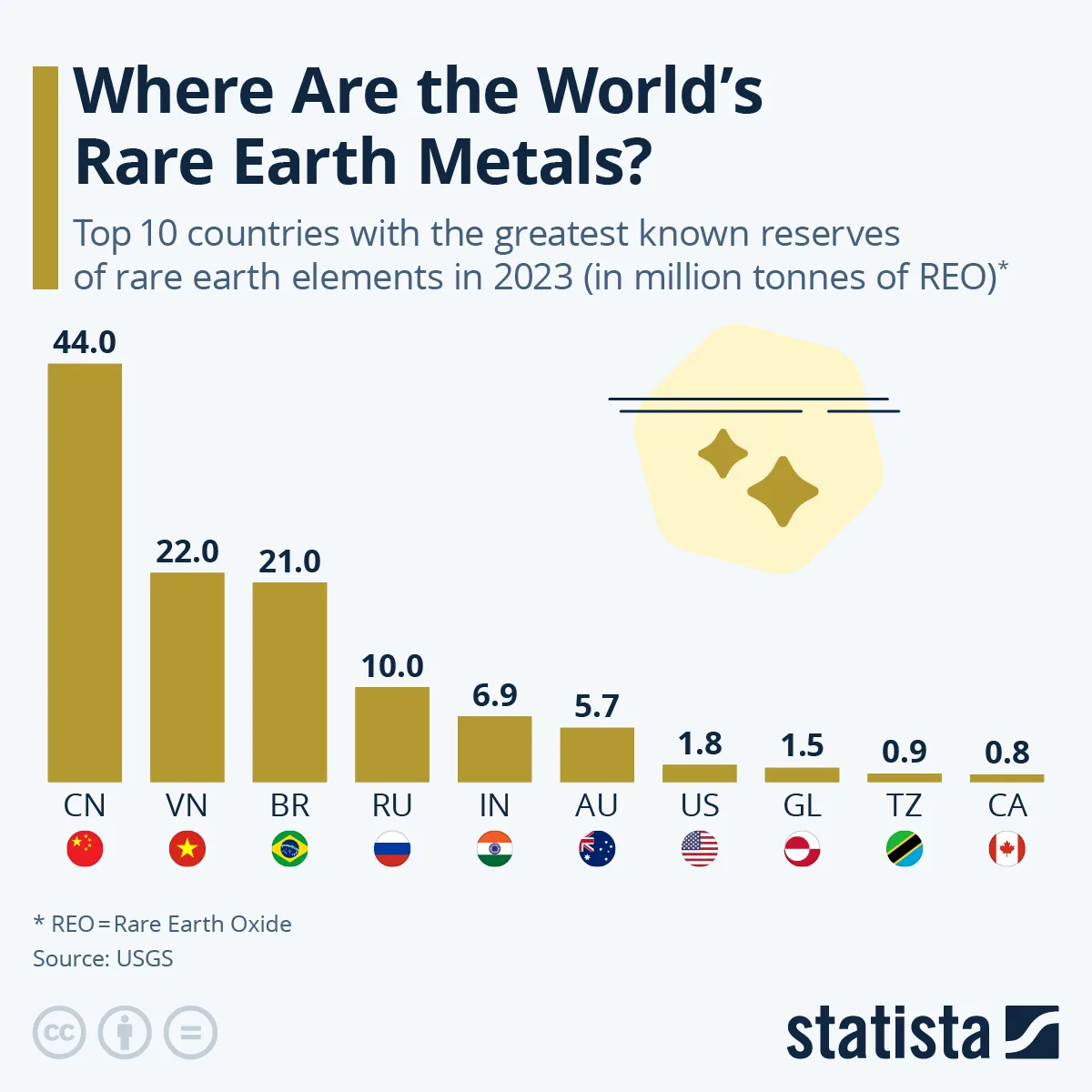
  • Global Rare Earth Reserves: 44 MT in China, 1.5 MT in Greenland

    Global Rare Earth Reserves: 44 MT in China, 1.5 MT in Greenland

    The Global Landscape of Rare Earth Metals: A Focus on Greenland

    Rare earth metals are essential components in a myriad of technologies, driving innovations from electronics to renewable energy solutions. Understanding where these resources are found globally is crucial, especially given the increasing demand for sustainable technologies. This blog delves into the positioning of rare earth metals, particularly highlighting Greenland’s potential within this global framework.

    What Are Rare Earth Metals?

    Rare earth elements (REEs) refer to a group of 17 metallic elements that have unique properties useful in many high-tech applications. These include:

    • Lanthanum
    • Cerium
    • Praseodymium
    • Neodymium
    • Samarium
    • Europium
    • Gadolinium
    • Terbium
    • Dysprosium
    • Holmium
    • Erbium
    • Thulium
    • Ytterbium
    • Lutetium
    • Yttrium
    • Scandium
    • Tantalum

    These elements are integral in the making of magnets, batteries, phosphors, and catalysts, driving the green technology transition and the global move towards more electronic devices.

    Greenland’s Rare Earth Reserves

    Greenland stands out as a significant player on the map of rare earth reserves. According to data from the United States Geological Survey (USGS), Greenland holds approximately 1.5 million tonnes of rare earth elements. This positions it as the eighth largest reserve holder globally, standing closely next to the United States, which has 1.8 million tonnes.

    The Strategic Importance of Greenland

    The geographical and geopolitical significance of Greenland is noteworthy. As the Arctic sea ice continues to reduce due to climate change, previously inaccessible areas become viable for navigation and exploration. This has implications not just for maritime trade but also for securing strategic resources. U.S. interests in Greenland have recently been underscored by former President Donald Trump’s bold proposals connected to national security concerns.

    The Challenges of Mining in Greenland

    Despite its rich deposits, Greenland has faced substantial obstacles regarding the mining of rare earth elements. As of 2023, no mining activities for rare earth elements were reported. Several factors contribute to this situation:

    1. Environmental Concerns: The potential ecological impact of mining activities has taken center stage. Voters in Greenland have expressed significant apprehension about the consequences of mining on their traditional land and lifestyle.

    2. Uranium Production: Extracting certain rare earths could coincide with the production of radioactive materials such as uranium. This aspect has led to a prominent ban on uranium mining in Greenland, stalling the momentum of mining-related projects.

    3. Economic Self-Sufficiency: While the extraction of rare earth elements could present an opportunity for economic development, many Greenlanders weigh this against potential environmental degradation and a possible loss of autonomy over their lands.

    The Global Market and Competition

    China remains a dominant force in the rare earth market, controlling approximately 44 million tonnes, which is nearly 40% of known global reserves. This domination complicates the landscape for other countries, including Greenland, which might be looking to exploit its own resources.

    Shifts in Investment Dynamics

    Historically, Greenlandic firms have sought investments from China for the development of their mining projects. However, political and public sentiment against the environmental implications has resulted in halted projects. The landscape continues to evolve as nations reassess their strategies towards securing rare earth metal supplies without compromising environmental integrity or indigenous rights.

    The Future of Rare Earth Mining in Greenland

    As mineral extraction projects remain on hold, the focus shifts to finding a balance between economic growth and sustainable practices. The conversation about renewable energy and green technology is growing louder, emphasizing the need for responsible sourcing of rare earth metals. The question remains: Can Greenland harness its vast resources while addressing the concerns of its citizens and protecting its environment?

    By examining the intricate dynamics of rare earth metal reserves, particularly in Greenland, we can better understand the broader implications for global trade and technology in a rapidly changing world.