الوسم: quantum computing

  • Scientists develop a novel Schrödinger’s cat variant

    Scientists develop a novel Schrödinger’s cat variant

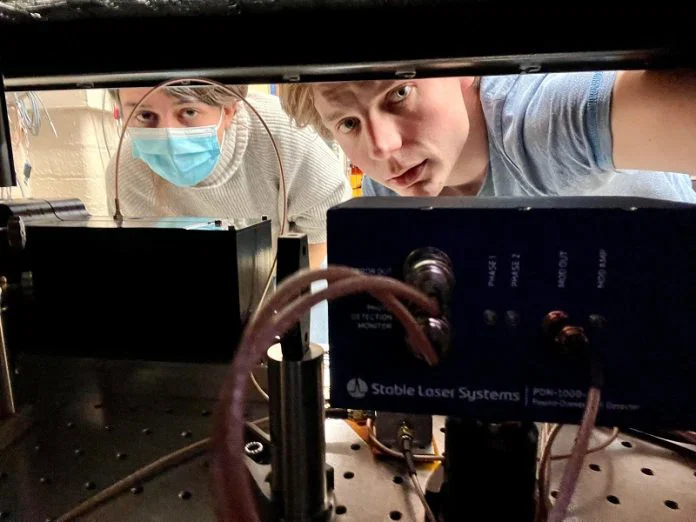
    Physicists at the University of Oxford have developed a new kind of quantum state that could accelerate advancements in quantum computing and offer deeper insights into the peculiar laws of the quantum universe. This breakthrough expands on one of the most renowned concepts in physics: Schrödinger’s cat.

    Proposed by physicist Erwin Schrödinger in 1935, the thought experiment describes a cat that is simultaneously alive and dead until someone opens the box to observe it. Although no actual cats are involved in modern experiments, the idea exemplifies a fundamental aspect of quantum mechanics—the capacity for particles and systems to exist in multiple states at once.

    Scientists can generate real-world versions of these quantum superpositions in laboratory settings. Such states are vital because they underpin the development of quantum technologies, including quantum computers, super-precise clocks, and advanced sensors.

    In a typical quantum computer, information is stored in quantum bits, or qubits. Unlike traditional bits, which are either 0 or 1, qubits can be in both states simultaneously. But quantum systems are often more complex than just simple qubits. Many physical phenomena—like light, vibrations, and particle movement—behave as quantum harmonic oscillators, capable of occupying numerous energy levels that allow scientists to craft a broader spectrum of quantum states.

    One iconic example is the “cat state,” where a quantum system exists in a superposition of two distinct states at once. Traditionally, these states are constructed from special quantum wave packets called coherent states.

    The Oxford researchers introduced an innovative approach. Instead of relying on standard building blocks, they engineered entirely new types of quantum superpositions by harnessing highly unconventional, deeply quantum states. Some of these involve “squeezing,” a technique that redistributes quantum uncertainties from one property to another, effectively reshaping the quantum landscape.

    To create these states, the team used a single trapped ion—an electrically charged atom confined with electromagnetic fields. This ion exhibits two critical quantum features: its internal state functions as a qubit, and its motion behaves like a quantum harmonic oscillator.

    By entangling these two properties, the scientists could manipulate the ion’s motion into specific quantum superpositions through precise measurements. Their method affords exceptional control over the resulting quantum state. Adjusting experimental parameters enables them to tune the size, orientation, and separation of the components within the superposition.

    The team verified the quantum nature of the states by detecting interference patterns and other indicators that classical physics cannot explain. These findings suggest practical benefits, such as the potential for these new states to be more resistant to errors—a major hurdle in quantum computing. They could also streamline error correction processes, making them more reliable.

    Beyond technological applications, this research opens new pathways to explore one of science’s fundamental questions: where does the boundary lie between our everyday classical world and the weird, counterintuitive quantum realm? The scientists believe they’ve only just begun to unveil the rich possibilities offered by this novel family of quantum states.

  • Quantum Computing Receives An AI Boost

    Quantum Computing Receives An AI Boost

    Nvidia is developing a groundbreaking machine that integrates artificial intelligence, supercomputing, and quantum technology all in one. This initiative will emerge from the newly established Nvidia Accelerated Quantum Research Center (NVAQC).

    During its GTC Global AI Conference, Nvidia unveiled an important announcement that is sure to excite fans of quantum computing.

    A key challenge in the realm of quantum computing has been scaling. This innovative center aims to directly address this issue, paving the way for next-generation computational advancements.

    A significant hurdle for quantum computing lies in managing the inherent errors associated with qubits. When qubits interact with their environment, they produce noise that must be filtered out. This process involves analyzing outputs from multiple measurements of these noisy qubits.

    The technique of identifying, monitoring, and correcting qubit errors is known as decoding. This is where the synergy of artificial intelligence and supercomputing comes into play, as their integration may significantly speed up the decoding process — the primary objective of the NVAQC.

    A Collaborative Effort

    Nvidia isn’t embarking on this journey alone; a consortium of quantum computing pioneers will collaborate to tackle these challenges. Notable contributors include Quantinuum, QuEra, and Quantum Machines.

    The initiative will also include participation from academic institutions such as the Harvard Quantum Initiative and the Engineering Quantum Systems group at the MIT Center for Quantum Engineering.

    “The NVAQC provides critical and long-sought-after tools for scaling quantum computing to next-generation devices,” stated Tim Costa, senior director of computer-aided engineering, quantum, and CUDA-X at NVIDIA. He added, “The center will facilitate large-scale simulations of quantum algorithms and hardware while fostering the integration of quantum processors and the training and deployment of AI models for quantum applications.”

    Nvidia emphasized, “Leveraging tools like NVIDIA DGX Quantum — a reference architecture for merging quantum and classical hardware — along with CUDA-Q, the NVAQC is positioned to become a central hub for next-generation advancements in quantum computing, driving the transformation of qubits into powerful quantum computers.”

  • Google Claims Quantum Computing Applications Are Five Years Off

    Google Claims Quantum Computing Applications Are Five Years Off

    A few weeks ago at CES 2025, Jensen Huang, the CEO of Nvidia, suggested that practical applications of quantum computing might still be around 20 years away. In contrast, Google’s quantum lead, Hartmut Neven, recently told Reuters that we could see tangible uses for quantum computing much sooner—potentially within five years. So, who’s got it right?

    Huang argues that the existing quantum systems are lacking in “qubits,” estimating a shortage of about five or six orders of magnitude. But why is there such a high demand for qubits? Research indicates that a higher number of qubits leads to fewer errors, resulting in more precise quantum computers. Let’s delve into this issue.

    A qubit, or quantum bit, is fundamentally different from the standard binary bits found in traditional computers because it can represent multiple data values simultaneously. However, qubits are based on quantum particles, which often behave unpredictably. When quantum computations are performed, about one in every thousand qubits tends to “fail”—essentially deviating from their intended function—thereby disrupting the calculations.

    Historically, traditional computers faced a similar challenge. Take the ENIAC computer, for instance; it relied on over 17,000 vacuum tubes to convey bits. These tubes frequently malfunctioned, which resulted in errors. The solution back then was relatively simple: we phased out vacuum tubes in favor of silicon transistors, achieving a remarkably low failure rate of one in a billion.

    Unfortunately, that kind of straightforward solution isn’t applicable to quantum computing. Because qubits are quantum particles, their characteristics can’t be altered or controlled in a conventional sense; we have to work with their inherent properties.

    This brings us back to the issue of inadequate qubit numbers. Just last year, Google’s Willow quantum chip demonstrated that adding more qubits reduces errors. Essentially, Google created a system of mega qubits from several physical qubits that share the same information. This setup acts as a safeguard—if one physical qubit fails, there are others that can maintain the calculation. The greater the number of physical qubits present, the more failures can be absorbed, resulting in improved accuracy.

    However, since qubits are prone to failure and high accuracy is crucial for real-world applications, we’ll need a substantial quantity of qubits to make quantum computing viable. Huang believes it could take as long as 20 years to reach the required number, while Neven is optimistic, claiming it could happen in five.

    So, does Google have insights that Nvidia lacks, or is this a friendly rivalry stirring the pot? At this point, the answer remains elusive. Perhaps Neven’s comments were motivated by a desire to buoy quantum computing stocks after Huang’s earlier remarks led to about an $8 billion loss in that sector.

    Whenever the breakthrough occurs, Google envisions leveraging quantum computing to devise enhanced batteries for electric vehicles, develop new medications, and potentially discover alternative energy sources. While the idea of these projects materializing within a five-year time frame seems ambitious, it won’t be long before we find out just how right or wrong Neven’s predictions are.

  • Chinese Scientists Allegedly Use Quantum Computers to Breach Military Encryption

    Chinese Scientists Allegedly Use Quantum Computers to Breach Military Encryption

    Chinese researchers have reportedly achieved what they are calling the first successful quantum attack on widely utilized encryption algorithms, as detailed in a report from the South China Morning Post (SCMP).

    The research team, led by Wang Chao at Shanghai University, employed a D-Wave quantum computer to penetrate cryptographic protocols, raising alarms about the security of essential sectors like banking and military operations.

    Published on September 30 in the Chinese Journal of Computers, the study showcases a notable advancement in the field of quantum computing.

    Utilizing the D-Wave Advantage machine—which was originally intended for practical tasks such as logistics—the researchers focused on attacking algorithms based on the Substitution-Permutation Network (SPN) architecture. This type of algorithm is fundamental to encryption standards in widespread use, including AES-256, which is regarded as the benchmark for secure communication in military and financial contexts.

    According to Wang’s team, this marks the first instance where a genuine quantum computer has demonstrated the potential to significantly threaten full-scale SPN algorithms currently in practice. Although they did not break any specific passcodes, the researchers caution that quantum computers could soon begin to challenge existing encryption methods.

    Quantum computers operate on principles that differ significantly from those of traditional computers; they leverage quantum annealing and tunneling to tackle intricate problems more effectively.

    The research team blended these quantum techniques with traditional mathematical approaches to create a new computational method capable of undermining SPN algorithms such as Present, Gift-64, and Rectangle, as reported by the SCMP.

    Nevertheless, the researchers recognize the current limitations of quantum computing, which include immature hardware and environmental factors that interfere with performance, ultimately restricting the technology’s capabilities at this stage.

    Wang refrained from providing additional comments on the research due to its sensitive nature.

    While contemporary encryption systems remain secure for the time being, experts are closely monitoring the swift advancements in quantum computing, which could expose new vulnerabilities in the future. Wang’s team has indicated that while there hasn’t been an immediate compromise, the rapidly evolving technology suggests that future quantum systems might pose substantial risks to existing encryption standards.