A new star’s birth begins deep within cold, dense clouds of gas and dust, known as prestellar cores. Researchers have long been curious about the processes leading to star formation, and recent observations are shedding light on one of the earliest stages.
A study published in Astronomy & Astrophysics reports a groundbreaking discovery by scientists from Kyushu University in Japan and the Max Planck Institute in Germany. They observed, for the first time, a phenomenon called ambipolar diffusion inside a prestellar core—a dense, cold cloud that has yet to ignite as a star.
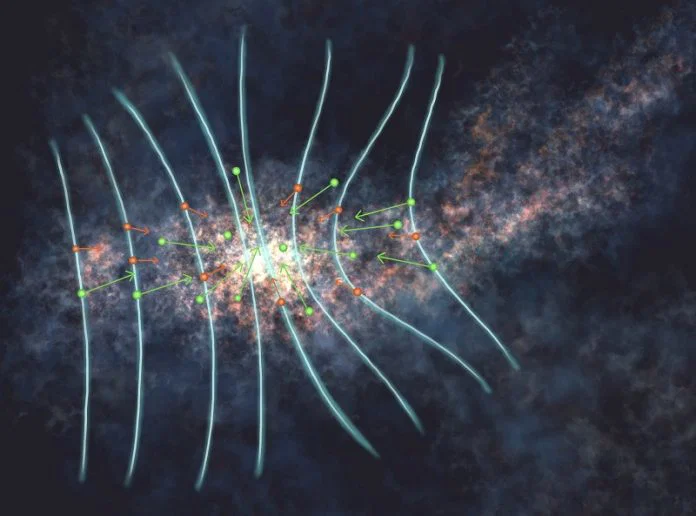
Stars like our Sun emerge from these cores. Gravity constantly pulls the gas and dust inward, striving to create a new star. But magnetic forces also play a crucial role, threading through the cloud and opposing gravity’s pull. These magnetic fields can slow or even halt the collapse, preventing immediate star formation. For years, scientists have believed that weakening of these magnetic fields is necessary for a star to form, but actually observing this process has been extremely challenging.
The team focused their study on a prestellar core named L1544, located in the Taurus Molecular Cloud—one of Earth’s closest star-forming regions. They utilized the powerful 30-meter IRAM radio telescope to gather data. Since these cores are extremely cold, many molecules freeze onto dust grains, making detection tricky. Instead, they targeted two specific molecules that stay in the gas phase: diazenylium-d1 (N₂D⁺), a charged molecule, and para-monodeuterated ammonia (para-NH₂D), a neutral molecule.
By analyzing the radio waves emitted by both molecules, the scientists measured their movements. They discovered that the neutral molecules moved approximately 0.05 kilometers per second faster than the charged ones—a tiny but significant difference. This difference served as clear evidence of ambipolar diffusion at work.
The explanation lies in how these particles interact with magnetic fields. Charged molecules remain tied to magnetic lines, while neutral molecules are not as constrained. As the cloud becomes denser, fewer charged particles linger, weakening magnetic support. Consequently, gravity pulls the neutral particles inward more freely, while the charged particles continue to follow magnetic lines, resulting in a gradual drift between the two groups.
Over time, this drift diminishes the magnetic field’s hold, allowing gravity to dominate. When gravity overpowers the magnetic resistance, the cloud collapses, and a protostar—an embryonic star—begins to form.
This discovery contributes a vital piece to understanding how stars originate. The researchers plan to observe additional prestellar cores with even more sensitive instruments to verify if ambipolar diffusion is a common step throughout our galaxy.
Understanding star formation is essential because stars are the factories of planets and the raw materials for life. By capturing this tiny cosmic drift, scientists have taken a significant step toward unraveling the cosmic story of how stars like our Sun, and countless others across the universe, come into existence.