الوسم: presidency

  • Trump Plans to Rename Defense Department the ‘Department of War’

    Trump Plans to Rename Defense Department the ‘Department of War’

    The Pentagon appears from above in Washington, D.C., on March 3, 2022.

    – Congressional approval is necessary for this change, though Republicans are unlikely to oppose it.
    – Critics claim renaming is expensive and serves as an unnecessary distraction.
    – This move would leave a personal mark from Trump on the nation’s largest government agency.

    On Thursday, a White House official announced that President Donald Trump intends to sign an executive order on Friday to rebrand the Department of Defense as the “Department of War.” This action would give Trump a distinctive influence over the country’s most significant government body.

    The proposed order would permit Defense Secretary Pete Hegseth, along with the Department of Defense and its subordinate agencies, to use alternative titles like “Secretary of War,” “Department of War,” and “Deputy Secretary of War” in official documents and public messaging, according to a White House fact sheet. It would also direct Hegseth to propose legislative and executive actions necessary for making the renaming permanent.

    Since his inauguration in January, Trump has aimed to rename various locations and institutions, including the Gulf of Mexico, and to restore the original names of military bases that were changed following racial justice protests.

    While name changes for departments are uncommon and typically require congressional approval, Trump’s narrow Republican majorities in both chambers have left congressional leaders with little motivation to oppose his initiatives. Historically, the Department of Defense was known as the War Department until 1949 when Congress unified the Army, Navy, and Air Force in the aftermath of World War II. The name change aimed partly to indicate that, in the nuclear era, the focus was on preventing wars.

    Reverting the department’s name again would be costly and involve updating signage and stationery used not just at the Pentagon but across military installations worldwide. For example, a previous effort by President Joe Biden to rename nine bases honoring Confederate figures was projected to cost around $39 million. That effort was halted earlier this year by Hegseth.

    The Trump administration’s effort to cut Pentagon costs, managed by the Department of Government Efficiency, has been focused on reducing expenditures. Democratic Senator Tammy Duckworth, a military veteran and member of the Senate Armed Services Committee, questioned this approach, stating, “Why not allocate these funds to support military families or to employ diplomats who can help prevent conflicts before they begin?” She added, “Trump seems more interested in using our military for political gains than strengthening national security or supporting our servicemembers and their families.”

    Many critics believe the proposed name change is not only expensive but also an unnecessary distraction for the Pentagon. Hegseth argues that the change is “about the warrior ethos, not just words.”

    This year, Republican Congressman James Comer, Chair of the House Oversight Committee and a close ally of Trump, introduced legislation to simplify the process for presidents to reorganize and rename agencies. Trump has voiced support, stating last month, “We’re just going to do it. Congress will probably back us if necessary. Defense should be proactive, not just defensive.”

    Trump also speculated in June that the original name change was motivated by political correctness. For some within his administration, the idea of renaming the department harks back further—during Trump’s first term, FBI Director Kash Patel, who briefly served at the Pentagon, signed his emails as “Chief of Staff to the Secretary of Defense & the War Department.” Patel told Reuters in 2021 that he saw this as “a tribute to the history and heritage of the Department of Defense.”
  • Trump’s Doctor Declares President in ‘Excellent Health’ After Exam

    Trump’s Doctor Declares President in ‘Excellent Health’ After Exam

    Trump Declared in Great Health Following Medical Checkup

    Washington D.C.: The White House released a statement on Sunday indicating that Donald Trump is in "excellent health" after undergoing his first annual medical examination since reclaiming the presidency.

    At 78 years old, Trump, a member of the Republican party, has continuously praised his own vitality throughout his second term while casting doubts on the capabilities of his 82-year-old Democratic opponent, Joe Biden, whom he views as aging and mentally unfit for the role.

    According to a letter from the presidential physician made available by the White House, "President Trump shows excellent cognitive and physical health and is fully capable of fulfilling the responsibilities of the Commander-in-Chief and Head of State."

    The report did mention a few minor irregularities, including some sun damage to Trump’s skin and scars on his right ear from a gunshot wound sustained during an assassination attempt last July.

    Last year, a colonoscopy revealed that Trump suffers from diverticulosis—small pouches in the colon—along with a benign polyp. The medical team recommended a follow-up examination in three years.

    Currently, Trump is taking four medications: two for managing cholesterol, aspirin for heart health, and a topical steroid cream. Overall, the report painted a positive picture of Trump’s health, applauding his "active lifestyle" and noting his "frequent wins in golf tournaments." The former president refrains from alcohol and tobacco, though he is known for his fondness for fast food and his preference for steaks cooked well-done. Interestingly, he appears slimmer than he did during his first term, with his current weight listed at 224 pounds (101.6 kg), down from 243 pounds in 2019.

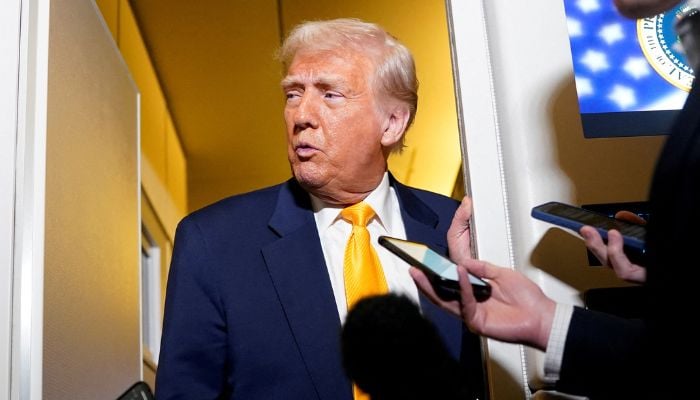
    Trump expressed on Friday that he felt he was "in very good shape" following his exam that day at Walter Reed National Military Medical Center located in a suburb of Washington, D.C. He remarked to reporters aboard Air Force One, "I took a cognitive test. All I can say is that I got every answer correct."

    Controversial Health Statements

    Despite widespread public interest in the health of the nation’s leader, Trump has faced accusations of lacking transparency regarding his health status. The White House previously stated that Dr. Sean Barbabella, the presidential physician, would provide details about the examination and promised to release the full report.

    However, in the past, both Trump’s personal and presidential doctors have made exaggerated claims about his well-being. During his first presidential campaign in 2015, Trump’s physician, Harold Bornstein, issued a statement claiming that Trump "will unequivocally be the healthiest individual ever elected to the presidency." Bornstein later clarified to CNN that Trump had dictated that letter himself.

    In 2018, another doctor, Ronny Jackson, claimed that Trump could "live to be 200 years old" with a healthier diet. Jackson’s subsequent report indicated that Trump should work on losing 10 to 15 pounds but still categorized him as being in "excellent health" with no cognitive decline detected.

    By 2019, an examination noted that Trump weighed 243 pounds, an increase from the time he took office, classifying him as technically obese.

    Age became a significant topic during the lead-up to the 2024 election, with Trump and Biden representing the oldest presidential candidates in U.S. history. Biden had to withdraw from the race after a notably weak performance in a televised debate against Trump in June, which raised issues concerning his mental fitness to serve.

  • US Attorney General: A Third Trump Term Would Be Challenging

    US Attorney General: A Third Trump Term Would Be Challenging

    U.S. President Donald Trump and U.S. Attorney General Pam Bondi shake hands during his visit to the Department of Justice in Washington, D.C., on March 14, 2025. — Reuters

    On Sunday, the U.S. Attorney General remarked that it would be a significant challenge for Donald Trump to find a legitimate way to campaign for a third presidential term.

    “I wish we could keep him as our president for 20 years,” Pam Bondi shared with Fox News on Sunday, adding, “but I believe he will probably be done after this term.”

    The U.S. Constitution was revised in 1947 to establish a two-term limit for the presidency, following Franklin Roosevelt’s death early in his fourth term.

    However, amendments to the Constitution require a two-thirds majority from both chambers of Congress, along with ratification from three-quarters of the 50 states, a process that political analysts find highly improbable.

    “That’s really the only way it could happen,” Bondi stated. “It would be a heavy lift.”

    Trump’s initial comments about running for a third term seemed fanciful to many, but on March 31, the 78-year-old president told NBC News he was “not joking” about the possibility, mentioning that there were “methods” that could make it happen.

    Bondi’s remarks about the hurdles of legally pursuing a third term resonate with the views of most constitutional experts. Yet, as a staunch Trump supporter in a prominent law enforcement role, her opinion carries added weight.

    Earlier in the interview with Fox’s Shannon Bream, Bondi expressed concerns about the extensive legal challenges facing the still-nascent Trump administration as it aggressively implements its policies.

    “We’ve seen more than 170 lawsuits against us; that should be the real constitutional crisis,” she said. “We will keep fighting” those cases as they progress through the legal system.

    Bondi also stood by the administration’s move to pursue the death penalty in the case of Luigi Mangione, who is accused of murdering health insurance executive Brian Thompson on December 4, 2024, in New York.

    “The president’s directive was very clear: we are to pursue the death penalty whenever possible,” she noted. “If there’s ever a case for the death penalty, it’s this one.”

    Elated by a recent legal triumph, she highlighted that the Supreme Court sided with the administration over the Education Department’s decision to suspend funding for diversity, equity, and inclusion (DEI) grants.

    “We just secured a fantastic win,” Bondi exclaimed, promising, “and we will continue to fight every day.”