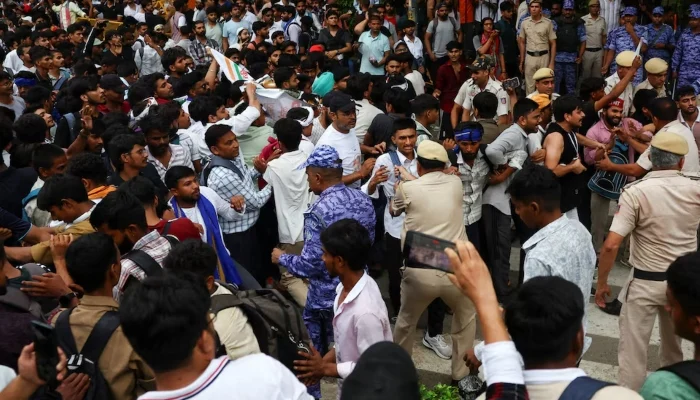
Indian activists are challenging Prime Minister Narendra Modi’s government over the deployment of AI-powered surveillance during the country’s largest youth protest in decades. One court case is expected to test federal authority, even after the protest has concluded.
The controversy over surveillance arose during recent student protests about exam paper leaks. Protesters shared images on social media of a mobile police van equipped with cameras mounted on a telescopic mast that provided a 360-degree view of the gathering.
Student activist Aishe Ghosh has petitioned the Delhi High Court to declare mass surveillance of protesters unconstitutional. She is requesting the court to order the destruction of all personal data collected during the protest and to establish guidelines for the use of surveillance technologies.
Ghosh continues to pursue the case despite the protest ending following Education Minister Dharmendra Pradhan’s resignation, a rare setback for Modi, who has since announced a panel to reform the exam system, which has been plagued by cheating.
India currently lacks specific laws governing police use of facial recognition technology. Activists argue that surveillance at the main protest site in New Delhi violated existing laws.
The government contends that such measures were lawful and aimed at maintaining order. Modi’s administration has faced accusations from opposition parties and digital rights advocates of broadening surveillance powers and controlling digital communications tightly. Officials deny these claims, asserting their actions serve the public interest.
During a hearing on Friday, Solicitor General Tushar Mehta defended police actions, calling privacy concerns at a public protest “ironic” and stating that the measures were “absolutely necessary” for legitimate state interests. In a separate brief hearing on Monday, the court heard arguments from Ghosh, who called the extensive surveillance disproportionate and requested more clarity regarding government espionage policies during protests. The case is scheduled for additional review on Tuesday.
A digital rights organization based in Delhi, Internet Freedom Foundation, sent a letter on July 24 to police officials demanding that the biometric data collected at the protest site be deleted.
Delhi police have not responded to requests for comment from Reuters. However, they posted on social media that they had not “restricted anyone’s freedom through facial recognition technology.”
Police officers were also observed noting Instagram handles of protesters arriving at the site. When questioned, Inspector Sunil Kumar told Reuters that this was to prevent individuals with criminal backgrounds from participating.
The surveillance van used at the protest was marked with the Delhi Police emblem and bore the branding “Ikshana,” Hindi for “vision.” Details about Ikshana are scarce online; however, an earlier post by Indian CCTV company CP Plus mentioned that the system featured “advanced AI-powered” cameras, mobile units, and “Varifocal Bullet Cameras” with adjustable lenses.
The CP Plus website removed the relevant post over the weekend, and the company has not responded to inquiries. When a Reuters reporter recently passed by the van, a display inside showed his face with a green box and a “face accuracy” score. Shortly after, a police officer inside the van closed the window.
Police officials stated that the AI systems assist in identifying individuals with criminal records and counting protesters. Officer Raj Kumar Dahiya explained that the technology helps “identify those who have a criminal history” and “helps us count the number of protesters.” Meanwhile, critics emphasize the need for accountability, pointing out that if facial recognition is used to track protesters, it should also identify officers who may have acted without proper identification badges during the crackdown.