Tag: Philippines

  • Three Dead, Five Injured in Central Philippines School Shooting

    Three Dead, Five Injured in Central Philippines School Shooting

    Three individuals lost their lives and five others sustained injuries in a school shooting in the central Philippines, according to local authorities on Monday.

    Officials reported that two suspects have been taken into custody following the incident at San Jose National High School in Tacloban City, Leyte Province.

    The shooting took place around 9:00 a.m. (0100 GMT) within the school premises in Barangay San Jose, with an investigation underway to uncover what led to the event, the Tacloban City Police Department said.

    Tacloban Police Chief Noelito Getigan informed news outlets that the assailants were armed with a .38-caliber and a 9mm firearm during the attack.

    One of the suspects, a ninth-grade student and minor, was arrested shortly after the shooting, while the other surrendered later, Getigan added.

    Authorities transported the injured victims to nearby healthcare facilities for treatment. Additional law enforcement officers have been deployed to the school to maintain safety for students, staff, parents, and the surrounding community.

    The public is advised to refrain from sharing unverified information and to cooperate fully with ongoing investigations.

    School shootings are relatively rare in the Philippines, making this incident unusual. In July 2022, a gunman opened fire at the Ateneo de Manila University law school graduation ceremony in Quezon City, killing three people, including former Lamitan City mayor Rose Furigay.

  • Rain and aftershocks hinder rescue efforts as Philippine quake reaches 55 deaths

    Rain and aftershocks hinder rescue efforts as Philippine quake reaches 55 deaths

    Rescuers in southern Philippines worked through rain and aftershocks on Friday, clearing roads and searching for missing persons as the death toll from a powerful earthquake climbed to 55. The 7.8 magnitude quake struck just off the coast of Mindanao on Monday, causing buildings to collapse, landslides to occur, and triggering tsunami alerts across the region.

    A government report released Friday confirmed eight new fatalities, with 31 people still missing as local authorities continued to gather reports. In Sarangani province, which was severely affected, provincial disaster officer Rene Punzalan told AFP that many blocked roads had been reopened, but helicopters remained essential to deliver food and water to residents cut off from supplies and still without power.

    “Aftershocks are slowing our progress, and it rained last night, so we’ve had to halt some operations,” Punzalan explained, noting that heavy equipment was being used to move large boulders blocking the roads. He also expressed little hope of rescuing survivors, stating, “Many days have passed since the earthquake, so it would be a miracle if anyone is still alive. Our main focus now is to recover bodies.”

    Philippine President Ferdinand Marcos visited the affected areas of General Santos—largest city in the region—including a damaged school and a relief distribution point. He announced that the government would allocate 100 million pesos ($1.6 million) to rebuild the city hall.

  • Philippines Earthquake Deaths Surge to 46

    Philippines Earthquake Deaths Surge to 46

    A damaging earthquake with a magnitude of 7.8 struck off the coast of Mindanao, Philippines, on Monday, causing buildings to collapse and triggering landslides. Tsunami alerts were issued across the southern region. By Wednesday, rescuers recovered a body from the rubble of a supermarket in General Santos City, raising the death total to 46. Joey Deluvio, 39, was among two workers at the store still being searched for after the disaster. Rescue teams detected faint signs of life earlier, but unfortunately, his body was ultimately found trapped between two beams. The official death toll from the national disaster agency increased to 45, with the number of missing persons rising from four to 17. Deluvio’s death was not included in the official count. Most casualties occurred in Davao Occidental, primarily from landslides and structural collapses, according to civil defense authorities.

  • Philippine Quake Death Toll Reaches 41, Ongoing Outdoor Hospital Relief

    Philippine Quake Death Toll Reaches 41, Ongoing Outdoor Hospital Relief

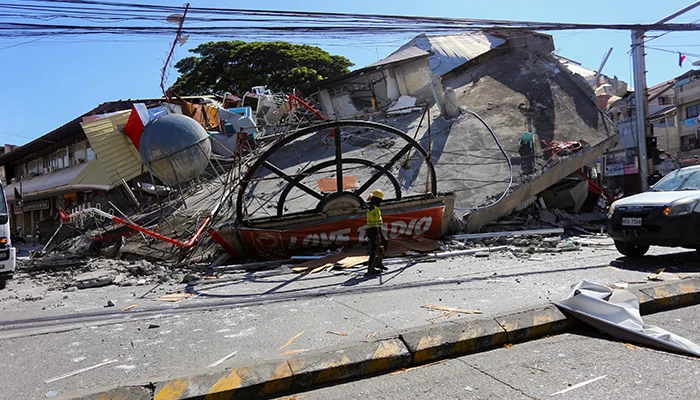
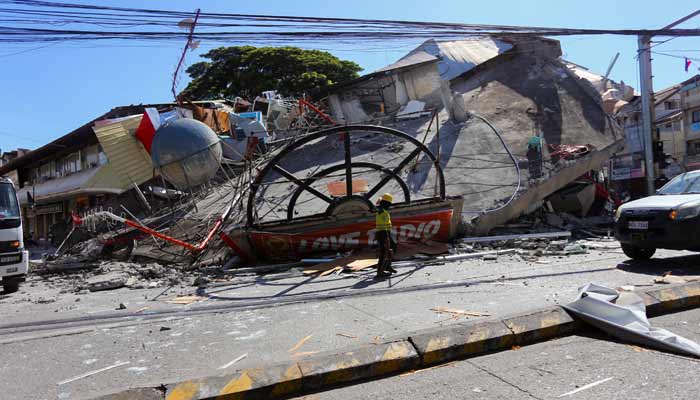
    A laborer walks near a destroyed structure after a magnitude 7.8 earthquake hit General Santos in southern Philippines on June 8, 2026. — Reuters

    – A young mother delivered her baby outside the hospital.
    – Damage to roads and bridges has isolated several communities.
    – Tsunami warnings were lifted after the threat subsided.

    Doctors treated patients in tents under the intense Philippine sun on Tuesday, including assisting a young mother with childbirth. The death toll from the powerful earthquake, which caused building collapses and triggered tsunami alerts, surpassed 40.

    Thousands remain displaced, and over 450 people are injured following the magnitude-7.8 quake that struck off Mindanao on Monday. Based on reports from national and local disaster agencies, only four individuals are now missing.

    In Sarangani Province, one of the hardest-hit areas, some regions are only accessible via helicopter. Rescue efforts are slowed by ongoing aftershocks, according to local officials briefing reporters Tuesday.

    “There are still aftershocks, so rescue teams are proceeding with caution. That’s a challenge,” said Rodrigo Sosmena, regional civil defense chief.

    Multiple strong aftershocks rattled the region within hours of the initial quake, along with hundreds of smaller tremors.

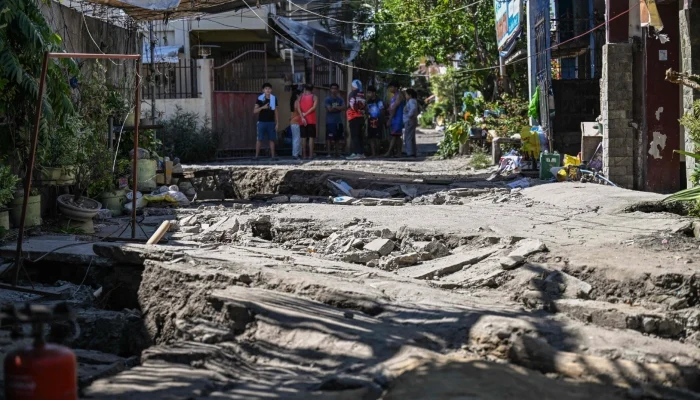
    Structural damage means some communities will be cut off for at least a week due to destroyed roads and a collapsed bridge.

    At a hospital near General Santos— the largest city in the region— AFP journalists heard a woman cry out “push” followed by the newborn’s cries outdoors, behind a makeshift screen, as she delivered her baby.

    In Glan municipality, where at least 13 residents were buried inside landslide-affected homes, staff at another hospital reported more than 60 patients were placed on beds outside the facility because of safety concerns about the building’s stability.

    “The hospital sustained extensive damage,” said a hospital staff member. “The municipal engineer decided it’s unsafe to keep using the building.”

    By Tuesday morning, provincial sources reported the death toll had reached 41.

    Rescue teams resumed efforts outside a collapsed grocery store in General Santos after an overnight pause, attempting to recover two workers trapped inside when the building fell.

    AFP cameras watched as search dogs and handlers combed through heaps of broken concrete and jagged metal.

    A rescue official indicated the focus had shifted from rescue to recovery, though this had not been officially confirmed.

    At a nearby beach resort, a Coast Guard vessel searched for two missing swimmers caught in turbulent waters caused by the quake.

    Social media videos verified by AFP showed the collapse of a shopping mall housing a Jollibee restaurant and the destruction of an unoccupied school building in General Santos.

    Another video depicted school children screaming as they were held by teachers during the tremor, with a background shot of a collapsing metal structure. The school’s official Facebook page stated no one was underneath the structure when it fell.

    Thousands of people in coastal areas of the southern Philippines and neighboring Indonesia were ordered to evacuate, as multiple countries and the regional tsunami center issued warnings. However, by midday, the threat had passed, and alerts were canceled.

    Waves that did reach Japan’s Pacific coast, where a tsunami advisory was issued, measured no more than 8 inches (about 20 centimeters).

    In October, eastern Mindanao experienced two earthquakes of magnitudes 7.4 and 6.7, which caused at least eight deaths.

  • Gunfire erupts during Philippine Senate standoff over ICC suspect

    Gunfire erupted at the Philippine Senate on Wednesday, prompting people to seek cover after a prominent politician wanted by the International Criminal Court claimed his arrest was imminent and security forces entered the building.

    No immediate injuries or casualties were reported, according to Senate Secretary Mark Llandro Mendoza, who spoke to reporters after the chaos inside the legislative chamber in Manila.

    Senator Ronald dela Rosa, a former police chief known for enforcing former President Rodrigo Duterte’s controversial anti-drug campaign, had earlier called on supporters to mobilize to prevent his arrest and extradition to the ICC.

    The Hague-based court unsealed an arrest warrant for dela Rosa on Monday, charging him with crimes against humanity — the same accusations levelled against 81-year-old Duterte, who is currently awaiting trial after being transferred there last year.

    Dela Rosa, 64, has denied any involvement in illegal killings.

    “I am asking for your help. Please do not allow another Filipino to be taken to The Hague,” he said in a Facebook video from his Senate office, where he has taken refuge under legislative protection since Monday.

    Senate Secretary Mendoza stated that law enforcement officials, believed to be from the National Bureau of Investigation, had attempted to enter the Senate and reportedly fired shots as they retreated.

    However, NBI Director Melvin Matibag told GMA News that no agents had been dispatched, stating, “I spoke to the justice minister, and he told me to wait for further instructions. We aren’t prepared for any operation at this time.”

    Over ten military personnel dressed in camouflage and carrying assault rifles arrived at the scene, witnesses from Reuters observed.

    The military’s public affairs chief, Xerxes Trinidad, mentioned that the Senate had requested assistance to help secure the premises.

    Interior Minister Jonvic Remulla said it remains unclear who shot the guns and that authorities would review security footage. He reassured dela Rosa’s safety and confirmed that no arrests were planned.

    Dela Rosa, once Duterte’s top lieutenant responsible for overseeing a brutal crackdown that resulted in thousands of deaths, has fought against the charges, which rights groups claim involve systematic murders and cover-ups by police.

    Police assert that all over 6,000 casualties in anti-drug operations were armed and resisted arrest.

    Activists argue that the true number may never be known, citing daily shootings of drug users and small-time peddlers in impoverished neighborhoods, often blamed on vigilantes and gang conflicts.

    Throughout Wednesday, the Senate was tightly guarded, with police positioned to maintain order amid protests demanding dela Rosa’s arrest. Many protesters also called for him to be handed over to the ICC.

    Senate President Alan Peter Cayetano said he discussed the situation with President Ferdinand Marcos Jr., who assured him that no government officials were involved in Wednesday’s incident.

    Dela Rosa returned to the Senate Monday for the first time since going into hiding last November, urging Marcos not to extradite him to the ICC. He has also filed an emergency petition with the Supreme Court to prevent his transfer, which the court acknowledged, giving all parties involved 72 hours to respond.

    Dela Rosa claims any transfer would be illegal because the Philippines no longer adheres to the Rome Statute after Duterte unilaterally withdrew from the ICC in 2018, shortly after the court announced an initial review of his anti-drugs campaign. The ICC maintains jurisdiction over crimes committed while a country was a member.

    Duterte, who faces potential trial at the ICC—making him the first Asian former head of state in that position—has publicly challenged the court, declaring he’s willing to “rot in jail” to protect his nation from drug-related violence. His legal team continues to deny the allegations against him.


  • Philippines Ferry Sinks: 15 Dead, Hundreds Rescued

    Philippines Ferry Sinks: 15 Dead, Hundreds Rescued

    A ferry carrying 342 passengers sank in the southern Philippines, prompting an immediate response from the Philippine Coast Guard’s rescue team. The rescue boat was actively participating in search and rescue operations following the maritime disaster, which resulted in at least 15 confirmed deaths. A total of 316 individuals have been saved so far, with 28 still reported missing.

    The incident happened at approximately 1:50 a.m. local time on Monday, while the vessel, MV Trisha Kerstin 3, was heading to Jolo in Sulu Province after leaving Zamboanga. The boat was operating within its approved capacity of 352 passengers and crew, with 332 passengers and 27 crew members onboard at the time of the sinking.

    Rescue teams are working in relatively calm waters to expedite search efforts. Efforts include deploying military aircraft and vessels to aid in the rescue and investigation processes. Officials are now looking into what caused the ferry to capsize.

    Basilan’s governor, Mujiv Hataman, shared video clips from the scene at Isabela port on Facebook, showing survivors being helped off boats, some wrapped in thermal blankets and others accompanied on stretchers. He mentioned that most survivors are doing well, though several elderly passengers require urgent medical attention. Authorities are currently cross-checking the passenger list as rescue operations continue.

    Ferry accidents are a frequent tragedy in the Philippines, an archipelago composed of over 7,000 islands with a variable safety record concerning maritime travel.

  • Vitaly, Russian Vlogger, Shares 290-Day Philippine Jail Nightmare

    Vitaly, Russian Vlogger, Shares 290-Day Philippine Jail Nightmare

    Digital Phablet – YouTuber Vitaly Zdorovetskiy, famous for his provocative pranks on the platform, recently shared his ordeal on social media regarding his 290-day detention in the Philippines.

    Earlier this month, Vitaly was deported back to Russia after spending nearly ten months in a Philippine jail on allegations of bothering people for content while visiting the country. The Philippine authorities also prohibited him from re-entering the nation.

    Commissioner Joel Anthony Viado explained that the government placed the content creator on a blacklist, emphasizing, “While we warmly welcome visitors from all countries, respecting our laws is essential. Those who partake in harassment or cause disruptions threaten public order and will face swift penalties.”

    Russian vlogger Vitaly opens up about nightmare experience of 290 days in Filipino jail

    After spending 290 days behind bars in the Philippines — surrounded by rats, cockroaches, and enduring temperatures over 95°F — I am finally free. They truly tried to break me, but instead, I was strengthened. During my time there, I endured 91 days in total isolation. They aimed to make me disappear, but I am still here, all thanks to GOD!!! ⛓️💥 pic.twitter.com/li2tsgMarG

    — VitalyTheGoat🐐 (@vitalyzdtv), January 20, 2026

    The news agency reported that Vitaly was caught engaging in multiple misconducts, including harassing a security guard, insulting a Filipino woman wearing a mask, stealing an electric fan, and crashing a tricycle into a vehicle.

    Vitaly shared on X (formerly Twitter), “After 290 days in the Philippines jail with rats, cockroaches, and temperatures over 95°F, I am finally free. They really tried to break me but it built me.” He further added, “Out of those 290 days, I spent 91 in complete isolation. They wanted me gone, but I’m still here — all glory to GOD!”

    Many social media users welcomed Vitaly back, including popular streaming platform KICK, which posted, “Welcome home 💚.” Contrarily, some others responded skeptically, saying, “This could have been avoided. Follow the law, and incidents like this could be prevented.”

  • Philippine Immigration Reports ‘Indian’ Shooters at Bondi Beach

    Philippine Immigration Reports ‘Indian’ Shooters at Bondi Beach

    Philippine immigration authorities have confirmed that the father-son pair involved in the Bondi Beach shooting visited as “Indian nationals.” Earlier, Australian police also stated that the two suspects—who attacked a Hanukkah celebration at Sydney Beach—had traveled to the Philippines prior to the incident, which resulted in 15 fatalities and appeared to be motivated by ISIS.

    According to BBC, citing the Philippines Immigration Bureau, the suspects entered the country on November 1 using Indian passports and departed on November 28. They reportedly listed the southern city of Davao as their final destination before returning to Sydney. Davao is a major city situated on the eastern coast of Mindanao, the Philippines’ largest southern island. It’s known that armed groups operate in some economically disadvantaged areas of central and southwestern Mindanao.

    The Philippine military mentioned that it was unable to verify early claims that the suspects received “military-style training” during their stay in the Philippines, despite earlier reports suggesting otherwise.

    This is an evolving story and updates will follow as more details emerge.

  • Super Typhoon Fung-wong Hits Philippines, Two Fatalities

    Super Typhoon Fung-wong Hits Philippines, Two Fatalities

    Super Typhoon Fung-Wong made landfall in the Philippines on Sunday, resulting in two deaths and prompting the evacuation of around one million residents ahead of one of the strongest storms this year. The cyclone traversed the northern part of Luzon, the country’s most populated island, bringing torrential rains, sustained winds of 115 mph (185 kph), and gusts reaching up to 140 mph (230 kph), according to PAGASA, the local weather bureau. This marks the 21st storm to hit the Philippines in 2025, following shortly after Typhoon Kalmaegi, which caused 224 fatalities in the Philippines and five in Vietnam.

    Christopher Sanchez, 50, described evacuating early after hearing warnings about the storm’s severity. His family moved their belongings to their roof in advance of the flooding and took refuge in a sports arena filled with tents, elderly people on plastic chairs, and children playing nearby. “We’re scared. We’re here with our grandchildren and kids,” he said.

    Early damage reports indicate Luzon and Eastern Visayas bore the worst impact, with one person drowning and another trapped under debris amid the heavy rains and winds. The storm is forecast to diminish as it moves inland, heading north of the country, and is expected to remain a typhoon into Monday morning before moving out to sea, weakening near western Taiwan by Thursday.

    Pope Leo XIII expressed concern and offered prayers for the Filipino people, many of whom are Catholic. “I am close to the people of the Philippines affected by this violent typhoon. I pray for the deceased, their families, the injured, and those displaced,” he said on Sunday.

    In Aurora province, where the storm made landfall, power outages occurred but communication lines remained operational, according to civil defense officials. Several airports, including Sangley near Manila and those in Bicol, temporarily closed operations in response to the storm.

    Fung-Wong is expected to track northward, reaching coastal waters on Monday, before moving out to sea and gradually losing strength as it approaches western Taiwan on Thursday.

  • Philippines Prepares as Fung-wong Becomes Super Typhoon, Evacuates 100,000

    Philippines Prepares as Fung-wong Becomes Super Typhoon, Evacuates 100,000

    A satellite image captures Storm Fung-Wong, which has strengthened into a typhoon, as reported by the Cooperative Institute for Research in the Atmosphere (CIRA). The image shows the storm over the Philippine Sea on November 7, 2025, taken from a video feed. — Reuters

    – Winds are blowing at 115 mph with gusts reaching up to 143 mph, potentially striking Aurora Province by Sunday night.
    – Early power outages are being reported in Eastern Visayas as the weather conditions worsen.
    – Over 300 domestic and international flights have been canceled nationwide.

    The Philippines has evacuated more than 100,000 residents in its eastern and northern regions as Fung-Wong escalated into a super typhoon on Sunday. The storm threatens to bring heavy rainfall, destructive winds, and storm surges as it approaches later in the day.

    Warning signals have been issued across large parts of the country. Signal No. 5 — the highest alert level — has been issued for southeastern Luzon, including Catanduanes and coastal areas of Camarines Norte and Camarines Sur. Metro Manila and surrounding areas are under Signal No. 3.

    Super Typhoon Fung-Wong, locally called Uwan, is expected to make landfall in Aurora Province in central Luzon early Sunday evening. It boasts sustained winds of 115 mph and gusts up to 143 mph. Parts of Eastern Visayas are already experiencing power outages.

    Photos from the Philippine Coast Guard in Camarines Sur show evacuees carrying their belongings while transferring from narrow passenger boats to waiting trucks during preemptive evacuations.

    More than 300 flights have been canceled according to civil aviation authorities. A video shared by ABS-CBN News shows the storm in Catanduanes, with dark skies, trees swaying violently, heavy rain, and the loud sound of the downpour.

    This storm arrives just days after Typhoon Kalmaegi battered the Philippines, causing 204 fatalities and widespread destruction before moving into Vietnam, where it caused five additional deaths and wrecked coastal communities.

    In Vung Cheo, a fishing village in central Vietnam, vessels are piled along the main road, and many lobster farms have been destroyed or severely damaged.

  • Typhoon Kalmaegi causes 1 death in Philippines, heading to Vietnam

    Typhoon Kalmaegi causes 1 death in Philippines, heading to Vietnam

    A person lost their life when Typhoon Kalmaegi struck central Philippines on Tuesday, according to the national disaster agency. Heavy rainfall, fierce winds, and storm surges prompted tens of thousands to evacuate their homes.
    With sustained winds reaching 150 km/h and gusts up to 205 km/h at landfall early Tuesday, Kalmaegi—locally called Tino— is expected to traverse the Visayas islands and exit into the South China Sea by Wednesday.
    Throughout the Visayas, as well as parts of southern Luzon and northern Mindanao, mass evacuations took place, and the disaster agency confirmed one fatality.
    A video shared by DZRH radio on Facebook depicted homes in Talisay City fully submerged, with just rooftops visible. Similar scenes emerged on social media from Cebu City, where streets and vehicles were underwater.
    The Philippine weather bureau PAGASA explained that the combined effects of Kalmaegi and a shear line brought heavy rains and strong winds across the region.
    “Due to interaction with the terrain, Tino may weaken slightly as it crosses Visayas, but it’s projected to stay at typhoon strength throughout its passage over the country,” PAGASA stated in a morning update.
    More than 160 flights to and from the affected zones have been canceled. Mariners were advised to find safe harbor immediately and remain anchored until conditions improve.
    The agency issued warnings for potentially life-threatening and damaging storm surges, estimating heights over 3 meters along coastlines and low-lying areas in central Philippines, including parts of Mindanao.
    Vietnam also announced preparations for the worst as Kalmaegi approaches, with landfall expected Thursday night in central regions already hit hard by recent floods that resulted in at least 40 deaths and six missing persons last week.
    “The typhoon is extremely strong and continues to intensify in the East Sea,” the government noted in a statement, referencing the South China Sea.
    This storm hits as the Philippines, accustomed to around 20 tropical storms annually, recovers from a series of recent disasters, including earthquakes and severe weather events.
    In September, Super Typhoon Ragasa battered northern Luzon, causing shutdowns of government operations and schools due to powerful winds and relentless rain.

  • Six Dead After Major Earthquake Rocks Southern Philippines

    Six Dead After Major Earthquake Rocks Southern Philippines

    A powerful 7.4 magnitude quake struck off the southern coast of the Philippines on Friday, resulting in a minimum of six fatalities and prompting tsunami alerts that were eventually canceled. The earthquake occurred approximately 12 miles (20 km) offshore near Manay town in Mindanao at 9:43 a.m., according to the US Geological Survey. Just over a week prior, a magnitude-6.9 quake in Cebu province caused 75 deaths and injured over 1,200.

    Rescue teams are working tirelessly to access isolated mountainous regions affected by the tremor. In the mountains west of Manay, three miners trapped in tunnels when the shafts collapsed have been confirmed dead; one miner was rescued alive, and several others sustained injuries. Rescue efforts are concentrated in Gumayan, a remote area only reachable by dirt bikes. In Mati city, the nearest major urban center to the epicenter, one person died due to a collapsing wall, and another died from a heart attack. Davao city, over 60 miles (100 km) away, also reported a fatality, though details remain unclear.

    In the immediate aftermath, Philippine authorities issued a tsunami warning, evacuating residents along the eastern coast where waves up to three meters (roughly ten feet) were feared. The Pacific Tsunami Warning Center canceled the alert around midday, confirming that the threat had subsided.

    Eyewitnesses described scenes of chaos, with people fleeing in panic from government buildings, schools, and malls—all caught on social media videos. Some footage shared online was misleading, showing images of buildings damaged before the quake occurred. Overall, the tremors caused limited damage, with more than 100 aftershocks recorded—some as strong as magnitude 5.0. Power and communication disruptions have hampered damage assessments, prompting the suspension of classes and the dismissal of non-essential government staff.

    Schoolteacher Christine Sierte recounted that she was in an online meeting when the shaking intensified, making it impossible to exit the building right away. She noted some office ceilings fell but no injuries were reported, though some students experienced panic attacks and breathing difficulties. Earthquakes are a common occurrence in the Philippines, situated on the Pacific “Ring of Fire,” an area known for intense seismic activity stretching from Japan through Southeast Asia across the Pacific. In 1976, an 8.0 magnitude quake off Mindanao triggered a tsunami that caused approximately 8,000 deaths or missing persons—the worst natural disaster in the country’s history.

  • Tsunami Alert Lifted After 7.6 Magnitude Quake in Philippines

    Tsunami Alert Lifted After 7.6 Magnitude Quake in Philippines

    A powerful 7.6 magnitude earthquake hit off the southern coast of the Philippines on Friday, prompting a tsunami warning and urging residents in nearby coastal areas to evacuate to higher ground. The country’s seismology agency, Phivolcs, reported the quake struck waters near Manay town in Davao Oriental, Mindanao, at a depth of 10 km (6 miles).

    The agency issued warnings of potential damage and additional aftershocks following this strong offshore tremor. Authorities advised residents in coastal towns across central and southern Philippines to evacuate immediately and move further inland or to elevated areas.

    No immediate reports of damage were received. Phivolcs also indicated that wave heights could rise more than one meter above normal tides within the next two hours. Meanwhile, the European-Mediterranean Seismological Centre estimated the quake’s magnitude at 7.4 with a depth of approximately 58 km (36 miles).

    The U.S. Tsunami Warning System confirmed a tsunami threat, warning that hazardous waves could affect coasts within 300 km (186 miles) of the epicenter.

  • Philippines concludes quake rescue; shifts focus to aiding 20,000 displaced

    Philippines concludes quake rescue; shifts focus to aiding 20,000 displaced

    Residents impacted by the 6.9-magnitude earthquake wait along the roadside for assistance in Bogo, Cebu, Philippines, October 2, 2025. — Reuters

    Philippine officials announced on Thursday that search and rescue efforts in the affected Cebu province have concluded. The current death count of 72 is unlikely to rise significantly, and all missing persons have been accounted for. The focus has shifted to providing aid and support to survivors of the quake, which has become the deadliest in over ten years.

    The quake struck offshore waters near Cebu’s central island late Tuesday, displacing more than 20,000 people and injuring over 300. On Thursday, President Ferdinand Marcos Jr. visited Bogo, a city of approximately 90,000 and the hardest-hit area. He reassured evacuees and acknowledged that relief operations are complicated by extensive infrastructure damage.

    “We’re facing difficulties because we don’t have suitable places to temporarily house displaced families, as we’re unsure about the stability of the evacuation centers,” he explained to reporters. “We will ensure the availability of food, water, and electricity—possibly using generators if necessary. Whatever is needed, we will provide it.”

    Many casualties resulted from buildings and homes collapsing during the quake or landslides triggered afterward. Heavy rain and power outages have further hampered rescue efforts.

    Located along the Pacific Ring of Fire, a path marked by frequent volcanic activity and earthquakes stretching from South America to the Russian Far East, the Philippines endures over 800 quakes annually.

  • Philippines Earthquake: Deaths Near 60 as Hospitals Overrun

    Philippines Earthquake: Deaths Near 60 as Hospitals Overrun

    A powerful earthquake in central Philippines has resulted in nearly 60 fatalities, with hospitals on Cebu Island overwhelmed by injured patients as emergency teams evacuated dozens of bodies amidst chaos. The shallow 6.9 magnitude quake struck at 9:59 p.m. Tuesday near Bogo, a city with a population of 90,000, located off the island’s northern tip, according to the US Geological Survey.

    Children crying and adults screaming endured treatment on beds beneath blue tents set up in the Cebu Provincial Hospital’s driveway, having been hurried out due to fears of aftershocks and structural instability. Hundreds of tremors shook the area overnight, prompting hospital staff to carry black body bags into vans headed to local mortuaries, observed reporters.

    Deputy Civil Defense Administrator Rafaelito Alejandro stated that up to 60 fatalities have been confirmed so far, adding that casualty numbers are still changing as new reports come in. The National Disaster Risk Reduction and Management Council earlier mentioned 147 injured across the central islands, with 22 buildings damaged.

    Rescue worker Teddy Fontillas, 56, explained he had not slept, noting that some patients had to be moved to other hospitals due to the Bogo hospital reaching capacity. “We’re already overwhelmed, so we had to transfer some to Cebu City,” he said, referring to the provincial capital about 60 miles south. “I’m struggling, but it’s necessary to help our patients.”

    Cebu Province’s governor, Pamela Baricuatro, shared on Facebook that medical teams were tending to some injuries outside the hospital because of the high volume of patients.

    Footage captured by residents and circulated on social media showed an old Catholic church on Bantayan Island swaying violently moments before its belfry collapsed into the courtyard. Witness Martham Pacilan, 25, recalled hearing a loud boom before rocks fell from the structure, but luckily no one was hurt.

    On nearby Cebu bridges, travelers had to dismount from motorcycles and hold onto rails as structures violently shook. Buildings across Cebu City sustained damage, with online merchant Jayford Maranga, 21, describing how he hid under a restaurant table to avoid a falling metal ceiling in a shopping mall. “It felt like the Earth had stopped spinning, and then the mall started shaking,” he said, noting his friend was slightly injured during the chaos.

    The provincial government has called for volunteer medical assistance through social media, warning of potential victims trapped beneath collapsed structures. Rescue efforts continued through the night, despite difficulty caused by darkness and ongoing aftershocks. The Philippine Institute of Volcanology and Seismology reported 379 aftershocks, and power outages affected Cebu and nearby islands, though power was restored in Cebu shortly after midnight.

    Damage assessments indicated a collapsed school and commercial building in Bantayan and severe destruction at a Bogo fast food restaurant. Bantayan resident Agnes Merza, 65, recounted that her kitchen tiles cracked during the quake, and neighbors rushed out of their homes in panic. Her teenage assistants hid under a table following safety instructions, she added.

    Village roads also suffered damage, with cracks about two inches wide seen in Tabogon. The initial seismic reading was 7.0 before being revised down to 6.9, and authorities confirmed there was no tsunami threat. Earthquakes are common in the Philippines due to its position on the Pacific “Ring of Fire,” which hosts intense seismic activity from Japan through Southeast Asia and across the Pacific. Most tremors are minor, but powerful quakes like this can strike unpredictably without warning.

  • Major quake triggers damage and panic on central Philippine island

    Major quake triggers damage and panic on central Philippine island

    A strong 6.9 magnitude earthquake struck off the coast of central Philippines on Tuesday evening. The tremor caused buildings and roads to shake, with some structures collapsing and power outages affecting parts of the region as rescue teams searched for possible victims.

    Municipal authorities inspected a collapsed public building and a gym in northern Cebu within hours of the quake, which occurred at 9:59 p.m. (1359 GMT) off the island’s northern tip, according to provincial rescue official Wilson Ramos.

    “There may be people trapped beneath collapsed buildings,” Ramos told AFP, mentioning ongoing rescue operations in San Remigio and Bogo, a city near the epicenter with a population of around 90,000. The number of missing persons remained unknown at that time.

    Darkness and aftershocks hindered recovery efforts. The U.S. Geological Survey recorded four aftershocks of magnitude 5.0 or greater following the initial quake.

    The local seismology office warned residents of the central islands—Leyte, Cebu, and Biliran—to avoid beaches and coastlines due to the potential for minor sea-level disturbances.

    Cebu firefighter Joey Leeguid shared with AFP that he felt the tremor at his station: “It was so strong. Our lockers moved side to side, and I felt slightly dizzy for a moment, but everyone is safe now.”

    In Bantayan, a nearby resort town close to the epicenter, resident Martham Pacilan recounted being near a church that was damaged by the quake: “I heard a loud booming noise from the church’s direction, then saw rocks falling. Fortunately, no one was hurt.” He added, “I was in shock and panic, unable to move, just waiting for the shaking to stop.”

    Power outages were widespread after the quake caused power lines to trip. Agnes Merza, a caretaker in Bantayan, said her kitchen tiles cracked when the earth shook: “It felt like the whole house might fall apart. My neighbors rushed outside, and my teenage helpers hid under a table following scout safety instructions.”

    The provincial government reported the collapse of a school and a commercial building in Bantayan, along with damage to several village roads.

    The authorities urged calm, with Cebu’s governor Pamela Baricuatro advising residents via a live Facebook broadcast to evacuate to open areas, stay away from structures that could collapse, and remain alert to aftershocks. She explained that officials were assessing the situation and coordinating with local officials.

    While the USGS initially estimated the quake at magnitude 7.0, that figure was later revised downward. The Pacific Tsunami Warning Center announced there was no tsunami threat from this seismic event.

    Earthquakes are common in the Philippines due to its location on the Pacific “Ring of Fire,” a zone of frequent seismic activity stretching from Japan through Southeast Asia and across the Pacific. Most are minor and go unnoticed, but occasionally, powerful quakes occur without warning, posing ongoing risks with no precise prediction methods available.

  • Philippines Toll Hits 11 as Storm Bualoi Heads for Vietnam

    Philippines Toll Hits 11 as Storm Bualoi Heads for Vietnam

    The death toll from Severe Tropical Storm Bualoi increased to 11 in the Philippines on Saturday as the storm approached Vietnam, officials reported. Bualoi impacted small islands in central Philippines on Friday, knocking down trees and power lines, tearing off roofs, causing flooding, and prompting evacuations for 400,000 residents.

    The smallest island of Biliran was among the hardest hit, with eight fatalities and two individuals listed as missing, according to provincial disaster management official Noel Lungay. He added, “Widespread flooding occurred, and some roads remained submerged early today. People are beginning to return home as weather conditions improve.”

    Earlier reports from Manila’s civil defense agency indicated three additional deaths on the neighboring islands of Masbate and Ticao, including two individuals who were crushed by fallen trees and walls caused by strong winds. Overall, 14 people remain missing across central Philippines, with no further details provided, and over 200,000 people continue to stay in evacuation centers.

    Bualoi followed Super Typhoon Ragasa, which previously caused 14 fatalities across northern Philippines. As of Saturday, Bualoi was moving across the South China Sea at typhoon strength speeds of 75 miles per hour (120 km/h), according to the Philippine weather service. It was expected to be off the coast of central Vietnam by Sunday afternoon.

    The Philippines experiences roughly 20 storms and typhoons annually, affecting disaster-prone regions where millions live in poverty. Experts warn that climate change is likely increasing the intensity of these storms.

    Meanwhile, public outrage in the Philippines is escalating over a corruption scandal involving fake flood-control projects believed to have cost taxpayers billions. Thousands took to the streets on Sunday to demonstrate, with peaceful protests turning chaotic as police vehicles were set ablaze and police station windows were shattered.